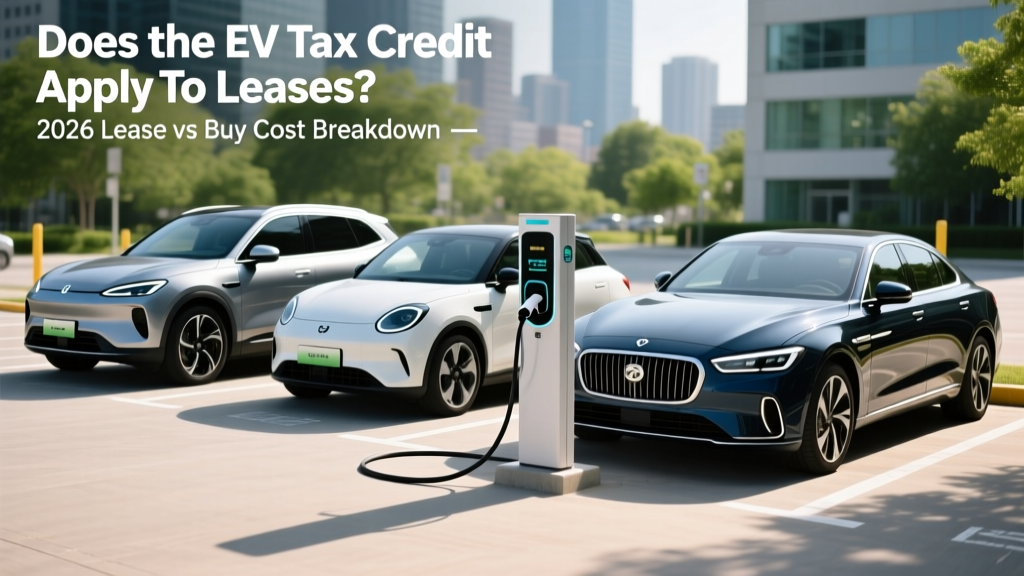
The federal EV tax credit under IRS §30D can deliver up to $7,500 toward a new electric vehicle — but strict income caps, MSRP limits, and battery-sourcing requirements disqualify many buyers. That's where leasing enters the picture. Under a separate provision known as the "commercial clean vehicle credit" (§45W), EVs leased through a dealership's financing arm can pass the full $7,500 to the lessee as a capitalized-cost reduction, regardless of the buyer's income, the vehicle's MSRP, or where the battery minerals were sourced.
Before you sign a lease agreement thinking you've found a loophole, the math gets more complicated. Lease payments, insurance premiums, mileage penalties, and end-of-term disposition fees can erase the upfront credit advantage. This guide walks through the real 5-year cost of owning an EV — whether you buy or lease — using concrete 2026 figures for vehicles like the Tesla Model Y, Hyundai Ioniq 5, and Chevrolet Equinox EV.
Does the EV Tax Credit Apply to Leases? The §45W Loophole Explained
The short answer: not directly, but effectively yes. The §30D new clean vehicle credit is available only to purchasers who file IRS Form 8936 and meet all eligibility requirements. A lease is technically not a purchase — the leasing company (the lessor) owns the vehicle. However, under §45W, the lessor can claim the commercial clean vehicle credit and pass the savings to you as a "lease cash" incentive or capitalized-cost reduction.
Here's why this matters in practice: the §45W commercial credit does not carry the same restrictions as §30D. There are no buyer income caps, no MSRP price caps, and no critical-mineral or battery-component sourcing requirements. According to the IRS guidance on clean vehicle credits, the lessor is the legal owner and may transfer the credit benefit to the lessee in the form of reduced monthly payments or a down-payment credit.
§30D Purchase Credit Requirements (2026)
- Buyer income cap: AGI ≤ $150,000 (single) / $225,000 (head of household) / $300,000 (joint)
- Vehicle MSRP cap: ≤ $55,000 for sedans; ≤ $80,000 for SUVs, vans, and trucks
- Battery sourcing: Critical minerals and battery components must meet escalating domestic/free-trade-partner thresholds
- Point-of-sale transfer: Available — you can apply the credit at the dealer to reduce your purchase price
- Form required: IRS Form 8936 filed with your tax return (or transferred at point of sale via IRS Energy Credits Online portal)
If you exceed the income cap, want a vehicle priced above the MSRP limit (like a fully loaded BMW iX or Mercedes EQS), or the specific VIN doesn't meet battery-sourcing rules, leasing may be your only path to the $7,500 benefit. But the credit passes through at the lessor's discretion — confirm the dealer is applying it as a cap-cost reduction before signing.
5-Year Total Cost of Ownership: EV vs. Gas Baseline
To understand whether leasing or buying an EV saves money, we need a full 5-year / 60,000-mile ownership model. The table below compares a representative 2026 EV (Hyundai Ioniq 5 SEL AWD, 290-mile EPA range, ~$48,000 MSRP) against a comparable gas-powered crossover (Toyota RAV4 AWD, 30 MPG combined, ~$35,000 MSRP).
| Cost Category | 2026 Hyundai Ioniq 5 SEL AWD (EV) | 2026 Toyota RAV4 LE AWD (Gas) |
|---|---|---|
| Purchase/Lease Price (after incentives) | $40,500 (after $7,500 credit) | $35,000 |
| Fuel / Charging (60,000 mi) | $3,240 (home L2 at $0.14/kWh, 3.5 mi/kWh) | $7,000 (gas at $3.50/gal, 30 MPG) |
| Maintenance (5 yr) | $1,200 | $3,500 |
| Insurance (5 yr avg.) | $10,500 ($2,100/yr) | $7,500 ($1,500/yr) |
| Depreciation (est. 5 yr) | $20,250 (50%) | $14,000 (40%) |
| Total 5-Year Cost | $75,690 | $67,000 |
| Cost Per Mile | $1.26/mi | $1.12/mi |
The EV saves roughly $3,760 on fuel and $2,300 on maintenance over five years, but gives back most of that advantage through higher insurance ($3,000 more) and steeper depreciation ($6,250 more). The Ioniq 5 still costs about $0.14/mile more to own than the RAV4 in this scenario — though the gap narrows significantly if you charge primarily on off-peak utility rates or if gas prices rise above $4/gallon.
Fuel Savings: Charging Cost Per Mile vs. Gas
The single biggest operational advantage of an EV is fuel cost. But the savings depend entirely on where and when you charge.
| Charging Scenario | Rate ($/kWh) | Efficiency (mi/kWh) | Cost/Mile | vs. Gas at 30 MPG, $3.50/gal |
|---|---|---|---|---|
| Home Level 2, off-peak utility rate | $0.10 | 3.5 | $0.029 | Save $0.088/mi |
| Home Level 2, national avg. residential | $0.16 | 3.5 | $0.046 | Save $0.071/mi |
| Public DC fast charging ( Electrify America, EVgo avg.) | $0.40 | 3.2 | $0.125 | Save $0.000/mi (break even) |
| Tesla Supercharger (member pricing) | $0.28 | 3.5 | $0.080 | Save $0.037/mi |
At the national average residential electricity rate of roughly $0.16/kWh and a typical EV efficiency of 3.0–3.5 miles per kWh (the Ioniq 5 AWD achieves about 3.4 mi/kWh per fueleconomy.gov), home charging costs approximately $0.046/mile. A comparable 30 MPG gas vehicle at $3.50/gallon costs $0.117/mile. That's a 60% fuel savings — but only if you charge at home.
If you rely exclusively on public DC fast chargers at $0.35–$0.48/kWh, your per-mile cost approaches or exceeds gasoline. This is why home Level 2 charging access is the single most important variable in EV ownership economics. Before buying or leasing, confirm you can install a 240V / 40A Level 2 circuit at home (typically $500–$2,000 for installation, depending on panel capacity and run length).
Maintenance: What You Save and Why
EVs eliminate the most routine and expensive maintenance items on internal-combustion vehicles. No oil changes, no transmission fluid, no spark plugs, no timing belts, and no exhaust system repairs. Regenerative braking dramatically reduces brake pad and rotor wear — many EV owners report original brake pads at 80,000+ miles.
| Maintenance Item | Gas Vehicle (5 yr / 60K mi) | EV (5 yr / 60K mi) |
|---|---|---|
| Oil changes (6 @ $50–$80) | $300–$480 | $0 |
| Transmission fluid service | $150–$300 | $0 |
| Brake pads and rotors | $400–$800 | $0–$200 (regen extends life) |
| Engine air filter | $50–$100 | $0 (cabin filter only, ~$40) |
| Coolant flush | $100–$200 | $0–$150 (some EVs require at 100K+ mi) |
| Tire rotation and replacement | $800–$1,200 | $1,000–$1,500 (EVs wear tires faster due to weight and instant torque) |
| Total Estimated Maintenance | $1,800–$3,080 | $1,040–$1,890 |
Net maintenance savings over five years: roughly $800–$1,500. The savings are real but modest — and partially offset by higher tire costs. EVs are 15–25% heavier than equivalent gas vehicles and deliver instant torque, both of which accelerate tire wear. Budget for a set of EV-rated touring tires (Michelin Pilot Sport EV, Hankook iON evo) at $800–$1,200 around the 35,000–45,000 mile mark.
The Insurance Reality: Why EVs Cost More to Insure
This is where the EV ownership math catches most buyers off guard. EV insurance premiums run 15–30% higher than comparable gas vehicles, according to industry data. For our Ioniq 5 vs. RAV4 comparison, that translates to roughly $500–$700 more per year, or $2,500–$3,500 over five years.
The reasons are structural, not arbitrary:
- Higher repair costs: EV battery packs, power electronics, and specialized ADAS sensors (cameras, radar, ultrasonic) are expensive to replace after a collision. A minor fender-bender that might total a sensor array on a gas car can cost $3,000–$8,000 on an EV.
- Specialized labor: High-voltage system repairs require certified EV technicians, and fewer shops have them. This drives up labor rates and cycle times.
- Higher vehicle values: Comprehensive and collision coverage is priced partly on replacement cost. A $48,000 EV costs more to replace than a $35,000 gas crossover.
- Emerging actuarial data: Insurers are still building claims histories for newer EV models, and uncertainty is priced into premiums.
Some insurers now offer EV-specific policies with discounts for home charging, low annual mileage, or bundled home-auto coverage. Shop quotes from at least three carriers — Geico, Progressive, State Farm, and EV-specialty insurers like Lemonade or Root can vary by $400–$800/year on the same vehicle.
Depreciation: The Elephant in the EV Ownership Equation
Depreciation is the single largest cost of vehicle ownership, and it's where EVs have struggled historically. According to iSeeCars and Kelley Blue Book data, average 5-year EV depreciation sits around 45–55%, compared to 35–45% for mainstream gas vehicles. Several factors drive this gap:
- Rapid technology advancement: Each new model year brings longer range, faster charging, and lower prices. A 2022 EV with 250 miles of range and 100 kW charging looks dated next to a 2026 model offering 330 miles and 250 kW — depressing used values for older models.
- Tesla price cuts: Aggressive new-vehicle pricing from Tesla in 2023–2025 reset the used-EV market downward, affecting all brands.
- Battery health uncertainty: Used-EV buyers worry about remaining battery capacity. While most 2026 models carry 8-year / 100,000-mile battery warranties (mandated minimum per fueleconomy.gov tax credit pages), second-owner confidence remains lower than for gas powertrains.
- Incentive compression: When new buyers receive $7,500 in federal credits plus state rebates, the effective new-vehicle price drops — and used values must adjust downward to remain competitive.
Some EVs hold value better than others. The Tesla Model Y and Model 3 benefit from Supercharger network access and strong brand recognition. The Toyota bZ4X and Hyundai Ioniq 5 have shown improving retention as consumer familiarity grows. Luxury EVs (Mercedes EQS, BMW iX) depreciate the hardest — often 55–65% over five years — mirroring their gas counterparts but amplified by higher starting prices.
State and Local Incentives: Check Your Jurisdiction
Beyond the federal §30D credit, many states and utilities offer additional EV incentives that can shift the ownership math significantly:
- California: Up to $7,000 via the Clean Fuel Rebate and CVRP for income-qualified buyers
- Colorado: $5,000 state tax credit for new EVs (income-dependent)
- New York: Drive Clean Rebate up to $2,000 at point of sale
- Utility rebates: Many utilities offer $250–$1,000 for home Level 2 charger installation, plus time-of-use rate discounts
These programs change frequently and have varying income and vehicle eligibility rules. Check your state energy office and local utility for current offerings. A licensed tax professional can help you stack federal, state, and utility incentives correctly.
Lease vs. Buy: The Decision Framework
Given the variables above, here's when each approach makes financial sense:
Choose to Lease If:
- Your AGI exceeds the §30D income caps ($150K single / $300K joint)
- The vehicle you want exceeds the MSRP cap or fails battery-sourcing rules
- You plan to drive fewer than 12,000–15,000 miles per year (lease mileage limits apply)
- You want to upgrade every 2–3 years as EV tech improves
- You want to avoid depreciation risk entirely — return the car at lease end
- The dealer passes the $7,500 §45W credit as a confirmed cap-cost reduction
Choose to Buy If:
- You qualify for the full §30D credit and the vehicle meets all sourcing rules
- You drive more than 15,000 miles/year (lease overage penalties of $0.15–$0.30/mile add up fast)
- You plan to keep the vehicle 5+ years (amortizing the higher purchase price over a longer ownership period)
- You have home Level 2 charging and can maximize fuel savings
- You want the flexibility to sell or trade at any time without lease-termination penalties
A 36-month lease on a 2026 Ioniq 5 SEL with $7,500 applied as cap-cost reduction and $2,500 down might yield payments around $350–$425/month, depending on money factor and residual. Over three years, that's $12,600–$15,300 in payments plus $2,500 down, for a total of $15,100–$17,800. At lease end, you walk away — no equity, no depreciation risk, but no asset either.
Buying the same Ioniq 5 at $48,000 MSRP, minus $7,500 credit, with a 5-year loan at 6.5% APR and $5,000 down yields monthly payments around $670. Over five years, you pay $45,200 total (including interest) but own a vehicle worth roughly $24,000 at the end. Net cost of ownership in the purchase scenario: about $21,200 over five years for the vehicle itself, versus $15,100–$17,800 over three years for the lease (with nothing to show for it).
Frequently Asked Questions
Does the EV tax credit apply to leases in 2026?
Not directly under §30D, but effectively yes through §45W. The leasing company (lessor) claims the commercial clean vehicle credit and can pass the $7,500 to you as a capitalized-cost reduction. This bypasses the §30D income caps, MSRP limits, and battery-sourcing requirements. Confirm with the dealer that the credit is being applied to your lease before signing.
How much does it really cost to own an EV over 5 years?
For a mainstream EV like the Hyundai Ioniq 5 or Tesla Model Y, expect a total 5-year cost of $70,000–$80,000 including purchase price (after incentives), charging, insurance, maintenance, and depreciation. That's roughly $1.17–$1.33 per mile. A comparable gas crossover costs $62,000–$70,000, or $1.03–$1.17 per mile. The gap narrows with cheap home charging, low insurance quotes, and strong resale values.
Do I qualify for the federal EV tax credit?
Under §30D for 2026, you qualify if your adjusted gross income is ≤ $150,000 (single), $225,000 (head of household), or $300,000 (joint filers). The vehicle must have an MSRP ≤ $55,000 (cars) or ≤ $80,000 (SUVs/trucks/vans) and meet battery-sourcing requirements. Check the specific VIN on the IRS clean vehicle credit page or the DOE's fueleconomy.gov for eligibility.
How much do I save on fuel and maintenance with an EV?
With home Level 2 charging at $0.16/kWh, expect fuel savings of $3,000–$4,500 over 5 years / 60,000 miles compared to a 28–32 MPG gas vehicle at $3.50/gallon. Maintenance savings run $800–$1,500 over the same period, primarily from eliminated oil changes, transmission service, and reduced brake wear. Combined operational savings: $3,800–$6,000 over five years.
Are EVs more expensive to insure?
Yes, typically 15–30% more than comparable gas vehicles. For a $45,000–$55,000 EV, expect annual premiums of $1,800–$2,500, versus $1,300–$1,800 for a similar gas crossover. The difference is driven by higher repair costs (battery, sensors, power electronics), specialized labor requirements, and higher replacement values. Shop at least three insurers for competitive quotes.
How well do EVs hold their value?
Average 5-year EV depreciation is 45–55%, compared to 35–45% for mainstream gas vehicles. The gap is driven by rapid technology advancement, aggressive new-vehicle pricing (especially from Tesla), and used-buyer concerns about battery health. Teslas and mainstream models from Hyundai/Kia hold value best; luxury EVs depreciate most steeply. Battery warranties (8 yr / 100,000 mi minimum) help support long-term used values.
Can I claim the tax credit if I lease and then buy out the vehicle?
Generally, no. If you leased the vehicle and the lessor claimed the §45W credit, you cannot also claim the §30D credit when exercising a lease buyout option. The credit has already been applied to the vehicle. The buyout price reflects the residual value set at lease inception and is not eligible for an additional tax credit.
The bottom line: leasing can unlock the $7,500 EV credit for buyers who don't qualify under §30D purchase rules, but it's not free money. Weigh the cap-cost reduction against lease mileage limits, higher insurance costs, steeper depreciation risk, and the fact that you'll own nothing at the end. Run the numbers for your specific vehicle, utility rate, annual mileage, and insurance quotes before deciding. The math favors leasing when you can't access §30D directly and plan to drive under 15,000 miles per year; it favors buying when you qualify for the full credit, drive more, and plan to keep the vehicle long-term.