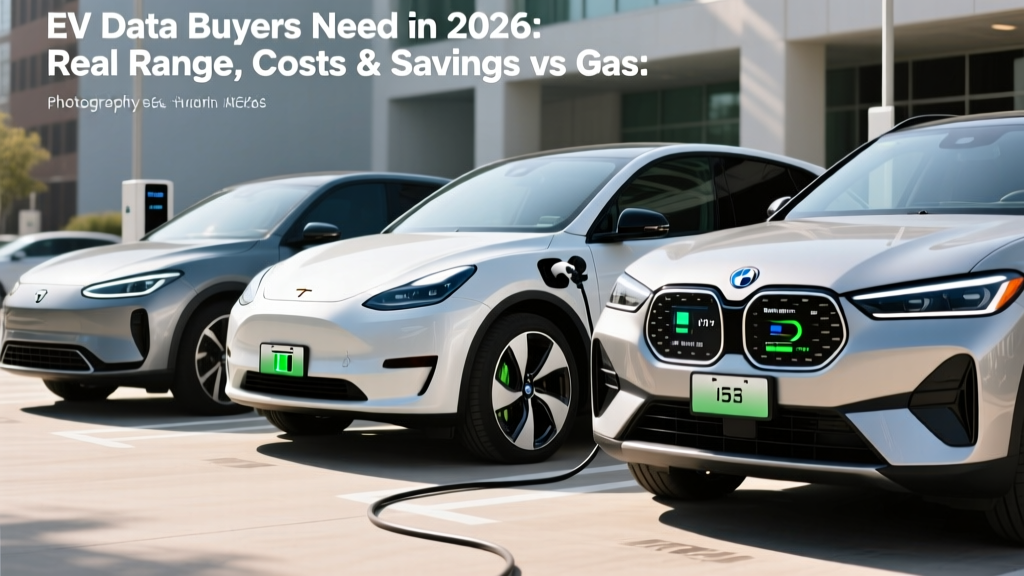
The EV Planner Quick Answer
An effective EV planner answers four questions in order: (1) Can I charge at home or work reliably? (2) Does my daily driving fall within ~70% of a vehicle's EPA range to buffer for cold weather and highway use? (3) Do I qualify for the federal §30D tax credit (up to $7,500) or a state incentive? (4) Does the 5-year total cost of ownership beat the gas or hybrid alternative? If your answer to all four is yes, an EV will almost certainly save you money and hassle. If any answer is no, a plug-in hybrid (PHEV) or hybrid (HEV) may serve you better — and that's a perfectly rational outcome.
Step 1: Map Your Real Driving Before You Shop
The biggest mistake first-time EV buyers make is shopping by EPA range sticker alone. The EPA estimate assumes a mix of city and highway driving at moderate temperatures. Real-world conditions change the math significantly.
Here's what testing and owner data consistently show:
- Highway driving at 70+ mph: Expect 10–20% less range than the EPA combined estimate. Aerodynamic drag dominates at speed, and EVs don't benefit from regenerative braking on flat interstate stretches.
- Cold weather (below 30°F): Range loss of 15–30% is typical, depending on whether the vehicle has a heat pump. Cabin heating draws directly from the traction battery. According to fueleconomy.gov, cold temperatures reduce battery efficiency and increase energy demand simultaneously.
- Mountain driving: Climbing elevation consumes energy heavily, though regenerative braking on descents can recover 20–40% of the uphill cost.
Your EV planner rule of thumb: Take your longest regular trip (not your once-a-year road trip) and ensure it's no more than 65–70% of the EPA range. A vehicle rated at 300 miles EPA should comfortably cover a 200-mile regular route in winter highway conditions.
Step 2: Solve Charging Before You Solve the Car
EV ownership satisfaction correlates more strongly with charging access than with any vehicle spec. If you have a garage or driveway where a Level 2 charger can be installed, daily EV life is effortless — you wake up every morning with a full "tank." If you rely solely on public charging, your experience depends entirely on your local infrastructure.
| Level | Power (kW) | Voltage | Miles of Range per Hour | Best For |
|---|---|---|---|---|
| Level 1 (120V outlet) | 1.0–1.4 kW | 120V | 3–5 mi/hr | Overnight top-up for low-mileage drivers; PHEVs |
| Level 2 (240V home/public) | 7.2–11.5 kW | 240V | 25–45 mi/hr | Daily home charging; full overnight recharge |
| DC Fast Charging | 50–350 kW | 400–800V DC | 150–800+ mi/hr (peak) | Road trips; 10–80% in 18–40 min depending on vehicle |
Home Level 2 installation cost reality: A quality Level 2 charger (such as the ChargePoint Home Flex or Emporia V2) costs $400–$700 for the hardware. Professional installation by a licensed electrician typically runs $600–$2,000 if your electrical panel has capacity for a new 40–60A circuit. If your panel needs an upgrade from 100A to 200A service, add $1,500–$3,500. Total realistic range: $1,000–$5,500 depending on your home's electrical infrastructure.
Apartment and street-parking reality: If you can't install a home charger, check whether your workplace offers Level 2 charging, whether your city has reliable public Level 2 stations near your regular parking, or whether DC fast chargers from networks like Electrify America, EVgo, or Tesla Superchargers are within 10–15 minutes of your home. Without regular access to at least Level 2 speeds, EV ownership becomes a chore rather than a convenience.
Step 3: The Real Cost Breakdown — EV vs Gas vs Hybrid
The purchase price of an EV is typically higher than a comparable gas car, but fuel and maintenance savings close the gap over time. Here's a 5-year comparison using representative 2026 models and national averages.
| Cost Category | EV (e.g., Hyundai Ioniq 6 SE, ~$38,000 MSRP) | Gas (e.g., Toyota Camry LE, ~$29,000 MSRP) | Hybrid (e.g., Toyota Camry Hybrid LE, ~$31,000 MSRP) |
|---|---|---|---|
| Purchase Price (MSRP) | $38,000 | $29,000 | $31,000 |
| Federal Tax Credit (§30D, if eligible) | −$7,500 (point-of-sale) | $0 | $0 (HEV ineligible) |
| Effective Purchase Price | $30,500 | $29,000 | $31,000 |
| Fuel/Energy (5 yrs, 75,000 mi) | $4,500 (home L2 at ~$0.14/kWh) | $10,500 (gas at ~$3.50/gal, 32 MPG) | $6,100 (gas at ~$3.50/gal, 52 MPG) |
| Maintenance (5 yrs) | $1,200 (cabin filter, wipers, tire rotation, brake fluid) | $3,800 (oil changes, filters, belts, brakes) | $3,200 (similar to gas, less brake wear from regen) |
| Insurance (5 yrs, avg) | $9,500 (EV premiums run ~15–25% higher) | $7,500 | $7,800 |
| Estimated Depreciation | $14,000 | $11,000 | $12,000 |
| 5-Year Total | $59,700 | $61,800 | $60,100 |
Key takeaways from the numbers:
- With the full $7,500 federal credit applied at point of sale, the EV's effective purchase price drops below the hybrid's MSRP.
- Fuel savings of $4,800–$6,000 over five years are realistic for drivers who charge primarily at home on residential electricity rates.
- Higher insurance premiums and steeper depreciation partially offset the savings. EV insurance costs more because repair costs after collisions are higher (specialized parts, battery safety protocols, certified technician requirements).
- Public DC fast charging costs significantly more than home Level 2 — typically $0.30–$0.55/kWh, which narrows the fuel-cost advantage. If most of your charging will be public, run the numbers with your local rates.
For detailed tax credit eligibility, always check the latest rules at irs.gov, as battery sourcing requirements, MSRP caps, and income limits are subject to legislative changes.
Step 4: Federal Tax Credit Eligibility — The §30D Checklist
The federal Clean Vehicle Credit under IRS §30D can reduce your effective purchase price by up to $7,500, applied at the point of sale. But eligibility is not automatic. Here's what determines whether you qualify:
- Vehicle MSRP cap: Vans, SUVs, and pickup trucks must have an MSRP ≤ $80,000. Sedans and other passenger cars must be ≤ $55,000.
- Buyer income cap: Modified adjusted gross income must not exceed $300,000 (married filing jointly), $225,000 (head of household), or $150,000 (single/other).
- Battery sourcing requirements: A percentage of critical minerals must be sourced from the U.S. or free-trade-agreement partners, and battery components must meet North American manufacturing thresholds. These percentages increase annually, disqualifying some models that previously qualified.
- Final assembly: The vehicle must undergo final assembly in North America.
- Point-of-sale transfer: Since 2024, you can transfer the credit to the dealer at purchase, reducing your out-of-pocket cost immediately rather than waiting to claim it on your tax return.
- One vehicle per taxpayer per year: You cannot claim the credit more than once per calendar year, and the vehicle must be for personal use, not resale.
Because sourcing requirements tighten over time, a model that qualifies in early 2026 may not qualify later in the year. Always verify current eligibility on the fueleconomy.gov tax credit page before signing a purchase agreement.
Step 5: Common EV Misconceptions — Fact vs Fiction
| Myth | Fact |
|---|---|
| "EV batteries need replacing every few years and cost $20,000." | Federal law mandates battery warranties of at least 8 years / 100,000 miles. Real-world degradation data shows most EV batteries retain 85–92% capacity after 100,000 miles. LFP (lithium iron phosphate) chemistries in vehicles like the Tesla Model 3 RWD show even slower degradation. Full replacement is rare and usually covered under warranty. |
| "EVs are worse in cold weather — they're useless in winter." | Cold weather does reduce range by 15–30%, but EVs start reliably in any temperature (no cold-crank issues), and preconditioning while plugged in warms the battery and cabin using grid power, preserving range. Owners in Minnesota, Norway, and Canada drive EVs year-round with planning. |
| "Charging takes too long for road trips." | Modern EVs on 350 kW-capable chargers can add 150–200 miles of range in 15–20 minutes (10–80% SoC). Vehicles on 800V architectures (Hyundai Ioniq 5/6, Kia EV6, Porsche Taycan) charge fastest. The charging curve tapers above 80%, so road-trip strategy is to charge to 80% and go, not to 100%. |
| "EVs are worse for the environment because of battery mining." | Lifecycle analyses consistently show EVs produce fewer total emissions than gas cars over their lifetime, even accounting for battery manufacturing. The emissions advantage grows as the electrical grid adds renewable capacity. See EPA's EV myths page for sourced data. |
| "I need a 400-mile range EV to make it work." | The average American drives ~37 miles per day. A 250-mile EPA-range EV covers 95%+ of daily needs with home charging. The range you need is determined by your longest regular trip, not your longest conceivable trip. For rare long trips, DC fast charging or renting a gas car are both valid strategies. |
Step 6: Your EV Planner Decision Framework
Choose a Battery Electric Vehicle (BEV) If:
- You have reliable home or workplace Level 2 charging access.
- Your daily driving is under 80 miles round-trip, and your longest regular trip is within ~70% of the EV's EPA range.
- You qualify for the federal §30D credit and/or state incentives, narrowing the upfront price gap.
- You want the lowest per-mile fuel cost and minimal scheduled maintenance.
- You're willing to plan charging stops on road trips (15–20 min every 2–3 hours).
Choose a Plug-In Hybrid (PHEV) If:
- You want electric-only commuting (typically 25–45 miles EPA electric range) but need gas-engine flexibility for long or remote trips.
- You have Level 1 or Level 2 home charging but travel frequently beyond EV range.
- You live in an area with sparse DC fast charging infrastructure.
- You want to reduce fuel consumption 50–70% without any range anxiety.
Choose a Hybrid (HEV) If:
- You have no access to home or workplace charging.
- You want maximum fuel efficiency (45–55 MPG combined) with zero plug-in behavior change.
- You drive in extreme cold frequently and want consistent range without weather dependency.
- Lower upfront cost is a priority, and the EV tax credit doesn't close the gap enough for your budget.
Stick With Gas (For Now) If:
- You regularly tow heavy loads over long distances (towing cuts EV range 40–60%).
- You live in a charging desert with no realistic prospect of home, work, or public charging access.
- Your budget is firmly under $25,000 and you need a newer vehicle (the used EV market is improving but limited at this price point).
Step 7: First-Time EV Buyer Essentials
If you've decided a BEV or PHEV fits your situation, here's what to know before signing:
Understand kW vs kWh. This is the single most common point of confusion. kWh (kilowatt-hours) measures battery capacity — think of it as the size of your fuel tank. A 77 kWh battery holds 77 kWh of energy. kW (kilowatts) measures power flow — think of it as the width of the fuel hose. A 150 kW DC fast charger delivers energy at 150 kW, but only at peak; the actual charge curve tapers as the battery fills, especially above 80% State of Charge (SoC).
Check the charge curve, not just peak kW. A vehicle that peaks at 240 kW but sustains that rate for only 5 minutes before tapering may charge slower overall than a vehicle peaking at 180 kW but sustaining it longer. Look for 10–80% charging time as the more useful metric. For example, the Hyundai Ioniq 5 (800V architecture) achieves 10–80% in approximately 18 minutes on a 350 kW charger, while many 400V vehicles with similar peak ratings take 25–35 minutes.
Connector compatibility matters. As of 2026, the North American Charging Standard (NACS), developed by Tesla, has been adopted by Ford, GM, Rivian, Hyundai, Kia, and most major automakers for new vehicles. CCS1 is still present on many existing vehicles and public chargers. CHAdeMO is largely legacy (Nissan Leaf). If you're buying new, a NACS port gives you access to Tesla's Supercharger network, which has the highest reliability and coverage of any DC fast charging network in the U.S.
Budget for a home charger installation. Even if the vehicle comes with a portable Level 1 cord, plan for a dedicated 240V Level 2 circuit. It's the single biggest quality-of-life upgrade in EV ownership. Get quotes from at least two licensed electricians and ask specifically whether your panel has capacity or needs an upgrade.
Get insurance quotes before you buy. EV insurance premiums vary significantly by model and insurer. Some companies offer EV-specific discounts; others charge 20–30% more than the gas equivalent. Shop quotes from at least three insurers with the exact trim and MSRP before finalizing your purchase.
Frequently Asked Questions
How do I know if my home electrical panel can handle a Level 2 charger?
A Level 2 charger on a 48A circuit draws about 11.5 kW continuously. Your electrician will calculate whether your panel (typically 100A or 200A) has enough spare capacity after accounting for existing loads (HVAC, oven, dryer, water heater). If your panel is near capacity, you may need a service upgrade (100A → 200A, costing $1,500–$3,500) or a smart panel/load-management device that throttles the charger when other high-draw appliances are running. Only a licensed electrician can make this determination — do not guess.
Is a used EV a smart way to start?
Used EVs can offer strong value, especially models from 2022–2024 that have already absorbed initial depreciation. The federal used EV credit (§25E) offers up to $4,000 (30% of the sale price, capped) for vehicles priced at $25,000 or less, purchased from a dealer. Check the battery's State of Health (SoH) before buying — many EVs display this in the settings menu, and third-party tools like CAN OBD readers can pull detailed degradation data. A battery at 90%+ SoH with under 60,000 miles is typically a solid buy.
What happens if I run out of charge on the road?
Running an EV to 0% SoC is rare because modern EVs provide extensive low-charge warnings and will reduce power to preserve the last few miles. If it happens, roadside assistance services (AAA and manufacturer programs) can provide a flatbed tow to the nearest charger — EVs should generally not be flat-towed or towed with drive wheels on the ground, as this can damage the motors. Plan road trips with apps like A Better Routeplanner or PlugShare and maintain a 10–15% buffer.
Do EVs really need less maintenance?
Yes. BEVs have no engine oil, no transmission fluid changes, no spark plugs, no timing belts, no exhaust systems, and no emissions testing. Brake pads last significantly longer because regenerative braking handles most deceleration. The primary maintenance items are cabin air filter replacement ($30–$80 annually), windshield wiper fluid, tire rotation and replacement (EVs are heavier and have instant torque, which can accelerate tire wear), brake fluid checks, and coolant system service at manufacturer-specified intervals. Expect annual maintenance costs of $200–$400 versus $600–$1,200 for a gas car, based on AAA and Consumer Reports data.
Should I buy or lease my first EV?
Leasing can be advantageous for a first EV because it eliminates long-term battery degradation risk and lets you upgrade as charging and range technology improves. Some manufacturers pass the §30D tax credit through as a lease incentive even on models that don't qualify for the purchase credit (due to sourcing rules), because leased vehicles fall under different commercial clean vehicle credit rules (§45W). However, if you drive high mileage (over 15,000 mi/yr), lease mileage penalties can erase the savings. Compare the total lease cost (down payment + monthly payments × term + mileage overage risk) against the purchase cost (effective price after credit + 5-year fuel/maintenance savings) for your specific situation.