The Short Answer on Motors for Electric Vehicles
Most 2026 EVs use one of two motor types: Permanent Magnet Synchronous Motors (PMSM) or AC Induction Motors. PMSM motors dominate because they're 3–7% more efficient at part-load (the driving you actually do), which translates directly to 10–25 extra EPA miles on a typical 80 kWh battery pack. Induction motors cost less to build, handle high-speed highway cruising well, and don't rely on rare-earth magnets — but they're heavier and slightly less efficient. If you're shopping for an EV, the motor type matters less than the battery size and thermal management system, but it does influence real-world MPGe, regenerative braking feel, and long-term service costs.
How EV Motors Actually Work (Without the Textbook Jargon)
An electric vehicle motor converts electrical energy from the battery pack into rotational force (torque) that turns the wheels. Unlike a gas engine, which needs to rev up to make power, an EV motor delivers maximum torque from 0 RPM. That's why even a modest 200-hp EV feels punchy at stoplights while a similarly rated gas car feels sluggish.
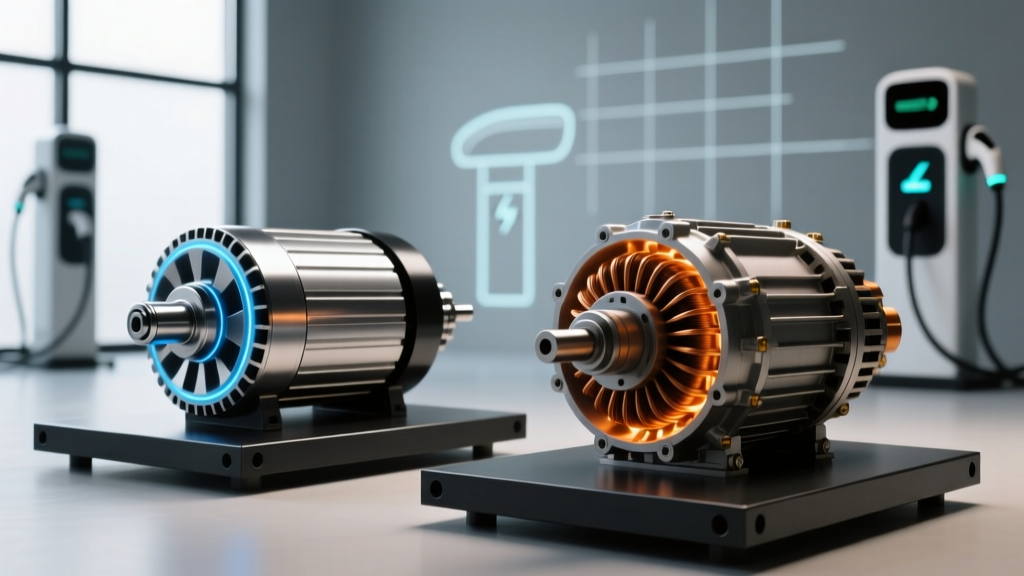
The two dominant architectures in 2026 production EVs:
- PMSM: Uses permanent rare-earth magnets (neodymium-iron-boron) embedded in the rotor. The stator's electromagnetic field pulls the magnet-laden rotor in sync — hence "synchronous." Used in the Tesla Model 3/Y rear motor, Hyundai Ioniq 5/6, Ford Mustang Mach-E, Rivian R1T/R1S, and most Chinese-market EVs.
- AC Induction: Has no permanent magnets. Instead, current is induced into the rotor's copper or aluminum bars by the stator's rotating field. Heavier, slightly less efficient at low loads, but cheaper and magnet-free. Tesla uses these as the front motor in dual-motor AWD models (the rear is PMSM). Also found in older Model S/X and some commercial EVs.
A growing third type — Externally Excited Synchronous Motors (EESM) — replaces rare-earth magnets with a copper-wound rotor fed by a small current. BMW's Gen5 eDrive (i4, iX) uses this design. It avoids rare-earth supply chain risks but adds complexity with slip rings or wireless rotor excitation.
Side-by-Side: PMSM vs. Induction vs. EESM Motors
| Attribute | PMSM | AC Induction | EESM |
|---|---|---|---|
| Peak Efficiency | 95–97% | 90–94% | 94–96% |
| Part-Load Efficiency (city driving) | Excellent (92–95%) | Good (85–90%) | Very Good (90–93%) |
| Rare-Earth Magnets | Yes (neodymium) | No | No |
| Weight (typical 200 kW motor) | ~40–50 kg | ~55–70 kg | ~50–60 kg |
| Regen Braking Effectiveness | Strong, smooth | Strong | Strong |
| Highway Efficiency (75+ mph) | Good | Very Good (low drag at high RPM) | Very Good |
| Manufacturing Cost | Higher (magnet cost) | Lower | Medium |
| Notable 2026 Applications | Tesla Model 3/Y (rear), Ioniq 5, Mach-E, ID.4 | Tesla Model S/X, dual-motor front units | BMW i4/iX, Renault Megane E-Tech |
How Motor Choice Affects Your Real-World Range and MPGe
Motor efficiency isn't an abstract spec — it directly determines how many miles you get per kilowatt-hour (kWh) of battery energy. Here's the math that matters:
A PMSM-equipped Hyundai Ioniq 5 RWD (84 kWh usable battery, 168 kW motor) achieves 132 MPGe combined on the EPA cycle, consuming roughly 25 kWh/100 miles. That yields an EPA-estimated 303 miles of range.
Compare that to a similarly sized EV with a less efficient motor drawing 28 kWh/100 mi — the same 84 kWh battery would deliver only ~270 miles. That's a 33-mile gap driven largely by motor and inverter efficiency, not battery chemistry.
Real-World Range Reality: The Ioniq 5's 303-mile EPA sticker assumes mixed driving at moderate temperatures. Expect ~260–280 miles in sustained 70-mph highway driving (aerodynamic drag dominates at speed), ~220–250 miles in sub-30°F winter conditions (cabin heating + battery resistance), and ~290–303 miles in mild-weather city driving where regen braking recaptures energy and the PMSM's part-load efficiency shines.
Motor type also affects regenerative braking. PMSM motors generally offer smoother, more progressive regen because the permanent magnets create a predictable magnetic field at all speeds. Induction motors can feel slightly less linear during light regen but handle aggressive deceleration well. In practice, the difference is subtle — most drivers won't notice it after the first week.
Cost Implications: Does Motor Type Change What You Pay?
Motor type doesn't appear as a line item on your window sticker, but it influences the vehicle's base MSRP and long-term ownership economics.
| Cost Factor | PMSM-Based EV | Induction-Based EV | Notes |
|---|---|---|---|
| Vehicle MSRP Impact | +$200–$600 (magnet cost baked in) | Baseline | Absorbed into trim pricing; not itemized |
| Battery Size Needed (for 300-mi target) | ~78–84 kWh | ~84–90 kWh | Less efficient motor requires bigger (heavier, costlier) pack |
| Electricity Cost (15k mi/yr, $0.14/kWh) | ~$525/yr (at 25 kWh/100mi) | ~$588/yr (at 28 kWh/100mi) | ~$63/yr difference |
| Maintenance (motor-specific) | $0 — no brushes, no service interval | $0 — no brushes, no service interval | Both types are essentially maintenance-free |
| Motor Replacement (out of warranty, rare) | $4,000–$7,000 | $3,000–$5,000 | Induction motors are cheaper to replace; failure before 200k mi is uncommon |
For context on total savings vs. a gas car: a comparable compact SUV averaging 28 MPG at $3.40/gallon costs roughly $1,821/year in fuel for 15,000 miles. The PMSM-based EV at $525/year saves about $1,296 annually in energy costs — before accounting for any time-of-use electricity discounts or free workplace charging.
EV vs. Gas: The Motor Is Where the Efficiency Gap Starts
| Metric | EV (PMSM, 84 kWh) | Gas SUV (2.5L Turbo AWD) |
|---|---|---|
| Drivetrain Efficiency (tank/wall-to-wheel) | 85–90% | 20–30% |
| Energy Cost per Mile | $0.035–$0.05 | $0.12–$0.14 |
| Moving Parts in Drivetrain | ~20 (motor + single-speed reducer) | ~200+ (engine, transmission, differential) |
| Scheduled Powertrain Maintenance (5 yr) | $0–$150 (cabin filter, fluid top-offs) | $1,200–$2,000 (oil, filters, plugs, transmission fluid) |
| 0–60 mph (typical mid-trim AWD) | 4.5–5.5 sec | 6.5–8.0 sec |
| EPA Combined Efficiency | 115–132 MPGe | 24–28 MPG |
The core reason EVs convert energy 3–4x more efficiently isn't just the battery — it's the motor. A PMSM wastes only 3–5% of electrical energy as heat. A gasoline engine wastes 70–80% of fuel energy as heat, exhaust, and friction before torque even reaches the wheels.
Common Misconceptions About EV Motors — Fact-Checked
| Myth | Fact |
|---|---|
| "EV motors wear out like gas engines." | EV motors have no piston rings, valves, or timing chains. The main wear items are bearings, which typically last 200,000+ miles. Most 2026 EVs warranty the motor for 8 years / 100,000 miles (federally mandated minimum for emissions-related components in some classifications; manufacturers often match or exceed this). |
| "More horsepower always means a better motor." | A 500-hp induction motor that's 88% efficient at cruise wastes more energy than a 300-hp PMSM at 95% efficiency. For daily driving, motor efficiency at part-load matters far more than peak output. |
| "Rare-earth magnets make PMSMs environmentally worse." | Mining rare-earth elements has environmental costs, but a PMSM motor contains roughly 1–2 kg of neodymium. The lifetime efficiency gain (3–7% better) saves far more upstream emissions from power generation over 150,000+ miles of driving than the magnet's extraction footprint. |
| "EV motors need regular servicing." | Unlike gas engines requiring oil changes every 5,000–10,000 miles, EV motors are sealed units. The only fluid is reduction-gear oil, typically checked or replaced once at 100,000+ miles. Coolant loops servicing the motor and inverter should be inspected per the manufacturer schedule (often every 40,000–60,000 miles). |
| "All EVs use the same motor." | As shown above, three distinct architectures (PMSM, induction, EESM) are in mass production, each with different trade-offs. Some vehicles use both — Tesla's AWD models pair a PMSM rear motor with an induction front motor for efficiency + cost balance. |
First-Time Buyer Decision Framework: What Motor Should You Care About?
If you drive mostly in the city (under 45 mph, lots of stops): Prioritize a PMSM-equipped EV. The superior part-load efficiency and smooth regen braking maximize your MPGe and range in stop-and-go conditions. Best 2026 picks: Hyundai Ioniq 5, Tesla Model 3 RWD, Volkswagen ID.4.
If you drive mostly highway (70+ mph, long commutes): Motor type matters less at sustained high speed — aerodynamic drag dominates. Focus instead on battery size (kWh), frontal area, and whether the EV has a heat pump (reduces cabin-heating energy draw). Both PMSM and induction motors perform well here. The Tesla Model S (induction) and Ioniq 6 (PMSM) are both excellent highway cruisers.
If you want AWD without range penalty: Look for dual-motor setups that pair a PMSM primary axle with an induction secondary that can fully disconnect (freewheel) when not needed. Tesla and Rivian use this approach — the front induction motor adds zero drag during RWD-only cruising.
If rare-earth supply ethics concern you: Choose an EESM-based vehicle (BMW i4, Renault Megane E-Tech) or an induction-motor EV. You sacrifice 2–4% efficiency but eliminate neodymium from the drivetrain entirely.
If budget is your top priority: The motor type is less important than the battery size and federal tax credit eligibility. Under current IRS §30D rules, qualifying new EVs can receive up to $7,500 (point-of-sale transfer available), subject to MSRP caps ($55,000 for cars, $80,000 for SUVs/trucks), buyer income limits ($150k single / $300k joint AGI), and battery critical-mineral sourcing requirements. Always verify eligibility on the IRS qualified vehicles list before purchase.
Real-World Ownership Considerations Beyond the Motor
The motor is one piece of a larger ownership equation. Before buying, honestly assess these factors:
Home Charging Access: If you can install a Level 2 (240V, 7.7–11.5 kW) home charger, EV ownership is dramatically more convenient — you start every morning with a full battery. Installation typically costs $800–$2,500 depending on panel capacity and run length. If you lack home charging and rely solely on public DC fast chargers, expect to pay $0.30–$0.48/kWh (roughly 2–3x home rates) and invest 20–40 minutes per session.
Climate Impact: In cold climates (sustained sub-30°F), expect 20–35% range reduction due to battery resistance and cabin heating. A heat pump (standard on most 2026 PMSM-based EVs from Hyundai, Tesla, and VW) recovers roughly 10% of that loss. Motor type has minimal impact on cold-weather range — the battery and thermal management system do the heavy lifting.
Insurance Costs: EV insurance premiums run 10–25% higher than equivalent gas vehicles due to higher repair costs (specialized parts, high-voltage safety protocols, and lower-volume body shop expertise). Get quotes before committing to a purchase.
Depreciation: EV resale values have stabilized after the 2023–2024 price wars. Well-equipped models with 300+ mile EPA range from established brands retain 55–65% of MSRP after 3 years, per industry data. Budget EVs with under 250 miles of range depreciate faster.
Frequently Asked Questions About EV Motors
How long do electric vehicle motors last?
EV motors routinely exceed 200,000 miles with zero internal service. The primary failure point is bearing wear, which is gradual and audible (increasing whine or vibration). Inverter failure (the electronics controlling the motor) is statistically more common than motor failure and typically costs $2,000–$4,000 to replace out of warranty. Both components are covered under the standard 8-year/100,000-mile EV powertrain warranty on most 2026 models.
Do EV motors lose power over time?
The motor itself does not degrade meaningfully — a PMSM's permanent magnets can lose a fraction of a percent of field strength over decades of thermal cycling, but this is negligible. What does reduce range over time is battery degradation (typically 8–15% capacity loss over 100,000 miles for NMC chemistry, less for LFP). When owners report an EV "losing range," it's almost always the battery, not the motor.
Can I swap or upgrade the motor in my EV?
In practice, no. EV motors are deeply integrated with the inverter, reduction gear, thermal management loop, and vehicle software. Unlike a gas engine swap, an EV motor upgrade would require re-engineering the entire high-voltage system. It's not economically viable. Choose the right motor and power level at purchase.
Why do some EVs have two different motor types?
Tesla's dual-motor AWD vehicles pair a PMSM on the rear axle (for efficiency during normal driving) with an induction motor on the front axle (for AWD traction when needed). The induction front motor can completely disconnect — its rotor freewheels with zero electromagnetic drag — so during highway cruising, the car operates as a RWD PMSM EV. This hybrid-motor approach optimizes both efficiency and capability without requiring a mechanical clutch.
Are PMSM motors affected by extreme heat?
Neodymium magnets begin to lose magnetic strength (demagnetize) above approximately 150–180°C, depending on the magnet grade. EV manufacturers engineer thermal management systems (liquid cooling loops through the stator) to keep motor temperatures well below this threshold — typically under 120°C even during sustained high-load driving. Motor overheating is extremely rare in production EVs and would trigger power-limiting software long before damage occurs.