The Short Answer on EV Maintenance
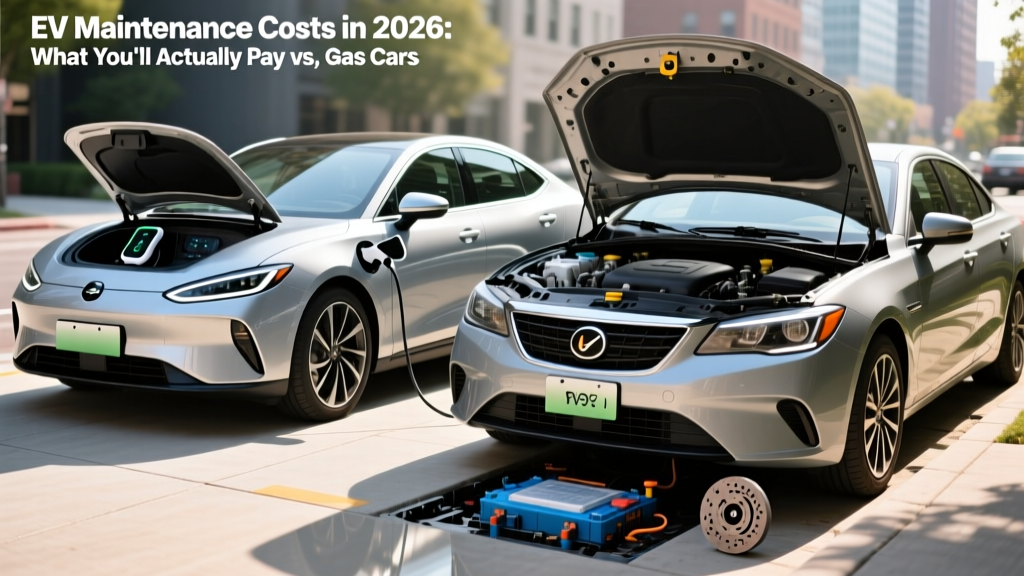
Electric vehicles cost roughly $0.061 per mile to maintain over five years, compared to $0.101 per mile for comparable gasoline cars, according to fueleconomy.gov data. That translates to roughly $600-$700 per year in EV maintenance versus $1,000-$1,200 per year for gas vehicles. Over a typical 5-year/60,000-mile ownership period, EV owners save approximately $2,400-$3,000 on service and repairs. The trade-off: EVs have higher upfront purchase prices, insurance premiums that run 15-25% higher, and potential battery replacement costs after warranty expiration.
What EV Maintenance Actually Includes
EVs eliminate the majority of routine service items that gas car owners take for granted. There's no engine oil to change, no transmission fluid (most EVs use single-speed reductions gears with lifetime fluid), no spark plugs, no timing belts, no catalytic converters, and no exhaust system to rust out. What remains is a surprisingly short list:
- Tire rotation and replacement: EVs wear tires 20-30% faster than gas cars due to instant torque delivery and heavier curb weights (battery packs add 500-1,000 lbs). Expect tire replacement every 30,000-40,000 miles instead of 50,000-60,000 miles. Budget $800-$1,400 for a set of four EV-rated tires.
- Cabin air filter: Replacement every 20,000-30,000 miles, $25-$60 per filter.
- Brake fluid flush: Every 2-3 years, $80-$120. Regenerative braking drastically reduces pad and rotor wear—many EVs go 100,000+ miles on original brake pads.
- Windshield wipers and washer fluid: Standard consumables, $30-$50 annually.
- Coolant system service: Battery thermal management systems use coolant that may need flushing every 5 years or 100,000 miles, $150-$250.
- 12V auxiliary battery: Still present in EVs to power electronics; replacement every 4-6 years, $150-$300.
EV vs Gas Car: 5-Year Maintenance Cost Comparison
Let's compare a 2026 Tesla Model Y Long Range ($47,990 MSRP) against a 2026 Toyota RAV4 gas model ($32,350 MSRP) over 60,000 miles of mixed driving. Both are popular compact crossovers, but the maintenance profiles diverge sharply.
| Service Item | 2026 Tesla Model Y (EV) | 2026 Toyota RAV4 (Gas) |
|---|---|---|
| Oil changes | $0 | $450 (6 changes @ $75 each) |
| Tire replacement | $2,400 (2 sets) | $1,600 (1.5 sets) |
| Brake pads/rotors | $0 (regen braking) | $600 (1 replacement) |
| Cabin air filter | $150 (3 replacements) | $150 (3 replacements) |
| Transmission fluid | $0 | $200 (2 services) |
| Engine air filter | $0 | $120 (3 replacements) |
| Coolant flush | $200 (1 service) | $200 (2 services) |
| Spark plugs | $0 | $400 (1 replacement) |
| Brake fluid flush | $200 (2 services) | $200 (2 services) |
| Wipers/fluids/misc | $250 | $250 |
| Total 5-year maintenance | $3,400 | $4,170 |
| Cost per mile | $0.057 | $0.070 |
The Model Y saves roughly $770 over five years in this comparison. However, this doesn't account for the Tesla's $15,640 higher purchase price before incentives, or the RAV4's lower insurance costs. When you factor in the federal §30D tax credit (up to $7,500 if the vehicle meets battery sourcing and income requirements), the Model Y's effective price drops to around $40,490—still $8,140 more than the RAV4, but the gap narrows further when you include fuel savings.
The Hidden Costs: Where EVs Cost More
EV maintenance savings are real, but ownership economics involve trade-offs that buyers should understand before signing a purchase agreement.
Insurance Premiums
EVs cost 15-25% more to insure than comparable gas vehicles. Insurers cite higher repair costs after collisions (specialized training, expensive battery modules, aluminum body panels), limited repair shop networks, and elevated total-loss rates. A 2026 Model Y might cost $2,200-$2,600 annually to insure versus $1,600-$1,900 for a RAV4, depending on your location, driving record, and coverage levels. Over five years, that's an additional $3,000-$3,500 in insurance costs, which can erase maintenance savings entirely.
Battery Degradation and Replacement
Modern EV batteries are designed to last 150,000-200,000 miles before degrading to 70-80% of original capacity. Most manufacturers warrant batteries for 8 years/100,000 miles with a minimum 70% capacity retention threshold. If you plan to keep your EV beyond the warranty period, budget for potential battery replacement:
- Tesla Model Y: $12,000-$16,000 (75 kWh NMC pack)
- Hyundai Ioniq 5: $10,000-$14,000 (77.4 kWh NMC pack)
- Ford Mustang Mach-E: $14,000-$18,000 (91 kWh NMC pack)
- Chevrolet Bolt EV: $8,000-$11,000 (65 kWh NMC pack)
These costs are prohibitive for most owners and effectively total the vehicle. However, real-world data from Recurrent Auto shows that battery degradation is slower than early EV fears suggested—most 2018-2020 EVs still retain 85-92% capacity at 100,000 miles.
Charging Infrastructure Access
EV maintenance savings assume you can charge at home. If you rely exclusively on public DC fast charging, your "fuel" costs rise significantly. Home Level 2 charging costs $0.12-$0.18 per kWh (national average), while public DC fast charging runs $0.30-$0.50 per kWh. For a vehicle averaging 3.5 miles per kWh:
- Home charging: $0.034-$0.051 per mile
- Public DC fast charging: $0.086-$0.143 per mile
- Gas car (30 MPG, $3.50/gallon): $0.117 per mile
If you can't install a Level 2 home charger (apartment living, older electrical panels requiring $2,000-$4,000 upgrades), public charging costs can exceed gas car fuel costs in some markets.
Common EV Maintenance Myths vs. Reality
| Myth | Reality |
|---|---|
| "EVs never need maintenance" | EVs still require tire rotations, cabin filters, brake fluid, and coolant service. Budget $600-$700 annually. |
| "EV batteries need replacement every 5 years" | Modern NMC and LFP batteries last 150,000-200,000 miles. Warranty covers 8 years/100,000 miles minimum. |
| "Regenerative braking eliminates brake service entirely" | Brake pads last 100,000+ miles, but brake fluid still needs flushing every 2-3 years to prevent moisture contamination. |
| "EVs are maintenance-free, so I can skip service appointments" | Skipping tire rotations causes uneven wear and reduces range. Neglecting coolant can damage the battery thermal management system. |
| "Any mechanic can service an EV" | High-voltage systems require specialized training and equipment. Dealer service centers or EV-certified shops are often necessary. |
Real-World Ownership Considerations
Climate Impact on Maintenance
Cold-weather EV owners face unique maintenance considerations. Battery preconditioning (heating the pack before fast charging) is essential to avoid charging speed throttling and potential lithium plating damage. Most modern EVs handle this automatically when you navigate to a charger, but it consumes energy—expect 10-15% range loss in sub-freezing temperatures. Additionally, cold climates accelerate 12V battery degradation; budget for replacement every 3-4 years instead of 5-6 years.
Hot climates (Arizona, Texas, Southern California) stress battery cooling systems. Ensure coolant levels are checked annually and flushed per manufacturer intervals. Prolonged exposure to 100°F+ temperatures accelerates battery degradation—garage parking or shaded charging can extend battery life by 10-20%.
Driving Patterns and Tire Wear
EVs with high torque output (Tesla Model S Plaid, Lucid Air, Porsche Taycan) wear tires aggressively if driven hard. Owners who frequently accelerate from 0-60 mph in under 4 seconds should budget for tire replacement every 20,000-25,000 miles. Conversely, conservative drivers who rely on regenerative braking and avoid jackrabbit starts can stretch tire life to 40,000-50,000 miles.
Home Charging Access
Before purchasing an EV, confirm you can install a Level 2 home charger. Most homes with 200-amp electrical panels can accommodate a 48-amp (11.5 kW) Level 2 charger on a dedicated 60-amp circuit. Installation costs range from $500-$1,500 if your panel is near the garage, to $2,000-$4,000 if you need a panel upgrade or long conduit runs. Renters and condo owners should check with property management—some jurisdictions now require landlords to permit EV charger installations.
Decision Framework: Is an EV Right for Your Maintenance Budget?
Choose an EV if:
- You have home charging access (garage, driveway, or workplace Level 2)
- You drive 12,000-15,000 miles annually (maintenance savings compound with mileage)
- You plan to keep the vehicle 5-8 years (within battery warranty period)
- You qualify for the federal §30D tax credit (income under $150K single / $300K joint, vehicle MSRP under $55K cars / $80K SUVs/trucks)
- You live in a mild climate or have garage parking
- You value reduced service appointments (1-2 per year vs. 3-4 for gas cars)
Stick with a gas car or hybrid if:
- You rely exclusively on street parking or public charging (fuel costs may exceed gas)
- You drive under 8,000 miles annually (maintenance savings won't offset higher purchase price)
- You plan to keep the vehicle 10+ years (post-warranty battery replacement risk)
- You live in extreme cold climates without garage access (range loss, charging delays)
- You frequently tow heavy loads (EV range drops 30-50% when towing)
- Your budget can't absorb $2,000-$4,000 in unexpected battery or powertrain repairs after warranty
Frequently Asked Questions
Do EVs need oil changes?
No. EVs have no internal combustion engine, so there's no engine oil to change. Some EVs have reduction gearboxes with lubricant, but this is typically "lifetime" fluid that doesn't require scheduled replacement.
How often do EV brakes need service?
Brake pads and rotors on EVs often last 100,000-150,000 miles due to regenerative braking handling 80-90% of deceleration. However, brake fluid should be flushed every 2-3 years regardless of mileage to prevent moisture absorption and corrosion.
What's the most expensive EV maintenance item?
Battery replacement is the single most expensive potential cost, ranging from $8,000-$18,000 depending on the vehicle. However, this is rare within the 8-year/100,000-mile warranty period. Tires are the most common high-cost maintenance item, with EV-rated tires costing $200-$350 each and requiring replacement every 30,000-40,000 miles.
Can I take my EV to any mechanic?
Basic services like tire rotations, cabin filter replacement, and wiper changes can be done at any shop. However, high-voltage system diagnostics, battery issues, and powertrain repairs require EV-certified technicians with specialized safety equipment. Dealer service centers or dedicated EV shops are often necessary for complex work.
Do EVs last as long as gas cars?
EVs can last 150,000-200,000 miles with proper maintenance, comparable to modern gas vehicles. The limiting factor is typically battery degradation rather than mechanical wear. If you're willing to budget for a potential battery replacement ($8,000-$18,000) after 150,000 miles, an EV can remain economical for 200,000+ miles.
Are EV maintenance costs really lower than gas cars?
Yes, but the savings are modest—roughly $600-$800 over five years for a typical driver. The real financial advantage comes from fuel savings ($3,000-$5,000 over five years with home charging) and potential tax credits ($3,750-$7,500). Maintenance savings alone rarely justify the higher upfront cost of an EV.