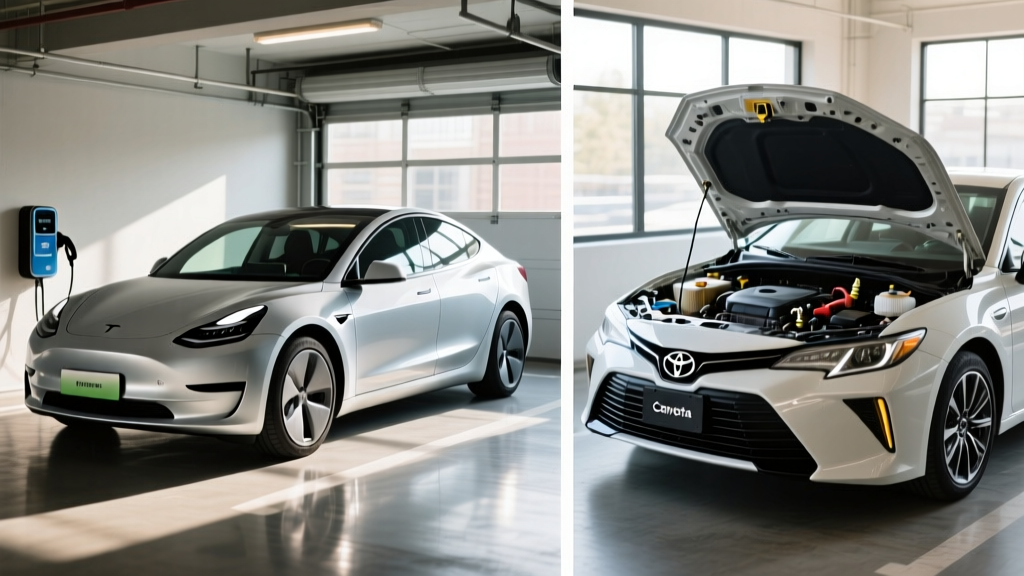
The Real Math Behind EV Maintenance Costs
The sticker price of an electric vehicle often draws the most attention, but the ownership equation extends far beyond MSRP. For buyers weighing an EV against a comparable gas car, the ongoing cost picture — maintenance, fuel, insurance, depreciation, and available incentives — determines whether going electric saves or costs money over time.
EV maintenance costs are genuinely lower than internal combustion engine (ICE) vehicles. There's no engine oil to change, no spark plugs to replace, no transmission fluid to flush, and no exhaust system to repair. Regenerative braking dramatically extends brake pad life. But maintenance is only one line item. Insurance tends to run higher for EVs, depreciation has been volatile, and the federal tax credit comes with eligibility strings that disqualify many buyers and vehicles.
This guide breaks down every major ownership cost over a realistic 5-year, 60,000-mile horizon using current 2026 pricing, EPA efficiency data, and IRS §30D tax credit rules.
5-Year Total Cost of Ownership: EV vs Gas
The table below models a mid-price EV (similar to a Hyundai Ioniq 5 or Tesla Model 3) against a comparable gas sedan (similar to a Toyota Camry or Honda Accord) over 5 years and 60,000 miles. Assumptions: $0.16/kWh average electricity, $3.50/gallon regular unleaded, 12,000 miles driven annually.
| Cost Category | EV (Mid-Price) | Gas Sedan | Difference |
|---|---|---|---|
| Purchase Price (base MSRP) | $42,000 | $30,000 | +$12,000 EV |
| Federal Tax Credit (§30D) | −$7,500 (if eligible) | $0 | −$7,500 EV |
| Net Purchase After Credit | $34,500 | $30,000 | +$4,500 EV |
| Fuel/Energy (60,000 mi) | $3,072 | $6,300 | −$3,228 EV |
| Maintenance (5 years) | $1,800 | $4,200 | −$2,400 EV |
| Insurance (5 years) | $10,500 | $7,800 | +$2,700 EV |
| Depreciation (est. 5-yr) | −$17,250 (50%) | −$12,000 (40%) | +$5,250 EV loss |
| Net 5-Year Cost | $32,622 | $36,300 | −$3,678 EV savings |
The EV saves roughly $3,700 over five years in this scenario — but only if the buyer qualifies for the full $7,500 federal tax credit. Without the credit, the EV costs approximately $3,800 more to own over the same period. This sensitivity to incentive eligibility is the single most important variable in the EV ownership equation.
Federal Tax Credit: Do You Actually Qualify?
The IRS §30D Clean Vehicle Credit offers up to $7,500 for qualifying new EVs, but the rules are restrictive and have tightened significantly since the Inflation Reduction Act. As of 2026, eligibility depends on three interlocking requirements: buyer income, vehicle MSRP, and battery component/mineral sourcing.
- Income caps (modified AGI): $150,000 single filer / $225,000 head of household / $300,000 joint filers
- MSRP caps: $55,000 for sedans, wagons, and hatchbacks / $80,000 for SUVs, vans, and pickup trucks
- Battery sourcing (§30D requirements): Battery components must be manufactured or assembled in North America (percentage thresholds increase annually); critical minerals must be sourced from the US or free-trade-agreement partners
- Foreign entity of concern (FEOC) restriction: Vehicles with battery components or critical minerals from a FEOC (primarily targeting Chinese supply chains) are disqualified
- Point-of-sale transfer: As of 2024, buyers can transfer the credit to the dealer at purchase, reducing the sale price directly rather than waiting for a tax refund — but you must still meet all eligibility requirements at tax time
- Final assembly: Vehicle must undergo final assembly in North America
Many popular EVs qualify for only $3,750 (meeting one of the two battery-sourcing thresholds but not both), and some qualify for $0 despite being assembled in North America. The fueleconomy.gov tax credit lookup tool maintains a current list of eligible vehicles and their credit amounts — check it before committing to a purchase.
Critical caveat: If you transfer the credit at point of sale but later discover you didn't qualify (income exceeded the cap, for example), the IRS will recapture the credit amount on your tax return. Always verify eligibility with a tax professional.
State, Local, and Utility Incentives
Beyond federal credits, many states, municipalities, and electric utilities offer additional incentives — but availability varies enormously by ZIP code.
Examples of current programs (verify locally — these change frequently):
- California: CVRP rebate up to $7,000 for income-qualified buyers; additional $2,000 for low-income applicants in disadvantaged communities
- Colorado: State tax credit up to $5,000 for new EVs (MSRP under $80,000), stackable with federal credit
- Utility rebates: Many utilities offer $250–$1,500 for home Level 2 charger installation; some provide off-peak charging credits or reduced electricity rates for EV owners
- HVAC/panel upgrades: Some utilities and states rebate the cost of electrical panel upgrades needed to support a Level 2 home charger
Check the Alternative Fuels Data Center for a state-by-state incentive database. Income-qualified programs can add $2,000–$7,000 on top of federal credits, materially changing the ownership math.
Charging Costs vs Gas: The $/Mile Reality
The fuel-cost advantage of an EV depends heavily on how and where you charge. Home charging on a residential electricity rate delivers the biggest savings. Public DC fast charging narrows the gap significantly and can, in some cases, exceed the per-mile cost of gasoline.
| Fuel Source | Rate Assumption | Vehicle Efficiency | Cost per Mile |
|---|---|---|---|
| Home Level 2 (average US) | $0.16/kWh | 3.5 mi/kWh (120 MPGe) | $0.046/mi |
| Home Level 2 (off-peak utility rate) | $0.09/kWh | 3.5 mi/kWh | $0.026/mi |
| Public DC fast charging | $0.40/kWh | 3.5 mi/kWh | $0.114/mi |
| Tesla Supercharger (varies) | $0.28–$0.48/kWh | 3.5 mi/kWh | $0.080–$0.137/mi |
| Gas sedan (30 MPG combined) | $3.50/gallon | 30 MPG | $0.117/mi |
| Gas sedan (25 MPG combined) | $3.50/gallon | 25 MPG | $0.140/mi |
At 12,000 miles per year, a home-charged EV costs roughly $550 annually in electricity versus $1,260 in gasoline for a 30 MPG sedan — a $710/year fuel savings. Over five years, that's $3,550 in fuel savings alone.
But if you rely primarily on public DC fast charging at $0.40/kWh, your annual fuel cost jumps to $1,370 — actually exceeding the gas car. This is why home charging access is the single biggest financial factor in EV ownership. Buyers without reliable home or workplace charging should run their own numbers carefully before purchasing.
EV Maintenance Costs: Where the Savings Are Real
This is where EVs genuinely shine. An electric drivetrain has roughly 20 moving parts compared to 2,000+ in an internal combustion engine. No oil changes, no timing belts, no oxygen sensors, no catalytic converters, no transmission fluid flushes, no spark plug replacements.
| Maintenance Item | EV (5-Year Cost) | Gas Car (5-Year Cost) |
|---|---|---|
| Oil changes (synthetic, 2x/yr) | $0 | $600 |
| Brake pads (front + rear) | $0–$200 (regen extends life 2–3x) | $600–$1,000 |
| Transmission fluid | $0 (single-speed reduction gear, typically sealed) | $150–$300 |
| Engine air filter | $0 | $100–$150 |
| Coolant flush | $100–$150 (battery thermal management system) | $150–$250 |
| Cabin air filter | $100–$150 | $100–$150 |
| Tire rotation | $200–$300 | $200–$300 |
| Wiper blades, bulbs, misc. | $100–$150 | $100–$150 |
| Tire replacement (EVs are heavier, tires wear faster) | $1,000–$1,400 | $600–$900 |
| Total Estimated 5-Year Maintenance | $1,500–$2,300 | $2,500–$4,750 |
Two nuances worth noting:
Brake savings are real. Regenerative braking handles most deceleration, meaning friction brakes are used far less. Many EV owners report original brake pads at 80,000+ miles. Some manufacturers recommend periodic brake caliper lubrication to prevent seizing from disuse.
Tire costs are higher. EVs are 10–20% heavier than equivalent gas cars (the battery pack adds significant mass) and deliver instant torque, both of which accelerate tire wear. Budget for tire replacement sooner than you would on a gas car, and consider EV-specific tire compounds (Michelin Pilot Sport EV, Hankook iON) designed for higher load ratings and lower rolling resistance.
Net maintenance savings: approximately $1,000–$2,500 over five years, depending on the gas car you're comparing against and whether your EV needs tire replacement within the window.
Insurance: The Cost EV Owners Often Overlook
EV insurance premiums run 15–30% higher on average than comparable gas vehicles. Several factors drive this:
- Higher repair costs: EV collision repairs often require specialized technicians, high-voltage safety protocols, and OEM battery diagnostics. Minor rear-end damage that would cost $2,000 on a gas car can total an EV if the battery enclosure is compromised.
- Higher vehicle values: Insurers base comprehensive/collision premiums partly on replacement cost. A $45,000 EV costs more to insure than a $30,000 gas sedan.
- Parts scarcity: Some EV models have limited aftermarket parts availability, pushing repair shops toward OEM components at premium pricing.
- Specialized labor: Not every body shop is certified to work on high-voltage systems, narrowing the repair network and increasing labor rates.
Typical annual premiums: $1,800–$2,400 for an EV versus $1,300–$1,800 for a comparable gas sedan (varies heavily by driver profile, state, and coverage level). Over five years, expect to pay $2,000–$4,000 more in insurance for the EV.
Mitigation strategies: Shop quotes from insurers with dedicated EV programs (some offer discounts for home charging, low mileage, or bundled home-auto policies). Tesla Insurance, where available, uses real-time driving data to price premiums and can be competitive for safe drivers. Always compare at least three quotes before binding coverage.
Depreciation and Resale Value: The Wildcard
EV depreciation has been volatile. In 2023–2024, Tesla's aggressive price cuts on new vehicles cratered used EV values across the market — some models lost 30–40% of value in a single year. By 2025–2026, the market has stabilized somewhat, but EVs still depreciate faster on average than popular gas vehicles.
Typical 5-year depreciation:
- EVs (average): 45–55% of original MSRP
- Gas sedans (average): 35–45%
- Gas trucks/SUVs (popular models): 25–35%
On a $42,000 EV, 50% depreciation means a $21,000 loss. On a $30,000 gas sedan at 40%, that's a $12,000 loss — a $9,000 gap that can wipe out fuel and maintenance savings.
Depreciation risk is lower for EVs with strong battery warranties (8 years/100,000 miles is standard under federal mandate), proven long-term reliability data, and models that haven't seen aggressive price cuts on the new-vehicle market. Buying a slightly used EV (2–3 years old) lets the original owner absorb the steepest depreciation curve, significantly improving your ownership economics.
Battery health is the key resale variable. A vehicle with a verified state of health (SoH) above 90% commands a meaningful premium. Most modern LFP and NMC batteries degrade 1–2% per year under normal use, meaning a 5-year-old EV should retain roughly 90–95% of original capacity — but buyers remain cautious, and that caution suppresses resale values.
Frequently Asked Questions
How much does it really cost to own an EV over 5 years?
For a mid-price EV ($42,000 MSRP) with full $7,500 tax credit eligibility, home charging, and average insurance, expect roughly $30,000–$35,000 in total 5-year costs (net of depreciation and resale). A comparable gas sedan costs $33,000–$40,000 over the same period. The EV typically saves $2,000–$5,000, but the margin is heavily dependent on tax credit eligibility, home charging access, and how well the specific model holds its value.
Do I qualify for the $7,500 federal EV tax credit?
Eligibility requires meeting ALL of the following: income below $150K (single) / $300K (joint), vehicle MSRP under $55K (cars) or $80K (SUVs/trucks), final assembly in North America, and battery components and critical minerals meeting escalating domestic/FTA sourcing thresholds. Many vehicles qualify for only $3,750 or $0. Check the current eligible vehicle list at fueleconomy.gov and consult a tax professional — the point-of-sale transfer option means you can apply the credit at purchase, but the IRS will recapture it if you're later found ineligible.
How much do I save on fuel and maintenance with an EV?
Combined fuel and maintenance savings typically total $1,000–$1,500 per year for a home-charging EV owner driving 12,000 miles annually. Over five years, that's $5,000–$7,500. Fuel savings alone average $700–$800/year (home charging at $0.16/kWh vs. $3.50/gallon gas). Maintenance savings add $400–$600/year (no oil changes, minimal brake wear, fewer scheduled service visits). These savings shrink significantly if you rely on public DC fast charging.
Are EVs more expensive to insure than gas cars?
Yes — typically 15–30% more, translating to $400–$700 in additional annual premium. Higher repair costs (specialized high-voltage labor, OEM parts requirements, battery enclosure sensitivity), higher vehicle values, and a smaller repair-shop network all contribute. Over five years, the insurance premium gap costs $2,000–$3,500, partially offsetting fuel and maintenance savings. Always get insurance quotes before purchasing to build the real cost into your decision.
How well do EVs hold their resale value?
Average EVs lose 45–55% of MSRP over five years, compared to 35–45% for gas sedans. The gap is driven by rapid technology advancement (newer models offer better range and charging speed, making older ones less desirable), battery health uncertainty among used buyers, and market disruptions from new-vehicle price cuts. Buying a 2–3-year-old used EV is the most depreciation-efficient strategy — you get a modern vehicle while the original owner absorbs the steepest value drop.
Does the EV battery need replacement, and what does it cost?
Modern EV batteries (both LFP and NMC chemistries) are designed to last the life of the vehicle. Federal law mandates a minimum 8-year/100,000-mile battery warranty covering defects and excessive capacity loss (typically defined as dropping below 70% of original capacity). Average annual degradation is 1–2%, meaning most batteries retain 85–95% capacity at 100,000 miles. Out-of-warranty battery replacement, if needed, costs $5,000–$15,000 depending on the vehicle, but full replacements remain rare for vehicles under 150,000 miles.
The Bottom Line: When Does an EV Save You Money?
EV ownership economics work best when you can check multiple boxes: you qualify for the full $7,500 federal tax credit, you have reliable home Level 2 charging (keeping fuel costs at $0.04–$0.05/mile), you drive 12,000+ miles per year (amplifying fuel savings), and you plan to keep the vehicle 5+ years (spreading the higher purchase price and insurance over a longer horizon).
If you can't charge at home, don't qualify for the tax credit, or plan to sell within 3 years, the math gets thin fast. EV maintenance costs are genuinely lower — there's no ambiguity there — but maintenance is the smallest piece of the ownership cost puzzle. Fuel savings, tax incentives, insurance premiums, and depreciation collectively determine whether your EV saves or costs money over time. Run the numbers for your specific situation before signing the purchase agreement.