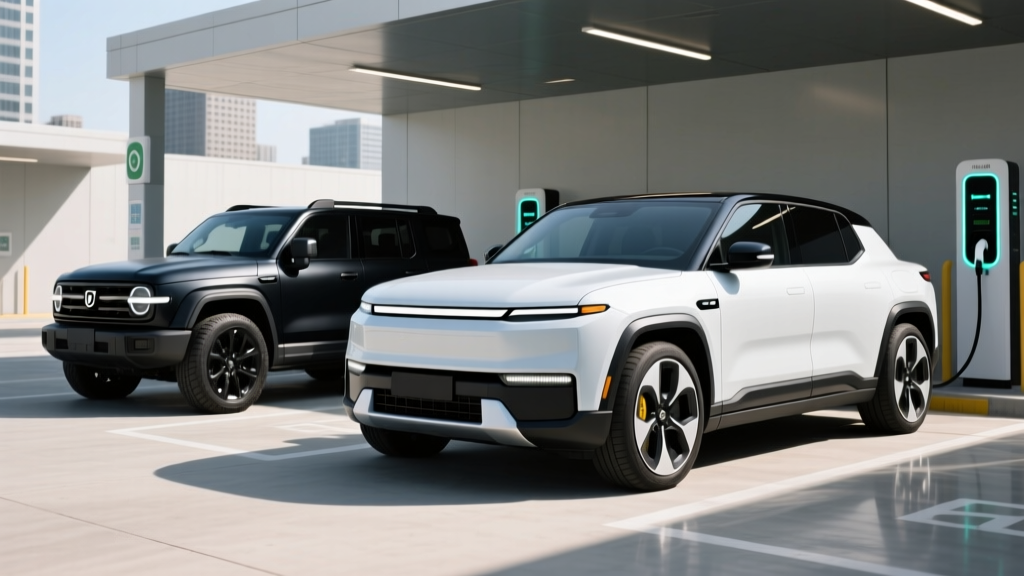
The Quick Answer: Which EV Jeep Should You Buy?
As of the 2026 model year, Jeep offers three electrified options for buyers searching for EV Jeeps. The Wagoneer S is the all-electric flagship SUV with up to 300 miles of EPA range and a starting MSRP around $65,200. The Jeep Recon is the more affordable, trail-rated all-electric SUV starting near $47,000 with an estimated 290 miles of range. The Wrangler 4xe remains a plug-in hybrid (PHEV) with 22 miles of electric-only range and a base price near $51,000. Your best pick depends on whether you prioritize pure-electric daily driving, serious off-road capability, or a bridge solution that eliminates range anxiety entirely.
The 2026 EV Jeep Lineup at a Glance
Jeep's electrification strategy spans three distinct vehicle architectures. Understanding the differences is critical before you visit a dealer or configure one online.
| Spec | Wagoneer S (BEV) | Recon (BEV) | Wrangler 4xe (PHEV) |
|---|---|---|---|
| Powertrain | All-Electric (BEV) | All-Electric (BEV) | Plug-In Hybrid (PHEV) |
| EPA Range (Electric) | ~300 mi | ~290 mi (est.) | 22 mi (electric-only) |
| Battery Capacity | 100 kWh (NMC) | ~85 kWh (NMC) | 17.3 kWh (NMC) |
| Horsepower | 600 hp | ~400 hp (est.) | 375 hp (combined) |
| 0-60 mph | ~3.4 sec | ~5.0 sec (est.) | ~6.0 sec |
| Max DC Fast Charge | ~200 kW (peak) | ~175 kW (peak) | N/A (Level 2 only) |
| 10-80% DC Charge | ~23 min | ~28 min (est.) | N/A |
| Level 2 Charge Rate | 11.5 kW | 11.5 kW | 7.2 kW |
| Trail Rated | No | Yes | Yes |
| Base MSRP | ~$65,200 | ~$47,000 | ~$51,000 |
| §30D Federal Credit | Up to $7,500* | Up to $7,500* | Up to $3,750* |
| Battery Warranty | 8 yr / 100,000 mi | 8 yr / 100,000 mi | 8 yr / 100,000 mi |
*Federal §30D tax credit eligibility depends on buyer income, MSRP caps, and battery critical-mineral sourcing requirements. See the IRS clean vehicle credits page for current rules. Credits may be transferred to the dealer at point of sale.
Wagoneer S: The Electric Performance SUV
The Wagoneer S is Jeep's first fully electric vehicle built on Stellantis's STLA Large platform. It targets the luxury electric SUV segment with serious performance credentials: 600 horsepower, a 3.4-second 0-60 time, and a 100 kWh NMC battery delivering approximately 300 miles of EPA-estimated range.
Real-World Range Expectations: Wagoneer S
EPA Sticker: ~300 miles
Highway driving (70-75 mph): Expect ~240-260 miles. EVs lose efficiency at sustained highway speeds due to aerodynamic drag — there's no multi-gear transmission to optimize like in a gas car.
Cold weather (below 32°F): Expect ~210-240 miles. Battery chemistry slows in cold temperatures, and cabin heating draws significant energy. The Wagoneer S includes a heat pump, which mitigates but doesn't eliminate cold-weather loss.
Mixed city/suburban: ~280-300 miles — closest to the EPA estimate thanks to regenerative braking recapturing energy in stop-and-go traffic.
On a DC fast charger, the Wagoneer S peaks around 200 kW. In practice, that peak rate holds roughly from 10% to 40% state of charge before tapering. Expect a 10-80% session to take approximately 23 minutes at a capable 350 kW station. Above 80%, charging slows dramatically to protect battery health — plan to unplug at 80% on road trips rather than waiting for a full charge.
At home on a Level 2 charger (240V, 48A), the 11.5 kW onboard charger replenishes the battery in about 9 hours from empty. That's ideal for overnight charging: plug in when you get home, wake up to a full battery every morning.
Jeep Recon: The Trail-Rated Electric SUV
The Recon is the EV Jeep that off-road enthusiasts have been waiting for. It's the first all-electric Jeep to carry the Trail Rated badge, with selectable drive modes, electronic locking differentials, and serious ground clearance. Pricing starts around $47,000, making it significantly more accessible than the Wagoneer S.
With an estimated 85 kWh battery and ~290 miles of range, the Recon is positioned for daily driving and weekend trail use. Its ~175 kW peak DC charging rate means 10-80% sessions in roughly 28 minutes at a high-power station. The trade-off versus the Wagoneer S is performance: the Recon targets ~400 horsepower and a ~5.0-second 0-60, which is brisk but not supercar territory.
For buyers who want an EV Jeep that can genuinely handle rock crawling, mud, and snow without compromising daily-driver practicality, the Recon is the strongest candidate in the lineup. Its pricing also keeps it under the $55,000 MSRP cap for SUVs under the §30D federal tax credit, assuming your income and the vehicle's battery sourcing qualify.
Wrangler 4xe: The Plug-In Hybrid Bridge
The Wrangler 4xe is not a battery electric vehicle — it's a plug-in hybrid. But for many Jeep buyers, it may be the most practical electrified option. Here's why: 22 miles of electric-only range covers most daily commutes and errands, while the gas engine eliminates range anxiety on road trips and remote trail runs where charging infrastructure doesn't exist.
| Metric | Wrangler 4xe (PHEV) | Wrangler Gas (3.6L V6) |
|---|---|---|
| Electric-Only Range | 22 mi | 0 mi |
| Combined MPG (gas mode) | 20 MPG | 19 MPG |
| MPGe (electric + gas) | 49 MPGe | N/A |
| Total Range | ~370 mi | ~430 mi |
| 0-60 mph | ~6.0 sec | ~7.5 sec |
| Horsepower | 375 hp | 285 hp |
| Annual Fuel Cost (est.) | ~$1,800 | ~$2,700 |
| Base MSRP | ~$51,000 | ~$36,000 |
Source: fueleconomy.gov — EPA estimates. Actual costs vary by driving pattern, electricity rate, and fuel price.
The 4xe's 17.3 kWh battery charges on Level 2 (240V) at 7.2 kW, reaching a full charge in about 2.5 hours. It does not support DC fast charging. If your daily driving is under 22 miles and you can charge at home, you'll burn very little gasoline during the week. On weekends, the gas tank takes over for longer adventures — no charging-station planning required.
Real Costs: EV Jeeps vs. Gas Jeeps Over 5 Years
Upfront price is only part of the ownership equation. Here's a realistic 5-year cost comparison for a buyer driving 12,000 miles per year, assuming home charging access and average US electricity and fuel prices.
| Cost Category (5 Years) | Wagoneer S (BEV) | Recon (BEV) | Wrangler 4xe (PHEV) | Wrangler Gas (Baseline) |
|---|---|---|---|---|
| Purchase Price (base) | $65,200 | $47,000 | $51,000 | $36,000 |
| Federal Tax Credit | -$7,500* | -$7,500* | -$3,750* | $0 |
| Effective Purchase | $57,700 | $39,500 | $47,250 | $36,000 |
| Fuel/Energy (60k mi) | ~$4,200 | ~$4,500 | ~$9,000 | ~$13,500 |
| Maintenance (5 yr) | ~$1,500 | ~$1,500 | ~$3,500 | ~$4,500 |
| Insurance (5 yr est.) | ~$12,000 | ~$9,500 | ~$9,800 | ~$8,500 |
| Est. 5-Year Total | ~$75,400 | ~$55,000 | ~$70,050 | ~$62,500 |
Assumptions: $0.16/kWh electricity, $3.75/gal gasoline, 3.0 mi/kWh average EV efficiency, 50% electric driving for 4xe. Insurance estimates vary widely by driver profile, state, and insurer. Tax credit eligibility not guaranteed — verify at irs.gov.
Key takeaways: BEVs save significantly on fuel and maintenance (no oil changes, fewer brake replacements thanks to regenerative braking, no transmission fluid). However, insurance premiums for EVs tend to run 15-25% higher due to higher repair costs for battery and structural components. The Recon's lower MSRP and tax credit eligibility make it the most cost-competitive EV Jeep over five years.
Charging at Home: What EV Jeep Buyers Need to Know
Home charging is the backbone of EV ownership. If you can install a Level 2 charger, daily life with a Wagoneer S or Recon is remarkably convenient — you start every morning with a full "tank."
| Home Charging Item | Cost Range |
|---|---|
| Level 2 Charger (hardwired, 48A) | $400 - $700 |
| Electrician labor (standard install) | $500 - $1,500 |
| Electrical panel upgrade (if needed, 200A) | $1,500 - $3,500 |
| Permit and inspection | $100 - $400 |
| Total (no panel upgrade) | $1,000 - $2,600 |
| Total (with panel upgrade) | $2,500 - $6,100 |
Both the Wagoneer S and Recon support 11.5 kW Level 2 charging, which requires a 240V circuit rated for at least 60 amps (to support continuous 48A draw). The Wrangler 4xe needs only a 40A circuit for its 7.2 kW charger. Have a licensed electrician evaluate your panel capacity before purchasing equipment — older homes with 100A service may need an upgrade.
If you cannot charge at home (apartment, street parking, no garage), BEV ownership becomes significantly harder. You'll rely on public DC fast charging, which costs roughly 2-3x more per kWh than home electricity and requires time planning. The Wrangler 4xe is a far more practical choice in this scenario — you can charge opportunistically and fall back on gasoline.
Common Misconceptions About EV Jeeps
| Myth | Fact |
|---|---|
| "EVs can't off-road." | The Recon is Trail Rated with locking differentials, low-range gearing simulation, and serious ground clearance. Electric motors deliver instant torque at zero RPM — an advantage on technical rock-crawling terrain. |
| "The battery will need replacing in 5 years." | Jeep warranties the battery for 8 years / 100,000 miles against degradation below 70% capacity. Real-world data from NMC batteries in similar platforms shows ~10-15% degradation at 100,000 miles — far from needing replacement. |
| "EVs don't work in cold weather." | Range drops 20-30% in freezing temperatures — that's real. But a 300-mile EV with 20% loss still has 240 miles, which covers most daily needs. Preconditioning the battery while plugged in mitigates both range loss and charging-speed reduction. |
| "Charging takes too long." | At home, you plug in for 10 seconds and the car charges overnight while you sleep — zero time spent at a station. On road trips, a 23-minute DC fast charge is a reasonable rest stop. |
| "The tax credit is gone." | The §30D credit is still available for qualifying vehicles and buyers in 2026, but eligibility depends on MSRP caps ($80,000 for SUVs), buyer income limits ($300K joint / $150K single), and battery sourcing requirements. Check current rules at fueleconomy.gov. |
Decision Framework: Which EV Jeep Is Right for You?
Choose the Wagoneer S if:
- You want a premium, high-performance electric SUV and budget is not the primary constraint
- Your daily driving is under 250 miles and you have reliable home Level 2 charging
- You value acceleration (3.4s 0-60) and a luxury interior over hardcore off-road ability
- You rarely drive to remote areas without charging infrastructure
Choose the Recon if:
- You want a true off-road-capable EV with the Trail Rated badge
- You want to stay under $50,000 (before options) to maximize tax credit value
- You need daily-driver range (~290 mi) plus weekend trail capability
- You're upgrading from a gas Wrangler or Cherokee and want to go fully electric
Choose the Wrangler 4xe if:
- You regularly drive to remote areas (trails, camping, rural land) with no charging access
- You can't install a Level 2 charger at home but can use a standard 120V outlet
- You want electric daily commuting (22 mi) without giving up the open-air Wrangler experience
- You're not ready to commit to full EV ownership and want a bridge solution
Frequently Asked Questions
Are EV Jeeps good for off-roading?
The Jeep Recon is specifically engineered for off-road use and carries the Trail Rated badge. Electric motors provide instant torque at zero RPM, which is advantageous for precise rock crawling. The Wrangler 4xe also retains full Trail Rated capability. The Wagoneer S is a road-focused luxury SUV and is not designed for serious off-road use.
How long does it take to charge an EV Jeep at home?
On a Level 2 home charger (240V), the Wagoneer S charges from empty to full in approximately 9 hours at 11.5 kW. The Recon takes roughly 8 hours. The Wrangler 4xe reaches a full charge in about 2.5 hours at 7.2 kW. Most owners plug in overnight and wake up to a full battery every morning.
Do EV Jeeps qualify for the federal tax credit?
The Wagoneer S and Recon may qualify for up to $7,500 under IRS §30D, and the Wrangler 4xe may qualify for up to $3,750. Eligibility depends on your modified adjusted gross income (under $300K for joint filers, $150K for single), the vehicle's MSRP being under the $80,000 SUV cap, and battery critical-mineral and component sourcing requirements that change annually. Verify current eligibility on irs.gov or ask your dealer about point-of-sale credit transfer.
What happens if the battery degrades?
Jeep warranties the high-voltage battery for 8 years or 100,000 miles, covering capacity loss below 70% of original. Real-world NMC battery data suggests typical degradation of 10-15% over 100,000 miles. If the battery does fall below the warranty threshold, Jeep will repair or replace it at no cost. Full battery replacements outside warranty currently range from $12,000 to $20,000 depending on the model, though prices are declining.
Can I tow with an electric Jeep?
The Wagoneer S is rated for approximately 5,000 pounds of towing. The Recon's towing capacity is estimated around 4,000-5,000 pounds (final specs pending). The Wrangler 4xe is rated for 3,500 pounds. Note that towing significantly reduces EV range — expect a 30-50% reduction depending on trailer weight and terrain.
Is the Wrangler 4xe considered an EV?
The Wrangler 4xe is a plug-in hybrid electric vehicle (PHEV), not a battery electric vehicle (BEV). It combines a 2.0L turbocharged gas engine with an electric motor and a 17.3 kWh battery for 22 miles of electric-only driving. It's an excellent option for buyers who want some electric capability without committing to a fully electric vehicle.