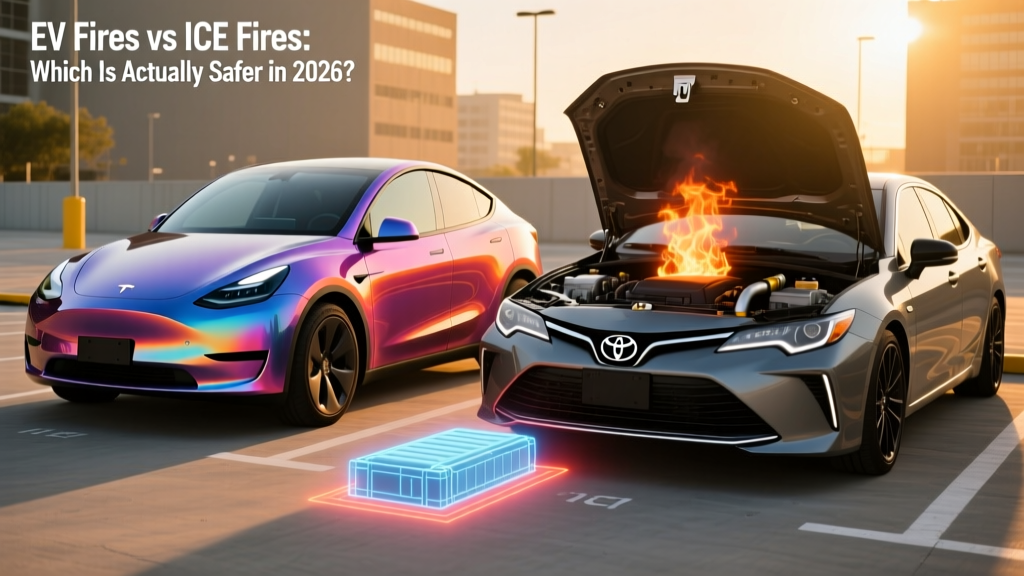
Search "EV fires vs ICE fires" and you'll find two parallel universes: viral videos of battery blazes that burn for hours, and statistics suggesting gasoline cars catch fire at far higher rates. Both narratives contain truth. Neither tells the whole story.
As of the 2026 model year, electric vehicles represent roughly 12% of new light-duty vehicles sold in the U.S., yet they dominate fire-safety headlines in a way that doesn't match their market share or actual incident rate. Internal combustion engine (ICE) vehicles, meanwhile, account for the vast majority of vehicle fires by raw count — but also by rate per 100,000 vehicles on the road.
This comparison doesn't pick a side. It dissects the data, explains the physics of why each fire type behaves differently, and gives you a framework for weighing fire risk alongside every other factor in your next vehicle purchase.
The Raw Numbers: Fire Incidence Rates Compared
The most reliable U.S. data on vehicle fires comes from the National Fire Protection Association (NFPA), the National Highway Traffic Safety Administration (NHTSA), and Sweden's Civil Contingencies Agency (MSB), which has tracked EV fires separately since 2022.
| Metric | ICE / Gas Vehicles | Battery Electric Vehicles (BEV) | Hybrids (HEV/PHEV) |
|---|---|---|---|
| Fires per 100,000 vehicles sold (AutoinsuranceEZ / NHTSA composite) | ~1,530 | ~25 | ~3,475 |
| Fires per 100,000 vehicles (Sweden MSB, 2022–2023) | ~130 | ~3.8 | Not separated |
| Estimated U.S. vehicle fires/year (all causes) | ~170,000–190,000 | ~200–400 (estimated) | Included in ICE totals |
| Fatalities per vehicle fire | Higher (more fires, more exposure) | Very low (few fires, better egress time) | Comparable to ICE |
| Primary ignition source | Fuel line, electrical short, exhaust heat | Thermal runaway (cell damage, manufacturing defect) | Fuel system + high-voltage battery |
Key takeaway: By rate, gasoline vehicles catch fire at roughly 30–60× the rate of battery-electric vehicles, depending on the dataset. Hybrids — which carry both a fuel system and a high-voltage battery — show the highest fire rate, likely because they combine two ignition pathways and skew toward older, higher-mileage vehicles in the current fleet.
Why EV Fires Look Worse Than They Are
If BEVs catch fire less often, why do they dominate the news cycle? Three factors:
1. Thermal Runaway Is Spectacular and Prolonged
A lithium-ion battery fire isn't like a gasoline fire. When a cell enters thermal runaway — typically from physical damage, manufacturing defect, or extreme overcharge — it releases oxygen from its own cathode chemistry (especially NMC cells). This means the fire sustains itself even without outside air, burns at higher temperatures (~1,800–2,200°F at the cell level), and can reignite hours or even days after initial suppression. Firefighters may need 20,000–30,000 gallons of water to fully extinguish a single BEV pack fire, compared to 500–1,500 gallons for an engine-bay gasoline fire.
2. Novelty Bias
EVs are still newsworthy. A Tesla or Rivian fire generates clicks; a 2014 Honda Civic engine-bay fire does not. Media amplification creates a perception gap that raw statistics don't support.
3. Recall Amplification
High-profile battery recalls — the Chevrolet Bolt (2021–2022, LG cell defect), certain Hyundai Kona Electric batches, and select 2024–2025 packs from emerging OEMs — reinforce the impression that EV batteries are inherently unstable. In reality, these recalls demonstrate the industry's conservative approach: manufacturers are pulling vehicles over potential defects before fires occur.
Why ICE Fires Are Deadlier in Aggregate
Gasoline vehicle fires kill far more people per year (~350–450 in the U.S. annually, per NFPA) than EV battery fires (single-digit fatalities in the U.S. in any year so far). The reasons are structural:
- Volume: ~280 million ICE vehicles on U.S. roads vs. ~5 million BEVs (as of early 2026).
- Age: The average ICE vehicle is ~12.7 years old. Aging fuel lines, corroded fittings, and degraded wiring harnesses are leading ignition sources.
- Crash-related ignition: Gasoline is carried in a thin-walled tank at the rear of most vehicles. A moderate rear-end collision can rupture the tank and expose fuel to hot exhaust components.
- Egress time: A gasoline fire can engulf a cabin in 60–90 seconds. An EV thermal-runaway event typically provides a longer warning window (smoke, error codes, cell venting) before cabin compromise — though this varies by pack location and crash geometry.
Category-by-Category Verdict
🏆 Fire Incidence Rate (per 100K vehicles)
Winner: Battery Electric Vehicles
At ~25 fires per 100,000 vehicles vs. ~1,530 for ICE, BEVs are statistically far less likely to catch fire under any circumstance — parking, driving, or charging.
🏆 Fire Suppression Difficulty
Winner: ICE Vehicles (easier to extinguish)
Gasoline fires are well-understood by fire services. A Class B foam or dry-chemical attack suppresses most engine-bay and fuel fires within minutes. EV battery fires require prolonged water application, thermal monitoring, and sometimes submersion or quarantine — making them the harder fire to fight.
🏆 Fatalities per Fire Event
Winner: Battery Electric Vehicles
Fewer fires + longer egress windows + no volatile liquid fuel pooling under the vehicle = fewer fatalities per incident. However, sample size is still small; this could shift as EV fleet share grows.
🏆 Post-Crash Fire Risk
Winner: Battery Electric Vehicles (marginally)
Modern BEV packs are housed in reinforced structural enclosures (e.g., Tesla's 4680 structural pack, Hyundai's body-integrated battery tray). NHTSA crash testing shows lower post-crash fire incidence in BEVs than in comparable ICE vehicles, though high-energy side impacts remain a risk for both architectures.
🏆 Parking Garage / Structure Fire Risk
Winner: ICE Vehicles
Some municipalities and parking operators have restricted EV parking in underground or enclosed structures due to the prolonged suppression challenge. While EV parking fires are rare, the consequence of one in a confined concrete structure is severe enough that insurers and fire marshals treat it as a distinct risk category.
Battery Chemistry Matters: LFP vs NMC Fire Risk
Not all EV batteries carry equal fire risk. The two dominant chemistries in 2026 model-year BEVs behave very differently under abuse:
| Property | LFP (Lithium Iron Phosphate) | NMC / NCA (Nickel Manganese Cobalt / Nickel Cobalt Aluminum) |
|---|---|---|
| Thermal runaway onset temperature | ~518°F (270°C) | ~392°F (200°C) or lower at high SoC |
| Oxygen release during runaway | Minimal — no oxygen released from cathode | Significant — cathode releases oxygen, sustaining combustion |
| Propagation risk (cell-to-cell) | Low — single-cell events often contained | Higher — cascading thermal runaway more likely |
| Energy density | Lower (~160–180 Wh/kg cell-level) | Higher (~250–300 Wh/kg cell-level) |
| Typical 2026 applications | Tesla Model 3/Y RWD, Ford Mustang Mach-E Select (LFP pack), Rivian Standard | Long-range / performance trims, Lucid, Porsche, BMW iX |
Practical implication: If fire risk is a primary concern, an LFP-equipped EV offers a meaningful safety margin over NMC. LFP cells are far more resistant to thermal runaway and, when they do fail, tend to vent rather than burn violently. The trade-off is lower energy density, which translates to slightly less range for the same pack weight.
Real-World Considerations: What the Data Doesn't Show
Statistics flatten nuance. Here's what the raw numbers miss:
Charging-Related Fires
A small subset of EV fires occur during charging — typically involving Level 2 home chargers with damaged cables, non-UL-certified aftermarket equipment, or electrical panels that haven't been inspected. The vehicle battery itself is rarely the root cause; the fault lies upstream. Using a UL-listed charger and having a licensed electrician verify your panel capacity (most Level 2 installs require a 240V/40–60A circuit) mitigates this risk almost entirely.
Aftermarket Modifications
Lifted EVs, aftermarket battery-heater deletes, or third-party fast-charge adapters that bypass OEM safety interlocks introduce fire risk that doesn't show up in manufacturer defect data. If you modify your EV's electrical system, you assume risk outside the warranty and safety engineering envelope.
Age and Fleet Composition
The EV fleet in 2026 is young — median age roughly 3.5 years. The ICE fleet is old — median age ~12.7 years. Older vehicles have more wear-related fire causes (cracked fuel lines, corroded wiring, failing catalytic converters running at 1,400°F+). As the EV fleet ages, its fire rate may rise slightly — though it's unlikely to approach ICE levels, because EVs eliminate the gasoline fuel system entirely.
Ownership Implications: Insurance, Parking, and Resale
| Factor | BEV | ICE Vehicle |
|---|---|---|
| Average insurance premium (national avg, 2025–2026) | ~$2,100–$2,600/yr (higher repair cost, not fire-driven) | ~$1,500–$1,900/yr |
| Fire-related insurance surcharge | None specific; premiums reflect total-loss repair cost | None specific |
| Parking structure restrictions | Some garages (esp. in Europe, emerging in U.S.) limit EV parking to ground level or designated zones | No restrictions |
| Firefighter response protocol | Specialized training required; not all departments fully equipped as of 2026 | Standard protocol nationwide |
| Post-fire vehicle disposal | Requires hazmat handling for battery; costly (~$5,000–$15,000 for tow + quarantine) | Standard salvage/tow |
| Resale impact of fire history | Severe — battery fire history essentially totals the vehicle permanently | Moderate — engine-bay fires can be repaired if cabin intact |
Insurance premiums for EVs remain higher than for comparable ICE vehicles, but not because of fire risk. The primary drivers are higher repair costs (specialized body shops, battery-pack replacement pricing, OEM-only parts channels) and higher initial vehicle cost. Fire is a negligible factor in actuarial EV pricing as of 2026.
Decision Framework: How to Weigh Fire Risk in Your Purchase
Choose a BEV if:
- You prioritize statistical safety: BEVs are ~30–60× less likely to catch fire per vehicle on the road.
- You can install a UL-listed Level 2 charger on a properly rated circuit (eliminates the most common EV charging fire vector).
- You prefer LFP chemistry for additional thermal margin (check trim-level battery specs — not all trims offer LFP).
- You value longer egress time in a worst-case scenario and carry no volatile liquid fuel.
Choose an ICE vehicle if:
- You frequently park in underground or enclosed structures that restrict EV parking in your jurisdiction.
- You live in an area where fire services have not yet trained or equipped for EV battery fires (rural / volunteer departments — check locally).
- You modify your vehicles and want to avoid voiding battery safety systems.
- Fire suppression speed matters to you more than fire incidence rate (ICE fires are faster to extinguish).
Choose a Hybrid (HEV/PHEV) if:
- You want electric-only commuting but need long-range capability without charging infrastructure.
- You accept the highest statistical fire rate among powertrain types — hybrids combine both ignition pathways. This isn't a reason to avoid them (the absolute numbers remain low), but it's the honest data point.
Frequently Asked Questions
Do electric cars catch fire more often than gas cars?
No. By every major dataset — NHTSA, NFPA, and Sweden's MSB — battery-electric vehicles catch fire at a dramatically lower rate per 100,000 vehicles than internal combustion vehicles. The perception gap is driven by media amplification of rare but visually dramatic battery fires.
Why are EV fires harder to put out?
Lithium-ion battery fires, especially in NMC chemistry cells, release their own oxygen during thermal runaway, making them self-sustaining. They also burn hotter and can reignite hours after initial suppression. Firefighters must apply water for extended periods (sometimes hours) and may need to quarantine the vehicle afterward to monitor for re-ignition.
Is LFP battery chemistry safer than NMC?
Yes, meaningfully so. LFP (lithium iron phosphate) cells have a higher thermal runaway onset temperature (~270°C vs ~200°C for NMC) and do not release oxygen from the cathode during failure, making them far less prone to violent combustion. Most 2026 standard-range EVs from Tesla, Ford, and Rivian use LFP in their base trims.
Should I be worried about charging my EV at home?
Charging-related fires are extremely rare and almost always involve faulty equipment, damaged cables, or electrical panels that haven't been upgraded to handle the load. A UL-listed Level 2 charger installed by a licensed electrician on a dedicated 240V circuit is very safe. Avoid cheap, non-certified chargers from unknown brands sold on marketplace sites.
Do hybrids catch fire more than EVs or gas cars?
According to the AutoinsuranceEZ/NHTSA composite analysis, hybrids show the highest fire rate per 100,000 vehicles (~3,475) — higher than both pure ICE (~1,530) and pure BEV (~25). This is likely because hybrids carry both a gasoline fuel system and a high-voltage battery, creating two potential ignition pathways, and because the hybrid fleet skews older with higher mileage.
What should I do if my EV battery is smoking or smells like chemicals?
Exit the vehicle immediately, move at least 50 feet away, and call 911. Tell the dispatcher it's an electric vehicle. Do not attempt to open the battery enclosure or apply water yourself. Modern EVs provide thermal warnings (dashboard alerts, audible alarms) well before critical failure in most non-crash scenarios — take them seriously and pull over.
Sources: National Fire Protection Association (NFPA), National Highway Traffic Safety Administration (NHTSA), Sweden Civil Contingencies Agency (MSB) EV Fire Report 2023, IRS §30D Clean Vehicle Credit guidelines (for ownership cost context). Fire-rate data synthesized from AutoinsuranceEZ composite analysis and peer-reviewed MSB publications. Consult your local fire authority for EV-response capability in your area.