The Quick Answer: There Is No "EV Engine" — Here's What Powers Electric Cars
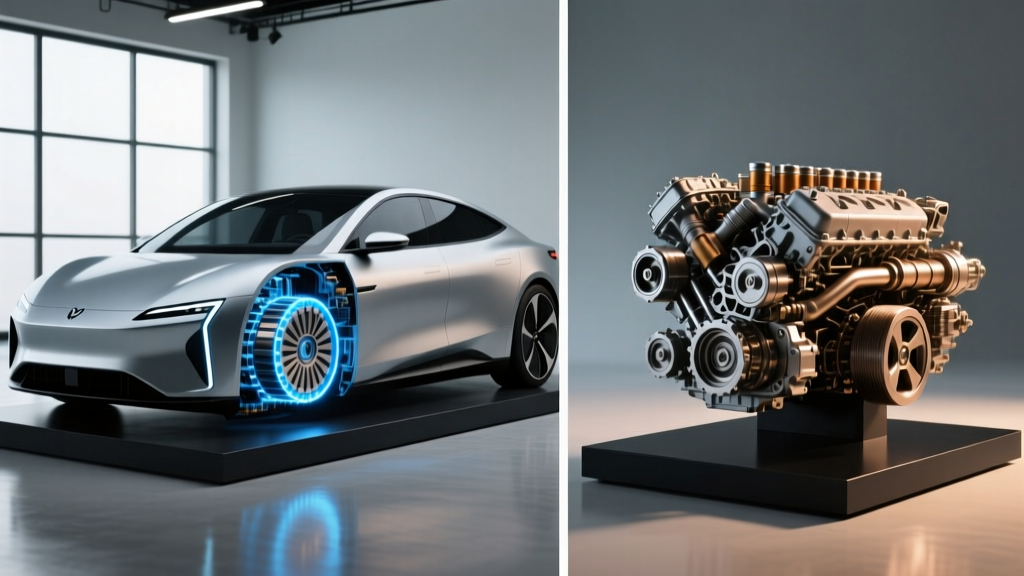
Electric vehicles don't have engines. They use electric motors powered by a high-voltage battery pack. A gas car's internal combustion engine (ICE) burns fuel in cylinders to create motion; an EV's motor uses electromagnetic force to spin the wheels instantly, with no pistons, spark plugs, exhaust, or multi-speed transmission. The difference isn't just mechanical — it reshapes what you pay, how you "refuel," and what maintenance looks like over 10 years of ownership.
If you've been searching for "ev engine" to understand what makes an electric car tick, you're not alone — it's one of the most common search terms from first-time EV shoppers. The terminology matters because it signals a fundamentally different ownership experience. Let's break down exactly how EV motors work, how they stack up against gas engines and hybrids on cost and capability, and what the real numbers look like for a 2026 buyer.
How an Electric Motor Actually Works (And Why It's Simpler Than an Engine)
A gasoline engine is a controlled explosion machine. It mixes air and fuel, ignites the mixture in cylinders, and converts the resulting linear piston motion into rotational force through a crankshaft. A typical 4-cylinder engine has hundreds of moving parts: pistons, valves, camshafts, timing chains, oil pumps, water pumps, turbochargers, and a multi-speed transmission to keep the engine in its narrow power band.
An EV's electric motor does the same job with radically fewer parts. Current runs from the battery pack through an inverter (which converts DC battery power to AC motor power), into a stator — a ring of copper windings. That current creates a rotating magnetic field, which pulls a permanent-magnet or induction rotor along with it. The rotor connects directly (or through a single-speed reduction gear) to the wheels.
Key mechanical differences at a glance:
| Attribute | Electric Motor (EV) | Gas Engine (ICE) |
|---|---|---|
| Moving parts in drivetrain | ~20 (rotor, bearings, gear) | ~200+ (pistons, valves, cams, etc.) |
| Peak torque delivery | Instant, from 0 RPM | Ramps with RPM, peaks mid-range |
| Transmission | Single-speed reduction gear | 6–10 speed automatic or CVT |
| Energy conversion efficiency | ~85–90% (battery to wheels) | ~20–30% (fuel to wheels) |
| Routine fluid changes | Coolant, brake fluid, washer | Oil, transmission, coolant, brake, washer |
| Exhaust/emissions system | None | Catalytic converter, O2 sensors, EGR, DPF |
| Typical lifespan (major service) | Motor: 15–20+ years; battery: 10–15 years | 10–15 years; major overhauls common after 120k mi |
The efficiency gap is the single most consequential number here. According to fueleconomy.gov, EVs convert over 77% of electrical energy from the grid to power at the wheels. Gas vehicles convert only 12–30% of the energy stored in gasoline. The rest is lost as heat, friction, and pumping losses. This is why an EV with a 75 kWh battery (holding roughly $10–$14 of electricity at residential rates) can travel 250–300 miles, while a gas car needs a $45–$60 tank of fuel for the same distance.
EV vs Gas vs Hybrid: Real Cost and Performance Data
The "ev engine" question usually leads to a purchase decision: should you buy a battery-electric vehicle (BEV), a conventional hybrid (HEV), a plug-in hybrid (PHEV), or stick with gas? Here's a data-driven comparison using representative 2026 models across a midsize SUV segment.
| Metric | BEV (Tesla Model Y LR) | PHEV (Toyota RAV4 Prime) | HEV (Honda CR-V Hybrid) | Gas (Mazda CX-5 Turbo) |
|---|---|---|---|---|
| Base MSRP | $44,990 | $43,690 | $36,850 | $38,950 |
| Fed. tax credit (§30D) | Up to $7,500* | Up to $7,500* | $0 | $0 |
| EPA range / MPG / MPGe | 310 mi / 111 MPGe | 42 mi EV + 38 MPG gas | 40 MPG combined | 25 MPG combined |
| Annual fuel/energy cost (15k mi) | ~$540 | ~$950 (mixed EV/gas) | ~$1,310 | ~$2,100 |
| Annual maintenance estimate | ~$300 | ~$550 | ~$500 | ~$700 |
| 5-yr fuel + maintenance total | ~$4,200 | ~$7,500 | ~$9,050 | ~$14,000 |
| 0–60 mph | 4.8 sec | 5.7 sec | 7.6 sec | 6.4 sec |
*§30D credit eligibility depends on MSRP caps ($55,000 for cars, $80,000 for SUVs/trucks), buyer income limits ($150k single / $300k joint), battery-critical-mineral sourcing, and North American final assembly. Rules are current for 2026 but subject to legislative change. Verify eligibility at irs.gov or with a tax professional before purchasing. Many 2026 models qualify for point-of-sale transfer, reducing your purchase price directly at the dealer.
The 5-year operating cost gap is stark: roughly $9,800 less in fuel and maintenance for the BEV versus the gas-only CX-5, even before accounting for the federal credit. That said, BEVs carry higher insurance premiums (typically 15–25% above comparable gas models due to repair costs and parts pricing), and depreciation varies significantly by model. The Tesla Model Y has held value well; some other BEVs have depreciated faster than their gas counterparts due to rapid technology turnover and price cuts.
Types of EV Motors: Permanent Magnet vs Induction vs Dual-Motor
Not all electric motors are identical. The three main architectures in 2026 production vehicles each have trade-offs:
Permanent Magnet Synchronous Motor (PMSM): The most common type in 2026, found in the Hyundai Ioniq 5, Chevrolet Equinox EV, and most Tesla models. Uses rare-earth magnets (neodymium) in the rotor. Delivers the highest efficiency at partial load — the condition you're in 90% of the time during normal driving. Downsides: rare-earth supply chain dependency and slight efficiency loss at very high sustained speeds.
AC Induction Motor: Used in some Tesla front axles and older Model S/X designs. No permanent magnets — the rotor's magnetic field is induced by the stator. Excellent at high power output and naturally disconnects (zero drag) when not energized, which is why Tesla uses an induction motor on the front axle of dual-motor vehicles for coasting efficiency. Slightly less efficient at low-to-medium loads than PMSM.
Dual-Motor / AWD Configurations: Many 2026 EVs pair a PMSM on one axle with an induction motor on the other (e.g., Tesla Model Y Long Range) or use two PMSMs (e.g., Hyundai Ioniq 5 AWD). The result is all-wheel drive, faster 0–60 times (often sub-4 seconds), and redundancy. The trade-off is ~10–15% less range due to the added weight and power draw of the second motor.
What "EV Engine" Power Numbers Actually Mean: kW, Horsepower, and Torque
Gas engines are rated in horsepower and lb-ft of torque, with peak figures delivered at specific RPMs. EV motors are rated in kilowatts (kW) — the same unit used for charging, but here describing mechanical power output. One kilowatt equals roughly 1.34 horsepower.
A 2026 Tesla Model Y Long Range produces approximately 346 kW (464 hp) combined from its dual motors. But unlike a gas engine that might hit peak horsepower at 5,500 RPM, the electric motor delivers maximum torque from zero RPM. This is why a 350-hp EV feels substantially quicker off the line than a 350-hp gas car — there's no waiting for the engine to rev into its power band, no transmission downshift delay.
One nuance that catches new EV owners off guard: sustained power vs peak power. An EV motor can deliver peak output for short bursts (hard acceleration, passing), but thermal management systems will limit sustained output to prevent overheating. On repeated full-power launches or extended high-speed driving (like a track day), you'll see power taper. For normal highway merging and daily driving, this is irrelevant — but it's why EV lap times at tracks often degrade after a few hot laps.
Real-World Ownership: What First-Time EV Buyers Must Know
The motor is the simplest part of EV ownership. The battery and charging infrastructure are where the real learning curve lives.
Before you buy, honestly answer these questions:
- Can you charge at home? If yes (garage, driveway, or landlord-approved outlet), a BEV is practical for most drivers. If no (apartment with no outlet, street parking only), a PHEV or HEV may be a better fit until public charging improves in your area.
- Is your daily round-trip under 80 miles? If yes, even a modest-range BEV (200–250 mi EPA) with home Level 2 charging means you'll rarely visit a public charger. If your commute exceeds 100 miles one-way, prioritize a 300+ mi EPA range BEV or a PHEV.
- Do you regularly drive in sub-25°F weather? Expect 20–35% range loss in extreme cold due to battery chemistry and cabin heating demands. A BEV with a heat pump (standard on most 2026 models from Tesla, Hyundai, BMW) loses less than one with resistive heating, but the loss is real. Plan for it.
- Do you take road trips longer than 200 miles more than 6 times per year? If yes, research DC fast-charging corridors along your common routes. Tesla Supercharger access (now open to NACS-equipped non-Tesla vehicles via adapter or native NACS port) remains the most reliable network in 2026. CCS networks (Electrify America, EVgo) have improved uptime but still lag in rural coverage.
Home Charging: The Make-or-Break Factor
Level 1 charging (120V household outlet) adds roughly 3–5 miles of range per hour — adequate for PHEVs with small batteries (15–20 kWh) and BEVs driven under 40 miles daily. For most BEV owners, a Level 2 home charger (240V, 32–48 amps) is essential, adding 25–44 miles of range per hour and fully replenishing a 75–100 kWh battery overnight.
Level 2 installation costs in 2026 typically range from $500–$1,500 if your electrical panel has capacity for a new 50-amp circuit. If you need a panel upgrade (common in homes with 100-amp service), expect $2,000–$4,000 additional. The federal 30% residential clean energy credit (up to $1,000) can offset charger hardware and installation costs — verify current-year eligibility with your tax professional.
Battery Longevity: The Other "Engine" Question
The EV motor will almost certainly outlast the car. The battery is the component buyers worry about — and should understand. Most 2026 BEVs use either NMC (nickel-manganese-cobalt) or LFP (lithium iron phosphate) chemistry:
| Factor | NMC/NCA Chemistry | LFP Chemistry |
|---|---|---|
| Energy density | Higher (more range per kg) | Lower (heavier for same range) |
| Typical degradation at 100k mi | ~10–15% capacity loss | ~5–10% capacity loss |
| Recommended daily charge limit | 80% (for longevity) | 100% (LFP tolerates full charge) |
| Cold-weather performance | Better in freezing temps | More range loss in extreme cold |
| Found in (2026 examples) | Tesla Model Y LR, Hyundai Ioniq 5, BMW iX | Tesla Model 3/Y RWD, Ford Mustang Mach-E Select |
| Federal warranty minimum | 8 years / 100,000 miles (capacity retention ≥60–70%) | |
Real-world battery replacement is rare before 150,000 miles. When it is needed, costs in 2026 range from $8,000–$18,000 depending on pack size, though prices continue to decline as battery manufacturing scales and recycling matures.
Common "EV Engine" Myths — Corrected With Data
| Myth | Fact |
|---|---|
| "EVs are slower than gas cars." | Most 2026 BEVs hit 0–60 in under 6 seconds; the Tesla Model 3 Performance does it in 2.9 sec. Instant torque makes EVs feel quicker than their numbers suggest. |
| "You'll need to replace the motor like an engine." | EV motors have minimal wear components. The bearings and cooling system may need service at very high mileage, but motor replacement is uncommon. The battery is the expensive longevity variable. |
| "EVs cost more to maintain." | Consumer Reports and DOE data consistently show BEV maintenance costs at roughly 50% of gas-car costs — no oil changes, no spark plugs, no timing belts, regenerative braking extends pad life to 80,000+ miles. |
| "EVs don't work in cold climates." | Norway is the world's per-capita EV leader, with harsh winters. Range drops 20–35% in extreme cold, but preconditioning (warming the battery while plugged in) and heat pumps mitigate this. Planning matters more than climate. |
| "The power grid can't handle EVs." | Most charging happens overnight during off-peak demand. A single BEV charging at Level 2 draws roughly the same power as an electric clothes dryer. Grid strain is a local/peak concern, not a systemic barrier at current adoption rates. |
Your Decision Framework: Which Powertrain Fits Your Life?
Choose a BEV (full electric motor) if:
- You have reliable home or workplace Level 2 charging access.
- Your daily driving is under 100 miles round-trip.
- You want the lowest 5-year operating cost and qualify for the §30D tax credit.
- You value instant torque, quiet operation, and minimal maintenance.
Choose a PHEV (electric motor + gas engine) if:
- You can charge at home but also take frequent long road trips (300+ mi) through areas with sparse DC fast-charging.
- You want 30–45 miles of daily electric-only driving with gas backup for longer trips.
- You live in a region with extreme cold and limited charging infrastructure.
Choose an HEV (hybrid, gas engine + small motor) if:
- You cannot charge at home or at work.
- You want better MPG (45–55 combined) without any plug-in behavior change.
- Your budget is tighter and you don't qualify for EV tax credits.
Stick with gas (for now) if:
- You tow heavy loads frequently (5,000+ lbs) and need the range density of diesel or gasoline in remote areas.
- You live in a charging desert and drive long distances daily with no charging access at either end.
Frequently Asked Questions
Do EVs have engines at all?
No. EVs use electric motors, not internal combustion engines. The term "EV engine" is a common misnomer from shoppers transitioning from gas vehicles. The motor performs the same function — converting stored energy into wheel motion — but through electromagnetic force rather than fuel combustion.
How long do EV motors last compared to gas engines?
EV motors routinely last 200,000+ miles with minimal service (coolant changes, bearing inspections). Gas engines often require major service (head gaskets, timing chains, turbo replacement) between 100,000–150,000 miles. The EV battery, not the motor, is the longevity variable to budget for.
Is an electric motor more powerful than a gas engine?
Pound for pound, electric motors produce more usable power because they deliver peak torque from zero RPM. A 200-hp EV will feel quicker in city driving than a 200-hp gas car. For sustained high-speed power (track use, prolonged mountain climbing), gas engines still have thermal endurance advantages in some applications.
What maintenance does an EV motor require?
Essentially none beyond periodic coolant system service. There are no oil changes, no air filters, no spark plugs, no timing belts, and no exhaust system. Brake pads last 2–3× longer than on gas cars thanks to regenerative braking. The main scheduled costs are tire rotation/replacement (EVs are heavier and wear tires faster), cabin air filters, and brake fluid checks.
Can I convert a gas car to have an EV motor?
Technically yes — EV conversion shops exist — but it typically costs $15,000–$40,000, voids all safety certifications, and results in a vehicle with limited range and no warranty. For nearly all buyers, purchasing a production BEV is safer, more reliable, and more cost-effective.