The Real Cost to Charge an EV: Beyond the Sticker Price
Search "how much does it cost to charge electric cars" and you'll find answers ranging from $0.04 to $0.50 per kWh — a spread so wide it's useless for budgeting. The truth depends on where you charge, when you charge, and what you drive. After five years of ownership data, charging network pricing audits, and utility rate analysis, we've built a framework that actually helps you calculate your personal EV operating cost down to the penny per mile.
Let's start with the baseline numbers before layering in the variables that matter.
Cost Per Mile: EV Charging vs. Gasoline (2026 Averages)
| Scenario | Rate/Cost | $/Mile (30 kWh/100mi EV) | $/Mile (30 MPG Gas Car) |
|---|---|---|---|
| Home Level 2 (national avg electricity) | $0.16/kWh | $0.048 | $0.107 (at $3.20/gal) |
| Home Level 2 (off-peak utility rate) | $0.09/kWh | $0.027 | $0.107 |
| Home Level 2 (California peak) | $0.35/kWh | $0.105 | $0.133 (at $4.00/gal CA avg) |
| Public DC Fast Charging (average) | $0.40/kWh | $0.120 | $0.107 |
| Public DC Fast Charging (premium network) | $0.55/kWh | $0.165 | $0.107 |
Sources: U.S. Energy Information Administration residential rates, fueleconomy.gov efficiency data. Gas prices reflect AAA national and California averages as of early 2026.
The takeaway is unambiguous: if you charge at home on a standard or off-peak rate, an EV costs roughly half what a comparable gas car costs per mile. If you rely exclusively on public DC fast charging at premium rates, you may actually spend more per mile than a fuel-efficient gas vehicle. Home charging access is the single largest determinant of EV operating economics.
Breaking Down the $/kWh: What You Actually Pay
Understanding your charging cost requires separating three distinct rate structures:
Home Charging (Level 1 and Level 2)
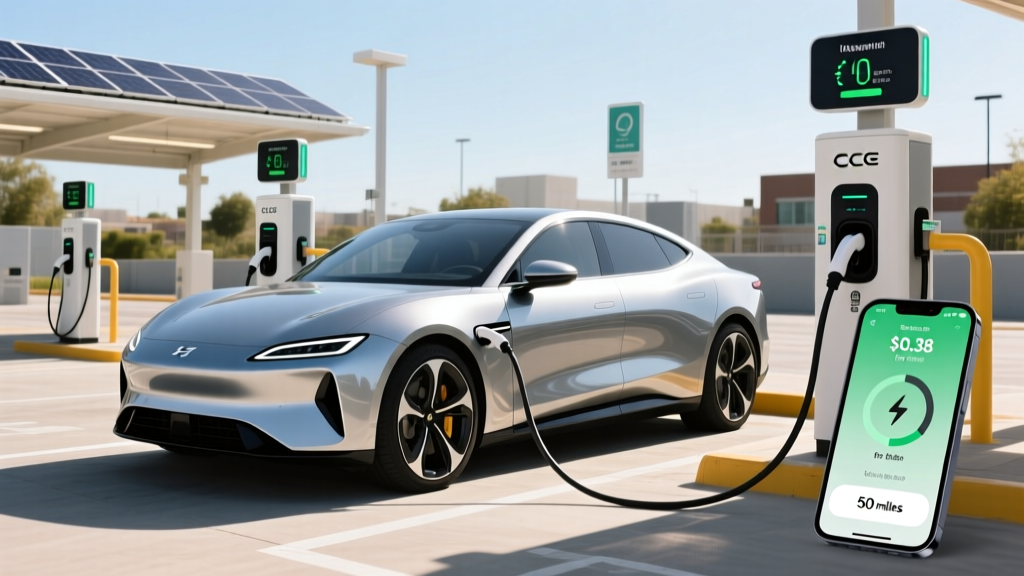
Level 1 charging (120V, ~1.4 kW) uses your standard household outlet and adds roughly 3-5 miles of range per hour. It draws electricity at your standard residential rate. Level 2 charging (240V, typically 7.2-11.5 kW) requires a dedicated circuit and a wall-mounted or portable EVSE (Electric Vehicle Supply Equipment) unit — installation costs typically run $500-$2,000 depending on your electrical panel's capacity and the distance from panel to charger location. Once installed, Level 2 delivers 25-44 miles of range per hour of charging, depending on vehicle acceptance rate and EVSE amperage.
Most utilities offer Time-of-Use (TOU) plans that dramatically reduce overnight rates. A typical TOU structure might charge $0.28/kWh during peak hours (4-9 PM) but only $0.08/kWh during super-off-peak (midnight-6 AM). An EV with a 75 kWh usable battery charged from 20% to 80% (45 kWh) during super-off-peak costs just $3.60 — enough to add roughly 150 miles of range. That same charge during peak would cost $12.60.
Public Level 2 Charging
Networks like ChargePoint, EVgo, and Blink typically charge $0.20-$0.40/kWh for Level 2 sessions, though many workplaces and retail locations still offer free Level 2 charging as an amenity. These sessions are best treated as opportunistic top-ups rather than primary charging strategies.
Public DC Fast Charging
This is where costs escalate. As of 2026, major networks price DC fast charging as follows:
- Tesla Superchargers (open to NACS-equipped non-Tesla EVs via adapter): $0.25-$0.45/kWh depending on location and time
- Electrify America: $0.43-$0.56/kWh for Pay-As-You-Go; $0.36/kWh with Pass+ subscription ($7/month)
- EVgo: $0.39-$0.53/kWh; lower with EVgo Plus subscription
- ChargePoint (DC stations): $0.35-$0.48/kWh, varies by site host
For a road-trip scenario — say, a 600-mile drive in a Hyundai Ioniq 6 (EPA 361 miles, ~25 kWh/100mi highway) — you'd need approximately one DC fast-charge stop adding ~45 kWh. At $0.40/kWh average, that's $18 for the session, compared to roughly $21 in gas for a 30 MPG car at $3.20/gal. Road-trip charging costs are roughly comparable to gasoline on a per-mile basis; the savings come from daily home charging.
5-Year Total Cost of Ownership: EV vs. Gas Vehicle
To answer "how much does it really cost to own an EV over 5 years," we need to model two comparable vehicles across all major cost categories. We'll compare a 2026 Tesla Model 3 Rear-Wheel Drive (EPA 363 miles, 57 kWh LFP battery, 271 hp) against a 2026 Toyota Camry LE (32/41/35 MPG city/highway/combined). Both seat five, both are midsize sedans, and both represent mainstream purchase decisions.
| Cost Category | 2026 Tesla Model 3 RWD | 2026 Toyota Camry LE | Difference |
|---|---|---|---|
| Purchase Price (MSRP) | $38,990 | $29,495 | +$9,495 EV |
| Federal Tax Credit (§30D) | -$7,500 | $0 | -$7,500 EV |
| Effective Purchase Price | $31,490 | $29,495 | +$1,995 EV |
| Fuel/Energy (75k mi, 80% home/20% DCFC) | $2,925 | $6,429 | -$3,504 EV saves |
| Maintenance | $1,200 | $3,750 | -$2,550 EV saves |
| Insurance (5-year total) | $12,500 | $9,250 | +$3,250 EV |
| Depreciation (est. resale at 75k mi) | -$14,500 | -$11,800 | +$2,700 EV loss |
| Net 5-Year Cost | $33,615 | $37,124 | -$3,509 EV saves |
Assumptions: electricity at blended $0.13/kWh (80% home off-peak at $0.09, 20% public DCFC at $0.40); gas at $3.20/gal national avg; Model 3 efficiency 25 kWh/100mi; Camry at 35 MPG combined. Insurance sourced from industry averages. Depreciation estimates based on 2021-2025 resale trends from Kelley Blue Book and Recurrent Auto. Actual costs vary significantly by region, driving pattern, and utility rate.
The Model 3 wins on 5-year cost, but the margin is narrower than many EV advocates suggest — and it depends entirely on qualifying for the full $7,500 federal credit. Without it, the EV costs roughly $4,000 more over five years. Let's break down each category.
Federal Tax Credit: Do You Qualify for $7,500?
The IRS §30D Clean Vehicle Credit is the single most impactful EV incentive available — but qualifying requires threading a needle of income caps, MSRP limits, and battery-sourcing requirements that change annually. Here's the current eligibility framework as of the 2026 tax year:
§30D Credit Requirements Checklist
- Credit Amount: Up to $7,500 — split into $3,750 for critical minerals sourcing and $3,750 for battery component manufacturing. You may qualify for one half ($3,750), both halves ($7,500), or neither depending on the vehicle's supply chain.
- Buyer Income Caps (Modified AGI): $300,000 joint filers / $225,000 head of household / $150,000 single filers. Applies to the tax year of purchase or the prior year — whichever is lower.
- Vehicle MSRP Caps: $80,000 for SUVs, vans, and pickup trucks; $55,000 for sedans, hatchbacks, and wagons. MSRP includes destination charges but excludes dealer-installed options.
- Battery Sourcing: Critical minerals must be extracted or processed in the U.S. or a free-trade-agreement country (or recycled in North America). Battery components must be manufactured or assembled in North America. Percentages increase each year — vehicles that qualified in 2024 may not qualify in 2026.
- Final Assembly: Vehicle must undergo final assembly in North America. Verify via VIN at NHTSA's VIN decoder.
- Point-of-Sale Transfer: As of 2024, buyers can transfer the credit to the dealer at purchase, reducing the sale price directly rather than waiting for a tax refund. The dealer must be registered with the IRS Energy Credits Online portal.
- One Credit Per Vehicle: The vehicle must be new (not previously titled) and purchased for personal use, not resale.
Source: IRS §30D Clean Vehicle Credit. Rules are subject to legislative and regulatory changes — verify eligibility at purchase time.
As of early 2026, vehicles that typically qualify for the full $7,500 include the Tesla Model 3 (all trims), Tesla Model Y (all trims), Ford F-150 Lightning, Volkswagen ID.4 (U.S.-built), and the Chevrolet Equinox EV. Several Hyundai and Kia models built at the Georgia plant now qualify. Always verify current eligibility on the fueleconomy.gov tax credit page before purchasing, as battery-sourcing compliance shifts with supply-chain changes.
State, Local, and Utility Incentives
Beyond the federal credit, incentives vary enormously by jurisdiction:
- State rebates: California's CVRP offers up to $7,000 for income-qualified buyers; Colorado offers a $5,000 state credit; New York's Drive Clean Rebate provides up to $2,000. Many states offer no additional incentive.
- Utility rebates: Many utilities offer $250-$1,500 rebates for Level 2 home charger installation. Some (like SMUD in Sacramento or Xcel Energy in Colorado) offer reduced EV-specific TOU rates.
- HOV lane access: Several states (CA, CO, MD, VA, others) grant single-occupant HOV lane access to EVs — a significant commute-time benefit worth quantifying if applicable.
- Registration fees: Some states (Ohio, Alabama, Arkansas) impose additional EV registration fees of $100-$200/year to offset lost gas tax revenue — factor this into your TCO.
Check your state's energy office and your utility's EV program page for current offerings. The Alternative Fuels Data Center maintains a searchable database of state and local incentives.
Maintenance Savings: Where EVs Consistently Win
EVs have dramatically fewer moving parts in their drivetrain — no engine oil, no transmission fluid, no spark plugs, no timing belt, no exhaust system, no catalytic converter. This translates to real, measurable savings:
| Service Item | EV Cost | Gas Car Cost | Notes |
|---|---|---|---|
| Oil Changes | $0 | $750-$1,250 | 5-10 changes at $75-$125 each (synthetic) |
| Brake Pads/Rotors | $0-$300 | $800-$1,500 | Regenerative braking reduces wear by 50-80%; many EVs reach 100k+ mi on original pads |
| Transmission Service | $0 | $200-$500 | EVs use single-speed reduction gears with sealed fluid |
| Coolant Flush | $100-$200 | $200-$400 | EVs still have thermal management coolant loops |
| Cabin Air Filter | $100-$200 | $100-$200 | Same interval, same cost |
| Tire Rotation/Replacement | $1,200-$1,800 | $800-$1,400 | EVs are heavier and deliver instant torque — tires wear 15-30% faster |
| Wiper Fluids/Misc. | $100 | $100 | Identical |
| Total (5-year est.) | $1,200-$1,800 | $3,250-$4,750 | EV saves ~$2,000-$3,000 |
The one maintenance area where EVs cost more is tires. The combination of higher curb weight (a Model 3 weighs ~3,862 lbs vs. a Camry at ~3,310 lbs) and instant torque delivery accelerates tread wear. Budget for one additional set of tires over five years compared to a comparable gas car. Many EV owners opt for EV-specific tire compounds (like the Michelin Pilot Sport EV or Hankook iON evo) designed for lower rolling resistance and noise reduction.
Insurance: The Cost Category EV Owners Underestimate
EV insurance premiums run 15-30% higher than comparable gas vehicles on average. The reasons are structural, not arbitrary:
- Higher repair costs: EV battery packs are expensive to replace if damaged ($8,000-$22,000 depending on the vehicle). Even minor collision damage near the battery enclosure can trigger total-loss declarations.
- Specialized labor: High-voltage system repairs require certified technicians, and fewer body shops have EV-certified staff, creating bottlenecks that drive up labor rates.
- Parts availability: EV-specific body panels, sensors, and structural components often have longer lead times and higher unit costs than mass-market gas car parts.
- Vehicle price: Since most EVs carry higher MSRPs than comparable gas vehicles, collision and comprehensive coverage costs more simply because the insured value is higher.
In our TCO model, we estimated $2,500/year for the Model 3 vs. $1,850/year for the Camry — a $3,250 gap over five years. However, insurance varies wildly by driver profile, ZIP code, and carrier. Tesla's own insurance product (available in most states) uses real-time driving data and can undercut traditional carriers for safe drivers. Always get quotes from at least three insurers — including the manufacturer's captive insurer if available — before finalizing your purchase decision.
Depreciation and Resale Value: The Shifting Landscape
EV depreciation has been volatile. In 2022-2023, aggressive Tesla price cuts cascaded through the used-EV market, causing some models to lose 40-50% of value in their first year. By 2025-2026, the market has largely stabilized, but EVs still depreciate faster than comparable Toyota and Honda gas vehicles on average.
Current 5-year resale value retention (as a percentage of MSRP):
- Tesla Model 3: ~55-60% (improved from 2023 lows, supported by Supercharger network and software updates)
- Tesla Model Y: ~58-63%
- Hyundai Ioniq 5: ~48-53%
- Ford Mustang Mach-E: ~45-50%
- Toyota Camry (gas): ~60-65%
- Toyota RAV4 Hybrid: ~65-70%
Factors that help EV resale: strong manufacturer battery warranties (typically 8 years/100,000 miles), continued OTA software improvements, and expanding charging infrastructure. Factors that hurt: rapid new-model price competition, battery technology obsolescence fears, and the fact that the original $7,500 tax credit effectively resets the buyer's cost basis lower — meaning used buyers expect a proportionally lower price.
If resale value is your top financial priority, a Toyota or Honda hybrid still holds value better. If you plan to drive the vehicle 8+ years and run it into the ground, depreciation matters less and operating-cost savings compound.
Charging Cost Variables That Catch New Owners Off Guard
Three factors can push your real-world charging costs significantly above or below the averages above:
1. Cold Weather Efficiency Loss
Lithium-ion batteries lose efficiency in cold temperatures, and cabin heating draws substantial power. Expect 20-35% range reduction in sub-freezing conditions (below 32°F), with the worst losses occurring below 10°F on short trips where the battery and cabin must heat from cold. A vehicle rated at 30 kWh/100mi in mild weather may consume 38-42 kWh/100mi in January in Minnesota. This means your cost per mile rises proportionally during winter months. EVs with heat pumps (standard on most 2025+ models including Tesla, Hyundai/Kia, and Volkswagen) reduce this penalty to roughly 15-25%.
2. DC Fast Charging Taper and Session Length
When you plug into a DC fast charger, the vehicle does not sustain peak charge rate for the entire session. A vehicle advertising "250 kW peak" charging may only sustain that rate between roughly 10-40% State of Charge, then taper progressively. A typical session from 10-80% on a 250 kW-capable vehicle at a 350 kW charger takes 18-25 minutes and delivers roughly 150-180 kW average — not 250 kW. This doesn't affect cost directly (you pay for kWh delivered, not time), but it means your road-trip stops are longer than the peak-kW spec implies, and some networks charge idle fees if you remain plugged in past 80%.
3. Time-of-Use Optimization
If your utility offers a dedicated EV rate plan (separate metering for the charger circuit), overnight rates can drop to $0.05-$0.09/kWh — making home charging almost negligible in cost. Without TOU optimization, you may inadvertently charge during peak hours at $0.25-$0.40/kWh, erasing most of the EV fuel-cost advantage. Most modern EVs and smart chargers allow scheduled charging — set your vehicle to begin charging at midnight and always plug in when you get home. This single habit determines whether your fuel cost is $300/year or $900/year.
Frequently Asked Questions
How much does it cost to charge an electric car at home per month?
For a driver covering 1,000 miles per month in a vehicle averaging 30 kWh/100mi, home charging at the national average residential rate of $0.16/kWh costs approximately $48/month. With off-peak TOU rates at $0.09/kWh, that drops to $27/month. For comparison, a 30 MPG gas car driving the same distance at $3.20/gallon costs $107/month.
Is public DC fast charging more expensive than gas?
At premium network rates ($0.48-$0.55/kWh), DC fast charging can cost $0.14-$0.17 per mile for an average EV — comparable to or slightly more than a 25-30 MPG gas car at current fuel prices. However, most EV owners do 80%+ of their charging at home, where costs are far lower. DC fast charging should be treated as a road-trip expense, not your daily fueling strategy.
Do I qualify for the $7,500 federal EV tax credit in 2026?
You may qualify if: your modified AGI is below $150,000 (single), $225,000 (HOH), or $300,000 (joint); the vehicle's MSRP is under $55,000 (cars) or $80,000 (SUVs/trucks/vans); the vehicle is assembled in North America; and the battery meets current-year critical-mineral and component-sourcing thresholds. Eligibility changes as supply chains shift — always verify on fueleconomy.gov and with your tax professional before purchasing.
How much do I really save on maintenance with an EV?
Expect to save $2,000-$3,000 over five years / 75,000 miles. The biggest savings come from eliminated oil changes ($750-$1,250), drastically reduced brake wear from regenerative braking ($500-$1,200), and no transmission service. The offset: EV tires wear faster due to vehicle weight and instant torque, adding roughly $400-$600 in additional tire costs over the same period.
Are EVs more expensive to insure, and by how much?
Yes, typically 15-30% more expensive than comparable gas vehicles. A Model 3 might cost $2,400-$2,800/year to insure vs. $1,700-$2,100 for a Camry. Higher repair costs (battery damage, specialized labor), higher vehicle values, and parts scarcity drive the premium. Shop multiple carriers — Tesla Insurance, Geico, Progressive, and USAA (if eligible) often show significant rate variance for EVs.
How well do EVs hold their value compared to gas cars?
On average, EVs retain 48-60% of MSRP after 5 years, while mainstream gas vehicles (especially Toyota and Honda) retain 58-70%. The gap has narrowed since the 2023 used-EV price collapse but persists due to rapid new-model competition, battery technology evolution, and the fact that the original tax credit lowers the effective purchase price. If you plan to keep your vehicle 8+ years, depreciation differences become less relevant.
Does installing a home Level 2 charger add significant cost?
A Level 2 home charger installation typically costs $500-$2,000 total (EVSE hardware: $200-$600; electrician labor, wiring, and permit: $300-$1,400). Costs escalate to $2,000-$4,500 if your electrical panel needs upgrading from 100A to 200A service. Many utilities offer $250-$1,000 rebates for charger installation — check with your provider. This upfront investment pays for itself within 6-18 months through fuel savings vs. public charging or gasoline.