The Real Math Behind EV Ownership Costs
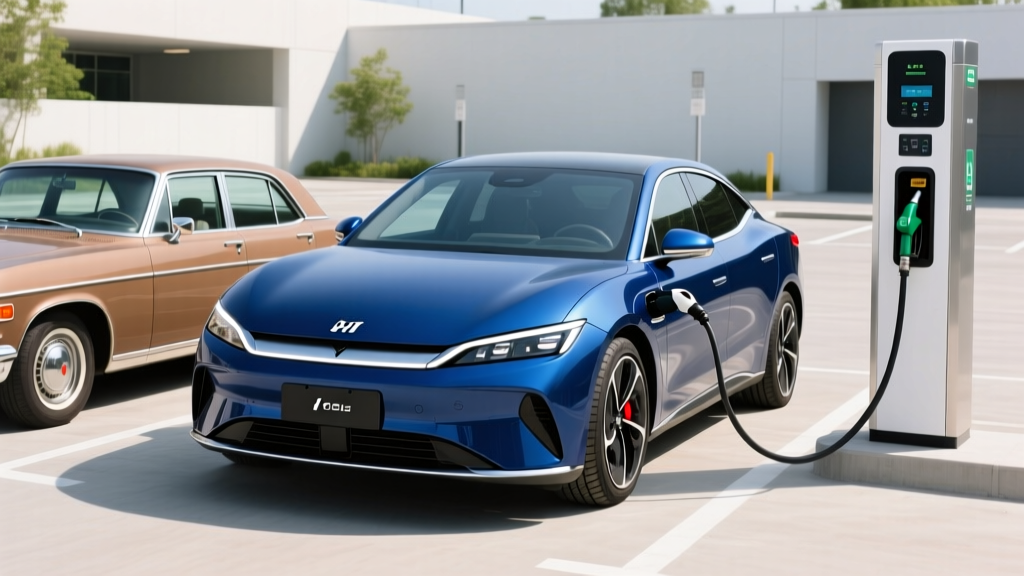
Search "ev car charge cost" and you'll find headlines claiming electric vehicles cost pennies to run. The reality is more nuanced. An EV's total cost of ownership depends on where you charge, what you drive, whether you qualify for federal incentives, and how insurance and depreciation factor in over five years. Some buyers save thousands; others break even or pay more than a comparable gas car.
This guide runs the exact numbers — electricity rates, gas prices, maintenance intervals, insurance premiums, and resale value — so you can calculate whether an EV makes financial sense for your situation. All figures reflect 2026 model-year pricing and current IRS §30D tax credit rules.
EV Car Charge Cost vs. Gas: The Per-Mile Showdown
The single biggest day-to-day savings from going electric comes at the fuel pump — or more accurately, the charger. But the gap between charging and gas costs varies enormously depending on your electricity rate and driving habits.
Cost Per Mile: EV Charging vs. Gasoline (2026)
| Scenario | Rate / Price | Efficiency | Cost Per Mile |
|---|---|---|---|
| Home charging (national avg. residential) | $0.16/kWh | 3.5 mi/kWh (119 MPGe) | $0.046 |
| Home charging (California avg.) | $0.27/kWh | 3.5 mi/kWh | $0.077 |
| Home charging with utility EV rate (off-peak) | $0.09/kWh | 3.5 mi/kWh | $0.026 |
| Public DC fast charging (avg.) | $0.48/kWh | 3.5 mi/kWh | $0.137 |
| Gas car (28 MPG combined) | $3.30/gal | 28 MPG | $0.118 |
| Gas car (22 MPG combined, truck/SUV) | $3.30/gal | 22 MPG | $0.150 |
Sources: EIA electricity rates, fueleconomy.gov, AAA fuel price averages. MPGe and kWh efficiency based on popular models like the Hyundai Ioniq 5 (114 MPGe combined) and Tesla Model Y (120 MPGe combined).
The takeaway: home charging is where the savings live. At the national average residential rate of $0.16/kWh, an EV costs roughly $0.05 per mile — less than half the cost of fueling a 28 MPG gas car. But if you rely entirely on public DC fast chargers at $0.48/kWh, your per-mile cost actually exceeds that of a fuel-efficient gas car.
Real-world charging cost tip: If your utility offers a time-of-use (TOU) or dedicated EV rate, scheduling charging between midnight and 6 AM can drop your effective rate to $0.07–$0.10/kWh, cutting your ev car charge cost by 40–60% compared to peak rates. Check your utility's website for EV-specific plans.
Let's annualize this. A driver covering 12,000 miles per year at the national average residential rate spends approximately $552/year on home electricity for charging. That same driver in a 28 MPG gas car spends $1,414/year on fuel. Annual savings: roughly $860 — but only if you charge at home.
Do You Qualify for the Federal EV Tax Credit?
The IRS §30D Clean Vehicle Credit can slash up to $7,500 off your tax bill — or, as of 2024, be transferred to the dealer at point of sale as an immediate price reduction. But the eligibility rules are strict and have tightened significantly since the Inflation Reduction Act reshaped the program. Not every EV qualifies, and not every buyer qualifies.
§30D Federal EV Tax Credit Checklist (2026 Rules)
- Credit amount: Up to $7,500 ($3,750 for critical minerals + $3,750 for battery components). Many vehicles only qualify for the partial $3,750 due to sourcing requirements.
- Income caps (modified AGI): $150,000 single filers / $225,000 head of household / $300,000 joint filers.
- MSRP caps: Vans, SUVs, and pickup trucks — $80,000 max. Sedans and other vehicles — $55,000 max.
- Battery sourcing: Critical minerals and battery components must meet escalating domestic/free-trade-partner sourcing percentages. These thresholds increase annually, meaning some models that qualified in prior years may not qualify now.
- Final assembly: Vehicle must undergo final assembly in North America (check VIN via the NHTSA VIN decoder).
- Point-of-sale transfer: You can transfer the credit to the dealer at purchase, reducing your out-of-pocket cost immediately — even if you have no tax liability.
- New vs. used: Separate §25E credit of up to $4,000 exists for used EVs (lower income caps apply).
Source: IRS Clean Vehicle Credit page. Rules are subject to change — verify eligibility at purchase time.
For a concrete example: a 2026 Tesla Model Y Long Range (MSRP ~$46,990, SUV classification) with North American assembly and compliant battery sourcing would qualify a buyer under the income caps for the full $7,500, bringing the effective price to approximately $39,490. A 2026 Hyundai Ioniq 5 SE (MSRP ~$42,600) similarly qualifies, though always verify the specific model year's battery-sourcing compliance with the dealer.
5-Year Total Cost of Ownership: EV vs. Gas
Charging savings alone don't tell the full story. Here's a comprehensive 5-year/60,000-mile comparison between a popular EV and a comparable gas-powered crossover, both starting around $43,000 MSRP before incentives.
5-Year / 60,000-Mile Total Cost of Ownership
| Category | EV (e.g., Model Y LR) | Gas Crossover (e.g., 28 MPG) |
|---|---|---|
| Purchase price (MSRP) | $46,990 | $42,500 |
| Federal tax credit (§30D) | −$7,500 | $0 |
| Effective purchase price | $39,490 | $42,500 |
| Fuel/charging (60,000 mi) | $2,760 (home avg.) | $7,071 |
| Maintenance (5 years) | $1,800 | $4,200 |
| Insurance (5 years) | $9,500 | $7,200 |
| Depreciation (est. 5-yr) | $19,800 | $17,400 |
| Total 5-Year Cost | $73,350 | $78,371 |
| Net savings (EV) | ~$5,000 over 5 years | |
Assumptions: 12,000 miles/year, $0.16/kWh home charging, $3.30/gal gas, national avg. insurance premiums. Depreciation based on industry trend data. Actual costs vary significantly by state, driving pattern, and individual insurance profile.
The EV wins on fuel and maintenance but loses ground on insurance and depreciation. The federal tax credit is the swing factor — without it, the EV's 5-year cost climbs to roughly $80,850, making the gas car cheaper overall.
Maintenance Savings: Where EVs Quietly Win
Electric vehicles have far fewer moving parts than internal combustion engines. No oil changes, no spark plugs, no transmission fluid flushes, no timing belts, and no exhaust system repairs. Regenerative braking also dramatically reduces brake pad wear — many EV owners report original brake pads at 60,000+ miles.
Typical 5-Year Maintenance: EV vs. Gas Vehicle
| Service Item | EV | Gas Vehicle |
|---|---|---|
| Oil changes (every 5,000–10,000 mi) | $0 | $600–$1,000 |
| Brake pads (replacement) | $0–$300 (regen extends life) | $600–$1,200 |
| Transmission fluid | $0 (single-speed reduction gear) | $200–$400 |
| Engine air filter | $0 | $100–$200 |
| Coolant flush | $100–$150 | $200–$400 |
| Tire rotation/replacement | $800–$1,200 (EVs wear tires faster due to weight/torque) | $600–$1,000 |
| Cabin air filter | $100–$200 | $100–$200 |
| Wipers, bulbs, misc. | $150–$250 | $150–$250 |
| Estimated 5-year total | $1,150–$2,100 | $2,550–$4,650 |
The caveat: EV tires. Electric vehicles are heavier (battery mass) and produce instant torque, which accelerates tire wear. Budget for tire replacement sooner than you would with a gas car — typically every 30,000–40,000 miles rather than 50,000+.
The Insurance Reality: Expect Higher Premiums
This is where EV ownership costs sting. On average, insuring an electric vehicle costs 15–30% more than an equivalent gas car. For our comparison above, that translates to roughly $460/year extra, or $2,300 over five years.
Why the premium? Several factors drive higher EV insurance costs:
- Higher repair costs: EV body repairs often require specialized training, high-voltage safety protocols, and OEM parts. A minor rear collision that might cost $2,500 to fix on a gas car can run $5,000+ on an EV if battery-adjacent components are affected.
- Total-loss thresholds: Insurers may declare an EV a total loss after battery-pack damage that would be a repairable issue on a conventional vehicle, because battery replacement costs $10,000–$20,000+.
- Vehicle price: EVs still carry higher MSRPs on average, and insurers price premiums partly on replacement value.
- Limited repair network: Fewer body shops are certified for high-voltage EV repairs, which means longer rental car periods and higher claims costs.
Shop aggressively. Insurers like GEICO, Progressive, and Tesla Insurance (available in select states) have begun offering EV-specific rates. Bundling home and auto, maintaining a clean record, and choosing higher deductibles can narrow the gap.
Depreciation and Resale Value: The Shifting Landscape
EV depreciation has been volatile. In 2023–2024, Tesla's aggressive price cuts cascaded through the used EV market, causing some models to lose 40–50% of their value in two years. That turbulence has moderated, but EVs still depreciate faster on average than reliable gas vehicles like the Toyota RAV4 or Honda CR-V.
Current 5-year depreciation trends for popular EVs:
- Tesla Model Y: ~40–45% depreciation over 5 years (improved from 2023 lows due to price stabilization)
- Hyundai Ioniq 5: ~45–50% (strong value retention relative to non-Tesla EVs)
- Ford Mustang Mach-E: ~48–55%
- Chevrolet Equinox EV: ~42–48% (benefiting from lower starting MSRP)
- Gas crossover average (RAV4, CR-V): ~35–40%
The gap is narrowing as battery longevity data improves and EV adoption broadens. Models with strong reliability records and competitive pricing hold value better. However, if resale value is your top priority, a proven gas hybrid like the RAV4 Hybrid still has an edge in 2026.
Don't Forget State, Local, and Utility Incentives
Beyond the federal §30D credit, many states and utilities offer additional savings — but these vary dramatically by region:
- State rebates: California's Clean Fuel Rebate ($1,000–$2,000), Colorado's state tax credit (up to $5,000 for income-qualified buyers), Massachusetts MOR-EV ($1,500–$3,500).
- Utility rebates: Many utilities offer $250–$1,000 toward Level 2 home charger purchase and installation. Some provide discounted EV-specific electricity rates.
- HOV lane access: States like California, Colorado, and Virginia offer solo HOV lane access for EVs — a significant time and fuel savings in congested metro areas.
- Property/sales tax exemptions: Several states exempt EVs from sales tax or reduced annual registration fees.
Check your state energy office and utility provider for current programs. Database of State Incentives for Renewables & Efficiency (DSIRE) is a reliable aggregator.
The Bottom Line: Who Actually Saves Money With an EV?
After running every number, the financial case for an EV comes down to four variables:
Choose an EV If:
- You can charge at home (Level 2, ideally on an off-peak utility rate)
- You qualify for the full $7,500 federal tax credit (check income, MSRP, and battery sourcing)
- You drive 10,000+ miles per year (more miles = more fuel savings)
- Your state offers additional rebates or incentives
A Gas Car or Hybrid May Cost Less If:
- You rely on apartment/condo living without home charging access
- You don't qualify for the federal credit (income above caps, vehicle above MSRP cap, or battery sourcing fails)
- You drive fewer than 8,000 miles per year (fuel savings don't offset higher insurance and depreciation)
- Your local electricity rates exceed $0.25/kWh and you lack access to off-peak TOU rates
The ev car charge cost advantage is real — but it's only one line item in a larger ownership equation. Home charging access and tax credit eligibility are the two make-or-break factors. Nail those, and an EV can save you $4,000–$7,000 over five years compared to a gas car. Miss them, and you may pay a premium for going electric.
Frequently Asked Questions
How much does it cost to charge an EV per month?
At the national average residential electricity rate of $0.16/kWh and driving 1,000 miles per month in an EV averaging 3.5 miles per kWh, your monthly ev car charge cost for home charging is approximately $46/month. With a utility off-peak EV rate of $0.09/kWh, that drops to about $26/month. Public DC fast charging at $0.48/kWh would cost roughly $137/month for the same mileage.
Is it cheaper to charge an EV at home or at a public station?
Home charging is dramatically cheaper. Public DC fast chargers typically charge $0.35–$0.60/kWh — two to four times the residential electricity rate. Use public chargers for road trips and occasional top-ups, but make home Level 2 charging your daily routine to keep costs low.
How much do I save on maintenance with an EV?
Typically $1,500–$2,500 over five years compared to a gas vehicle. You eliminate oil changes, spark plugs, transmission fluid, and most exhaust system repairs. Regenerative braking extends brake pad life significantly. The main offset is higher tire wear due to vehicle weight and instant torque.
Do EVs cost more to insure than gas cars?
Yes, typically 15–30% more. Higher repair costs, specialized body shop requirements, expensive battery replacement risk, and higher MSRP values all contribute. The gap varies by model, insurer, and state — shop multiple quotes and ask about EV-specific discounts.
How well do EVs hold their value compared to gas cars?
EVs currently depreciate faster — roughly 42–55% over five years versus 35–40% for popular gas crossovers. The gap has narrowed since the 2023 price-cut turmoil, and models with strong reliability data retain value better. If resale value is critical, a proven hybrid may still outperform a pure EV.
Does the federal EV tax credit apply at the dealership?
Yes. Since 2024, you can transfer the §30D credit to the dealer at point of sale, receiving it as an immediate price reduction rather than waiting to claim it on your tax return. This applies even if you have little or no federal tax liability. Verify eligibility with your dealer and consult a tax professional for your specific situation.