The Quick Answer
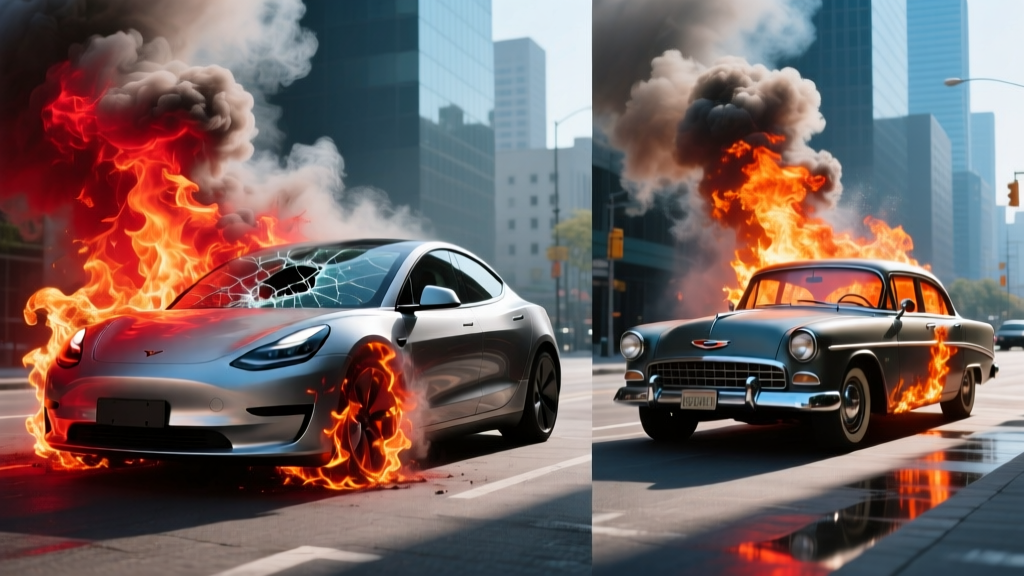
Headlines about a ship on fire with electric cars onboard — like the 2022 Felicity Ace and the 2023 Fremantle Highway — are alarming, but the data tells a different story for individual buyers. According to a 2023 National Transportation Safety Board (NTSB) analysis of fire incident databases, internal combustion engine (ICE) vehicles experience roughly 1,530 fires per 100,000 vehicles on U.S. roads annually, while battery electric vehicles experience approximately 25 fires per 100,000 vehicles. Hybrids fall in between at roughly 3,475 per 100,000 (largely because older hybrids are overrepresented in aging-fleet fire data).
EV battery fires are rarer but harder to extinguish due to thermal runaway chemistry. That matters for cargo ships and parking garages — but for daily ownership, an EV is statistically less likely to catch fire than the gas car you'd replace.
Why EV Cargo Ship Fires Make Headlines
When a roll-on/roll-off (RoRo) car carrier like the Felicity Ace burned for days in the Atlantic in February 2022, it wasn't just an EV story — the ship carried over 3,900 vehicles including conventional cars, and investigators never publicly confirmed an EV lithium-ion battery as the ignition source. Yet the narrative stuck: electric cars are floating tinderboxes.
Here's what actually makes cargo ship fires so destructive, regardless of what's parked below deck:
- Enclosed steel environments with limited fire-suppression access — once a fire starts (from any vehicle's wiring, fuel line, or battery), it spreads to adjacent cargo rapidly.
- Water-based suppression systems designed for conventional fires can react poorly with lithium-ion cells in thermal runaway, though modern ship-class systems have improved since 2023.
- Lithium battery thermal runaway burns at roughly 1,000–1,400°F and can reignite hours or days after initial suppression — a unique challenge that requires specialized protocols shipping companies have been updating since 2024.
The maritime shipping industry has responded. The International Maritime Organization (IMO) issued updated guidance in 2024 for RoRo vessels carrying EVs, including enhanced fire detection, segregated stowage recommendations, and crew training for lithium-ion incidents. Major carriers like Wallenius Wilhelmsen now require pre-loading battery state-of-charge (SoC) declarations and damaged-EV screening.
EV Fire Risk vs Gas Cars: The Numbers
The most reliable U.S. data comes from the NTSB's 2023 cross-reference of National Fire Incident Reporting System (NFIRS) data against Bureau of Transportation Statistics (BTS) vehicle registrations. Here's how the powertrains compare:
| Metric | Gas / Diesel (ICE) | Hybrid (HEV/PHEV) | Battery Electric (BEV) |
|---|---|---|---|
| Fire incidents per 100,000 vehicles | ~1,530 | ~3,475* | ~25 |
| Most common fire cause | Fuel system / electrical wiring | Electrical / aging hybrid battery | Charging fault / crash damage |
| Avg. suppression difficulty | Moderate (standard foam/water) | Moderate to high | High (thermal runaway, reignition risk) |
| Fatalities per fire incident | Higher (fuel-fed, rapid spread) | Comparable to ICE | Lower (fewer incidents overall) |
*Hybrid figure skewed by older-model overrepresentation in fire databases; newer PHEVs (2022+) show lower rates.
The key takeaway: gas cars catch fire roughly 61 times more often per vehicle than EVs. But when an EV battery fire does occur, it demands different firefighting tactics — extended water application (often 3,000–8,000 gallons vs. 500–1,000 for an ICE fire), thermal monitoring for 24–48 hours to prevent reignition, and specialized training that many municipal departments are still building out as of 2026.
What Causes EV Battery Fires (and How Rare They Are)
Modern EV battery packs use either NMC (nickel manganese cobalt) or LFP (lithium iron phosphate) chemistry. LFP cells, now standard in the Tesla Model 3 RWD, Ford Mustang Mach-E Select, and most BYD models, are inherently more thermally stable — they resist thermal runaway at higher temperatures (~518°F vs. ~392°F for NMC).
The primary triggers for EV battery fires include:
- Severe crash damage penetrating the battery enclosure — modern packs use titanium or high-strength steel skid plates and structural cell-to-pack designs to mitigate this.
- Manufacturing defects — the 2021–2022 Chevrolet Bolt recall (ultimately 143,000 vehicles) traced fires to folded separator tabs from an LG Energy Solution factory. GM replaced modules at no cost; the defect rate was approximately 0.04% of recalled vehicles experiencing fire events.
- Charging system faults — damaged DC fast-charge ports, aftermarket charger misuse, or repeated 100% SoC fast-charging on NMC packs without thermal management can accelerate dendrite formation over years, though modern battery management systems (BMS) actively prevent this.
- Post-flood saltwater intrusion — Hurricane Ian (2022) and Hurricane Idalia (2023) produced dozens of EV fires in Florida when saltwater-corroded battery packs short-circuited days or weeks after flooding. NHTSA issued updated post-flood EV handling guidance in 2023.
For context, the National Highway Traffic Safety Administration (NHTSA) maintains an EV safety page tracking recalls and incident data. As of early 2026, there have been no broad-pattern fire defects across the current-generation BEV fleet comparable to the Bolt incident — most 2024–2026 models benefit from improved cell-to-pack structural designs and more conservative BMS thermal thresholds.
Real Costs: Insurance, Safety, and Ownership
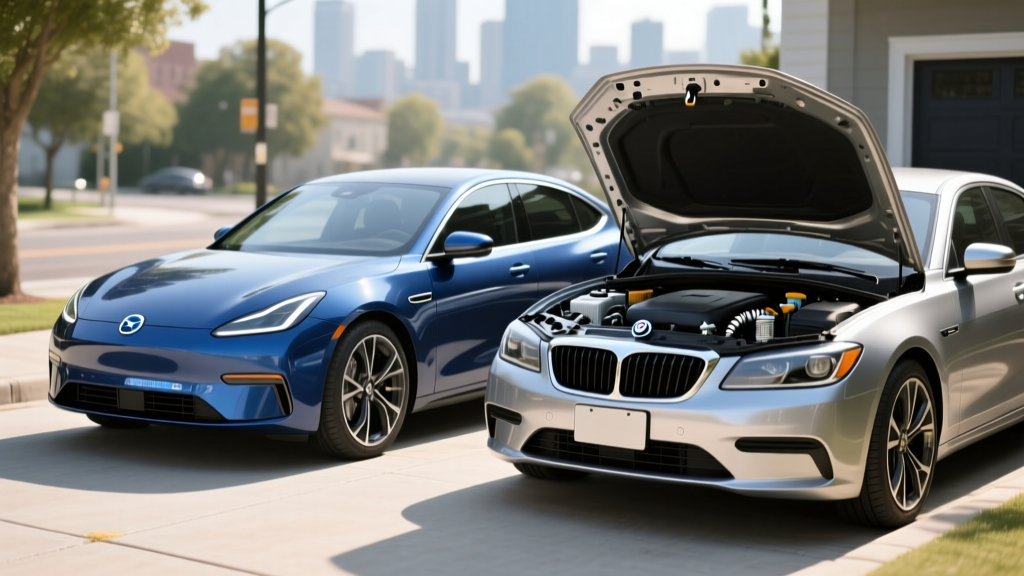
Fire risk is one line item in the total cost of EV ownership. Here's how a 2026 EV stacks up against a comparable gas vehicle over five years, using a mid-range crossover like the Hyundai Ioniq 5 (EPA 303 mi, $42,600 base MSRP) versus a Toyota RAV4 gas ($30,850 MSRP):
| Cost Category (5-Year) | Hyundai Ioniq 5 (BEV) | Toyota RAV4 (ICE) |
|---|---|---|
| Purchase price (after §30D credit) | ~$35,100* | $30,850 |
| Fuel / electricity | ~$3,200 | ~$7,800 |
| Maintenance (oil, filters, brakes) | ~$1,400 | ~$3,900 |
| Insurance (avg. national) | ~$11,500 | ~$9,200 |
| Estimated depreciation | ~$17,500 | ~$14,000 |
| Total 5-year cost | ~$68,700 | ~$65,750 |
*§30D federal credit eligibility depends on MSRP cap ($80,000 SUVs / $55,000 sedans), buyer income limits ($150K single / $300K joint), and battery critical-mineral sourcing requirements per current IRS rules. Always confirm eligibility with a tax professional before purchase.
The EV costs more upfront (even after the credit) and carries higher insurance premiums — typically 15–25% above comparable ICE models, driven by higher repair costs after collisions (battery pack replacement can run $10,000–$22,000) and limited independent body-shop expertise. But the fuel and maintenance savings are substantial: Level 2 home charging at the 2026 national average of $0.16/kWh delivers roughly $0.04–$0.06 per mile versus $0.12–$0.15 per mile for gas at $3.40/gallon and 28 MPG combined.
Common Misconceptions About EV Fires
| Myth | Fact |
|---|---|
| "EVs catch fire all the time — the news proves it." | News coverage reflects rarity and spectacle, not frequency. EV battery fires are newsworthy precisely because they're unusual. Gas car fires (~170,000/year in the U.S.) rarely make local news. |
| "You can't put out an EV fire." | You can, but it requires more water (3,000–8,000 gallons) and longer monitoring (24–48 hrs for reignition). Many U.S. fire departments now carry NFPA 1071 EV-specific training as of 2025. |
| "Parking an EV in a garage is dangerous." | No data supports elevated residential garage fire risk from properly maintained EVs. The NFPA has not issued guidance restricting home EV parking. Garage fires from EVs remain exceedingly rare. |
| "Shipping companies banned EVs on cargo ships." | No major carrier has implemented a blanket ban. Some require pre-boarding SoC limits (typically 30–50%) and enhanced screening for damaged vehicles. The IMO updated RoRo fire-safety guidance in 2024. |
| "LFP batteries never catch fire." | LFP chemistry is more thermally stable and resists thermal runaway better than NMC, but no lithium-ion cell is fireproof. LFP reduces risk — it doesn't eliminate it. |
What First-Time EV Buyers Should Know About Safety
If cargo-ship fire headlines are shaping your purchase hesitation, here's a practical decision framework:
Should Fire Risk Factor Into Your EV Decision?
Choose an EV confidently if:
- You want statistically lower fire risk than your current gas car (25 vs. 1,530 per 100K vehicles).
- You prefer LFP chemistry for maximum thermal stability (Tesla Model 3 RWD, base Ford Mustang Mach-E, many BYD models).
- You'll charge at home on Level 2 (the safest, most controlled charging environment — no public-charger wear concerns).
- You live in a non-flood zone or can elevate/protect your vehicle during hurricane-season storm surge events.
Consider a PHEV or delay if:
- You live in a coastal flood-prone area and lack elevated parking — saltwater intrusion is the most underappreciated EV fire risk.
- Your local fire department has publicly stated it lacks EV fire-response training or equipment (increasingly rare, but still true in some rural areas as of 2026).
- You plan to buy a used EV from a model year with a known battery defect (e.g., 2017–2022 Chevy Bolt pre-recall repair, certain 2021 Hyundai Kona EV units) — verify recall completion via the NHTSA VIN lookup tool.
Practical EV Fire-Safety Tips for Owners
- Don't fast-charge to 100% routinely on NMC packs — set your daily charge limit to 80% and reserve 100% for road trips. This reduces long-term dendrite risk and preserves battery health.
- Inspect your charge port and cable for physical damage, corrosion, or moisture ingress — especially after storms or car washes.
- If your EV sustains underbody damage (curb strike, road debris, minor collision), have the battery enclosure inspected even if no warning lights appear. Internal cell damage can manifest days later.
- After floodwater exposure, do not attempt to charge or start the vehicle. Contact your dealer and insurer immediately. NHTSA recommends a 10-day quarantine period for saltwater-submerged EVs.
- Use only UL-listed (or ETL-listed) home charging equipment and have your Level 2 installation permitted and inspected by a licensed electrician — faulty wiring is a more common fire source than the battery itself.
Frequently Asked Questions
Are electric cars more likely to catch fire than gas cars?
No. NTSB data shows gas vehicles catch fire at roughly 1,530 incidents per 100,000 vehicles annually, compared to approximately 25 per 100,000 for battery electric vehicles. EVs are statistically far less likely to experience a fire event.
Why do EV ship fires burn so long?
Lithium-ion battery thermal runaway produces its own oxygen supply, making it resistant to traditional smothering techniques. In an enclosed cargo hold with limited suppression access, a single battery fire can spread to adjacent vehicles. However, shipping companies have updated protocols since 2024, including SoC limits and improved detection systems.
Is LFP battery chemistry safer than NMC?
LFP (lithium iron phosphate) cells have a higher thermal runaway threshold (~518°F vs. ~392°F for NMC) and release less oxygen during decomposition, making them more resistant to cascading fires. If fire safety is a top priority, LFP-equipped models (Tesla Model 3 RWD, Ford Mustang Mach-E Select, Rivian R1S/R1T standard pack) offer an additional margin of safety.
Will my homeowner's insurance cover an EV garage fire?
Standard homeowner's policies generally cover vehicle-caused structure fires regardless of powertrain, but the vehicle itself is covered under your auto policy. Confirm with your insurer — some carriers have updated EV-specific endorsements as of 2025–2026 that address battery replacement and thermal-damage scenarios more explicitly.
Should I avoid buying a used EV because of fire risk?
Not categorically. Verify that all open recalls (especially battery-related) have been completed by checking the VIN at nhtsa.gov/recalls. Avoid known defect-year models unless the recall repair is documented. A well-maintained used EV from a post-recall model year carries minimal fire risk.