Quick Answer: What Are Electric Buffers in an EV Battery?
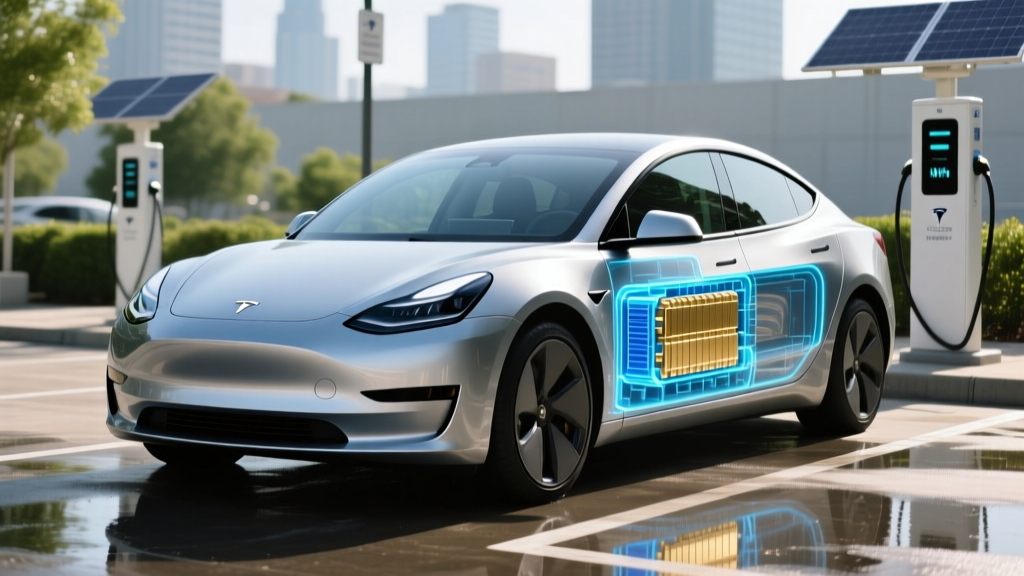
An electric buffer (or battery buffer) is the portion of an EV's total battery capacity that the manufacturer locks off from everyday use. If an EV has a 82 kWh total battery but only 77.4 kWh usable, that ~4.6 kWh gap is the buffer. Automakers reserve this energy at the top and bottom of the charge range to prevent the lithium-ion cells from hitting extreme states — full 100% saturation or true 0% depletion — which accelerate degradation. The buffer is why your dashboard shows 0 miles but the car can still creep forward, and why charging slows dramatically near 100%. Understanding buffers is essential for evaluating real-world range, battery longevity, and total cost of ownership.
Why EV Batteries Have Buffers: The Chemistry Reality
Lithium-ion cells — whether NMC (nickel-manganese-cobalt) or LFP (lithium iron phosphate) — degrade faster when held at voltage extremes. Charging a cell to its absolute maximum voltage stresses the cathode. Draining it to absolute zero risks copper dissolution in the anode. Neither outcome is acceptable for a battery pack expected to last 150,000+ miles under federal warranty requirements.
The solution is the buffer: a software-defined reservation of capacity at both ends of the State of Charge (SoC) spectrum.
- Top buffer: Typically 2-5% of total capacity. When your dash reads "100%," the cells are actually at roughly 95-98% true SoC. This is why manufacturers recommend daily charging to 80% for NMC batteries — the top buffer provides a smaller safety margin at full charge.
- Bottom buffer: Typically 3-6% of total capacity. When the dash reads "0 miles," there is still energy reserved to prevent cell damage and allow limited limp-home function.
The combined top and bottom buffer typically accounts for 4-10% of the total pack capacity, depending on the manufacturer's engineering philosophy and cell chemistry.
Total vs Usable kWh: Comparing Popular 2026 EVs
The gap between total and usable capacity varies significantly by model. Here is how several current EVs compare:
| Vehicle (2026 Model Year) | Total Capacity (kWh) | Usable Capacity (kWh) | Buffer Size (kWh) | Buffer % | Chemistry |
|---|---|---|---|---|---|
| Tesla Model Y Long Range | ~82 | ~75 | ~7 | ~8.5% | NMC |
| Hyundai Ioniq 5 (Std Range) | 63.0 | 58.0 | 5.0 | 7.9% | NMC |
| Ford Mustang Mach-E Extended Range | ~91 | ~84 | ~7 | ~7.7% | NMC |
| Chevrolet Equinox EV (3RS) | ~87 | ~82 | ~5 | ~5.7% | NMC |
| Tesla Model 3 RWD | ~60 | ~57.5 | ~2.5 | ~4.2% | LFP |
| Rivian R1T Dual-Motor Max Pack | ~149 | ~141 | ~8 | ~5.4% | NMC |
Note: Total capacity figures are approximate and sourced from manufacturer filings, EPA test documentation, and independent teardown data. Usable capacity is the figure that determines your EPA range rating. Source: fueleconomy.gov
How Buffers Affect Your Real-World Range
The EPA range sticker on the window is calculated using the usable capacity, not the total. So when the EPA says a 2026 Hyundai Ioniq 5 Long Range RWD delivers 318 miles, that is based on the ~77.4 kWh usable capacity and its tested efficiency of roughly 29 kWh/100mi (combined).
But real-world range diverges from the EPA number due to factors the buffer cannot control:
- Highway driving at 70-80 mph: Expect 10-15% below EPA combined range due to aerodynamic drag. A 318-mile EPA car delivers roughly 270-285 miles on a flat highway at 70 mph.
- Cold weather (below 32°F): Range loss of 20-35% is typical without preconditioning, as energy diverts to battery heating and cabin climate. The same 318-mile car may deliver 210-250 miles at 20°F.
- Elevation gain: Climbing consumes significantly more energy; regenerative braking recovers some on descent but not all.
The buffer itself does not reduce your usable range — that is already accounted for in the usable kWh figure. What the buffer does is ensure that the usable capacity you have access to today will still be largely available five and ten years from now.
Common Misconceptions About EV Battery Buffers
| Myth | Fact |
|---|---|
| "Manufacters hide capacity to sell bigger batteries." | Buffers protect cell health. Without them, warranty claims for degradation would skyrocket, costing manufacturers far more than the marginal capacity savings. |
| "I can unlock the buffer with a software hack." | Some third-party tuners offer this, but it voids the battery warranty, accelerates degradation, and can create thermal runaway risk. Not recommended. |
| "When the dash says 0%, the battery is truly empty." | The bottom buffer typically holds 3-6% of total capacity. The car may still move at reduced power for a short distance — but repeatedly draining into the buffer causes cumulative cell stress. |
| "LFP batteries don't need buffers." | LFP cells are more tolerant of voltage extremes and typically use smaller buffers (3-5% vs 6-10% for NMC), but they still require some protection. Tesla recommends periodic 100% charges for LFP specifically to aid BMS cell-balancing calibration. |
| "A bigger buffer means worse range." | Not necessarily. A larger buffer often means the manufacturer prioritized longevity over maximum range per charge. Over 10+ years, a well-buffered pack may retain more usable capacity than a minimally buffered one. |
Buffers, Degradation, and the 8-Year Warranty
Federal law mandates that EV battery packs carry a warranty of at least 8 years / 100,000 miles (10 years / 150,000 miles in CARB states). Most manufacturers guarantee the battery will retain at least 70% of its original usable capacity during that period.
Here is where the buffer plays a critical long-term role. As cells degrade over time and charge cycles, total capacity shrinks. Some manufacturers — notably Tesla and GM — have designed their buffers to release capacity gradually as degradation occurs. This means the usable capacity (and therefore your displayed range) decreases more slowly than the actual cell degradation would suggest.
For example, if a pack loses 8% of its total capacity over 5 years, but the manufacturer releases 3% from the buffer, the driver perceives only a 5% range loss. This engineering approach smooths the ownership experience but means that in later years (year 8-12), range loss may accelerate as the buffer is depleted.
According to data aggregated by Recurrent Auto, the average EV battery retains roughly 90-95% of its original range at 5 years and 80-88% at 10 years, with significant variation by climate, charging habits, and chemistry.
EV vs Gas vs Hybrid: How Buffers Factor Into Total Cost
The buffer itself does not appear on a cost spreadsheet, but its effect on battery longevity directly impacts total cost of ownership (TCO). A well-buffered battery that degrades slowly means you avoid a $10,000-$20,000+ replacement before selling or trading the vehicle.
| Cost Factor (5-Year / 75,000 Miles) | EV (e.g., Ioniq 5, ~$42,000 MSRP) | Hybrid (e.g., Toyota RAV4 Hybrid, ~$33,000) | Gas (e.g., Toyota RAV4 AWD, ~$31,000) |
|---|---|---|---|
| Purchase Price (after §30D credit) | ~$34,500* | ~$33,000 | ~$31,000 |
| Fuel / Energy Cost | ~$3,200 (home charging at $0.14/kWh) | ~$5,800 (38 MPG combined, $3.50/gal) | ~$7,600 (30 MPG combined, $3.50/gal) |
| Maintenance | ~$1,500 (tires, cabin filter, wipers) | ~$3,200 (oil changes, brakes, filters) | ~$3,800 (oil, brakes, transmission fluid) |
| Insurance (avg) | ~$9,500 (EV premium ~15-20% higher) | ~$8,000 | ~$7,800 |
| Estimated Depreciation | ~$14,000 | ~$11,500 | ~$12,000 |
| 5-Year Total Cost | ~$62,700 | ~$61,500 | ~$62,200 |
*§30D federal tax credit eligibility depends on MSRP caps ($55,000 for cars, $80,000 for SUVs/trucks), buyer income limits ($150K single / $300K joint), battery sourcing requirements, and point-of-sale transfer. Verify current rules at IRS.gov. State incentives vary by jurisdiction.
The EV's energy and maintenance savings are substantial — roughly $6,700 less than gas over 5 years — but higher insurance and depreciation partially offset the advantage. The battery buffer's role here is indirect but important: by protecting long-term battery health, it helps preserve resale value and reduces the risk of an out-of-warranty battery replacement that could cost $10,000-$20,000+.
Decision Framework: Does Buffer Size Matter for Your Purchase?
Choose an EV with a Larger Buffer (7-10%) If:
- You plan to keep the vehicle 8+ years and want maximum long-term capacity retention
- You live in a hot climate (above 90°F summers) where cell stress is higher
- You frequently DC fast charge, which accelerates degradation at voltage extremes
- You regularly charge to 100% out of range necessity (long commutes, no mid-day charging)
A Smaller Buffer (3-6%) Is Fine If:
- You lease for 3-4 years and will return the vehicle before meaningful degradation
- The vehicle uses LFP chemistry (inherently more degradation-resistant)
- You primarily charge at home on Level 2 to 80% daily
- You live in a temperate climate (50-80°F most of the year)
What First-Time EV Buyers Should Know:
- Always compare usable kWh, not total kWh. The usable number determines your actual range.
- Ask about the buffer size. Few spec sheets list it, but EV forums, EPA test documents, and independent teardowns often reveal the number.
- Don't obsess over it. Buffer size is one factor among many — charging speed, thermal management, and your driving habits matter as much or more.
- Monitor State of Health (SoH). Many EVs display battery health in the settings menu or via OBD-II apps like LeafSpy or Tessie. Track it quarterly.
Frequently Asked Questions
Can I use the buffer capacity in an emergency?
The bottom buffer may allow the vehicle to move at very low power when the dash reads 0%, but this is not designed for regular use. Repeatedly draining into the buffer stresses cells and may void warranty coverage if the BMS logs show chronic deep discharge. Always treat 0% as a hard stop.
Do all EVs have the same buffer percentage?
No. Buffer size varies from roughly 3% to 10% of total capacity depending on the manufacturer, cell chemistry, and thermal management system. Tesla historically uses moderate buffers (~5-8%), while Hyundai/Kia tends toward 6-8%. LFP-equipped vehicles generally use smaller buffers due to the chemistry's wider safe voltage window.
Will a software update ever increase my usable capacity?
Occasionally, yes. Tesla has issued over-the-air updates that slightly adjusted usable capacity based on accumulated fleet degradation data. However, this is not common and should not be expected. Manufacturers design buffers conservatively at launch and may release a small portion over time as confidence in long-term cell behavior grows.
How does the buffer interact with DC fast charging?
The top buffer is a key reason charging slows dramatically above 80% SoC. As cells approach their voltage ceiling, the BMS reduces charge rate (kW) to prevent overvoltage. This is the "charge curve taper" that makes 10-80% times much faster than 10-100%. A larger top buffer can mean slightly more aggressive tapering, but it also means the cells experience less stress during frequent fast charging sessions.
Does cold weather reduce the buffer?
The buffer itself is a fixed software reservation — it does not shrink in cold weather. However, cold temperatures reduce the total available capacity of the cells temporarily (due to increased internal resistance and slower ion diffusion). This means your usable range drops in winter, but the buffer percentage of the remaining capacity stays the same. Preconditioning the battery before driving or charging mitigates this temporary loss.