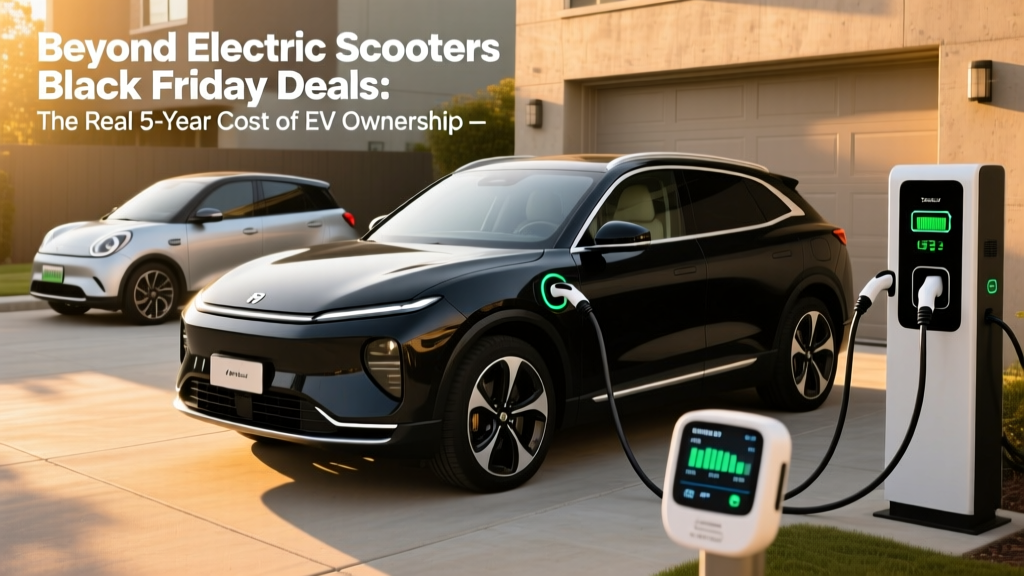
Every November, search feeds fill with electric scooters Black Friday deals — discounted kick-scooters, e-mopeds, and neighborhood low-speed vehicles advertised as the ultimate "go green and save money" purchase. And if your commute is three miles on a protected bike lane, a $799 scooter on sale might genuinely be the right tool.
But if you're actually weighing a full-size electric vehicle — a real highway-capable EV that replaces a gas car year-round — the economics look entirely different, and far more nuanced. A scooter deal saves you a few hundred bucks upfront. A properly chosen EV, paired with the right incentives and home charging, can reshape your transportation budget for half a decade.
This guide ignores the scooter hype and runs the actual numbers on what it costs to own a mainstream EV over five years in 2026: purchase price after federal and local incentives, electricity versus gasoline, insurance premiums, maintenance savings, and the depreciation reality that catches some buyers off guard.
The 5-Year Total Cost of Ownership: EV vs. Gas Baseline
Total cost of ownership (TCO) is the only honest way to compare vehicles. A $38,000 EV with a $7,500 tax credit, cheap home charging, and minimal maintenance can undercut a $32,000 gas sedan that burns $2,400 a year in fuel. The table below models a realistic five-year scenario using a midsize electric crossover (think 2026 Hyundai Ioniq 5 or Tesla Model Y) against a comparable gasoline compact SUV.
| Category | Midsize EV (e.g., Ioniq 5 / Model Y) | Gas Compact SUV (e.g., RAV4 / CR-V) |
|---|---|---|
| Purchase Price (MSRP, base trim) | $42,000 | $33,000 |
| Federal Tax Credit (§30D) | –$7,500 (if eligible) | $0 |
| Net Purchase After Credit | $34,500 | $33,000 |
| Fuel/Energy (5 yrs, 12k mi/yr) | $3,240 (home L2 @ $0.14/kWh) | $9,000 ($3.00/gal, 28 MPG) |
| Insurance (5 yrs) | $10,800 ($180/mo avg) | $8,400 ($140/mo avg) |
| Maintenance (5 yrs) | $1,800 | $4,500 |
| Depreciation (5 yrs) | –$18,500 | –$14,000 |
| Net 5-Year Cost | $31,840 | $40,900 |
Under these assumptions, the EV wins by roughly $9,000 over five years — but only if the buyer qualifies for the full §30D credit, charges predominantly at home, and drives an average commute. Change any of those variables — apartment living without charging access, a state with expensive electricity, ineligibility for the federal credit — and the math tightens or flips.
The §30D Federal Tax Credit: Who Actually Qualifies in 2026
The federal EV tax credit under IRS §30D remains the single largest purchase incentive available — up to $7,500 for a new qualifying EV. But "up to" is doing heavy lifting. The credit is a minefield of caps, sourcing rules, and income limits that disqualify many buyers and many vehicles.
§30D Eligibility Checklist (2026 Rules)
- MSRP Cap: Vans, SUVs, and trucks must be ≤$80,000 MSRP; sedans and other body styles ≤$55,000.
- Buyer Income Cap (MAGI): $300,000 joint / $225,000 head of household / $150,000 single. Exceed this in the purchase year or prior year and you get $0.
- Battery Component Manufacturing: Battery components must be manufactured or assembled in North America (percentage threshold increases annually through 2029).
- Critical Minerals Sourcing: A percentage of critical minerals must be sourced from the U.S. or FTA partners (threshold also escalates yearly).
- Foreign Entity of Concern (FEOC) Exclusion: Vehicles with battery components or critical minerals from a FEOC (effectively China, Russia, North Korea, Iran) are disqualified — this rule has tightened significantly since 2024.
- Final Assembly: Vehicle must undergo final assembly in North America.
- Point-of-Sale Transfer: As of 2024, buyers can transfer the credit to the dealer at purchase, reducing the sale price directly — no need to wait for a tax refund.
The practical effect: in 2026, the list of vehicles qualifying for the full $7,500 is shorter than marketing materials suggest. Many popular EVs qualify for only $3,750 (meeting one of the two battery-sourcing prongs but not both), and several have been dropped entirely due to FEOC supply-chain entanglements. Always verify current eligibility on fueleconomy.gov before committing to a purchase.
Charging vs. Gasoline: The Per-Mile Math That Matters
The fuel savings argument for EVs is real — but only if you charge at home on a residential electricity rate. Public DC fast charging at highway rest stops can cost as much per mile as premium gasoline.
| Scenario | Rate | Efficiency | $/Mile |
|---|---|---|---|
| Home Level 2 (national avg residential) | $0.14/kWh | 3.5 mi/kWh | $0.04 |
| Home with time-of-use (off-peak) | $0.09/kWh | 3.5 mi/kWh | $0.026 |
| Public Level 2 (ChargePoint, etc.) | $0.28/kWh | 3.5 mi/kWh | $0.08 |
| DC Fast Charging (Electrify America, etc.) | $0.48/kWh | 3.5 mi/kWh | $0.137 |
| Gas Car (regular, 28 MPG combined) | $3.00/gal | 28 MPG | $0.107 |
| Gas Car (premium, 24 MPG combined) | $3.60/gal | 24 MPG | $0.15 |
The takeaway: home charging at residential rates delivers a $0.04/mile cost — roughly one-third the cost of gasoline. But if you live in an apartment without charging access and rely exclusively on DC fast chargers at $0.48/kWh, you're actually paying more per mile than a fuel-efficient gas car. This is the single most overlooked variable in EV ownership economics.
For a driver covering 12,000 miles annually, the difference between home charging ($480/year) and exclusive DC fast charging ($1,644/year) is over $1,100 per year — $5,800 over five years. Home Level 2 installation ($600–$2,200 depending on panel capacity and run length) pays for itself within two years for most drivers.
Maintenance Savings: Where EVs Quietly Win
EVs eliminate most of the recurring maintenance that defines gas-car ownership. No engine oil, no transmission fluid, no spark plugs, no timing belts, no catalytic converters, no oxygen sensors. Regenerative braking dramatically extends brake pad and rotor life — many EV owners report original brake pads at 80,000+ miles.
| Service Item | EV Cost | Gas Vehicle Cost |
|---|---|---|
| Oil Changes (6-10 over 5 yrs) | $0 | $450–$750 |
| Brake Pads & Rotors | $0–$300 (regen extends life) | $800–$1,500 |
| Cabin Air Filter | $150–$250 | $150–$250 |
| Tire Rotation & Replacement | $1,200–$1,800 (heavier vehicle, instant torque wears tires faster) | $900–$1,400 |
| Coolant / Transmission Fluid | $0–$100 | $300–$600 |
| Misc. (belts, plugs, sensors) | $0 | $400–$800 |
| Total (5 yrs / 60k mi) | $1,350–$2,450 | $3,000–$5,300 |
The maintenance savings average $1,500–$3,000 over five years — meaningful, but not transformative on their own. The tire cost caveat is real: EVs are 10–20% heavier than equivalent gas vehicles and deliver instant torque, which accelerates tire wear. Budget for a tire replacement at 30,000–40,000 miles rather than the 50,000+ you might expect from a gas car.
The Insurance Reality: Higher Premiums, and Why
Here's the cost category EV skeptics love to cite — and they're not wrong. EV insurance premiums typically run 15–30% higher than comparable gas vehicles. The reasons are structural, not arbitrary:
- Higher repair costs: EV battery packs and power electronics are expensive to replace after collision damage. Even minor structural damage near the battery can trigger a total-write-off by cautious insurers.
- Specialized repair network: Fewer body shops have high-voltage certification, limiting competition and raising labor rates.
- Higher vehicle MSRP: Premiums scale with replacement cost, and EVs still carry a price premium over gas equivalents in many segments.
- Parts availability: Some EV models have longer parts lead times, increasing rental-car costs during repairs.
For a midsize electric crossover, expect to pay $160–$210/month for full coverage (depending on age, location, driving record) versus $120–$160/month for a gas equivalent. Over five years, that's an additional $2,400–$3,000 in insurance costs — a meaningful offset to fuel and maintenance savings.
Some insurers now offer specific EV discounts or telematics-based rates. Shopping quotes from at least four carriers before purchase is non-negotiable — premiums for the same vehicle can vary by $800+/year between insurers.
Depreciation: The Variable That Can Erase Everything
Depreciation is the largest single cost of vehicle ownership, and it's where EVs have been most volatile. The 2023–2024 price wars (led by Tesla's aggressive cuts) cratered used EV values, leaving early adopters with vehicles worth 40–50% less than purchase price after just two years.
As of 2026, the depreciation picture has stabilized somewhat but remains less favorable than for mainstream gas vehicles:
- Average EV 5-year depreciation: 50–60% of purchase price (vs. 40–50% for gas equivalents).
- Key risk factors: Battery health uncertainty in used market, rapid technology obsolescence (faster-charging newer models), and Tesla price cuts resetting the entire used EV market.
- Bright spots: Models with strong reliability reputations and limited availability (certain Hyundai/Kia EVs, Rivian) have held value better. LFP battery chemistry, with its longer cycle life and lower degradation, may support better long-term resale as buyers learn to distinguish chemistries.
On a $42,000 EV (net $34,500 after tax credit), expect a 5-year depreciation hit of $17,000–$21,000 versus $13,000–$17,000 for a $33,000 gas SUV. The tax credit narrows the gap but doesn't eliminate it. Leasing can mitigate depreciation risk — and in some cases, lease passthrough structures allow the lessor to claim the §30D credit and pass savings to the lessee even on vehicles that wouldn't qualify for a direct purchase credit.
So, Should You Buy an EV or Chase Those Scooter Deals?
The Decision Framework
Buy a full-size EV if: You have home charging access (garage, driveway, or employer Level 2), drive 8,000+ miles per year, qualify for the §30D credit, and plan to keep the vehicle 4+ years. The TCO math works decisively in your favor.
Consider a PHEV if: You can charge at home but frequently take long road trips where DC fast-charging infrastructure is sparse, or you're in a cold climate where EV range loss of 20–30% in winter is a concern.
Those electric scooters Black Friday deals make sense if: Your daily commute is under 10 miles, you live in a climate that permits two-wheeled transport year-round, you need a secondary micro-mobility vehicle rather than a primary car, and your budget is under $1,500. Just know that a scooter is a supplement, not a car replacement — no highway capability, no weather protection, minimal cargo, and no §30D eligibility (low-speed electric scooters and e-bikes do not qualify for the federal clean vehicle credit).
Stick with gas if: You can't charge at home, your electricity rates exceed $0.30/kWh, you drive fewer than 6,000 miles per year (fuel savings won't offset the purchase premium), or you need a specific vehicle configuration not yet available as an EV.
Frequently Asked Questions
How much does it really cost to own an EV over 5 years?
For a midsize electric crossover purchased at ~$42,000 MSRP with full §30D credit eligibility, home Level 2 charging, and 12,000 miles/year, expect a net 5-year cost of roughly $30,000–$35,000 including purchase (net of credit), energy, insurance, maintenance, and depreciation. A comparable gas SUV costs $38,000–$43,000 over the same period. The EV typically saves $5,000–$10,000, but variables like insurance costs, electricity rates, and depreciation can narrow or widen that gap significantly.
Do I qualify for the $7,500 federal EV tax credit?
It depends on three factors: (1) your modified adjusted gross income (≤$150k single, ≤$300k joint), (2) the vehicle's MSRP (≤$55k for cars, ≤$80k for SUVs/trucks/vans), and (3) whether the vehicle's battery meets critical-mineral sourcing and North American component manufacturing requirements — which eliminates many models due to FEOC supply-chain rules. Check the current qualified vehicle list at fueleconomy.gov and review IRS guidance before purchasing. Rules have changed annually and will continue to tighten.
How much do I actually save on fuel and maintenance?
Fuel savings average $900–$1,400 per year if you charge at home on residential electricity ($0.10–$0.16/kWh) versus a 28 MPG gas car at $3.00/gallon. Maintenance savings add another $300–$600 per year from eliminated oil changes, extended brake life, and fewer mechanical systems. Combined, expect $1,200–$2,000 in annual operating savings — but only with home charging. Exclusive reliance on public DC fast charging cuts fuel savings to near zero.
Are EVs more expensive to insure?
Yes, typically 15–30% more expensive than comparable gas vehicles. For a midsize electric crossover, budget $160–$210/month for full coverage versus $120–$160 for a gas equivalent. The premium reflects higher repair costs (battery replacement after collision), fewer certified repair shops, and higher vehicle MSRP. Over five years, expect to pay an additional $2,400–$3,000 in insurance. Always get quotes from multiple insurers before purchasing — the spread between carriers is often larger than the EV surcharge.
How well do EVs hold their value compared to gas cars?
EVs currently depreciate faster than mainstream gas vehicles — typically losing 50–60% of purchase value over five years versus 40–50% for gas equivalents. The 2023–2024 Tesla-led price wars severely impacted used EV values, and battery health uncertainty in the used market continues to suppress resale. However, models with strong reliability records and LFP battery chemistry are showing better retention. Leasing can transfer depreciation risk to the lessor and is worth considering if resale uncertainty concerns you.
Do electric scooters qualify for any federal tax credits?
No. Low-speed electric scooters, e-bikes, and neighborhood electric vehicles (NEVs) do not qualify for the §30D Clean Vehicle Credit. The credit applies only to highway-capable four-wheeled vehicles meeting specific battery capacity, weight, MSRP, and sourcing requirements. Some states or local utilities may offer small rebates for e-bikes or scooters, but these are separate from federal tax incentives. If you see "electric scooters Black Friday deals" advertising tax-credit savings, that claim is almost certainly misleading.