Quick Answer: Can an EV Truck Tow an Electric Wake Boat?
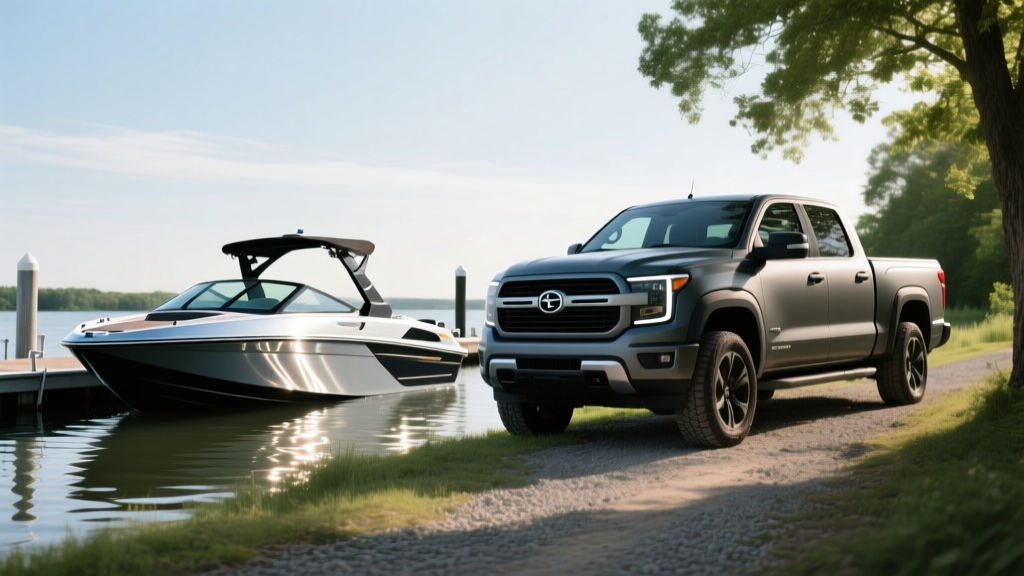
Yes — but with major caveats. Towing a 5,000–7,000 lb electric wake boat (like the MasterCraft NXT24 or the all-electric MasterCraft X24e prototype) with an EV truck such as the Ford F-150 Lightning or Rivian R1T cuts highway range by roughly 45–55%. That means a Lightning with a 320-mile EPA sticker drops to approximately 145–175 miles while towing. The electric wake boat itself eliminates fuel-dock stops and exhaust fumes on the water, but your tow vehicle becomes the bottleneck. Plan charging carefully, budget for a 200-amp home panel upgrade, and expect combined tow-vehicle + boat energy costs of $0.08–$0.14 per mile depending on your electricity rate.
Why the Electric Wake Boat Trend Matters to EV Buyers
The electric wake boat market has accelerated rapidly. Traditional wake boats burn 8–15 gallons of gasoline per hour on the water, costing $35–$65/hr at 2026 fuel prices. Electric wake boats — led by models like the MasterCraft X24e (announced, with dual 80 kWh LFP battery packs) and retrofitted platforms from brands like Bass Cat and Centurion — promise zero-emission wakes, instant torque for pull-ups, and dramatically quieter operation.
But here's the ownership reality most buyers overlook: an electric wake boat doesn't just change your day on the lake — it changes your tow-vehicle calculus entirely. If you're already driving or considering an EV truck, you need to understand the combined system: truck range under load, boat charging at the dock, and the electrical infrastructure required at home.
EV Truck Towing: The Real Range Numbers
Let's look at what happens to popular EV trucks when they're pulling a 6,000 lb wake boat and trailer (combined weight approximately 7,500 lbs with gear):
| EV Truck (2026 MY) | EPA Range | Est. Towing Range | Battery (kWh) | Max Tow (lbs) | Base MSRP |
|---|---|---|---|---|---|
| Ford F-150 Lightning Ext. Range | 320 mi | ~150–175 mi | 131 usable | 10,000 | $62,995 |
| Rivian R1T Dual-Motor Max | 410 mi | ~195–225 mi | 141 usable | 11,000 | $87,600 |
| Chevrolet Silverado EV 4WT | 440 mi | ~200–240 mi | 200 usable | 10,000 | $72,900 |
| Tesla Cybertruck AWD | 340 mi | ~155–185 mi | 123 usable | 11,000 | $79,990 |
Towing range estimates reflect 70 mph highway driving with a 7,500 lb combined load, based on real-world testing data from fueleconomy.gov and independent reviewers. Cold weather (below 40°F) can reduce these figures an additional 15–25%.
Electric Wake Boat Specs: What's Available and What's Coming
As of 2026, fully electric wake boats remain a niche but growing segment. Here's what's on the market or announced:
- MasterCraft X24e (announced/preliminary): Dual 80 kWh LFP packs, ~4–6 hours of wakeboarding runtime, DC fast-charge capable at up to 50 kW, estimated MSRP $225,000+
- Retrofitted electric platforms: Companies like Flux Marine and E-Motion offer electric outboard/inboard conversions for existing hulls, typically 40–60 kWh packs, 3–5 hours runtime, $45,000–$80,000 for the powertrain alone
- Hybrid marine setups: Some builders offer range-extended systems with a small diesel generator backing up a 30–50 kWh battery — similar to a PHEV car architecture
For comparison, a conventional 2026 MasterCraft X24 with a 6.2L Ilmor V8 runs approximately $95,000–$120,000 and burns ~12 gallons/hour under load. Over a 100-hour season, that's roughly $4,500–$5,500 in fuel alone at $3.80/gallon.
Cost Breakdown: Electric Wake Boat + EV Truck vs. Gas Rig
| Cost Category | EV Truck + Electric Wake Boat | Gas Truck + Gas Wake Boat |
|---|---|---|
| Vehicle purchase (truck) | $65,000–$90,000 | $50,000–$70,000 |
| Boat purchase | $120,000–$225,000 | $95,000–$120,000 |
| Annual fuel/energy (100 hrs boating + 3,000 mi towing) | $1,800–$2,800 | $7,500–$9,500 |
| Annual maintenance (truck + boat) | $400–$800 | $1,800–$3,000 |
| Home charging infrastructure | $2,500–$5,500 (one-time) | $0 |
| Insurance (combined annual) | $3,500–$5,500 | $2,800–$4,200 |
| 5-Year Total Cost | $225,000–$340,000 | $200,000–$290,000 |
The electric setup costs more upfront but saves $2,000–$4,000 annually on fuel and maintenance. Break-even typically arrives around year 4–5 for high-use owners (100+ hours/season). Low-use owners (under 40 hours/season) may never recoup the premium.
Home Charging Infrastructure: What You Actually Need
Charging an EV truck and an electric wake boat at home requires serious electrical capacity. Here's what a realistic installation looks like:
| Component | Specification | Cost Range |
|---|---|---|
| Electrical panel upgrade | 200A → 400A service | $2,500–$5,000 |
| Truck Level 2 charger | 48A / 11.5 kW hardwired | $600–$1,200 |
| Boat Level 2 charger | 32A / 7.7 kW (marine-rated) | $1,200–$2,500 |
| Electrician labor + permits | 2–3 days, conduit runs | $2,000–$4,000 |
| Total | $6,300–$12,700 |
Not every home can support this. Older homes with 100A or 150A service will need a full panel upgrade — and in some jurisdictions, the utility may need to upgrade the transformer on your street, adding weeks and $3,000–$8,000 to the project. Always get a licensed electrician's assessment before committing to an electric wake boat purchase.
If you lack home charging or dock-side charging at your marina, the electric wake boat proposition becomes much harder. Public DC fast chargers are designed for cars, not boats — there's no standardized public marine charging network in 2026.
Tax Credits and Incentives: What Applies
The EV truck may qualify for the federal §30D tax credit, but rules are strict in 2026:
- MSRP must be under $80,000 for trucks (vans/SUVs) — this eliminates some Rivian and Silverado EV trims
- Buyer income caps: $150,000 single / $300,000 joint AGI
- Battery critical-mineral and component sourcing must meet escalating annual thresholds per IRS §30D guidelines
- Point-of-sale transfer is available — you can apply the credit at the dealer rather than waiting for tax filing
The electric wake boat itself does not qualify for the §30D credit (it's a marine vessel, not a highway vehicle). However, some states — notably California, Washington, and Minnesota — offer marine electrification rebates of $5,000–$15,000 through clean-water or recreational-boating incentive programs. Check your state's DNR or environmental agency for current availability.
Common Misconceptions About Electric Wake Boats
| Myth | Fact |
|---|---|
| "Electric wake boats don't have enough torque for serious wakeboarding." | Electric motors deliver peak torque at 0 RPM. The X24e's dual motors produce over 800 lb-ft combined — more than any gas V8 in the segment. Pull-ups are instantaneous. |
| "You'll run out of battery mid-lake and get stranded." | Modern marine battery management systems include a 10–15% reserve buffer. Most electric wake boats can idle back to the dock at reduced speed on the reserve alone. Range estimation displays are now accurate within ~5%. |
| "Charging takes all night." | On a 50 kW DC fast charger (available at some marinas), an 80 kWh pack charges 10–80% in roughly 90 minutes. On Level 2 (7.7 kW), expect 8–10 hours — fine for overnight dock charging. |
| "The batteries will degrade quickly in water environments." | Marine-grade LFP cells are rated for 3,000+ cycles to 80% capacity. At 100 hours/year (roughly 50 full cycles), that's 60+ years of theoretical cycle life. Calendar degradation in climate-controlled bilge compartments is the real limiter — expect 85–90% capacity at year 10. |
| "My EV truck can tow it anywhere." | See towing range table above. A 320-mile EPA truck towing a wake boat gets ~150–175 real miles. Plan routes around truck-friendly DC fast chargers (350 kW capable) — and confirm the charger can accommodate a truck + trailer without unhitching. |
Decision Framework: Is an Electric Wake Boat Right for You?
Choose Electric Wake Boat + EV Truck If:
- You boat at a lake within 75 miles of home (round-trip tow is manageable on one charge or one fast-charge stop)
- You have or can install 400A home electrical service with dedicated chargers for truck and boat
- You boat 60+ hours per season (fuel savings justify the premium within 4–5 years)
- Your marina offers or allows dock-side Level 2 charging
- You value silent operation, zero water-level exhaust emissions, and instant torque for watersports
Stick With Gas Wake Boat + Gas/Diesel Truck If:
- You regularly tow 150+ miles to reach your lake (EV truck towing range becomes a serious constraint)
- Your home electrical service is under 200A and upgrading is cost-prohibitive
- You boat fewer than 40 hours per year (the electric premium won't pay back in reasonable time)
- You boat at remote reservoirs with no shore-power infrastructure
- You need the flexibility to trailer to different lakes on consecutive days without charging downtime
What First-Time EV Buyers Towing Boats Should Know
If you're new to EVs and considering this setup, start with the truck — not the boat. Own the EV truck for 6–12 months, learn its real towing range on your specific routes, and understand your local charging infrastructure before committing to an electric wake boat. The truck's EPA window sticker will show combined MPGe, but towing efficiency operates in a completely different regime — expect 1.5–2.2 kWh/mile while towing (compared to 0.4–0.5 kWh/mile unloaded).
Also factor in insurance. EV trucks carry 15–25% higher premiums than gas equivalents (per IIHS data) due to repair costs, and marine insurance on an electric wake boat is still being priced by underwriters — expect quotes 20–30% above gas-boat equivalents until actuarial data matures.
Frequently Asked Questions
Can I charge my electric wake boat from my EV truck's battery?
Some EV trucks offer vehicle-to-load (V2L) capability — the F-150 Lightning's Pro Power Onboard can output up to 9.6 kW. This could trickle-charge a wake boat in an emergency, but it's not practical for routine use. You'd drain ~20% of the truck's battery to add roughly 15 kWh to the boat — enough for maybe 30 minutes of wakeboarding.
Do electric wake boats qualify for the federal EV tax credit?
No. The §30D credit applies only to highway-capable motor vehicles. Electric boats are classified as marine vessels. Check your state's environmental or DNR programs for marine electrification rebates, which can range from $2,000–$15,000 depending on jurisdiction.
How does cold weather affect an electric wake boat's battery?
>LFP chemistry (used in most marine applications) loses roughly 15–20% capacity at 32°F compared to 77°F. Since most wakeboarding happens in warm months, this is less of a concern than it is for EV cars. However, if you store the boat in freezing temperatures, the battery management system will draw power for thermal protection — plug in during winter storage to prevent parasitic drain.What's the warranty on electric wake boat batteries?
MasterCraft and most conversion shops offer 5-year / 3,000-hour warranties on marine battery packs, with a guaranteed 70–80% capacity retention threshold. Replacement cost for a full 80 kWh marine pack is estimated at $18,000–$25,000 out of warranty — comparable to replacing a high-end gas inboard engine.
Is the electric wake boat market mature enough to buy now?
Honestly, it's early. Production volumes are low, dealer service expertise is still developing, and resale values are uncertain. If you're risk-tolerant and boat frequently enough to capture fuel savings, the technology works well. If you prefer proven platforms with established dealer networks, waiting 2–3 more model years is a defensible choice.