Why Power Steering Matters More in an EV Than You Think
When EV shoppers compare range, charging speed, and 0-60 times, the steering system rarely makes the shortlist. Yet the choice between electric power steering (EPS) and hydraulic power steering (HPS) directly affects an EV's energy consumption, range efficiency, and long-term ownership cost. Every kilowatt of parasitic loss from an accessory system is a kilowatt not reaching the wheels — and in a vehicle where efficiency is measured in kWh/100mi, those losses compound over every mile driven.
This comparison breaks down electric vs hydraulic power steering through the lens of electrified vehicles: which system modern EVs use, how each affects efficiency and range, what maintenance looks like over a 10-year ownership cycle, and why the steering rack under your car matters more for total cost of ownership than you might assume.
How Electric and Hydraulic Power Steering Actually Work
Hydraulic power steering (HPS) uses a belt-driven pump connected to the engine's crankshaft. That pump pressurizes hydraulic fluid, which assists the driver's steering input through a rack-and-pinion mechanism. The pump runs continuously whenever the engine is on — whether you're turning the wheel or driving straight on the highway. In a conventional ICE vehicle, that constant parasitic drag costs roughly 1-2% of fuel economy.
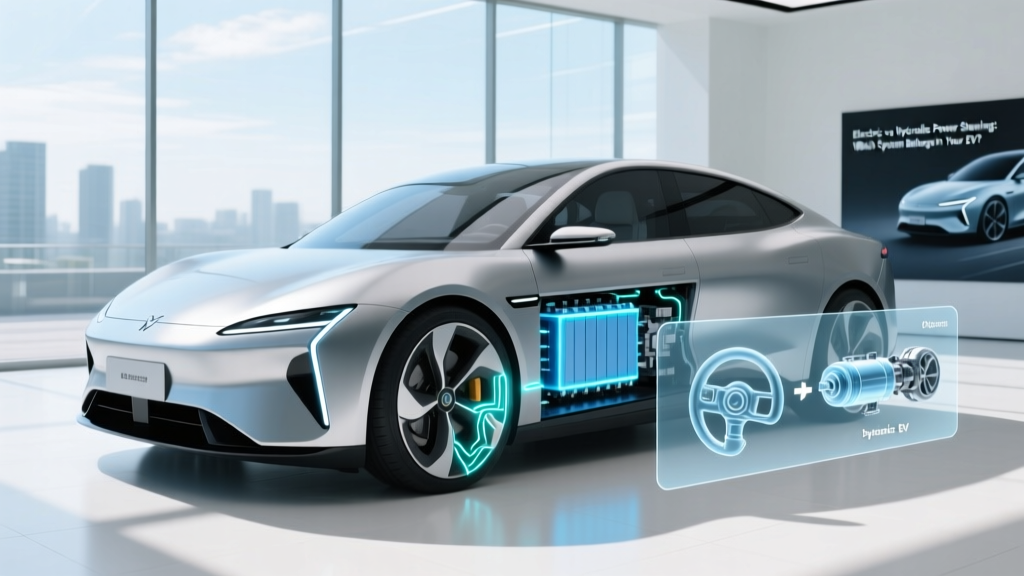
Electric power steering (EPS) replaces the hydraulic pump, fluid lines, and belt with an electric motor mounted on the steering column or rack. A control module reads torque sensor input and applies assist proportionally. The motor only draws power when steering assist is needed — meaning straight-line highway driving consumes essentially zero energy for steering assist.
In an EV context, the distinction becomes critical. There is no engine crankshaft to drive a belt. A hydraulic system in an EV would require a dedicated electric motor to run the hydraulic pump — adding weight, complexity, and energy draw. This is why virtually every production EV and PHEV sold today uses electric power steering. The question of electric vs hydraulic power steering in EVs is less about choosing between two available options and more about understanding why the industry moved decisively to EPS and what that means for you as an owner.
Side-by-Side Spec Comparison: EPS vs HPS in an EV Context
| Specification | Electric Power Steering (EPS) | Hydraulic Power Steering (HPS) |
|---|---|---|
| Power Source | Electric motor (12V/48V system) | Belt-driven pump (ICE) or dedicated electric motor (EV adaptation) |
| Parasitic Energy Draw | ~0.05-0.15 kW average (only under assist) | ~0.5-1.5 kW continuous (pump always running) |
| Estimated Range Impact (300-mi EV) | Negligible (1-2 miles) | 3-8 miles lost to pump draw |
| System Weight | ~8-12 kg (motor + ECU) | ~15-22 kg (pump, fluid, lines, reservoir) |
| Fluid Changes Required | None | Every 30,000-50,000 miles |
| Typical Maintenance Cost (10 yr) | $0-200 (sensor/module if failed) | $400-900 (fluid, pump, hoses, rack seals) |
| Steering Feel Character | Programmable, speed-sensitive, can feel artificial | Organic, road-feedback-rich, consistent feel |
| Compatibility with ADAS/Level 2+ | Native — required for lane-centering, auto-park | Requires additional electro-hydraulic actuator |
| Used in Current Production EVs? | Yes — universal across Tesla, Hyundai, Ford, BMW, Rivian, etc. | No — not used in any current mass-production EV |
Efficiency and Range: The Parasitic Loss Problem
The single biggest reason automakers abandoned hydraulic steering for EVs is energy efficiency. A hydraulic pump running continuously draws between 500 and 1,500 watts depending on system pressure and engine speed. In an ICE car, that's a rounding error on a 15-gallon tank. In an EV with a 75-100 kWh battery, every watt-hour of parasitic loss directly reduces range.
Consider a hypothetical 300-mile EPA-rated EV with a 82 kWh usable battery (roughly 27.3 kWh/100mi efficiency). If a hydraulic pump drew an average of 800W continuously over a 4-hour highway drive, that's 3.2 kWh consumed solely for steering assist — enough to cost approximately 7-8 miles of range. Electric power steering, by contrast, draws power only during actual steering input. On a highway drive with gentle lane corrections, average EPS draw sits around 50-100W, consuming roughly 0.2-0.4 kWh over the same trip — a range penalty of under 1 mile.
That 6-7 mile difference sounds small in isolation. But stack it against other parasitic loads — thermal management, cabin HVAC, infotainment, battery conditioning — and the cumulative effect becomes meaningful. Automakers engineer EVs to squeeze every fraction of a kWh/100mi, and eliminating a continuously-running hydraulic pump is one of the easier wins.
Steering Feel, Performance, and the Enthusiast Debate
This is where the electric vs hydraulic power steering discussion gets subjective — and where hydraulic advocates make their strongest case. Enthusiasts and automotive journalists have criticized EPS systems since their introduction for delivering numb, disconnected steering feel. Early EPS implementations (think early-2010s economy cars) earned that reputation: light, vague, and devoid of road feedback.
Modern EPS systems have improved dramatically. Automakers now use sophisticated torque-overlay algorithms, variable-ratio racks, and speed-sensitive assist curves that can simulate heavier feel at highway speeds and lighter effort during parking maneuvers. The Porsche 718 Cayman and current-generation BMW M cars demonstrate that well-tuned EPS can deliver communicative, engaging steering — though purists still argue it doesn't match the organic feedback of a hydraulic system.
For EVs specifically, the steering feel question is somewhat moot. The instant torque, low center of gravity, and one-pedal driving dynamics of EVs create a fundamentally different driving experience where steering precision matters more than raw feedback. Systems like Tesla's variable-ratio steering rack and Hyundai's R-MDPS (Rack-Mounted Motor Driven Power Steering) in the Ioniq 5 and Ioniq 6 deliver quick, accurate response that suits the character of electric propulsion.
One area where EPS holds a clear performance advantage: programmability. An EPS system can offer multiple steering modes (Comfort, Normal, Sport) that change effort and response characteristics with a menu tap. It can also integrate with drive-mode selectors to stiffen steering in performance modes and lighten it in efficiency modes. Hydraulic systems require mechanical changes to alter feel characteristics.
ADAS Compatibility: The Dealbreaker for Autonomous Features
Electric power steering isn't just preferred for advanced driver-assistance systems (ADAS) — it's a requirement. Lane-centering assist, automated lane changes, evasive steering assist, and automated parking all work by sending electronic commands to the EPS motor. The system receives steering-angle requests from the ADAS computer and applies torque to the rack accordingly.
Implementing these features with hydraulic steering would require an additional electro-hydraulic actuator layered on top of the existing hydraulic system — adding cost, weight, complexity, and failure points. No automaker has pursued this path for production vehicles. The steering system in every vehicle offering Level 2 driver-assist, from a base Toyota Corolla with Toyota Safety Sense to a Mercedes S-Class with Drive Pilot, uses electric power steering.
This means the electric vs hydraulic power steering debate has a definitive answer for anyone buying a new EV with any level of driver assistance: you're getting EPS, and that's by design.
Maintenance, Reliability, and 10-Year Ownership Cost
| Cost Category | Electric Power Steering (EPS) | Hydraulic Power Steering (HPS) |
|---|---|---|
| Fluid Changes (3-5 services) | $0 | $150-300 |
| Pump Replacement (if needed) | N/A | $300-600 |
| Hose/Line Replacement | N/A | $150-350 |
| Rack Seal Repair | N/A (no fluid seals) | $200-500 |
| EPS Motor/Module Replacement | $400-900 (if failed — uncommon) | N/A |
| Estimated 10-Year Total | $0-900 | $800-1,750 |
Hydraulic systems have more wear items: the pump, high-pressure hoses, return lines, reservoir, and rack seals all degrade over time. Fluid breaks down and absorbs moisture, requiring periodic flushes. In cold climates, hydraulic fluid thickens, increasing pump strain and the likelihood of hose and seal failures.
Electric power steering systems have fewer mechanical wear points. The electric motor, torque sensor, and control module are solid-state or sealed components with long service lives. When EPS systems do fail, the repair tends to be a single module or sensor replacement rather than the cascading maintenance items of a hydraulic system. According to IIHS vehicle reliability data, EPS-related complaints in modern vehicles are significantly lower than hydraulic system complaints were in the pre-2010 era.
For EV owners specifically, the maintenance advantage compounds. EVs already eliminate oil changes, transmission fluid, spark plugs, and exhaust system repairs. Adding a maintenance-free steering system keeps the EV ownership experience as close to "charge and drive" as possible.
Category-by-Category Verdict
🏆 Efficiency & Range Winner: EPS
Electric power steering eliminates the continuous parasitic draw of a hydraulic pump, preserving 3-8 miles of range per charge cycle and improving overall kWh/100mi efficiency.
🏆 ADAS Compatibility Winner: EPS
Every Level 2 driver-assist system requires EPS for lane-centering and automated steering. Hydraulic steering cannot natively support these features.
🏆 Maintenance Cost Winner: EPS
No fluid, no hoses, no pump, no seals. Estimated 10-year cost: $0-900 vs. $800-1,750 for hydraulic.
🏆 Steering Feel Winner: HPS (Narrow)
Hydraulic systems deliver more organic road feedback. However, modern EPS systems from Porsche, BMW, and others have narrowed this gap substantially.
🏆 Weight Winner: EPS
EPS systems weigh 8-12 kg vs. 15-22 kg for a complete hydraulic system — saving 5-10 kg that contributes to efficiency and handling.
🏆 Programmability Winner: EPS
Multiple steering modes, speed-sensitive assist, and integration with drive selectors are only possible with an electronically controlled system.
Decision Framework: What This Means for Your EV Purchase
Choose a Vehicle with EPS (Any Current EV) If:
- You want maximum range efficiency with minimal parasitic losses
- You plan to use ADAS features like lane-centering, auto-park, or highway assist
- You prefer lower long-term maintenance costs and fewer service visits
- You value configurable steering feel through drive-mode selection
- You're buying any new EV — EPS is standard across all current-production models
Consider Hydraulic Steering (Used ICE/Sportscar) If:
- You're buying a used sports car or classic vehicle where steering feedback is the priority
- You're modifying a track car and prefer the linear feel of a hydraulic rack
- You have access to affordable hydraulic system maintenance and don't mind periodic fluid services
- You're not concerned with ADAS features or electrified powertrain efficiency
The Bottom Line for EV Buyers
The electric vs hydraulic power steering comparison has a clear resolution in the EV space: electric power steering won, and it wasn't close. Every production electric vehicle — from the Chevrolet Equinox EV to the Tesla Model Y to the Rivian R1T — uses EPS because it's lighter, more efficient, maintenance-free, and required for the driver-assist features that buyers expect.
Hydraulic power steering remains relevant in the used-car market and among driving enthusiasts who prize its organic feedback. But for anyone purchasing a new EV or PHEV, the steering system is one less variable to worry about. You'll get a well-tuned EPS system that supports the full suite of ADAS features, contributes to the vehicle's efficiency, and won't require a single fluid change over its lifetime.
When evaluating your next EV, focus your comparison energy on the specs that actually differentiate current models: EPA range, DC fast-charging speed (look for 10-80% times under 25 minutes), battery chemistry (LFP for longevity, NMC for energy density), and federal tax credit eligibility under IRS §30D. The steering system, for better or worse, has been decided for you.
Frequently Asked Questions
Do any current production EVs use hydraulic power steering?
No. As of 2026, every mass-production EV and PHEV uses electric power steering. The efficiency, weight, and ADAS compatibility advantages of EPS make hydraulic systems incompatible with modern EV architecture.
Does electric power steering affect an EV's range?
Minimally. EPS draws roughly 50-150W during active steering assist and near-zero during straight-line driving. The total range impact over a full charge cycle is typically 1-2 miles — far less than HVAC, battery thermal management, or driving style.
Can I feel the difference between electric and hydraulic steering?
In modern vehicles, the gap has narrowed significantly. Early EPS systems felt numb and artificial, but current implementations from manufacturers like Porsche, BMW, and Genesis deliver speed-sensitive, road-communicative feel. Most drivers cannot distinguish a well-tuned modern EPS from hydraulic in a blind test.
Is electric power steering more expensive to repair?
Individual EPS repairs (motor or module replacement) can cost $400-900, but these failures are uncommon. Hydraulic systems require more frequent maintenance (fluid changes, hose replacements, pump service) totaling $800-1,750 over 10 years. EPS typically costs less to own over the vehicle's lifetime.
Why do driving enthusiasts prefer hydraulic steering?
Hydraulic systems transmit road surface texture and tire grip through fluid pressure, providing continuous, analog feedback. EPS systems use sensors and algorithms to simulate this feedback, which some enthusiasts find less natural. However, this preference applies to used ICE sports cars — not EVs, where EPS is universal.