Quick Answer: Are Electric Vehicle Fires More Common?
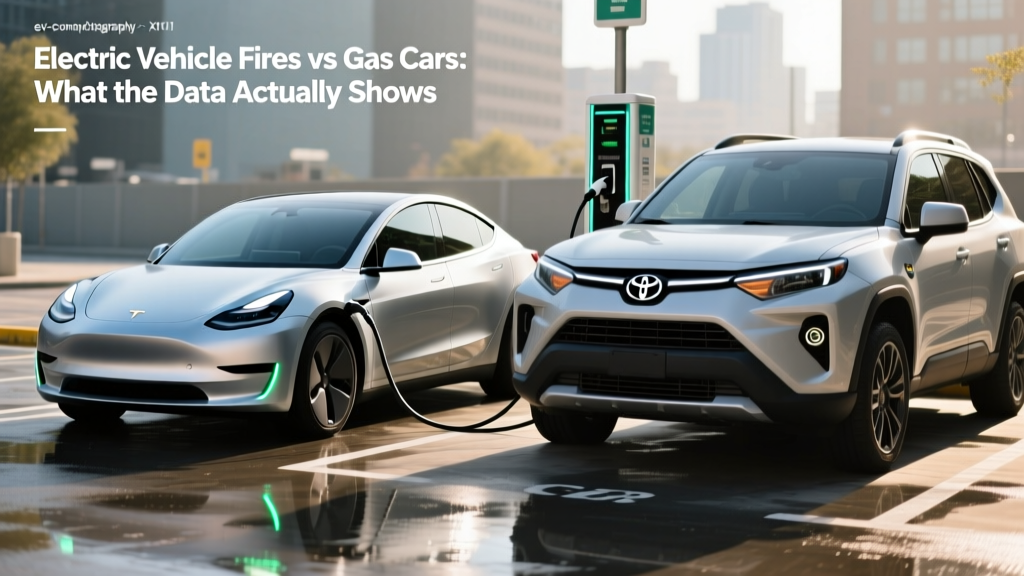
No. By every major dataset, electric vehicle fires occur at a significantly lower rate than internal-combustion engine (ICE) vehicle fires. The best-available analysis — from the National Transportation Safety Board (NTSB) and AutoInsuranceEZ using Bureau of Transportation Statistics data — found that EVs experience roughly 25.1 fires per 100,000 vehicles, compared to 1,529.9 fires per 100,000 for gasoline vehicles. Hybrids sit in between at approximately 3,474.5 per 100,000 (elevated because many older hybrids are high-mileage fleet vehicles). EV fires, however, tend to burn hotter and are harder for firefighters to extinguish due to lithium-ion thermal runaway — a legitimate nuance buyers should understand.
Few EV topics generate more headlines — and more misinformation — than electric vehicle fires. A single battery fire at a charging station or in a parking garage dominates news cycles for days, creating a perception that EVs are rolling fire hazards. The data tells a very different story. This guide breaks down the actual fire-rate statistics, explains why EV fires behave differently when they do happen, and gives you a practical framework for evaluating battery safety as part of your EV purchase decision.
EV Fire Rates vs Gas Cars: The Numbers
The most widely cited fire-rate study in the U.S. comes from a collaboration between AutoInsuranceEZ and data from the NTSB, the Bureau of Transportation Statistics (BTS), and the National Interagency Fire Center. Here's how the three powertrains compare:
| Powertrain | Fires per 100,000 Vehicles | Relative Risk |
|---|---|---|
| Gasoline/Diesel (ICE) | 1,529.9 | Baseline (61× higher than EV) |
| Hybrid (HEV/PHEV) | 3,474.5 | Highest rate* |
| Electric (BEV) | 25.1 | Lowest rate |
*Hybrid fire rates are skewed by older, high-mileage vehicles in the sample — many early-generation hybrids (2004–2012 Prius, Civic Hybrid) now have aging wiring harnesses and fuel systems.
A separate analysis from the Swedish Civil Contingencies Agency (MSB) found that in 2022, only 0.004% of all registered EVs in Sweden caught fire, compared to 0.08% of ICE vehicles — a 20-to-1 ratio consistent with U.S. data. Sweden's cold climate makes this comparison particularly relevant for buyers in northern U.S. states.
Why EV Fires Get More Attention
If EVs catch fire far less often, why does it feel like they're always in the news? Three factors drive the perception gap:
- Novelty bias: Gas car fires happen roughly 17 times per hour in the U.S. (based on NFPA estimates of ~150,000+ highway vehicle fires annually). They're so routine that local media rarely covers them. An EV fire is still unusual enough to trigger coverage.
- Thermal runaway intensity: When a lithium-ion battery pack does ignite, it burns at temperatures exceeding 1,000°C (1,832°F), can reignite hours after being extinguished, and requires tens of thousands of gallons of water to suppress. Fire departments issue press releases because these fires are operationally challenging.
- Recall amplification: High-profile recalls — like the 2022 Chevrolet Bolt EV battery recall (ultimately ~140,000 vehicles) and select Hyundai Kona Electric units — generate sustained coverage even though the affected batteries were replaced.
What Actually Causes Electric Vehicle Fires?
Understanding the root causes helps contextualize the risk:
| Cause | How It Happens | Frequency |
|---|---|---|
| Severe crash damage | High-speed impact punctures battery enclosure, causing internal short circuit and thermal runaway | Most common EV fire trigger |
| Manufacturing defect | Cell-level contamination or welding flaw leads to dendrite growth and internal short over time | Rare; caught via recalls (Bolt, Kona) |
| Charging system fault | Damaged charge port, corroded connector, or faulty Level 2 equipment causes arcing | Very rare; typically involves aftermarket or damaged equipment |
| Bottom impact / road debris | Puncture from road debris compromises battery skid plate | Uncommon; most packs have titanium/steel armor plating |
| Aftermarket modification | Non-OEM accessories wired into high-voltage system improperly | Extremely rare |
The dominant cause — severe crash damage — is the same primary fire trigger for gas cars, except gasoline vehicles add a second major vector: fuel system leaks igniting on hot exhaust components, which EVs simply don't have.
Battery Chemistry and Fire Risk: LFP vs NMC
Not all EV batteries carry identical fire risk. The two dominant chemistries in 2026 model-year EVs behave differently under thermal stress:
| Property | LFP (Lithium Iron Phosphate) | NMC/NCA (Nickel Manganese Cobalt / Nickel Cobalt Aluminum) |
|---|---|---|
| Thermal runaway onset | ~270°C (518°F) | ~210°C (410°F) |
| Oxygen release during failure | Minimal (does not self-oxidize) | Significant (cathode releases oxygen, feeds fire) |
| Energy density | Lower (~160 Wh/kg cell-level) | Higher (~250–300 Wh/kg cell-level) |
| Vehicles using it (2026) | Tesla Model 3/Y RWD, Ford Mustang Mach-E Select, Rivian R1S/R1T Standard, BYD models | Hyundai Ioniq 5/6, Tesla Long Range/Performance, BMW i4/i5, most luxury EVs |
| Fire risk profile | Lower — harder to trigger thermal runaway, less intense if it occurs | Higher energy density means more stored energy to release, though still very low absolute risk |
If fire risk is a primary concern, LFP-equipped models offer a measurable chemistry-level safety advantage. The trade-off is lower energy density, which typically translates to slightly less range for a given battery size.
Real Costs: Insurance, Safety Equipment, and Ownership
Fire risk intersects with your wallet primarily through insurance premiums. Here's what the data shows for 2026:
| Cost Factor | EV Average | Gas Car Average | Notes |
|---|---|---|---|
| Annual insurance premium | $2,100–$2,800 | $1,600–$2,200 | EV premiums are 15–25% higher, driven by repair costs, not fire risk |
| Fire-related total loss rate | <0.01% annually | ~0.08% annually | Insurers price fire risk into both; EV fire losses are a rounding error |
| Post-crash repair (battery) | $15,000–$30,000+ if pack damaged | $3,000–$8,000 typical engine/transmission | This — not fire — is why EV insurance costs more |
| Fire suppression system (home) | Not required for residential charging | N/A | Some commercial garages install battery-specific suppression; homes do not need this |
The higher insurance cost for EVs is overwhelmingly driven by collision repair complexity — battery pack replacement, high-voltage safety protocols for body shops, and aluminum-intensive structures — not by fire probability. Insurers like State Farm, GEICO, and Progressive do not surcharge EVs for fire risk specifically.
What First-Time EV Buyers Should Know About Battery Safety
If you're evaluating an EV purchase and fire safety is on your mind, here's an actionable framework:
Battery Safety Decision Framework
Choose an LFP battery model if:
- Fire risk minimization is a top priority
- You don't need maximum range (LFP packs are heavier for equivalent kWh)
- You plan to charge to 100% regularly (LFP tolerates full-charge storage better than NMC)
- Examples: Tesla Model 3 RWD (EPA 272 mi, ~$38,990 MSRP), base Mustang Mach-E Select
Choose an NMC/NCA model if:
- You need 300+ miles of EPA range or maximum performance
- You can charge to 80% daily and only go to 100% for road trips
- You understand the marginally higher (but still very low) thermal runaway risk
- Examples: Hyundai Ioniq 5 Long Range (EPA 303 mi, ~$46,650), Tesla Model Y Long Range (EPA 320 mi, ~$48,990)
Regardless of chemistry, do these things:
- Check NHTSA recall database for your target model year and trim before purchasing
- Verify the vehicle has an intact battery skid plate (critical for used EVs — have a pre-purchase inspection check for underbody damage)
- Use only UL-listed Level 2 charging equipment at home (look for UL 2594 certification)
- Never charge with a visibly damaged cable or connector
- Install a hardwired Level 2 charger rather than relying on a 120V outlet with an extension cord
Home Charging Safety: Practical Steps
Home charging is where most EV owners spend 80%+ of their charging time, and it's where safety habits matter most. Based on NFPA electrical safety guidelines:
- Circuit capacity: A Level 2 charger drawing 32 amps requires a dedicated 40-amp circuit (NEC requires 125% headroom). Have a licensed electrician verify your panel can support this — a 200-amp service panel typically handles one Level 2 circuit without upgrade.
- Equipment certification: Only use chargers with UL, ETL, or equivalent NRTL certification. Budget brands sold on marketplace sites without certification have been linked to overheating incidents.
- Ventilation: While EVs don't emit fumes during charging, a garage-mounted charger should have basic airflow to dissipate heat from the charge cable and onboard charger. This is a thermal management concern, not a combustion concern.
- Smoke detection: A standard photoelectric smoke detector in your garage is sufficient. No specialized battery-fire detection system is needed for residential installations.
Installation costs for a home Level 2 charger typically range from $500–$2,500 depending on panel proximity and whether a panel upgrade (to 200A) is needed. This cost has no bearing on fire prevention — it's about electrical code compliance and convenience.
Frequently Asked Questions
Can an EV catch fire while parked and not charging?
It is possible but extremely rare. Most parked EV fires trace back to prior crash damage that compromised battery cells, triggering a slow internal short that eventually escalates. Manufacturers build in battery management systems (BMS) that monitor cell voltage and temperature even when the vehicle is off, and will alert owners via app if anomalies are detected. The probability of a spontaneous fire in an undamaged EV is vanishingly small.
Are EV fires harder to put out than gas car fires?
Yes. A lithium-ion thermal runaway fire can require 3,000–30,000+ gallons of water to fully suppress (compared to 500–1,000 gallons for a typical gas car fire), and the battery can reignite hours or even days later as damaged cells continue to short. Fire departments are increasingly trained on EV-specific suppression techniques, including full-vehicle submersion in some jurisdictions. This is an operational challenge for first responders, not a higher probability of fire for owners.
Do EV fires release toxic fumes?
Yes. Burning lithium-ion batteries release hydrogen fluoride (HF) gas and other toxic compounds. This is a serious concern for firefighters and anyone near an active battery fire. However, this is a hazard during the event — not during normal operation, charging, or ownership. Gas car fires also release toxic combustion products including carbon monoxide, benzene, and unburned hydrocarbons.
Should I avoid buying an EV because of fire risk?
The data does not support this decision. At 25.1 fires per 100,000 vehicles, your probability of experiencing an EV fire in a given year is approximately 0.025% — roughly 1 in 4,000. For context, the annual probability of a gas car fire is approximately 1 in 65. If fire risk is a specific concern, prioritize LFP-chemistry models, check NHTSA recalls, and maintain your charging equipment properly.
Do federal safety standards cover EV battery fires?
Yes. The National Highway Traffic Safety Administration (NHTSA) enforces FMVSS 305, which requires EV battery packs to withstand specific crash forces without electrolyte leakage or electrical shock hazards. Additionally, the UN ECE R100 standard (used globally) mandates thermal propagation tests. Every EV sold in the U.S. must meet these standards, and NHTSA can issue recalls and investigations when real-world incidents suggest a defect — as it did with the Chevrolet Bolt and Hyundai Kona battery recalls.
The bottom line for 2026 EV buyers: electric vehicle fires are real but statistically rare — roughly 60 times less likely than gas car fires by the best available U.S. data. The fires that do occur are more intense and harder to extinguish, which is a legitimate consideration for first responders and insurance adjusters. For the individual buyer, fire risk should rank well below range, charging speed, price, and home charging access in your purchase decision. Choose a chemistry you're comfortable with, verify recalls, install proper home charging equipment, and let the numbers guide you rather than the headlines.