Quick Answer: Electric vehicle fires are significantly less common than gasoline car fires per 100,000 vehicles sold. According to data analyzed by the National Transportation Safety Board and AutoInsuranceEZ, EVs experience roughly 25 fires per 100,000 vehicles, compared to approximately 1,530 fires per 100,000 for internal combustion engine (ICE) vehicles. However, when an EV battery fire does occur, it can be harder to extinguish due to thermal runaway in lithium-ion cells, requiring specialized firefighting techniques and substantially more water. For buyers, the statistical risk of a fire is lower in an EV than in a gas car — but understanding battery chemistry, charging habits, and post-collision protocols matters for minimizing that already-small risk.
The Data: How Often Do Electric Vehicle Fires Actually Happen?
Headlines about electric vehicle fires generate outsized attention, but the raw numbers tell a different story. A widely cited study using data from the National Transportation Safety Board (NTSB), the Bureau of Transportation Statistics, and the National Fire Incident Reporting System found stark differences in fire rates by powertrain:
| Powertrain | Fires per 100,000 Vehicles | Relative Risk |
|---|---|---|
| Hybrid vehicles | 3,475 | Highest |
| Gasoline (ICE) vehicles | 1,530 | ~61x higher than EVs |
| Electric vehicles (BEVs) | 25 | Lowest (baseline) |
The hybrid figure deserves context: most hybrid fires involve the ICE components (fuel systems, exhaust heat) rather than the smaller battery pack. Gasoline vehicles carry a flammable liquid that vaporizes easily and ignites at relatively low temperatures — a fundamental risk that EVs simply don't have.
For perspective, the National Fire Protection Association (NFPA) estimates that U.S. fire departments respond to an average of over 170,000 highway vehicle fires annually, the vast majority involving conventional gasoline or diesel vehicles. EV fires represent a tiny fraction of that total, consistent with the low per-vehicle rate.
Why EV Battery Fires Are Different — and Harder to Fight
Lower probability does not mean zero consequence. When a lithium-ion battery pack enters thermal runaway — a chain reaction where overheated cells ignite adjacent cells — the resulting fire burns hotter, longer, and can reignite hours or even days after initial suppression.
Key characteristics of EV battery fires versus gasoline fires:
- Temperature: Lithium-ion cell fires can reach 2,000°F–3,000°F, compared to roughly 1,500°F for a gasoline fire.
- Water volume: Extinguishing a large EV battery fire can require 3,000–8,000+ gallons of water, versus 500–1,500 gallons for a typical ICE vehicle fire.
- Reignition risk: Damaged battery cells can reignite 24–72 hours after the fire appears suppressed, requiring extended monitoring or submersion in water.
- Toxic off-gassing: Burning lithium-ion cells release hydrogen fluoride (HF) gas and other toxic compounds, requiring hazmat-level respiratory protection for firefighters.
Fire departments across the country have been updating training protocols to handle EV incidents. The NFPA's Emergency Response Guides provide model-specific procedures for first responders, including battery disconnect locations and recommended suppression methods.
Battery Chemistry and Fire Safety: LFP vs NMC
Not all EV batteries carry the same fire risk profile. The two dominant chemistries in 2026 model-year EVs differ meaningfully in thermal stability:
| Factor | NMC / NCA (Nickel-based) | LFP (Lithium Iron Phosphate) |
|---|---|---|
| Thermal runaway onset | ~392°F (200°C) | ~518°F (270°C) |
| Oxygen release during failure | Yes — accelerates fire | No — more stable cathode |
| Energy density | Higher (more range per kg) | Lower (heavier for same range) |
| Common in 2026 models | Tesla Model Y Long Range, Hyundai Ioniq 5, BMW iX | Tesla Model 3 RWD, Ford Mustang Mach-E Select (LFP option), BYD models |
| Cycle life | ~1,500–2,000 cycles | ~3,000–5,000 cycles |
| Fire risk profile | Moderate — requires robust BMS and cooling | Lower — inherently more thermally stable |
LFP chemistry's higher thermal runaway threshold and lack of oxygen release during cell failure make it inherently safer in extreme scenarios. Tesla has shifted its standard-range Model 3 and Model Y to LFP packs, and more manufacturers are following. If fire safety is a top concern, choosing an LFP-equipped model provides a measurable margin of safety — though the trade-off is slightly lower energy density and, in some models, reduced range.
EV vs Gas: Total Ownership Cost Including Insurance and Fire Risk
Fire risk factors into insurance premiums, but it's one of many variables. Here's a realistic five-year cost comparison between a representative 2026 EV and a comparable gasoline vehicle:
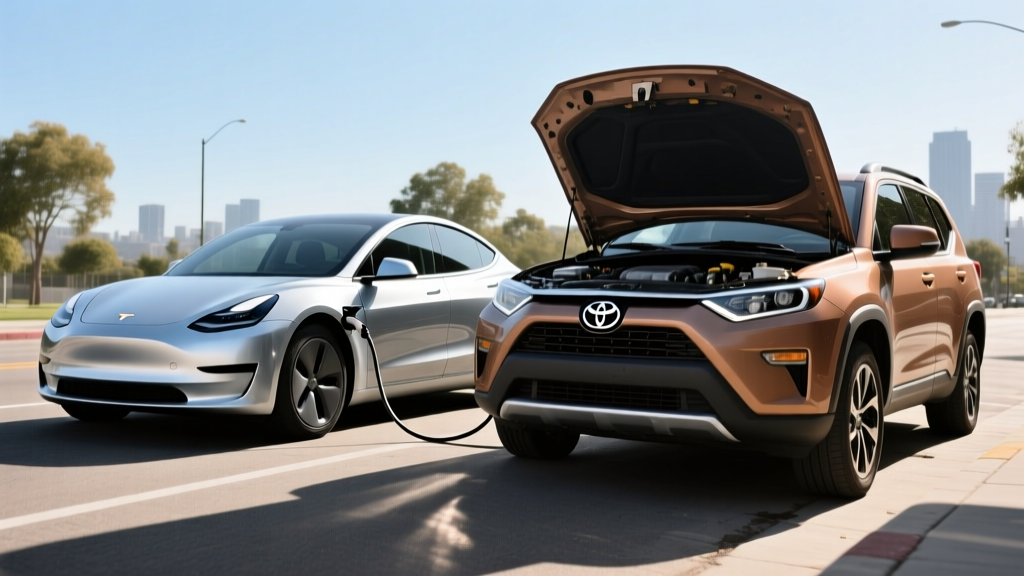
| Cost Category (5-Year) | 2026 Tesla Model 3 RWD (LFP) | 2026 Toyota Camry LE (Gas) |
|---|---|---|
| MSRP (base) | $38,990 | $29,995 |
| Federal tax credit (§30D, if eligible) | −$7,500 (point-of-sale) | $0 |
| Effective purchase price | $31,490 | $29,995 |
| Fuel / electricity (75,000 mi) | $3,750 (home charging avg $0.15/kWh, 25 kWh/100mi) | $9,375 (30 MPG avg, $3.75/gal) |
| Maintenance | $1,500 (tire rotations, cabin filter, fluid top-offs) | $4,200 (oil changes, filters, brakes, belts) |
| Insurance (5-year avg) | $10,500 (~$2,100/yr) | $7,500 (~$1,500/yr) |
| Depreciation (est.) | $14,000 | $11,000 |
| Total 5-Year Cost | $61,240 | $62,070 |
EV insurance premiums run 20–40% higher than comparable gas vehicles, driven by higher repair costs after collisions (battery pack replacement can cost $10,000–$22,000), specialized labor, and parts pricing. Fire risk specifically is a minor premium factor — insurers weight collision frequency and repair cost far more heavily than fire probability.
The fuel savings are where EVs close the gap: at $0.15/kWh for home Level 2 charging, electricity costs roughly $0.05/mile versus $0.125/mile for a 30 MPG gas car at $3.75/gallon. That gap widens further if you rely on public DC fast charging at $0.35–$0.50/kWh, which is why home charging access is a critical ownership variable.
Common EV Fire Myths — Addressed with Facts
| Myth | Fact |
|---|---|
| "EVs catch fire all the time from charging" | Charging-related EV fires are exceedingly rare. Most EV fires stem from severe collisions or manufacturing defects, not normal charging. Properly installed Level 2 home chargers with correct amacity and wiring present minimal fire risk. |
| "EV fires are impossible to put out" | They are suppressible but require more water and time. Many fire departments now carry specific EV fire protocols, and some use fire blankets or submersion tanks to contain thermal runaway. |
| "A damaged EV will spontaneously combust in your garage" | Post-collision thermal events are possible but uncommon. Modern battery management systems (BMS) continuously monitor cell temperatures and voltage. If you've been in a significant collision, manufacturers recommend a professional inspection before resuming charging. |
| "EVs are more dangerous than gas cars overall" | By fire frequency, EVs are far safer. By crash safety, EVs often score higher due to the low center of gravity (reducing rollover risk) and rigid battery-pack structure. IIHS Top Safety Pick ratings frequently include EVs like the Hyundai Ioniq 5, Tesla Model Y, and Genesis Electrified GV70. |
| "Home charging is a fire hazard" | A properly installed Level 2 charger on a dedicated 240V circuit with correct gauge wiring is no more a fire risk than an electric dryer or oven. The risk comes from improper installations — using extension cords, undersized outlets, or unpermitted DIY wiring. |
What First-Time EV Buyers Should Know About Safety
If fire safety is on your mind as you evaluate an EV purchase, here's a practical decision framework:
Choose an LFP-equipped EV if:
- Thermal stability is a top priority
- You're considering a standard-range model (LFP is common in base trims)
- You plan to charge to 100% regularly (LFP tolerates full-charge storage better than NMC)
- You're comfortable with slightly lower range for the same battery weight
Choose an NMC/NCA-equipped EV if:
- You need maximum range (Long Range / Performance trims)
- You'll primarily charge to 80% daily (recommended for NMC longevity)
- You prioritize energy density for road-trip efficiency
Regardless of chemistry, follow these safety practices:
- Home charging: Hire a licensed electrician for a dedicated 240V/40A–48A circuit. Ensure your panel has capacity (a 200A panel is typically sufficient; older 100A panels may need upgrading at $1,500–$3,000).
- Post-collision: Do not charge a damaged EV until a certified technician inspects the battery pack. Many manufacturers include post-crash battery assessment in their collision repair protocols.
- Recalls: Monitor NHTSA recall notices for your specific model year. A small number of EV models have had battery manufacturing defect recalls (e.g., certain Hyundai Kona Electric and Chevrolet Bolt EV battery packs in earlier model years) — these were addressed through replacement or software updates.
- Charging habits: Avoid repeated DC fast charging to 100% on NMC packs. The 10–80% window is where charging is fastest and the battery is under the least thermal stress.
- Garage parking: If your EV has sustained underbody damage or shows warning lights related to the battery system, park outdoors and contact your dealer — don't wait for symptoms to worsen.
The Bottom Line for EV Buyers
The data is unambiguous: electric vehicle fires are dramatically less frequent than gasoline vehicle fires. The ~25 per 100,000 EV fire rate versus ~1,530 per 100,000 for gas cars means you are roughly 60 times less likely to experience a vehicle fire in an EV. That statistical advantage holds even as the EV fleet grows and ages.
What makes EV fires newsworthy isn't frequency — it's the complexity of suppression when they do occur. Thermal runaway in a 75–100 kWh battery pack is a fundamentally different firefighting challenge than a gasoline fire, and the industry (both automakers and first responders) has been adapting. LFP chemistry adoption, improved battery enclosure designs, and better BMS monitoring continue to reduce an already-low risk.
For buyers, the practical takeaway is straightforward: an EV is statistically safer from fire than the gas car it would replace. Focus your evaluation on real ownership variables — home charging access, total cost of ownership, range for your driving pattern, and battery warranty coverage (typically 8 years/100,000 miles with a 70% capacity retention threshold) — rather than letting outlier fire headlines drive your decision.
Are electric vehicle fires more dangerous than gas car fires?
They burn hotter and longer due to thermal runaway, requiring more water and specialized suppression. However, they occur far less frequently. First responder training for EV fires has expanded significantly, and most major fire departments now have EV-specific protocols.
Can charging an EV at home cause a fire?
Charging-related fires are extremely rare when equipment is properly installed. Use a UL-listed Level 2 charger on a dedicated 240V circuit installed by a licensed electrician. Avoid extension cords, adapters not rated for continuous EV load, and unpermitted electrical work.
Which EV battery chemistry is safest?
LFP (lithium iron phosphate) has a higher thermal runaway threshold (~270°C vs ~200°C for NMC) and does not release oxygen during cell failure, making it inherently more stable. LFP is common in standard-range trims from Tesla, Ford, and others.
What should I do if my EV has been in a collision?
Do not resume charging until a certified technician inspects the battery pack and high-voltage system. Modern EVs have automatic high-voltage disconnects that activate during airbag deployment, but physical damage to the battery enclosure requires professional assessment.
Do EVs cost more to insure because of fire risk?
EV insurance premiums are 20–40% higher on average, but fire risk is a minor factor. The primary drivers are higher collision repair costs (battery replacement can exceed $15,000), specialized labor requirements, and higher vehicle purchase prices.