The Quick Answer: EVs Don't Have Engines — They Have Electric Motors
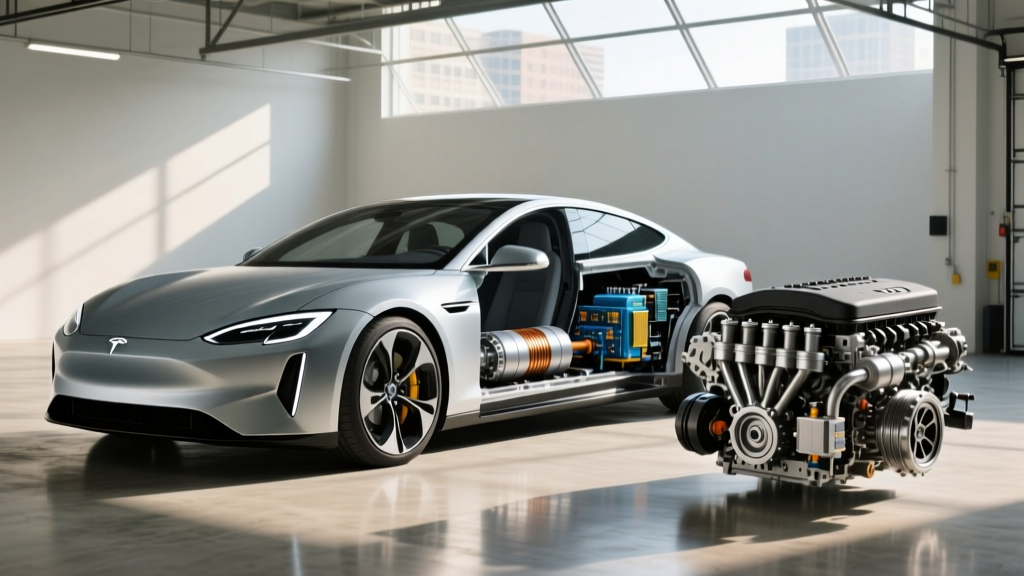
When shoppers search for an "electric vehicle engine," they're really asking about the electric motor that propels a battery-electric vehicle (BEV). Unlike a gasoline car's internal combustion engine (ICE), which burns fuel to move pistons, an EV uses an electric motor powered by a lithium-ion battery pack. There's no combustion, no pistons, no exhaust, and far fewer moving parts. A typical EV motor has around 20 moving components compared to over 2,000 in a gas powertrain.
Why this matters for buyers: That mechanical simplicity translates to lower maintenance costs (no oil changes, spark plugs, timing belts, or transmission fluid), instant torque for brisk acceleration, and higher energy efficiency. Where a gas engine converts only ~20-30% of fuel energy into motion, an EV motor converts roughly 85-90% of battery energy into forward movement.
But the motor is only part of the story. The battery pack, thermal management system, power electronics (inverter and onboard charger), and regenerative braking all work together as the EV's "powertrain." Understanding this system — and how it stacks up against a gas car or hybrid in cost, convenience, and capability — is essential before making a purchase in 2026.
How an Electric Motor Actually Works (Without the Engineering Jargon)
An EV's electric motor operates on electromagnetic principles: current flowing through wire coils in the stator creates a rotating magnetic field that spins the rotor, which connects to the wheels. Most modern EVs use one of two motor types:
- Permanent Magnet Synchronous Motor (PMSM): Used in vehicles like the Tesla Model Y, Hyundai Ioniq 5, and Ford Mustang Mach-E. These are highly efficient (up to 95%) and compact but rely on rare-earth magnets (neodymium, dysprosium), which carry supply-chain and cost implications.
- AC Induction Motor: Found in some Tesla configurations and older EVs. Slightly less efficient at low loads but avoids rare-earth materials entirely. Tesla uses these on front axles of dual-motor setups for their efficiency when coasting.
The inverter converts DC power from the battery into AC power for the motor (and vice versa during regenerative braking). The onboard charger handles converting AC power from your home outlet or public Level 2 station into DC power to charge the battery. These components collectively replace the engine, transmission, fuel pump, exhaust system, and dozens of sensors found in a gas car.
Performance-wise, electric motors deliver peak torque from 0 RPM, which is why even modest EVs feel punchy off the line. A 2026 Tesla Model 3 Long Range produces 346 horsepower and hits 0-60 mph in 4.4 seconds from a single rear motor, while the dual-motor Performance variant delivers 510 hp and a 3.1-second sprint. A comparably priced BMW 330i gas sedan produces 255 hp and runs 0-60 in about 5.6 seconds.
EV Motor vs. Gas Engine vs. Hybrid: The Numbers Side by Side
The table below compares a representative 2026 BEV, gas sedan, and plug-in hybrid across the metrics that matter for ownership:
| Metric | 2026 Tesla Model 3 LR (BEV) | 2026 Toyota Camry LE (Gas) | 2026 Toyota RAV4 Prime (PHEV) |
|---|---|---|---|
| Powertrain type | Single permanent magnet motor | 2.5L 4-cyl ICE | 2.5L 4-cyl + 2 electric motors |
| Horsepower | 346 hp | 203 hp | 302 hp combined |
| 0-60 mph | 4.4 sec | 7.6 sec | 5.7 sec |
| Energy efficiency | 132 MPGe (25 kWh/100mi) | 32 MPG combined | 94 MPGe (elec) / 38 MPG (gas) |
| EPA range | 341 miles | ~510 miles (13.2-gal tank) | 42 mi electric + 530 mi gas |
| Moving parts in drivetrain | ~20 | ~2,000+ | ~2,000+ (ICE) + electric motors |
| Annual maintenance (est.) | ~$300-$400 | ~$900-$1,200 | ~$700-$1,000 |
| Base MSRP | $44,130 | $29,495 | $44,590 |
Key takeaway: The EV motor wins decisively on efficiency, acceleration, and maintenance simplicity. The gas engine wins on upfront price and refueling infrastructure in rural areas. The PHEV splits the difference — offering electric-only commuting with a gas backup for road trips.
The Real Cost of Ownership: EV Motor Efficiency in Your Wallet
Because an electric motor wastes far less energy as heat, an EV's "fuel" cost per mile is dramatically lower — but the savings depend heavily on your local electricity rate and driving patterns.
| Cost Factor (5-Year/75,000 mi) | 2026 Tesla Model 3 LR | 2026 Toyota Camry LE | Notes |
|---|---|---|---|
| Purchase price (base) | $44,130 | $29,495 | EV qualifies for up to $7,500 §30D credit if eligible |
| Federal tax credit (§30D) | Up to -$7,500 | $0 | Subject to income, MSRP, and sourcing rules — see IRS §30D guidelines |
| Fuel / electricity cost | $2,810 (home charging at $0.15/kWh) | $8,440 ($3.40/gal avg, 32 MPG) | Public DC fast charging raises EV cost to ~$4,500 |
| Maintenance | $1,750 | $5,250 | EV: tire rotation, cabin filter, brake fluid. Gas: oil, filters, belts, spark plugs, transmission |
| Insurance (est.) | $9,500 | $7,200 | EV premiums run 15-30% higher on average |
| Estimated depreciation | $19,800 | $13,200 | EV depreciation has improved but still steeper for many models |
| 5-Year Total Cost | $30,890 | $37,185 | EV saves ~$6,295 if credit applies and home charging is used |
Several caveats apply. The §30D federal tax credit has strict eligibility requirements: buyer income caps ($150K single / $300K joint), vehicle MSRP caps ($55K sedans / $80K SUVs and trucks), and battery component and critical mineral sourcing requirements that shift annually. Always verify your specific eligibility on IRS.gov or consult a tax professional. The credit can now be transferred to the dealer at point of sale, reducing your purchase price directly.
Home charging is the economic linchpin. If you charge exclusively on public DC fast chargers (averaging $0.35-$0.50/kWh in 2026), your "fuel" savings shrink significantly. If you lack access to home or workplace Level 2 charging, an EV's cost advantage erodes — and a hybrid may make more financial sense.
Common EV Motor Myths vs. Reality
| Myth | Fact |
|---|---|
| "EVs need new batteries every few years." | Modern LFP and NMC batteries are warrantied for 8 years/100,000 miles (10 years/150,000 miles in CARB states). Real-world data from Tesla's 2025 Impact Report shows average battery degradation of ~12% at 200,000 miles. Full replacements remain rare and cost $5,000-$16,000 depending on pack size. |
| "EV motors can't handle cold weather." | The motor itself is unaffected by cold. However, the battery loses 20-35% of its range at temperatures below 20°F due to increased internal resistance and cabin heating demands. Preconditioning the battery (via the vehicle's app while plugged in) recovers much of this loss. |
| "EVs are slower than gas cars." | Instant torque gives most EVs a decisive advantage in 0-30 mph city acceleration. A $44K Tesla Model 3 LR out-accelerates a $60K BMW 330i to 60 mph. Highway passing power is strong, though sustained high-speed driving (80+ mph) consumes range rapidly. |
| "An electric vehicle engine needs oil changes." | EVs have no engine oil, no transmission fluid (most use a single-speed reduction gear), no spark plugs, and no timing belts. Maintenance is limited to tires, cabin air filters, brake fluid checks, and windshield washer fluid. |
| "Regenerative braking means you never use the brake pads." | Regen handles 80-95% of deceleration in normal driving, dramatically extending pad life (many owners report original pads at 80,000+ miles). But friction brakes are still needed for emergency stops and low-speed holding, and they still require periodic inspection. |
What First-Time EV Buyers Need to Know About the Powertrain
If you're transitioning from a gas car, the EV driving experience requires a few mental shifts:
1. Range is not a fixed number. The EPA sticker on a 2026 Hyundai Ioniq 5 says 303 miles for the Long Range AWD model. In real-world highway driving at 70 mph in moderate temperatures, expect roughly 260-280 miles. In sub-freezing conditions with the heater running, that drops to 210-240 miles. Always plan road trips using 75-80% of the EPA figure as your practical range.
2. Charging speed is measured in kW, battery size in kWh. The Ioniq 5's battery holds 84 kWh of usable energy. At a DC fast charger, it can accept up to 238 kW peak, charging from 10% to 80% in roughly 18 minutes. But that peak rate only holds up to about 40-50% state of charge — then the charge curve tapers. Your last 20% will take noticeably longer than your first 20%.
3. Home Level 2 charging is the ownership backbone. A 240V Level 2 home charger (typically 7.7-11.5 kW) adds 25-44 miles of range per hour of charging. Overnight charging fully replenishes most EVs. Installation costs range from $500-$2,000 if your electrical panel has capacity, or $2,000-$4,500+ if a panel upgrade (100A to 200A) is needed. Always get a quote from a licensed electrician before committing to a vehicle.
4. Battery chemistry matters. Vehicles with LFP (lithium iron phosphate) batteries — like the Tesla Model 3 RWD — can and should be charged to 100% daily. NMC (nickel manganese cobalt) batteries — like those in the Model 3 Long Range and most other EVs — last longer when daily charging is limited to 80%. Check your vehicle's battery chemistry before setting charge limits.
5. One-pedal driving changes everything. By lifting off the accelerator, regenerative braking slows the car significantly — often enough to avoid touching the brake pedal in stop-and-go traffic. Most EVs let you adjust regen strength. Give yourself two weeks to adapt; most owners never want to go back.
Decision Framework: Is an EV Powertrain Right for You?
Choose a full EV (BEV) if:
- You have reliable access to home or workplace Level 2 charging
- Your daily commute is under 80 miles round-trip (well within any EV's range)
- You take road trips 1-3 times per year and can plan around DC fast-charging stops
- You want the lowest per-mile fuel cost and minimal maintenance
- You qualify for the §30D tax credit, narrowing the upfront price gap
Choose a plug-in hybrid (PHEV) if:
- You lack reliable home charging but want electric commuting (PHEVs charge fine on standard 120V overnight for 30-42 miles of range)
- You frequently drive long distances through areas with sparse charging infrastructure
- You want electric driving without any range planning
- Your budget favors a lower MSRP and you don't qualify for the full EV credit
Stick with a gas car or conventional hybrid (HEV) if:
- You live in an apartment with no charging access and no workplace charging
- You regularly tow heavy loads (towing cuts EV range by 40-55%)
- Your annual mileage is very low (under 6,000 miles), making fuel savings negligible against a higher purchase price
- You live in an extreme-cold climate where 30%+ range loss creates genuine hardship for your commute
The electric motor is mechanically superior to the internal combustion engine in nearly every measurable way — efficiency, responsiveness, longevity, and maintenance. The real question in 2026 isn't whether the technology works; it's whether your charging situation, driving patterns, and budget align with what an EV requires. For most drivers with home charging access, the math and the driving experience make a compelling case.
Frequently Asked Questions
Do electric cars have engines or motors?
Electric cars have electric motors, not engines. The term "engine" specifically refers to a machine that converts thermal energy (from burning fuel) into mechanical motion. EVs use electromagnetic motors that convert electrical energy from a battery into rotational force. There is no combustion, no exhaust, and no multi-speed transmission in most EVs.
How long do EV electric motors last?
EV motors are extraordinarily durable and routinely last 300,000+ miles with essentially zero maintenance. Unlike gas engines, there are no piston rings to wear, no valves to adjust, and no gaskets to fail. The motor bearings are the primary wear item, and these are engineered for the life of the vehicle. Motor failure in modern EVs is extremely rare.
Can an electric vehicle motor be repaired if it fails?
Yes, but full motor replacement is uncommon. Most issues are diagnosed at the power electronics level (inverter, wiring, sensors) rather than the motor itself. If a motor does need replacement, costs range from $3,000-$7,000 depending on the vehicle — but this is covered under the federally mandated 8-year/100,000-mile powertrain warranty for most EVs sold in the US.
Why do some EVs have two motors?
Dual-motor EVs place one motor on each axle for all-wheel drive. This improves traction in rain and snow, enables faster acceleration (both motors contribute to 0-60 times), and allows for torque vectoring. Some dual-motor setups (like Tesla's) disengage the front induction motor during cruising to maximize efficiency. The trade-off is slightly higher cost, weight, and energy consumption.
Are EVs really cheaper to own than gas cars?
Over 5 years and 75,000 miles, a mid-range EV like the Tesla Model 3 can save $4,000-$8,000 compared to a comparable gas sedan — primarily through lower fuel and maintenance costs — if you qualify for the §30D tax credit and charge primarily at home. Without the tax credit or with exclusive public fast-charging use, the savings narrow to $1,000-$3,000 or may flip to a net cost. Check your specifics using the DOE's EV cost calculator at fueleconomy.gov.
What happens to an EV motor when the battery degrades?
Battery degradation reduces range but does not affect motor performance. The motor will deliver the same horsepower and torque whether the battery is at 100% or 70% state of health (SoH). However, a degraded battery means you'll need to charge more frequently to cover the same distance. Most EVs retain 85-90% of original battery capacity after 100,000 miles based on fleet data.