Electric Vehicle Comparison Australia: Tesla Model Y vs BYD Atto 3
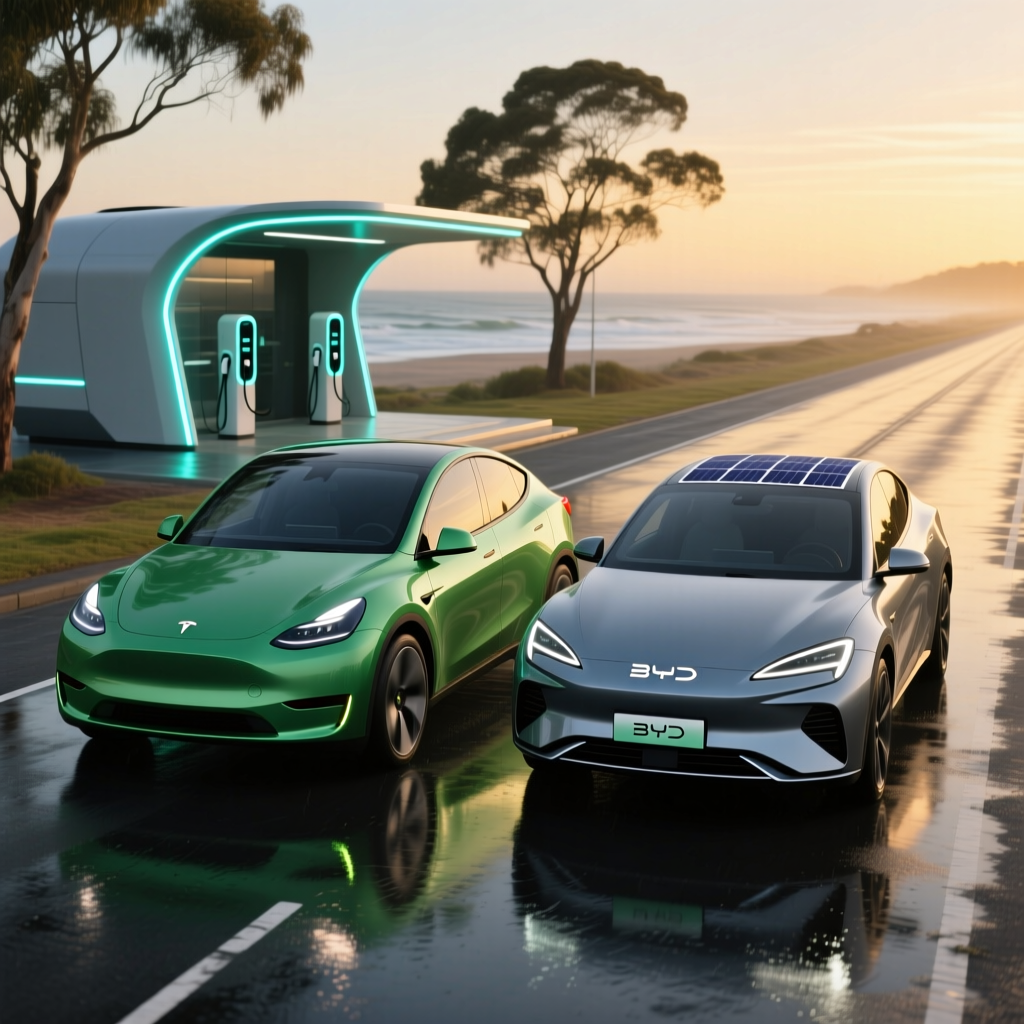
The Australian automotive landscape has undergone a seismic shift, with electric vehicles transitioning from niche novelties to mainstream necessities. When navigating the search for the perfect zero-emissions family hauler, two nameplates consistently dominate the conversation and the sales charts: the Tesla Model Y and the BYD Atto 3. Both vehicles have played pivotal roles in normalising EV ownership across the country, but they approach the market with vastly different philosophies, price points, and technological ecosystems.
In this comprehensive electric vehicle comparison, we put the benchmark-setting Tesla Model Y head-to-head against the value-driven BYD Atto 3. Whether you are commuting through Sydney’s bustling suburbs, tackling the steep inclines of Adelaide, or planning a long-distance road trip along the Hume Highway, understanding the nuances between these two popular SUVs is critical. For a broader look at the market, be sure to check out our guide to the best EVs in Australia and our ranking of the best electric SUVs currently available.
Side-by-Side Specification Comparison
Before diving into the real-world driving experience, it is essential to look at the raw numbers. The following table compares the most popular rear-wheel-drive and standard-range variants of both vehicles, which represent the bulk of Australian deliveries.
| Specification | Tesla Model Y (Rear-Wheel Drive) | BYD Atto 3 (Standard Range) |
|---|---|---|
| Battery Chemistry | LFP (Lithium Iron Phosphate) | LFP (Blade Battery) |
| Battery Capacity | ~60 kWh (usable) | ~50 kWh (usable) |
| WLTP Range | 455 km | 345 km |
| EPA Estimated Range | ~390 km | ~280 km |
| Power Output | 220 kW | 150 kW |
| Torque | 440 Nm | 310 Nm |
| 0-100 km/h | 6.9 seconds | 7.3 seconds |
| DC Fast Charging (Max) | 170 kW | 80 kW |
| Boot Space (Rear Seats Up) | 854 L | 440 L |
| Tow Rating (Braked) | 1,600 kg | 750 kg |
Range and Real-World Efficiency
Range anxiety remains a primary concern for Australian buyers, particularly given the vast distances between regional towns and the sprawling nature of our capital cities. The Tesla Model Y holds a distinct advantage on paper, offering a WLTP range of 455 km compared to the BYD Atto 3’s 345 km. However, paper figures rarely tell the whole story.
Both vehicles utilise Lithium Iron Phosphate (LFP) battery chemistry in their standard-range guises. LFP is highly regarded for its longevity, thermal stability, and the ability to be routinely charged to 100% without degrading the battery cells—a massive plus for daily commuters. While Australian consumers typically rely on WLTP and ADR figures, consulting EPA ratings often provides a more conservative and realistic expectation of highway range at higher speeds, which is crucial for Australian road trips. Under the stricter EPA testing cycle, the Model Y’s real-world highway capability shines, maintaining impressive efficiency even at 110 km/h.
According to independent test data from EV Database, real-world energy consumption varies significantly based on ambient temperature and driving style. The Model Y’s industry-leading heat pump and aerodynamic drag coefficient allow it to sip energy frugally on the open highway. The Atto 3, with its slightly boxier SUV profile, consumes more energy at higher speeds, making the Model Y the undisputed king for those who frequently travel between cities like Melbourne and Sydney or Brisbane and the Gold Coast.
Pricing and Value Proposition
Price is where the BYD Atto 3 mounts its most aggressive offensive. Positioned as a compact SUV, the Atto 3 undercuts the Model Y by a significant margin, making it an incredibly attractive entry point for first-time EV buyers. When factoring in drive-away costs, the Atto 3 frequently lands in the territory traditionally occupied by mid-spec internal combustion engine SUVs, offering a compelling value proposition that is hard to ignore.
The Tesla Model Y, while more expensive upfront, justifies its premium through sheer scale, performance, and technology. It is a mid-size SUV that competes directly with luxury European offerings but at a fraction of the cost. Furthermore, Australian tax incentives play a massive role in the true cost of ownership. Both vehicles often fall below the Luxury Car Tax (LCT) threshold for fuel-efficient vehicles, and they are eligible for the federal Fringe Benefits Tax (FBT) exemption when purchased through a novated lease. This FBT exemption has revolutionised the Australian EV market, effectively discounting the cost of the vehicle by thousands of dollars for salary-packaging employees.
State-based incentives also sweeten the deal. Depending on where you reside, you may be eligible for stamp duty exemptions in states like NSW and VIC, or direct rebates in QLD and WA. When you run the numbers through a novated lease calculator, the gap between the Atto 3 and the Model Y narrows considerably, though the BYD remains the undisputed champion of outright affordability. For more detailed pricing breakdowns, read our full BYD Atto 3 review and Tesla Model Y review.
Charging Speed and Infrastructure
Charging an EV in Australia requires an understanding of the local infrastructure, which relies heavily on the CCS2 standard for public DC fast charging. Here, the Tesla Model Y enjoys a massive ecosystem advantage. The Tesla Supercharger network is widely considered the most reliable, expansive, and user-friendly charging network in the country. While Tesla has begun opening select Superchargers to non-Tesla EVs, Model Y owners still benefit from seamless plug-and-charge functionality, automatic billing, and real-time stall availability integrated directly into the car’s navigation system.
The BYD Atto 3 relies on third-party networks like Chargefox, Evie, and Ampol. While these networks are expanding rapidly, they can occasionally suffer from downtime or payment app glitches. Furthermore, the Atto 3’s peak DC charging speed is capped at 80 kW. In real-world testing, the Atto 3’s charging curve is notoriously conservative, often taking over 45 minutes to charge from 10% to 80% on a fast trip. In contrast, the Model Y can peak at 170 kW (on V3 Superchargers) and typically completes the 10-80% sprint in under 25 minutes.
For home charging, both vehicles support AC charging, but the Model Y’s 11 kW onboard charger allows it to take full advantage of 3-phase power, which is common in many Australian homes. The Atto 3 is limited to 7 kW on AC, meaning a full home charge will take slightly longer. If you are new to plugging in at home and on the road, our Australian EV charging guide covers everything you need to know about setting up your garage and planning road trips.
Performance and Driving Dynamics
Electric vehicles are renowned for their instant torque, and both the Model Y and Atto 3 deliver the smooth, silent acceleration that makes EVs so addictive. The Tesla Model Y, with its 220 kW output and 440 Nm of torque, is genuinely quick, dispatching the 0-100 km/h sprint in just 6.9 seconds. The throttle response is razor-sharp, and the chassis feels planted, albeit slightly firm, over sharp urban bumps. Tesla’s regenerative braking system is highly refined, allowing for true one-pedal driving once you acclimatise to the aggressive bite.
The BYD Atto 3 takes a more relaxed approach to performance. Its 150 kW motor and 310 Nm of torque are more than adequate for suburban commuting and highway overtaking, but it lacks the sheer punch of the Tesla. Where the Atto 3 shines is in its ride comfort. The suspension is tuned to be softer and more forgiving, soaking up the corrugations and potholes of Australian suburban roads with less fuss than the stiffly sprung Tesla. However, the Atto 3’s regenerative braking is less intuitive, lacking a true one-pedal mode and requiring the driver to use the friction brakes more frequently to come to a complete stop.
Handling dynamics also favour the Tesla. The Model Y’s low centre of gravity and precise steering make it surprisingly engaging on twisty coastal roads. The Atto 3, conversely, suffers from noticeable body roll in corners and steering that feels overly light and disconnected at highway speeds. For the enthusiastic driver, the Model Y is the clear winner; for the comfort-seeking commuter, the Atto 3 offers a more relaxed cruise.
Interior Space, Comfort, and Technology
Stepping inside the Tesla Model Y is an exercise in extreme minimalism. The cabin is entirely devoid of physical buttons, with every function—from adjusting the mirrors to changing the air conditioning—routed through the central 15-inch touchscreen. The build quality has improved significantly in recent production runs, featuring premium vegan leather, acoustic glass, and a panoramic glass roof that floods the cabin with light. Space is where the Model Y truly demolishes the competition. With 854 litres of boot space, a massive under-floor storage area, and a front trunk (frunk), it can swallow family luggage, camping gear, and weekly groceries with ease.
The BYD Atto 3 offers a radically different interior experience. The cabin is quirky, featuring a gym-inspired design motif with dumbbell-shaped air vents, treadmill-style door panels, and guitar-string door pockets. While some buyers find it charming and unique, others find it slightly gimmicky. The 12.8-inch rotating touchscreen is a party trick that works reasonably well, and the physical buttons for climate and volume are a welcome addition for those who dislike Tesla’s screen-only approach. However, the Atto 3’s boot space is a modest 440 litres, and it lacks a frunk entirely, making it less practical for large families or bulky cargo.
On the technology front, Tesla’s software remains the gold standard. The infotainment system is lightning-fast, features over-the-air updates that genuinely add new features, and includes a premium audio system that rivals high-end luxury brands. The Atto 3’s software, while functional, can feel sluggish, and the translation of some menus is occasionally awkward. Both vehicles come equipped with comprehensive ADAS (Advanced Driver Assistance Systems), but Tesla’s Autopilot is vastly superior in lane centering and adaptive cruise control on Australian highways compared to BYD’s more intrusive and overly sensitive lane-keep assist.
Warranty, Servicing, and Ownership
Owning an EV in Australia also means evaluating the after-sales support network. BYD offers a comprehensive 6-year/150,000 km vehicle warranty and an 8-year/160,000 km battery warranty. The advantage of BYD is its traditional dealership model; partnered with established automotive groups across Australia, finding a physical service centre is relatively easy, even in some regional areas. Servicing is required annually or every 20,000 km, and while cheaper than a petrol car, it is a mandatory requirement to keep the warranty intact.
Tesla operates on a 4-year/80,000 km basic vehicle warranty and an 8-year/192,000 km battery warranty. Tesla’s service model is heavily reliant on mobile rangers and a smaller footprint of dedicated service centres. For minor issues, a Tesla ranger will come to your home or office, which is incredibly convenient. However, for major body repairs or complex hardware failures, wait times at physical service centres in major cities can sometimes stretch into weeks. Tesla does not mandate scheduled servicing to maintain the warranty, relying instead on condition-based maintenance, which can save owners money over the life of the vehicle.
The Verdict: Which EV is Right for You?
Choosing between the Tesla Model Y and the BYD Atto 3 ultimately comes down to your budget, your spatial requirements, and your typical driving routes. Both are exceptional vehicles that have rightfully earned their spots at the top of the Australian sales charts, but they cater to distinctly different buyer profiles.
Choose the Tesla Model Y if: You need maximum cargo space for a growing family, you frequently embark on long-distance regional road trips where fast charging and superior range are non-negotiable, and you value cutting-edge software, minimalist design, and class-leading performance. It remains the benchmark by which all other electric SUVs are measured.
Choose the BYD Atto 3 if: You are an urban commuter looking for an affordable, comfortable, and practical entry into the EV space. If you prefer a more traditional cabin layout with physical buttons, a softer suspension tune for city streets, and a lower upfront purchase price, the Atto 3 is a phenomenal value proposition that punches well above its weight class.
Frequently Asked Questions
Is the Tesla Model Y too big for Australian city parking?
The Tesla Model Y is classified as a mid-size SUV, measuring 4,751 mm in length and 1,921 mm in width (excluding mirrors). While it is larger than the BYD Atto 3, it is still highly manageable in most Australian city car parks. The inclusion of high-resolution 360-degree cameras and precise sensor visualisations on the touchscreen makes parking in tight suburban spots surprisingly easy. However, if you live in an area with exceptionally narrow streets or tight mechanical stackers, the more compact Atto 3 might be a less stressful choice.
Can I tow a trailer with the BYD Atto 3?
Towing is a significant weak point for the BYD Atto 3. It is rated for a maximum braked towing capacity of just 750 kg, which restricts you to small box trailers or light jet skis. It is entirely unsuited for towing caravans or large camper trailers. In contrast, the Tesla Model Y offers a braked towing capacity of 1,600 kg, making it a viable option for medium-sized caravans and boat trailers, provided you account for the reduction in driving range when hauling heavy loads.
How do LFP batteries handle the Australian heat?
Both the Tesla Model Y and BYD Atto 3 utilise Lithium Iron Phosphate (LFP) batteries in their standard-range variants. LFP chemistry is inherently more thermally stable than NMC (Nickel Manganese Cobalt) batteries, making them highly resistant to thermal runaway and exceptionally well-suited to Australia’s hot climate. Both vehicles feature active liquid thermal management systems that precondition the battery, ensuring optimal performance and longevity even during the peak of an Australian summer.
Which car has better resale value in Australia?
Historically, Tesla vehicles have enjoyed strong brand recognition and high demand in the used car market, which has helped stabilise their resale values despite aggressive new-car price cuts. The BYD Atto 3, while incredibly popular, is subject to the rapid iteration and aggressive pricing strategies of its parent company, which can sometimes soften used prices when newer, cheaper models are introduced. However, as the Australian EV market matures, both vehicles are expected to hold their value reasonably well compared to their internal combustion counterparts, largely due to the ongoing demand for affordable, used zero-emission vehicles.