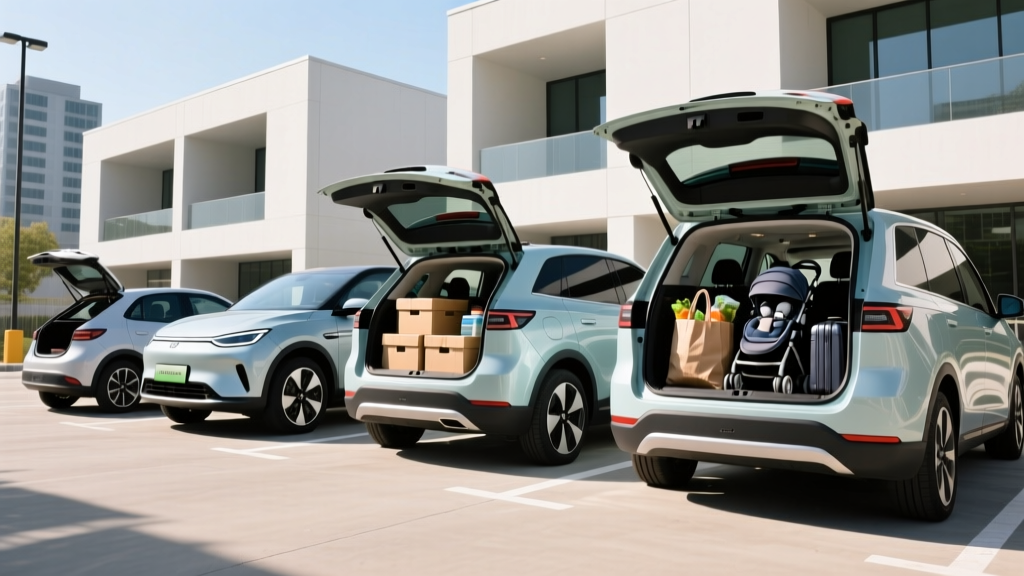
Quick Answer: Which EVs Offer the Most Cargo Space?
If you need maximum electric vehicle cargo capacity in 2026, the Rivian R1S leads SUVs with up to 104.7 cu ft (seats folded), the Tesla Model X provides 88.1 cu ft plus a 6.6 cu-ft frunk, and the Ford F-150 Lightning dominates trucks with a 528 cu-ft (18.1 cu ft) front trunk (Mega Power Frunk) alongside a 5.5-ft bed. For wagons and hatchbacks, the Tesla Model S delivers 28 cu ft behind the rear seats and 74 cu ft folded. Frunk (front trunk) space is a unique EV cargo advantage — gasoline vehicles have no equivalent — and ranges from 0 cu ft on some platforms to over 18 cu ft on the Lightning.
Why Electric Vehicle Cargo Space Works Differently Than Gas Cars
Electric vehicle packaging flips the traditional layout. Without a transmission tunnel, exhaust system, or engine bay, EV platforms sit on a flat "skateboard" chassis that frees up interior volume and creates front-trunk (frunk) storage. The battery pack, however, typically lives under the floor, which raises the load floor height compared to a comparable gas vehicle. This trade-off means:
- More total volume potential — flat floors and frunks add usable space.
- Higher load floors — tall items and dogs may face a bigger step-up.
- Weight penalty — EVs are 500–1,500 lbs heavier than gas equivalents, which can affect payload and towing range.
- No spare tire — most EVs omit a spare to save weight and preserve cargo volume, relying instead on tire-inflator kits.
According to fueleconomy.gov, the curb weight of a 2026 Tesla Model Y Long Range is approximately 4,398 lbs, compared to a gas-powered Toyota RAV4 at roughly 3,615 lbs — a 783-lb difference that eats into payload capacity even as total enclosed volume increases.
Electric Vehicle Cargo Space by Category: The Numbers
Below is a side-by-side comparison of cargo volume across popular 2026-model-year EVs. All figures are manufacturer-published cargo volumes with rear seats folded unless noted. Frunk volumes are listed separately.
| Vehicle | Body Style | Cargo (seats up) | Cargo (seats folded) | Frunk | Max Towing | EPA Range | Base MSRP |
|---|---|---|---|---|---|---|---|
| Rivian R1S (Dual Motor) | 3-row SUV | 21.0 cu ft (behind 3rd row) | 104.7 cu ft | 11.0 cu ft | 7,700 lbs | 352 mi | $79,900 |
| Tesla Model X (Long Range) | 3-row SUV | 15.0 cu ft (behind 3rd row) | 88.1 cu ft | 6.6 cu ft | 5,000 lbs | 329 mi | $77,990 |
| Kia EV9 (GT-Line AWD) | 3-row SUV | 20.2 cu ft (behind 3rd row) | 81.9 cu ft | 3.2 cu ft | 5,000 lbs | 270 mi | $59,900 |
| Hyundai Ioniq 9 (Long Range RWD) | 3-row SUV | 19.5 cu ft (behind 3rd row) | 80.0 cu ft (est.) | 4.5 cu ft | 5,000 lbs | 335 mi | $56,500 |
| Tesla Model Y (Long Range AWD) | 2-row SUV | 30.2 cu ft | 76.2 cu ft | 4.1 cu ft | 3,500 lbs | 320 mi | $46,630 |
| Ford F-150 Lightning (Lariat) | Pickup Truck | 528 cu ft (bed) | N/A | 18.1 cu ft (Mega Frunk) | 10,000 lbs | 320 mi (Ext. Range) | $62,995 |
| Rivian R1T (Dual Motor) | Pickup Truck | 54.0 cu ft (bed w/ tunnel open) | N/A | 11.0 cu ft | 11,000 lbs | 352 mi | $73,000 |
| Tesla Model S (Long Range) | Sedan/Hatch | 28.0 cu ft | 74.0 cu ft | — (none) | — | 402 mi | $74,990 |
| Hyundai Ioniq 5 (Limited AWD) | Crossover | 27.2 cu ft | 59.3 cu ft | 2.1 cu ft | 2,300 lbs | 290 mi | $46,700 |
| VW ID.4 (Pro S AWD) | Crossover | 30.3 cu ft | 64.2 cu ft | — (none) | 2,700 lbs | 263 mi | $47,545 |
Sources: Manufacturer spec sheets, fueleconomy.gov. Ranges and prices reflect 2026 model year where published. Estimated figures marked.
Frunk Space: The Cargo Advantage Gas Cars Can't Match
The frunk is where electric vehicle cargo design diverges most dramatically from internal combustion. A gas car's engine bay is occupied; an EV's is empty. The Ford F-150 Lightning's Mega Power Frunk offers 400 lbs of payload capacity with a lockable, weatherproof, drainable 18.1-cu-ft compartment — effectively a second bed that's secure and enclosed. Rivian's Gear Tunnel (on the R1T) adds a pass-through storage area between the cab and bed that's inaccessible on any gas truck.
However, not every EV includes a frunk. Vehicles built on adapted ICE platforms (like some early conversions) or those that package power electronics in the front may omit it entirely. The VW ID.4 and Tesla Model S (current generation) have no traditional frunk. Always check spec sheets — don't assume frunk space is universal.
Real-World Cargo Considerations: Towing, Range Loss, and Payload
Cargo capacity on paper doesn't tell the whole story. When you load an EV to its limits — especially for towing — the real-world consequences show up in range:
- Towing range loss: Expect 30–50% range reduction when towing near max capacity at highway speeds. The F-150 Lightning's 320-mile EPA range drops to roughly 160–210 miles when pulling an 8,000-lb trailer, based on real-world testing by multiple outlets.
- Cargo weight matters more than in gas cars: Because EVs are already heavy, adding 1,000+ lbs of cargo pushes energy consumption (kWh/mile) up noticeably. A loaded Model Y may see efficiency drop from 3.6 mi/kWh to 3.0 mi/kWh on the highway.
- Regenerative braking helps downhill: Loaded EVs recover more energy on descents than empty ones — a loaded truck descending a mountain pass can add meaningful range back. Gas vehicles simply waste that energy as brake heat.
- Cold weather compounds the problem: At 20°F, battery efficiency already drops 15–30%. Add a full cargo load and towing, and your effective range can halve. Plan charging stops accordingly.
Cost to Haul: EV vs Gas Truck (1,000-Mile Towing Trip)
| Factor | EV (F-150 Lightning Ext. Range) | Gas (F-150 3.5L EcoBoost) |
|---|---|---|
| Energy/fuel cost (1,000 mi towing) | ~$220–$310 (DC fast charging at $0.35–$0.48/kWh, ~320 kWh needed) | ~$260–$330 (10–12 MPG, 83–100 gal at $3.15/gal) |
| Charging/fueling stops needed | 3–4 stops (30–45 min each at 150–250 kW chargers) | 3–4 stops (10–15 min each) |
| Total trip time penalty | +2.0–3.0 hours | +0.5–1.0 hours |
| Maintenance impact | Minimal (no oil, transmission, or exhaust wear) | Higher (oil, transmission fluid, brake wear from heavier loads) |
Estimates based on 8,000-lb trailer, mixed highway/mountain terrain, 2026 average DCFC pricing of $0.40/kWh and national gas average of $3.15/gal. Actual costs vary by route and charger network. See fueleconomy.gov for official efficiency data.
EV vs Gas: Cargo Volume Head-to-Head
How do EVs stack up against their gas counterparts when it comes to total usable cargo space?
| EV Model | EV Cargo (folded) | Gas Equivalent | Gas Cargo (folded) | Difference |
|---|---|---|---|---|
| Tesla Model Y | 76.2 cu ft + 4.1 frunk | Toyota RAV4 | 69.8 cu ft | EV +10.5 cu ft |
| Kia EV9 | 81.9 cu ft + 3.2 frunk | Kia Telluride | 87.0 cu ft | Gas +1.9 cu ft |
| Ford F-150 Lightning | 528 cu ft bed + 18.1 frunk | Ford F-150 (5.5' bed) | 528 cu ft bed | EV +18.1 cu ft (frunk) |
| Rivian R1S | 104.7 cu ft + 11.0 frunk | Jeep Grand Cherokee L | 85.0 cu ft | EV +30.7 cu ft |
| VW ID.4 | 64.2 cu ft | VW Tiguan | 65.7 cu ft | Gas +1.5 cu ft |
Key takeaway: On dedicated EV platforms (Rivian, Tesla), electric vehicle cargo space generally exceeds the gas equivalent, especially when frunk volume is counted. On adapted or shared platforms (VW ID.4, some Hyundai/Kia models), the difference is negligible or slightly favors gas — the battery pack's floor intrusion offsets the missing engine bay.
Common Misconceptions About EV Cargo Capacity
| Myth | Fact |
|---|---|
| "EVs have less cargo room because of the battery." | Dedicated EV platforms use flat skateboard architectures that often increase total enclosed volume. The Rivian R1S offers 104.7 cu ft — more than most gas 3-row SUVs. |
| "You can't tow with an EV." | The F-150 Lightning tows up to 10,000 lbs; the Rivian R1T tows 11,000 lbs. Both exceed many gas half-ton trucks. Range drops significantly, but capability is there. |
| "All EVs have a frunk." | No. The VW ID.4, Tesla Model S, and several others have no usable frunk. Always verify before purchasing if front cargo is important to you. |
| "Roof racks aren't available on EVs." | Most EV SUVs and crossovers support roof rails and crossbars. The Model Y supports 165 lbs dynamic roof load. However, roof cargo increases drag and can reduce range by 5–15%. |
| "EVs can't handle heavy payloads." | EVs often have higher GVWR (gross vehicle weight rating) than gas equivalents due to their heavy curb weight. The Lightning's payload capacity is up to 2,235 lbs — competitive with gas F-150s. |
5-Year Ownership Cost: Cargo-Focused EV vs Gas
If you're buying an EV primarily for hauling — groceries, gear, or towing — how does the total cost of ownership compare over five years? Here's a breakdown comparing the Tesla Model Y Long Range AWD against the Toyota RAV4 AWD (gas), assuming 15,000 miles/year, 70% home charging at $0.14/kWh, and 30% public DCFC at $0.40/kWh.
| Cost Category | Tesla Model Y LR AWD | Toyota RAV4 AWD (Gas) |
|---|---|---|
| Purchase price (base MSRP) | $46,630 | $33,425 |
| Federal tax credit (§30D, if eligible) | –$3,750 (partial credit; varies by battery sourcing) | $0 |
| Effective purchase price | $42,880 | $33,425 |
| Energy/fuel (75,000 mi total) | $3,150 (est. ~21,000 kWh) | $7,875 (est. ~2,500 gal at $3.15/gal, 30 MPG combined) |
| Maintenance (5 years) | $1,200 (cabin filter, wiper, tire rotation) | $3,500 (oil changes, brake pads, transmission fluid, filters) |
| Insurance (5 years, avg) | $9,500 ($1,900/yr avg) | $6,750 ($1,350/yr avg) |
| Depreciation (est. 5-yr resale) | $22,000 | $14,000 |
| 5-Year Total Cost | ~$78,730 | ~$65,550 |
| Cost per mile | $1.05/mi | $0.87/mi |
Insurance estimates based on national averages; EV insurance premiums run 15–30% higher per III.org. Tax credit eligibility depends on MSRP caps, buyer income limits, and battery critical-mineral sourcing per IRS §30D rules. Consult a tax professional.
The Model Y costs roughly $13,000 more over five years, driven primarily by higher depreciation and insurance. However, you gain 10.5 additional cubic feet of cargo space, a frunk, significantly lower maintenance, and zero tailpipe emissions. For heavy-haul users who value the frunk and enclosed cargo volume, the premium may be justified — but it is a premium.
Decision Framework: Which EV Cargo Setup Is Right for You?
Choose Based on Your Hauling Pattern
Choose a 3-row EV SUV (Rivian R1S, Kia EV9, Tesla Model X) if:
- You regularly carry 5+ passengers and cargo simultaneously.
- You need 80+ cu ft of enclosed space for camping gear, furniture, or large hauls.
- You want a frunk for secure, weatherproof smaller items.
- Budget allows $55,000–$80,000+ MSRP.
Choose an EV pickup (F-150 Lightning, Rivian R1T) if:
- You need a truck bed for dirty, oversized, or wet cargo (lumber, bikes, kayaks).
- You tow trailers regularly and need 7,700–11,000 lb capacity.
- You value a large frunk (Lightning's 18.1 cu ft) as secure lockable storage.
- You accept 30–50% range loss when towing and plan charging stops accordingly.
Choose a 2-row EV SUV or crossover (Model Y, Ioniq 5, ID.4) if:
- You haul 1–4 passengers and moderate cargo (groceries, luggage, sports gear).
- You prioritize efficiency and lower cost over maximum volume.
- You want 60–76 cu ft of space with seats folded — enough for most weekend trips.
- Budget is $40,000–$55,000.
Choose a gas or hybrid vehicle instead if:
- You frequently tow 5,000+ lbs over long distances (>200 mi between stops) and cannot afford the time penalty of DC fast charging.
- You live in a charging desert with limited public DCFC infrastructure.
- Your budget is under $35,000 and you need 3-row cargo space (used gas SUVs dominate this price bracket).
- You need a full-size spare tire for remote/off-road hauling.
Frequently Asked Questions
Do EVs have less cargo space than gas cars because of the battery?
Not necessarily. On dedicated EV platforms (Tesla, Rivian, Hyundai E-GMP), the flat skateboard architecture often creates more total cargo volume than equivalent gas vehicles. The Rivian R1S offers 104.7 cu ft folded — exceeding most gas 3-row SUVs. On adapted platforms where the battery intrudes into the floor, the difference is smaller or slightly favors gas.
What is a frunk and how much can it hold?
A frunk (front trunk) occupies the space where a gas car's engine sits. Capacity varies enormously: the Ford F-150 Lightning's Mega Power Frunk holds 18.1 cu ft and 400 lbs — enough for several suitcases or a full cooler setup with power outlets. Smaller frunks (Tesla Model Y: 4.1 cu ft) are best for charging cables and a small bag. Not all EVs have one.
How much range do I lose when my EV is fully loaded with cargo?
Expect a 5–15% range reduction with a full passenger and cargo load under normal driving. Towing a trailer near max capacity at highway speeds causes 30–50% range loss. Cold weather (below 30°F) compounds this further. Always plan charging stops assuming worst-case consumption, not EPA sticker numbers.
Can I install a roof rack on an EV?
Most EV SUVs and crossovers support factory or aftermarket roof rails. The Tesla Model Y has a dynamic roof load limit of 165 lbs; the Rivian R1S supports up to 176 lbs. Roof cargo boxes and bike racks work, but aerodynamic drag increases at highway speed, reducing range by roughly 5–15%. Factor this into road-trip planning.
Do EVs come with a spare tire?
Almost no EVs include a full-size spare tire. Most provide a tire inflator kit and sealant to save weight and preserve cargo volume. The Rivian R1T is a rare exception with an available full-size spare mounted under the bed. If you frequently drive in remote areas, consider carrying an aftermarket compact spare or a robust roadside-assistance plan.
How does EV payload capacity compare to gas vehicles?
EVs often have competitive or higher payload ratings because their GVWR accounts for the heavier curb weight. The F-150 Lightning's payload is up to 2,235 lbs, similar to gas F-150 configurations. However, the EV's higher base weight means you reach that GVWR limit with less added cargo than you might expect — always check the door-jamb sticker for your specific vehicle's payload rating.