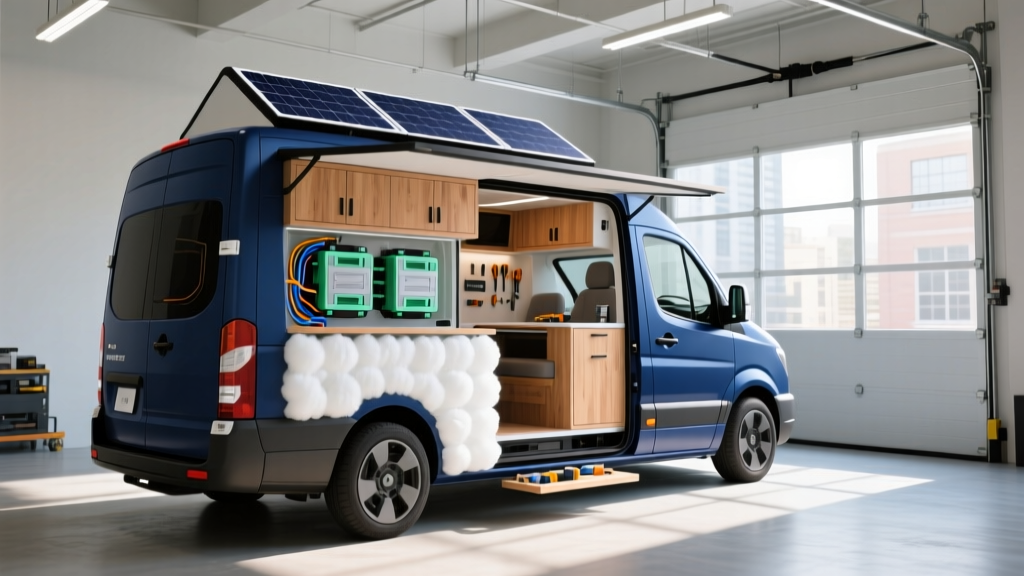
The short answer on electric van conversion: Converting a cargo or passenger van to electric power in 2026 typically costs between $25,000 and $65,000 for parts and labor on top of the donor vehicle price, yielding 80–200 miles of real-world range depending on battery capacity (60–150 kWh packs are common). Professional turnkey conversions from shops like EV West or Zelectric start around $50,000–$90,000 total. For most van owners doing local delivery, urban commuting, or campervan builds with home Level 2 charging access, the math works. For highway-heavy or cold-climate use without reliable charging, a factory-built electric van like the Ford E-Transit or a PHEV option may serve you better.
Is an electric van conversion worth it in 2026?
Yes, if: you drive under 120 miles/day, have home or depot Level 2 charging, and value silent operation, zero tailpipe emissions, and ~$0.08–$0.14/mile "fuel" cost vs. $0.22–$0.35/mile for gas.
Think twice if: you regularly tow heavy loads, drive highway routes exceeding 180 miles between charges, live where winter temps drop below 20°F without garage parking, or need a fully warrantied powertrain.
What an Electric Van Conversion Actually Involves
An EV van conversion replaces the internal combustion engine, fuel tank, exhaust, and transmission with an electric motor, inverter, battery pack, onboard charger, and DC-DC converter. The donor van's 12V systems (lights, wipers, HVAC blower) remain but draw power from a DC-DC converter stepping down the high-voltage traction battery.
The core components you'll source:
- Motor + inverter: Most conversions use a salvaged Tesla drive unit (Large Drive Unit or Small Drive Unit), a NetGain Hyper9, or a Cascadia Motion PM150. Output ranges from 100 kW (134 hp) to 250+ kW (335+ hp).
- Battery pack: Repurposed Tesla modules, Nissan Leaf modules, or new LG/CATL LFP prismatic cells wired in series-parallel. Usable capacity typically 60–150 kWh.
- BMS (Battery Management System): Orion BMS 2, SimpBMS, or Thunderstruck — non-negotiable for cell balancing and safety cutoffs.
- Onboard charger: Elcon PFC chargers or salvaged Tesla Gen 2/3 chargers, 3.3–19.2 kW AC input for Level 2 charging.
- Thermal management: Liquid cooling loops for batteries (critical for fast-charge longevity) and cabin heat via a PTC heater or heat pump.
- Instrumentation: EV-specific gauge cluster or tablet-based display showing SoC, kWh/mile, and cell voltages.
Electric Van Conversion Cost Breakdown
Below is a realistic 2026 parts-and-labor estimate for a mid-range conversion of a Ford Transit, Mercedes Sprinter, or Chevy Express. Costs assume a donor van you already own or purchase separately for $8,000–$25,000 (used, 2015–2022 model years).
| Component | Budget Build | Mid-Range | Pro / Turnkey |
|---|---|---|---|
| Motor + Inverter | $3,000–$5,000 | $5,000–$8,000 | $8,000–$12,000 |
| Battery Pack (60–150 kWh) | $8,000–$15,000 | $15,000–$28,000 | $25,000–$45,000 |
| BMS + Wiring + Safety | $1,500–$2,500 | $2,500–$4,000 | $4,000–$6,000 |
| Onboard Charger (Level 2) | $1,000–$2,000 | $2,000–$3,500 | $3,500–$5,000 |
| DC-DC Converter + 12V | $500–$800 | $800–$1,200 | $1,200–$2,000 |
| Thermal Management | $500–$1,500 | $1,500–$3,000 | $3,000–$5,000 |
| Fabrication + Labor | $2,000–$5,000 (DIY) | $8,000–$15,000 | $18,000–$30,000 |
| Misc (couplers, mounts, cooling) | $1,500–$3,000 | $3,000–$5,000 | $5,000–$8,000 |
| Total (excl. donor van) | $18,000–$35,000 | $38,000–$68,000 | $68,000–$113,000 |
Federal tax credit note: The IRS §30D new clean vehicle credit and §25E used-EV credit apply to factory-built EVs meeting battery-sourcing and MSRP caps — they do not apply to aftermarket conversions of existing gas vehicles. Some states offer conversion rebates (California's CORE program, for example, has funded commercial fleet conversions). Check your state energy office for current programs.
Range, Efficiency, and Charging: The Numbers
Vans are aerodynamically poor and heavy. Expect efficiency in the 2.0–3.5 kWh/mile range depending on roof height, payload, and speed. That means a 100 kWh usable battery pack delivers roughly 100–150 real-world miles at highway speeds, or 150–200 miles in stop-and-go urban driving where regenerative braking recovers energy.
Real-World Range vs. Pack Size
60 kWh pack: ~60–90 miles (highway) / ~90–120 miles (city) — last-mile delivery viable
100 kWh pack: ~100–150 miles (highway) / ~150–200 miles (city) — most commuter routes
140 kWh pack: ~140–200 miles (highway) / ~200–280 miles (city) — full-day commercial use
Cold weather penalty: Expect 25–40% range loss below 30°F without battery preconditioning. LFP chemistry loses slightly more in cold than NMC but offers longer cycle life (~3,000+ cycles vs. ~1,500–2,000 for NMC).
Charging speeds for conversions:
- Level 1 (120V, 1.4 kW): Adds ~0.5–0.7 miles/hour — impractical for daily use beyond topping off.
- Level 2 (240V, 7.2–19.2 kW): Adds 3–10 miles/hour. A 100 kWh pack at 11.5 kW takes ~9 hours from empty — overnight at home or depot.
- DC Fast Charging (CCS/NACS): Possible but complex. Requires a CCS-compliant charge controller and CAN-bus communication with the vehicle's BMS. Most conversions peak at 40–60 kW DC, adding 60–100 miles in 30 minutes. Retrofitting full 150+ kW CCS capability is rare and adds $3,000–$6,000 in hardware.
EV Van Conversion vs. Gas Van vs. Factory Electric Van
Here's how a converted electric van stacks up against the gas version and a purpose-built electric van like the Ford E-Transit (2025 model, 126-mile EPA range, 68 kWh usable battery, 266 hp, starting ~$47,000 MSRP before any fleet incentives).
| Metric | Converted EV Van (100 kWh) | Gas Ford Transit (3.5L EcoBoost) | Factory Ford E-Transit |
|---|---|---|---|
| Total Acquisition Cost | $46,000–$93,000 | $38,000–$52,000 | $47,000–$58,000 |
| Real-World Range | 100–180 mi | 320–420 mi | 90–126 mi (EPA) |
| Fuel/Energy Cost per Mile | $0.08–$0.14 | $0.25–$0.35 | $0.08–$0.14 |
| Maintenance (annual est.) | $300–$600 | $1,200–$2,000 | $400–$700 |
| Powertrain Warranty | None (self/shop only) | 5 yr / 60,000 mi | 8 yr / 100,000 mi (battery) |
| Refuel/Recharge Time | 6–10 hrs (L2) / 30–45 min (DC) | 5–8 min | 8 hrs (L2) / 45 min (DC 10–80%) |
| Cargo Volume Impact | Batteries may reduce under-floor space | None | Minimal (skateboard design) |
The conversion wins on per-mile operating cost and customization freedom. The factory E-Transit wins on warranty, reliability predictability, and resale. The gas Transit wins on range, quick refueling, and lowest upfront cost. Your daily mileage and charging access determine which trade-off makes sense.
Real-World Ownership: What First-Time Converters Miss
Home and Depot Charging Access
Most conversions rely on Level 2 charging. You'll need a dedicated 240V circuit — typically 40–60 amps — installed by a licensed electrician. Expect $800–$2,500 for a home Level 2 circuit if your panel has capacity, or $2,500–$5,000+ if a panel upgrade (100A → 200A) is needed. Commercial depot installations with multiple chargers run $5,000–$15,000+ per stall including utility coordination.
Insurance and Registration
Insuring a converted EV is more complex than a factory vehicle. Most major carriers will cover a conversion, but you'll need a specialty appraisal documenting the components and their value. Expect premiums 15–30% higher than the equivalent gas van due to the custom powertrain and limited repair-network familiarity. Some owners use agreed-value policies through specialty insurers like Hagerty or Grundy for high-value campervan conversions.
Registration and smog vary by state. In California, a converted EV is smog-exempt once registered as an electric vehicle, but the initial verification process at a BAR referee station takes time. Most states simply reclassify the fuel type on your title.
Battery Degradation and Longevity
Repurposed Tesla modules (NMC chemistry) typically arrive at 80–90% State of Health (SoH) and will degrade to ~70% over 5–8 years of daily cycling. New LFP cells from suppliers like EVE or CATL start at 100% SoH and retain ~85% after 3,000 cycles — potentially 15+ years in a van doing 30 miles/day. Budget $8,000–$20,000 for a battery replacement 8–12 years into ownership.
Common Electric Van Conversion Myths — Corrected
| Myth | Fact |
|---|---|
| "Conversions are illegal or can't be registered" | Legal in all 50 states. You reclassify the fuel type with your DMV. Federal emissions exemptions apply once the ICE is removed. |
| "I'll get 300 miles of range" | Not in a van. Aerodynamics and weight limit real-world range to 80–200 miles for most builds. The Ford E-Transit's EPA rating is only 126 miles with a 68 kWh pack. |
| "It's cheaper than buying a factory EV van" | Rarely. A quality conversion often costs $50,000–$80,000 total. The savings come from lower operating costs over 5–10 years, not the build itself. |
| "I can use any old battery" | Mismatched cells without a proper BMS create fire risk. You need matched, tested modules with active balancing and thermal monitoring. |
| "I'll save on maintenance immediately" | Yes on oil, filters, and exhaust. But conversion-specific issues (coolant leaks, contactor failures, BMS faults) can offset savings in year one. |
| "DC fast charging is easy to add" | Adding CCS/NACS DC fast charging requires CAN-bus integration, a compliant inlet, and protocol negotiation with the BMS. It's the single most complex part of a modern conversion. |
Decision Framework: Should You Convert, Buy Factory EV, or Stick With Gas?
Choose an Electric Van Conversion If:
- You want a specific van body (classic VW, Sprinter 170", vintage Dodge) that doesn't exist as a factory EV
- You drive under 120 miles/day and have reliable Level 2 charging at home or your depot
- You're building a campervan and value silent operation, no exhaust fumes, and the ability to run house loads off the traction battery via a DC-DC converter
- You have fabrication skills or a trusted conversion shop and a budget of $40,000–$80,000+
Choose a Factory Electric Van (Ford E-Transit, BrightDrop Zevo) If:
- You need a warranty-backed powertrain for commercial fleet use
- You want dealer service support and predictable resale value
- Your routes fit within 100–126 miles with overnight depot charging
- You want to potentially qualify for commercial clean vehicle credits (IRS §30D or §45W for fleets)
Stick With a Gas or Diesel Van If:
- You regularly drive 200+ miles between stops or tow over 5,000 lbs
- You operate in extreme cold (below 10°F) without garage access
- You lack any reliable charging access — no home outlet, no depot charger, limited public infrastructure in your area
- Your budget is under $40,000 total and you need the van working tomorrow
Frequently Asked Questions
How long does an electric van conversion take?
A professional shop typically takes 3–6 months from donor vehicle receipt to road-ready. A skilled DIY builder working weekends might take 9–18 months. Timeline depends heavily on parts sourcing (salvaged Tesla drive units can have 4–8 week lead times) and fabrication complexity.
Can I convert a Mercedes Sprinter or Ford Transit to electric?
Yes. The Ford Transit (2015–2023) and Mercedes Sprinter (2007–2022) are the most common conversion donors due to their large cargo bays (room for battery boxes), robust frames, and wide availability. The Chevy Express/GMC Savana platform is also popular for its simplicity and body-on-frame construction.
What's the most cost-effective battery for a van conversion?
Repurposed Tesla Model S/X modules (NMC, ~5.2 kWh each) at $80–$120/kWh remain the most common choice, giving 100 kWh for $8,000–$12,000. New LFP prismatic cells (EVE 280Ah or CATL 302Ah) at $100–$150/kWh offer longer life and safer chemistry but cost more upfront. Avoid unbranded cells from unverified suppliers — inconsistent capacity and internal resistance lead to balancing nightmares.
Do I need DC fast charging on my conversion?
If you charge overnight at home or your depot and drive under 120 miles/day, Level 2 alone is sufficient and saves $3,000–$6,000 in DC charge hardware. Add DC fast charging only if you need mid-day top-ups or take occasional longer trips and your route has CCS or NACS stations.
Will a conversion increase my van's resale value?
Generally no. Conversions are highly personal and the used market for custom EVs is small. Expect to recover 30–50% of conversion cost at resale. The exception: well-documented, professionally built campervan conversions in popular platforms (Sprinter, Transit) can command premiums in the adventure-van market.
How does a conversion compare to a PHEV van?
No factory PHEV vans are sold in the US as of 2026. The closest option is the Chrysler Pacifica Hybrid (PHEV minivan, 32 miles electric-only, ~$50,000 MSRP). For cargo applications, your choice is pure EV conversion, factory BEV, or gas/diesel. A PHEV would be ideal for mixed urban/highway use, but the platform simply doesn't exist in the commercial van segment yet.