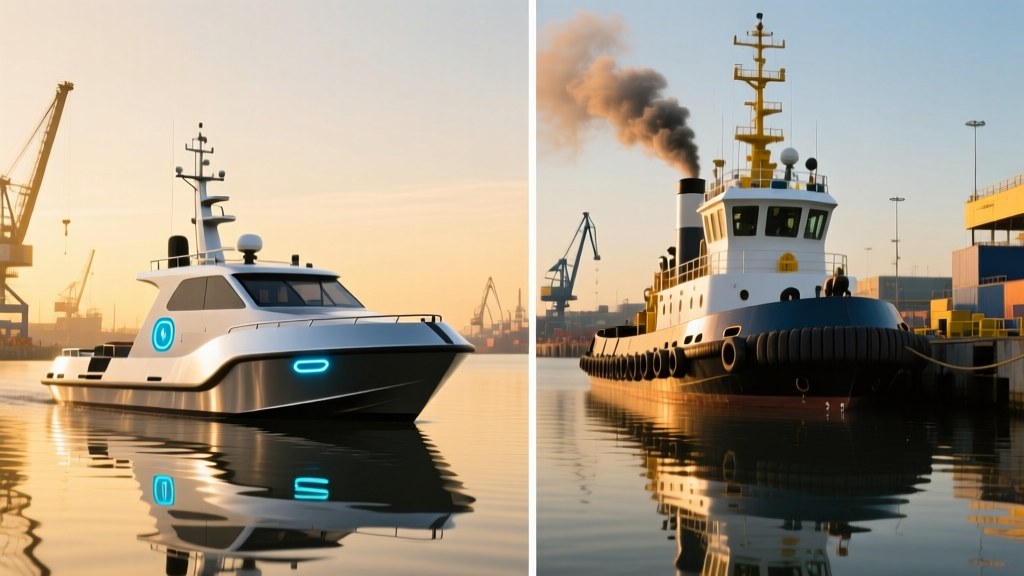
Quick Answer: Should You Consider an Electric Tug Boat?
For harbor and short-route port operations (under 60 nautical miles per shift), an electric tug boat eliminates diesel fuel costs (saving $180,000–$320,000 annually for a busy workboat), cuts maintenance by 40–60%, and delivers instant torque for bollard pull. The tradeoff: upfront capital runs 2–3× a comparable diesel tug ($4.5M–$8M vs $1.8M–$3M), battery capacity limits continuous high-load operation to roughly 6–10 hours before requiring a 2–4 hour shore charge, and cold-climate ports see 10–15% usable capacity loss in winter. Electric tugs make economic sense for operators with predictable routes, shore-power access, and 5,000+ annual operating hours. Long-range offshore towing and icebreaking remain diesel-dominant for now.
AutoEdgeView typically covers road-going EVs, but the electrification of commercial marine vessels — particularly harbor tugs, pushboats, and short-run ferries — follows the same battery, charging, and total-cost-of-ownership logic our readers rely on. This guide applies our EV ownership framework to the emerging electric tug boat segment using 2026 data.
Electric Tug Boat vs Diesel Tug: The Numbers That Matter
The core comparison mirrors what we do with road vehicles: energy cost per hour of operation, maintenance intervals, and capital recovery timeline. Here's how a representative 2,000 kW (2,680 hp) harbor tug compares across powertrains in 2026:
| Metric | Diesel Tug | Full-Electric Tug | Hybrid (Diesel-Electric) |
|---|---|---|---|
| Power Output | 2,000 kW (2,680 hp) | 2,000 kW (2,680 hp) | 1,500 kW diesel + 500 kW electric |
| Energy Source | Marine diesel (ULSD) | LFP battery bank, 3,000–5,000 kWh | Diesel + 800–1,200 kWh LFP |
| Fuel/Energy Cost per Hour (avg load) | $180–$260 (at ~45 gal/hr) | $45–$85 (at ~400 kWh/hr, $0.12–$0.21/kWh) | |
| Annual Energy Cost (5,000 hrs) | $900,000–$1,300,000 | $225,000–$425,000 | |
| Annual Maintenance | $120,000–$180,000 | $50,000–$75,000 | |
| Overhaul Interval | 15,000–20,000 hrs (engine rebuild) | 10–15 year battery replacement cycle | |
| Base Price (2026) | $1.8M–$3.0M | $4.5M–$8.0M | |
| Emissions (operational) | ~1,800 tons CO₂/yr | Zero (grid-dependent upstream) | |
| Continuous High-Load Runtime | Unlimited (refuel in 30 min) | 6–10 hours (depends on battery size) |
The energy-cost gap is the primary driver. A tug burning 45 gallons of ultra-low-sulfur diesel per hour at $4.50/gal spends roughly $202/hr on fuel alone. An electric tug drawing 400 kWh from shore power at an industrial rate of $0.15/kWh spends $60/hr — a 70% reduction. Over 5,000 annual operating hours, that's roughly $710,000 in annual energy savings, which recovers the electric premium in 4–6 years before factoring in maintenance savings or regulatory compliance value.
Battery Specs, Chemistry & Real-World Harbor Performance
Electric tug boats in 2026 predominantly use LFP (lithium iron phosphate) battery banks. The same chemistry trade-offs we cover in road-going EVs apply here, but marine use amplifies them:
| Factor | LFP (Standard for Marine Tugs) | NMC (Less Common in Tugs) |
|---|---|---|
| Energy Density | ~160 Wh/kg (heavier, larger bank) | ~250 Wh/kg (lighter, more compact) |
| Thermal Stability | Excellent — minimal fire risk, critical for enclosed engine rooms | Good — requires more robust thermal management |
| Cycle Life | 4,000–6,000 cycles to 80% SoH | 1,500–3,000 cycles to 80% SoH |
| Cold Performance | 10–15% capacity loss below 32°F; requires battery heating | 8–12% capacity loss below 32°F |
| Cost per kWh (pack level, 2026) | $110–$140/kWh | $140–$180/kWh |
| Typical Tug Bank Size | 3,000–5,000 kWh | 2,000–3,500 kWh |
A 4,000 kWh LFP bank weighs roughly 25–30 metric tons and occupies significant hull volume — a key reason electric tugs are currently limited to harbor and coastal operations where weight and space are less penalizing than on long-range vessels. For context, 4,000 kWh is equivalent to roughly 60 Tesla Model Y battery packs.
Real-world runtime reality check: A manufacturer-rated "12-hour shift" assumes mixed-load operation — idling, transit at partial power, and intermittent high-load bollard pull for ship assist. If your operation demands continuous maximum bollard pull (e.g., escorting large container ships in heavy current), expect 4–6 hours before requiring a charge. Just as with road EVs, the EPA-equivalent sticker number assumes a duty cycle that may not match your peak-demand scenario.
Charging Infrastructure: Shore Power & Turnaround Times
This is where electric tug ownership diverges sharply from road EVs. You cannot rely on a public charging network — shore-power infrastructure must be purpose-built at your home port.
Charging speeds in 2026:
- Standard shore connection (Level 2 marine equivalent): 350–500 kW AC/DC — adds roughly 350–500 kWh per hour. A 4,000 kWh bank charges from 10–90% in approximately 7–10 hours. Suitable for overnight charging between shifts.
- High-power DC shore charging: 1,000–2,000 kW (1–2 MW) — adds 1,000–2,000 kWh per hour. A 4,000 kWh bank charges 10–80% in roughly 2–3 hours. Required for multi-shift operations with quick turnarounds.
- Battery swapping (emerging): Containerized battery modules swapped by crane in 20–30 minutes. Eliminates charging downtime but requires 2–3× the battery capital and specialized port handling equipment.
Shore-power installation costs are substantial. A 1 MW DC shore charging station with marine-rated connectors, switchgear, and utility interconnection typically runs $800,000–$1.5M per berth, depending on existing electrical infrastructure. Ports with aging electrical systems may face utility upgrade costs on top of that. This is the marine equivalent of a home panel upgrade for a Level 2 charger — except at industrial scale.
Operators must also consider the charge curve. Just like road-going EVs, marine battery banks accept peak charge rates only at low states of charge. A system rated for 1.5 MW peak may sustain that rate from 10–50% SoC, then taper to 800 kW from 50–80%, and further to 300 kW from 80–100%. Planning turnaround times around the 10–80% window — rather than full charges — maximizes throughput.
Total Cost of Ownership: 10-Year Breakdown
The purchase-price premium of an electric tug is significant, but the operating-cost advantage compounds over time. Here's a 10-year TCO model for a 2,000 kW harbor tug operating 5,000 hours per year in a U.S. port with industrial electricity at $0.15/kWh and diesel at $4.50/gal:
| Cost Category | Diesel Tug | Electric Tug |
|---|---|---|
| Purchase Price | $2,500,000 | $6,000,000 |
| Shore Power / Refueling Infrastructure | $50,000 (fuel dock) | $1,200,000 (1 MW DC station) |
| Annual Energy Cost × 10 yrs | $11,000,000 | $3,000,000 |
| Annual Maintenance × 10 yrs | $1,500,000 | $625,000 |
| Mid-Life Overhaul (Year 7–8) | $400,000 (engine rebuild) | $0 (battery still within cycle life) |
| Battery Replacement (Year 12–15, if needed) | N/A | $480,000–$560,000 (4,000 kWh at $120–140/kWh) |
| 10-Year Total | $15,450,000 | $10,825,000 |
| Cost per Operating Hour | $309/hr | $217/hr |
The electric tug reaches cost parity around Year 5–6 and saves roughly $4.6M over 10 years — despite the higher upfront cost. This aligns with the same TCO dynamic we see in commercial electric fleet vehicles: higher capex, dramatically lower opex.
Regulatory and incentive context: Several U.S. port authorities and state clean-air programs (notably California's CARB and the Port of Los Angeles clean-air incentive programs) offer grants covering 25–50% of electric marine vessel premiums. Federal IRA tax incentives apply to commercial clean vehicles, though marine vessel eligibility under §45W (Commercial Clean Vehicle Credit) is narrower than for road vehicles and requires consultation with a tax professional. The EPA's Clean Ports Program also funds zero-emission port equipment, including shore-power installations.
Cold Climate & Demanding Operations: Where Electric Tugs Fall Short
Just as we caution road-EV buyers in northern climates, electric tug operators in cold-water ports (Duluth, Anchorage, Boston in winter) must plan for reduced battery performance:
- Capacity loss: LFP banks lose 10–15% usable capacity at or below freezing. A 4,000 kWh bank effectively delivers ~3,400–3,600 kWh in January in a Great Lakes port.
- Heating energy draw: Battery thermal management systems consume 5–10% of stored energy to maintain optimal temperature in cold conditions, further reducing available runtime.
- Charging speed reduction: Cold batteries accept charge more slowly. Expect 20–30% longer charge times in sub-freezing conditions unless the battery management system preconditions the pack using shore power before charging begins.
For icebreaking, long-range escort, or offshore operations where continuous maximum power is required for 12+ hours with no shore-power access, diesel remains the practical choice in 2026. Hybrid tugs (diesel genset + smaller battery bank) offer a bridge — capturing regenerative braking from propeller reversals, enabling zero-emission operation in port, and reducing fuel consumption by 20–35% on mixed-duty cycles.
Decision Framework: Is an Electric Tug Right for Your Operation?
Choose a Full-Electric Tug If:
- Your routes are predictable and under 60 nautical miles per shift
- You operate 4,000+ hours annually (higher utilization = faster payback)
- Your home port has shore-power capacity or can accommodate a 1 MW+ installation
- You operate in an emissions-regulated zone (CARB, ECA zones, port green mandates)
- Your duty cycle is mixed-load (ship assist, transit, standby) rather than continuous max pull
- You plan to hold the vessel 8+ years (to capture full TCO advantage)
Choose a Hybrid Tug If:
- You need occasional long-range or high-load operation beyond battery capacity
- Shore-power infrastructure is unavailable or prohibitively expensive at your port
- You want 20–35% fuel savings without the full capital premium
- You operate in cold climates where pure-electric range loss is operationally unacceptable
Stick With Diesel If:
- Your operation requires 12+ hours of continuous maximum bollard pull
- You operate offshore, in icebreaking roles, or in remote ports without grid access
- Your annual operating hours are below 2,500 (insufficient savings to justify premium)
- Your vessel replacement timeline is under 5 years
Common Misconceptions About Electric Tug Boats
| Myth | Fact |
|---|---|
| "Electric motors can't produce enough bollard pull for ship assist." | Electric motors deliver maximum torque at zero RPM. Several 2026-class electric tugs match or exceed the bollard pull (60–80 tonnes) of equivalent diesel tugs. Instant torque response actually improves precision in ship-handling. |
| "The batteries will need replacement every 3–5 years." | Marine-grade LFP banks are rated for 4,000–6,000 full cycles to 80% State of Health. At one full cycle per day, that's 11–16 years before reaching the 80% threshold — and the bank still functions at reduced capacity beyond that point. |
| "Electric tugs are unproven — no one is actually running them." | As of 2026, fully electric tugs are in commercial service at ports in Vancouver, Singapore, Rotterdam, Oslo, and several U.S. coastal ports. The EPA's Green Ports initiative has documented multiple operational deployments. |
| "Shore power takes too long — you'll lose an entire shift charging." | With a 1.5 MW DC shore connection, a 4,000 kWh bank charges 10–80% in roughly 2 hours. Most harbor tugs have 4–6 hour windows between peak ship-assist periods, which is ample for opportunity charging. |
Frequently Asked Questions
What is the typical range of an electric tug boat on a single charge?
Range depends entirely on load profile. At mixed harbor duty (transit, standby, intermittent ship assist), a 4,000 kWh bank supports 8–12 hours of operation. At continuous full-power bollard pull, expect 4–6 hours. In nautical miles at transit speed (8–10 knots), that translates to roughly 40–80 nm before requiring a charge. There is no single "EPA range" equivalent — it's duty-cycle dependent, much like an electric semi-truck's range varies with payload and terrain.
How much does it cost to charge an electric tug boat?
At an industrial electricity rate of $0.12–$0.21/kWh, fully charging a 4,000 kWh battery bank costs $480–$840. Compare that to fueling a diesel tug with 1,500 gallons of ULSD at $4.50/gal: $6,750. Per-shift energy cost drops by roughly 85–90%. Actual rates vary by port, utility tariff structure, and time-of-use pricing — some ports negotiate dedicated marine EV tariffs below $0.10/kWh.
Do electric tug boats qualify for federal tax credits or incentives?
Potentially, but the rules are narrower than for road vehicles. The IRS §45W Commercial Clean Vehicle Credit covers qualifying commercial clean vehicles, and marine vessels may qualify depending on classification, weight, and use. The EPA Clean Ports Program and state-level programs (especially in California, Washington, and New York) offer substantial grants for zero-emission marine equipment and shore-power infrastructure. Always consult a tax professional and check current-year program eligibility — rules evolve annually.
What happens when the battery bank reaches end of life?
Marine LFP battery banks are designed for modular replacement — individual racks or modules can be swapped rather than replacing the entire bank. At 2026 pack-level pricing of $110–$140/kWh, replacing a 4,000 kWh bank costs roughly $440,000–$560,000. Prices continue to decline. End-of-life marine batteries often retain 70–80% capacity and can be repurposed for stationary port energy storage before final recycling.
Can an electric tug operate in freezing or ice conditions?
Yes, with caveats. Battery thermal management systems maintain pack temperature, but this draws energy and reduces effective capacity by 10–15%. Charging also slows in cold conditions. For dedicated icebreaking or operations in sustained sub-zero environments, diesel or hybrid powertrains remain more practical in 2026. Several Arctic-class port operators are watching the segment but have not yet committed to full-electric for ice service.
Sources: EPA Clean Ports Program (epa.gov/green-ports), IRS Commercial Clean Vehicle Credits (irs.gov), U.S. Department of Energy Maritime electrification research, and manufacturer specification sheets from leading electric marine vessel builders (2025–2026 model year data).