The Short Answer: Which Electric Truck Workhorse Should You Buy?
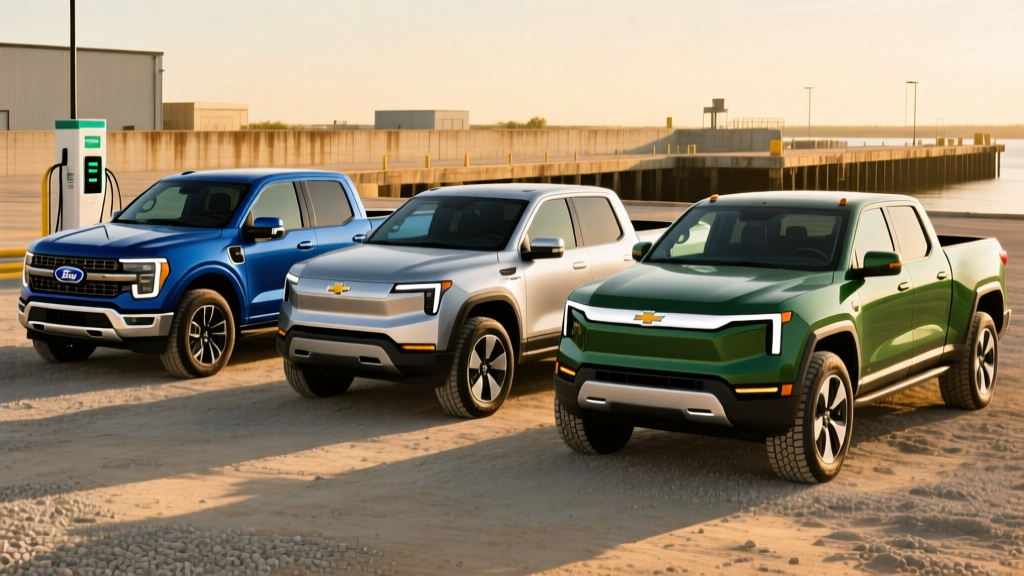
If you need a true work truck for towing, hauling, and job-site power, the Ford F-150 Lightning remains the default electric truck workhorse in 2026 — starting around $54,995 with up to 320 miles of EPA range, 7,700 lbs of towing, and Pro Power Onboard for running tools. If range is your top priority and you can stretch the budget, the Chevrolet Silverado EV delivers up to 492 miles (4WT trim) and 12,500 lbs of max towing. The Rivian R1T is the premium adventure-oriented option — quicker, more refined, but pricier at $69,900+ and less suited to commercial fleet duty. None of these trucks are cheap, and all demand Level 2 home charging to be practical. Read on for the full breakdown.
Spec Face-Off: The Three Electric Truck Contenders
Before we get into ownership realities, here are the hard numbers that matter. All figures reflect 2026 model-year specifications as published by each manufacturer and the EPA at fueleconomy.gov.
| Spec | Ford F-150 Lightning (Extended Range) | Chevy Silverado EV (4WT / RST) | Rivian R1T (Dual-Motor Max Pack) |
|---|---|---|---|
| Base MSRP | $54,995 (Pro) | $57,900 (4WT) | $69,900 (Dual-Motor Max) |
| Battery (usable kWh) | 131 kWh (NMC) | 200+ kWh (NMC) | 141 kWh (NMC) |
| EPA Range | 320 mi | 492 mi (4WT) / 440 mi (RST) | 410 mi |
| Real-World Range (highway, loaded) | ~240–270 mi | ~360–410 mi | ~310–350 mi |
| Peak DC Fast Charge | 150 kW | 350 kW | 200+ kW |
| 10–80% DC Charge Time | ~41 min | ~30 min (est.) | ~35 min |
| Level 2 Home Charge Rate | 19.2 kW (80A) | 19.2 kW (80A) | 19.2 kW |
| Horsepower | 580 hp | 510 hp (4WT) / 664 hp (RST) | 533 hp (Dual) / 1,025 hp (Tri) |
| 0–60 mph | ~4.0 sec | ~5.0 sec (4WT) | ~3.5 sec (Dual) |
| Max Towing | 7,700 lbs (10,000 w/ Max Tow pkg) | 12,500 lbs (RST) | 11,000 lbs |
| Max Payload | 2,235 lbs | 1,800 lbs (4WT) | 1,760 lbs |
| Frunk Volume | 14.1 cu ft | 10.7 cu ft (eTrunk) | 11.0 cu ft |
| Bed Length | 5.5 ft | 5.5 ft (4WT crew) | 4.5 ft (w/ Gear Tunnel) |
| Onboard Power | Pro Power 9.6 kW | PowerBase 10.2 kW | ~3.5 kW (camp-ready) |
| Battery Warranty | 8 yr / 100,000 mi | 8 yr / 100,000 mi | 8 yr / 175,000 mi |
| Federal §30D Credit Eligible? | Partial (varies by trim/sourcing) | Partial (varies by sourcing) | Yes (as of early 2026) |
Real-World Range: What the EPA Sticker Doesn't Tell You
The EPA range number is a laboratory average. For an electric truck workhorse, real-world conditions matter enormously because trucks are heavy, aerodynamically blunt, and frequently loaded.
Cold-weather reality check: At 20°F, expect 20–30% range reduction across all three trucks. The F-150 Lightning's 320-mile EPA figure drops to roughly 225–260 miles in freezing temps. The Silverado EV's massive battery gives it a buffer advantage — even at 70% retention, 492 miles becomes ~345 miles, still more than most competitors' full EPA ratings.
Towing penalty: Pulling a 6,000-lb trailer at 70 mph can cut range by 40–50%. If you tow frequently over distance, plan charging stops every 100–130 miles in the Lightning, 175–200 in the Silverado EV, and 150–175 in the R1T.
The Silverado EV's enormous 200+ kWh battery pack is the single biggest advantage for work use. More kWh means more buffer against the conditions that sap electric truck range. The tradeoff is weight — the Silverado EV tips the scales at over 8,900 lbs in some trims, which affects tire wear and registration fees in certain states.
Charging at Home and on the Job Site
An electric truck workhorse lives or dies by your charging setup. These trucks have massive batteries that make Level 1 (120V) charging functionally useless — plugging a 131 kWh Lightning into a standard outlet adds roughly 3 miles of range per hour. You'd need over 40 hours for a full charge.
Home Level 2 Charging: What You Actually Need
All three trucks accept up to 19.2 kW on Level 2 (80 amps). That requires a hardwired charger on a 100-amp dedicated circuit. Here's what that costs:
| Item | Estimated Cost |
|---|---|
| Level 2 charger (80A, hardwired — e.g., ChargePoint Home Flex, Ford Charge Station Pro) | $600–$1,200 |
| Electrical panel upgrade (100A service → 200A, if needed) | $1,500–$3,500 |
| Wiring, conduit, permit (50–80 ft run) | $800–$2,000 |
| Electrician labor | $1,000–$2,500 |
| Total (typical install) | $2,400–$5,700 |
| Total (with panel upgrade) | $3,900–$9,200 |
At 19.2 kW, the F-150 Lightning adds about 45–50 miles of range per hour of charging — a full overnight charge (10 hours) replenishes the entire 131 kWh battery. The Silverado EV's larger pack needs 12–14 hours at that rate for a full charge, which is tight for daily heavy use.
Key distinction — kW vs kWh: kW (kilowatts) is the rate of power flow — how fast energy goes into the truck. kWh (kilowatt-hours) is the total energy stored — how far you can drive. A 19.2 kW charger filling a 131 kWh battery is like a hose (kW) filling a tank (kWh).
Public DC Fast Charging on Work Routes
When you need a quick top-up between job sites, DC fast charging matters. The Silverado EV's 350 kW peak rate is a standout — on a compatible charger, it can add 100+ miles in roughly 10 minutes. The Lightning peaks at 150 kW, which means 10–80% takes about 41 minutes. That's noticeably slower and matters if your workday involves highway driving.
Remember: peak charge rates only hold between roughly 10–30% State of Charge (SoC). Above 50%, charging tapers significantly. Plan your route around 10–80% stops, not 0–100% fills.
EV Truck vs Gas Truck: The 5-Year Cost Breakdown
The purchase price of an electric truck workhorse is higher than a comparable gas F-150 or Silverado. But operating costs tell a different story — if your usage pattern fits.
| Cost Factor (5 Years / 75,000 Miles) | F-150 Lightning (Pro, Ext. Range) | F-150 Gas (XLT, 3.5L EcoBoost) |
|---|---|---|
| Purchase Price (MSRP) | $54,995 | $48,500 |
| Federal §30D Tax Credit (est.) | –$3,750 to –$7,500* | $0 |
| Net Purchase | ~$47,495–$51,245 | $48,500 |
| Fuel / Electricity (75k mi) | $4,800–$6,200** | $10,500–$12,000*** |
| Maintenance (oil, filters, brakes) | $800–$1,200 | $2,500–$3,500 |
| Insurance (avg. annual × 5) | $12,000–$14,000 | $9,000–$11,000 |
| Tires (replacement at ~40k mi) | $1,600–$2,400 | $1,200–$1,800 |
| 5-Year Total (approx.) | $67,000–$75,000 | $72,000–$77,000 |
* Federal §30D credit eligibility depends on battery critical-mineral sourcing, buyer income caps ($150k single / $300k joint for new vehicles), and MSRP caps ($80,000 for trucks). Rules change — verify at irs.gov and consult a tax professional. Point-of-sale transfer is available for 2026.
** Based on $0.14/kWh national average home charging; public DC charging costs $0.35–$0.50/kWh.
*** Based on 18 MPG combined, $3.40/gal regular unleaded.
The Lightning breaks even with the gas F-150 in roughly 3–4 years for most owners who charge primarily at home. If you rely on public DC fast charging exclusively, the fuel savings shrink considerably — DC rates can approach gasoline cost-per-mile in some regions.
Common Misconceptions About Electric Trucks as Workhorses
| Myth | Fact |
|---|---|
| "Electric trucks can't tow." | The Silverado EV RST tows 12,500 lbs — more than many gas half-tons. The issue isn't capability; it's range while towing (expect 40–50% reduction). |
| "The battery will need replacing in a few years." | NMC batteries in these trucks are warrantied for 8 years / 100,000–175,000 miles at ≥70% capacity retention. Real-world degradation data from early Lightnings shows ~5–8% loss over 3 years. Full replacement (if out of warranty) runs $15,000–$25,000 — rare but not cheap. |
| "You'll save $7,500 on every electric truck." | The §30D credit has income caps, MSRP caps, and battery-sourcing requirements that disqualify some trims and buyers. Always verify your specific situation before counting on the full amount. |
| "Electric trucks are maintenance-free." | No oil changes, but tires wear faster (heavier vehicle, instant torque), suspension components still need service, cabin air filters need replacing, and the 12V auxiliary battery can still die. |
| "Charging takes too long for a workday." | If you charge at home overnight (8–10 hours at Level 2), you start every morning with a full battery. Public DC stops add 20–40 minutes for 10–80%, which works for planned lunch breaks but not rapid job-site hopping without route planning. |
Onboard Power: The Killer Feature for Job Sites
One area where an electric truck workhorse genuinely outclasses a gas truck is onboard power. Ford's Pro Power Onboard delivers up to 9.6 kW of continuous 240V/120V AC power from the truck's battery. That's enough to simultaneously run a miter saw (1,800W), a compressor (1,500W), job-site lights (500W), and charge cordless tool batteries — all without a separate generator.
The Silverado EV's PowerBase system offers up to 10.2 kW with both bed-mounted and cabin outlets. Rivian's system is more consumer-oriented, designed for camping and tailgating rather than commercial use.
For contractors, this feature alone can justify the purchase. You eliminate the cost, noise, fuel, and maintenance of a portable generator — and you can run power tools in residential areas without noise complaints.
Tax Credits and Incentives: What's Actually Available in 2026
Federal §30D clean vehicle credit rules for 2026 include several conditions that affect electric truck buyers:
- MSRP cap: Trucks (pickup classification) must have an MSRP at or below $80,000. The F-150 Lightning Pro, Silverado EV 4WT, and base R1T Dual-Motor all qualify. Loaded RST and Tri-Motor R1T trims may exceed this cap.
- Buyer income cap: Modified AGI must not exceed $150,000 (single), $225,000 (head of household), or $300,000 (married filing jointly).
- Battery sourcing: Increasingly strict critical-mineral and battery-component requirements mean the credit amount varies — some trims qualify for the full $7,500, others for $3,750, and some for $0 depending on supply-chain compliance at time of purchase.
- Point-of-sale transfer: You can transfer the credit to the dealer at purchase, reducing your out-of-pocket cost directly rather than waiting for a tax refund.
- Commercial clean vehicle credit (§45W): If you buy through a business entity, a different credit of up to $7,500 (for vehicles under 14,000 lbs GVWR) may apply with different rules. Consult a tax professional.
Many states also offer additional incentives — California's CVRP, Colorado's innovative motor vehicle credit, and various utility-company rebates. Check afdc.energy.gov for your state's current programs.
Decision Framework: Which Electric Truck Workhorse Fits You?
Choose the Ford F-150 Lightning if:
- You want the most proven platform with the widest dealer/service network
- Your daily driving is under 250 miles and you charge at home
- You value Pro Power Onboard for job-site tool use
- You want the lowest entry price among full-size electric pickups
- You need a traditional 5.5-foot bed with standard accessories compatibility
Choose the Chevrolet Silverado EV if:
- Maximum range (492 mi EPA on 4WT) is your top priority
- You tow heavy loads and need the 12,500-lb rating
- Fast DC charging (350 kW peak) matters for your work route
- You're upgrading from a gas Silverado and want brand continuity
- You can accommodate the higher curb weight and longer wheelbase
Choose the Rivian R1T if:
- You want a premium, tech-forward truck for mixed work and adventure use
- Acceleration and driving dynamics are a priority (3.5-sec 0–60)
- You value the Gear Tunnel for secure, lockable side-access storage
- You don't need a full-size bed or commercial fleet compatibility
- Budget is flexible ($70k+ before options)
Stick with a gas or hybrid truck if:
- You regularly tow over 200 miles one-way without overnight charging at the destination
- You live in an apartment or lack access to Level 2 home charging
- Your work takes you to rural areas with sparse DC fast-charging infrastructure
- You need a heavy-duty (¾-ton or 1-ton) truck — no electric HD options exist yet
Frequently Asked Questions
Can I use an electric truck for daily job-site commuting and tool power?
Yes — this is the strongest use case. If your round-trip commute is under 200 miles and you charge at home overnight, an electric truck workhorse like the F-150 Lightning or Silverado EV can power your tools all day via onboard 240V outlets and still have range to drive home. Contractors report saving $15–$25/day in fuel plus eliminating generator maintenance.
How does cold weather affect electric truck range?
Expect 20–30% range loss at 20°F compared to the EPA rating. The battery's thermal management system uses energy to keep the pack warm, and cabin heating draws additional power. Preconditioning the battery while still plugged in (using grid power instead of battery power) mitigates some of this loss. All three trucks offer preconditioning via their apps.
What happens if the battery fails out of warranty?
Full battery replacement costs $15,000–$25,000 depending on the model and pack size. However, data from early adopters shows NMC packs retaining 90–95% capacity after 3–5 years of normal use. The 8-year/100,000-mile warranty covers packs that drop below 70% State of Health. Ford, GM, and Rivian also offer modular repair — replacing individual battery modules rather than the entire pack — which can reduce out-of-warranty costs to $3,000–$8,000.
Do electric trucks qualify for the commercial vehicle tax credit?
If purchased through a business entity (LLC, S-Corp, sole proprietorship), the §45W Commercial Clean Vehicle Credit may apply. This credit is up to $7,500 for vehicles under 14,000 lbs GVWR and has different sourcing and eligibility rules than the consumer §30D credit. A business buyer may qualify for §45W even if they exceed the §30D income cap. Consult a tax professional to determine which credit applies.
Are electric truck tires more expensive to replace?
Yes, modestly. Electric trucks are heavier (the Lightning weighs ~6,500 lbs; the Silverado EV over 8,900 lbs), and instant torque accelerates tire wear. Expect to replace tires at 30,000–40,000 miles instead of 50,000+. EV-specific tire compounds (like Michelin's e-Primacy or Hankook's iON) are designed for the weight and torque but cost $250–$400 per tire for truck sizes.