The Short Answer: Which Electric Truck Companies Matter in 2026?
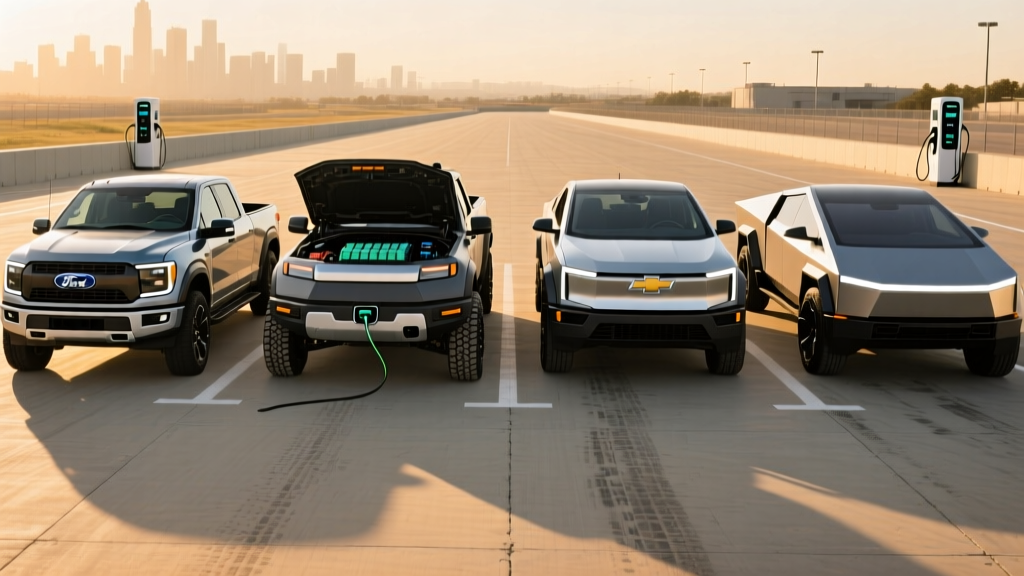
Four manufacturers dominate the US electric pickup market right now: Ford (F-150 Lightning), Rivian (R1T Dual-Motor and Tri-Motor), General Motors (Chevrolet Silverado EV), and Tesla (Cybertruck). Each targets a different buyer — from the fleet-oriented Lightning starting around $55,000 to the adventure-focused R1T at $70,000+. The Silverado EV pushes maximum range (up to EPA 450 miles on the 4WT trim), while the Cybertruck emphasizes stainless-steel construction and 48-volt architecture. Your best pick depends on towing needs, budget, home-charging access, and whether you qualify for the federal §30D tax credit.
Why Electric Trucks Have Become a Serious Category
Electric trucks are no longer a niche experiment. Through early 2026, combined sales across the four major electric truck companies have passed the half-million-unit mark in the US alone. The reasons are practical, not ideological: instant torque for towing, a front trunk (frunk) that adds lockable cargo space, lower per-mile fueling costs, and fewer drivetrain components to maintain.
But the market has also matured enough to expose real trade-offs. Highway range drops 20–35% when towing a 5,000-pound trailer. Cold climates (below 25°F) reduce usable range by 15–30% depending on whether the truck uses a heat pump. And public DC fast-charging infrastructure remains uneven outside major interstates.
Here's what each of the leading electric truck companies actually delivers in 2026 — with the numbers that matter for a purchase decision.
Side-by-Side Specs: The Big Four Electric Trucks
Before breaking down ownership costs, let's anchor the comparison in hard data. All figures below reflect 2026 model-year EPA and manufacturer-published specifications. Real-world highway and towing range estimates are drawn from independent testing and owner reports.
| Spec | Ford F-150 Lightning (Ext. Range) | Rivian R1T (Dual-Motor Max Pack) | Chevy Silverado EV (4WT) | Tesla Cybertruck (AWD) |
|---|---|---|---|---|
| Base MSRP | ~$69,995 | ~$87,900 | ~$74,900 | ~$79,990 |
| Battery Capacity (usable) | 131 kWh (NMC) | 149 kWh (NMC) | 200 kWh (NMC) | 123 kWh (NMC) |
| EPA Range | 320 mi | 410 mi | 450 mi | 340 mi |
| Real-World Highway Range | ~250–275 mi | ~330–350 mi | ~360–380 mi | ~275–295 mi |
| Towing Range (5,000-lb trailer) | ~140–170 mi | ~180–210 mi | ~200–230 mi | ~150–180 mi |
| Peak DC Fast Charge | ~150 kW | ~220 kW | ~350 kW | ~250 kW |
| 10–80% DC Fast Charge | ~41 min | ~30 min | ~20 min | ~25 min |
| Level 2 Charge Rate | 19.2 kW (80A) | 11.5 kW (48A) | 19.2 kW (80A) | 11.5 kW (48A) |
| 0–60 mph | ~3.8 sec | ~3.5 sec | ~4.5 sec | ~4.1 sec |
| Horsepower | 580 hp | 665 hp | 510 hp | 600 hp |
| Max Towing Capacity | 10,000 lb | 11,000 lb | 10,000 lb | 11,000 lb |
| Payload | 2,235 lb | 1,760 lb | 1,800 lb | 2,500 lb |
| Battery/Powertrain Warranty | 8 yr / 100,000 mi | 8 yr / 120,000 mi | 8 yr / 100,000 mi | 8 yr / 120,000 mi |
Real-World Range Reality Check
EPA range numbers assume a mix of city and highway driving at moderate temperatures without a trailer. For highway-only trips at 70–75 mph, expect to lose 15–20% from the sticker number. Add a 5,000-pound trailer and you'll cut range roughly in half — a physics reality that applies to every electric truck on the market, regardless of manufacturer. In sub-25°F weather, tack on another 15–30% reduction unless the truck has a heat pump (the R1T and Cybertruck do; the Lightning uses resistive cabin heating on earlier models, upgraded on 2025+ trims).
Cost Breakdown: Purchase, Fueling, Maintenance & Insurance
Sticker price is only the start. Let's model five-year ownership costs for a typical driver covering 15,000 miles per year, comparing the Ford F-150 Lightning (Extended Range) against a gas-powered Ford F-150 (3.5L EcoBoost, 4WD) as a baseline.
| Cost Category (5-Year / 75,000 mi) | F-150 Lightning (Ext. Range) | F-150 Gas (3.5L EcoBoost 4WD) |
|---|---|---|
| Base MSRP | $69,995 | $52,000 |
| Federal Tax Credit (§30D, if eligible) | –$7,500 | $0 |
| Effective Purchase Price | $62,495 | $52,000 |
| Fueling / Charging (75,000 mi) | $4,500 (home L2) – $7,800 (mostly DCFC) | $10,500 (20 MPG avg, $3.50/gal) |
| Maintenance | $1,200 (tires, cabin filter, fluid top-offs) | $4,000 (oil, filters, brakes, spark plugs) |
| Insurance (avg) | $9,500 | $7,200 |
| Estimated 5-Year Total Cost | $77,695 – $80,995 | $73,700 |
Key takeaways from this comparison:
- Fueling savings are real but not infinite. Home Level 2 charging at the US average of ~$0.16/kWh saves roughly $6,000 over five years versus gas. Relying primarily on public DC fast charging at $0.35–$0.50/kWh narrows that gap substantially.
- Maintenance savings are significant. No oil changes, no transmission fluid, regenerative braking extending pad life — these add up to $2,800+ saved.
- Insurance costs more for EVs. Heavier vehicles with expensive battery packs cost more to repair after collisions. Expect premiums 20–35% higher than a comparable gas truck, per IIHS data.
- The tax credit is the great equalizer — if you qualify. The §30D credit is subject to income caps ($300K joint / $150K single modified AGI), MSRP caps ($80,000 for trucks/vans), and critical-mineral and battery-component sourcing rules that change annually. As of 2026, the F-150 Lightning and Silverado EV (US-built with compliant sourcing on qualifying trims) may be eligible; the R1T and Cybertruck eligibility varies by trim and sourcing. Always verify on the IRS clean vehicle credit page before purchasing.
Charging Reality: Home, Public, and What It Actually Costs
Every electric truck company markets fast-charging capability, but the charge curve — the way peak kW drops as the battery fills — matters more than the headline number. Here's how charging actually works for these trucks in practice.
| Charging Level | Power (kW) | Miles of Range Added per Hour | Typical Use Case |
|---|---|---|---|
| Level 1 (120V outlet) | 1.2–1.9 kW | 3–5 mi/hr | Emergency only; insufficient for daily truck use |
| Level 2 (240V, 48A) | 11.5 kW | 25–32 mi/hr | Standard home charging; full overnight refill |
| Level 2 (240V, 80A) | 19.2 kW | 42–55 mi/hr | Faster home/fleet charging (Lightning, Silverado) |
| DC Fast (150 kW) | 150 kW peak | ~300 mi/hr (at peak) | Road trips; 10–80% in ~41 min (Lightning) |
| DC Fast (350 kW) | 350 kW peak | ~600 mi/hr (at peak) | Road trips; 10–80% in ~20 min (Silverado EV) |
Home Charging Installation Costs
If you're buying an electric truck, home Level 2 charging is nearly essential. These trucks carry 120–200 kWh batteries — Level 1 trickle charging would take 3–5 days for a full refill.
| Component | Cost Range |
|---|---|
| Level 2 EVSE (charger unit, 48A–80A) | $400 – $1,200 |
| 240V circuit installation (electrician, 50–100A breaker) | $800 – $2,500 |
| Electrical panel upgrade (if needed, 200A → 200A+ with EV load) | $1,500 – $4,000 |
| Permit and inspection | $100 – $500 |
| Total (typical, no panel upgrade) | $1,300 – $3,700 |
| Total (with panel upgrade) | $2,800 – $7,700 |
The Ford F-150 Lightning and Silverado EV both support 80-amp Level 2 charging (19.2 kW), which is a significant advantage for fleet operators and heavy-mileage drivers — you can add ~250 miles of range in a 5-hour overnight session. The R1T and Cybertruck cap at 48 amps (11.5 kW), which still covers most daily needs but requires a longer session for a full battery refill.
Connector Standards in 2026
As of 2026, the North American Charging Standard (NACS) has become the dominant connector. Tesla Cybertruck ships with NACS natively. Ford and GM have transitioned new-production Lightnings and Silverado EVs to NACS ports. Rivian R1T models built from late 2024 onward also use NACS. This means direct access to Tesla Supercharger stations (now over 25,000 stalls in North America) without an adapter — a major practical advantage for road-tripping truck owners.
Common Misconceptions About Electric Trucks
Marketing from electric truck companies and skeptical forums alike generate plenty of myths. Here are the ones that most often derail purchase decisions, addressed with data.
| Myth | Fact |
|---|---|
| "Electric trucks can't tow." | All four trucks here tow 10,000–11,000 lbs. The limitation isn't capability — it's range. Expect roughly 50% range reduction at max tow. Plan charging stops accordingly. |
| "Batteries need replacing every 5 years." | Modern NMC packs with active thermal management retain 85–92% capacity after 100,000 miles based on fleet data. All four manufacturers warranty the battery at 8 years / 100,000–120,000 miles against dropping below 70% capacity. |
| "You'll save $15,000 on fuel." | Realistic 5-year fuel savings are $3,000–$6,000 for home-charging-dominant owners. Public-charging-heavy drivers may save less than $1,000. Numbers depend on local electricity rates and driving patterns. |
| "All electric trucks qualify for the $7,500 tax credit." | Eligibility depends on MSRP (≤$80K for trucks), buyer income, battery sourcing compliance, and final assembly in North America. Verify current eligibility at fueleconomy.gov and the IRS §30D page. |
| "Electric trucks are maintenance-free." | Tires wear 15–25% faster due to higher vehicle weight and instant torque. Cabin air filters, brake fluid, coolant loops, and suspension components still require service. Budget ~$200–$300/year. |
Decision Framework: Which Electric Truck Company Is Right for You?
Choose Your Truck Based on Your Actual Use Case
Choose the Ford F-150 Lightning if:
- You want the most traditional truck experience with proven fleet support
- You need 80-amp Level 2 home charging for high daily mileage
- Your budget is $55,000–$75,000 and you value Pro Power Onboard (up to 9.6 kW V2L for job-site power)
- You tow occasionally but mostly drive unladen
Choose the Rivian R1T if:
- Off-road capability and adventure use are priorities (Tri-Motor offers ~850 hp and 410 miles of range)
- You want the most refined interior and tech in the segment
- Budget is flexible ($80,000–$100,000+)
- You value over-the-air updates and a direct-to-consumer sales model with no dealer markup
Choose the Chevy Silverado EV if:
- Maximum range is your top priority (450 miles EPA on 4WT)
- You need the fastest DC charging in the segment (350 kW peak, 10–80% in ~20 min)
- You want a GM dealer network for service in rural areas
- Work-truck configuration matters (the 4WT is designed for fleet use with a midgate for extended bed length)
Choose the Tesla Cybertruck if:
- You want native Supercharger network access and Tesla's software ecosystem
- Stainless-steel exoskeleton durability appeals to you
- You value the highest payload (2,500 lbs) and 48-volt electrical architecture
- You accept limited service-center access outside major metro areas and panel-repair complexity
What First-Time Electric Truck Buyers Need to Know
If this is your first EV purchase — or your first truck — these ownership realities will affect your daily experience more than any spec sheet:
- Home charging is non-negotiable for truck owners. With 120–200 kWh batteries, you need a 240V Level 2 circuit. Budget $1,300–$3,700 for installation (more if your panel needs upgrading). Confirm with a licensed electrician that your service panel can handle a 50–100 amp dedicated circuit.
- Plan road trips around charging, not just range. A truck with 320 miles of EPA range realistically gives you 200–220 miles between DC fast-charging stops on the highway at 75 mph — less with a trailer. Use tools like A Better Routeplanner to map trips before you go.
- Understand the charge curve. Peak kW only applies at low state-of-charge (typically 10–40%). Above 80%, charging slows dramatically to protect the battery. On a road trip, it's faster to charge from 10–80% and get back on the road than to wait for a full 100% fill.
- Cold weather matters more for trucks than cars. Large battery packs take longer to precondition, and cabin heating draws significant energy. If you live in a climate with sustained sub-30°F winters, expect 20–30% range loss and prioritize trucks with heat-pump HVAC systems.
- Tax credit eligibility is not guaranteed. The §30D credit has income caps ($300,000 joint / $150,000 single MAGI), MSRP caps ($80,000 for trucks and vans), and battery-component/critical-mineral sourcing requirements that change year to year. A truck that qualifies in January may not qualify in July if sourcing rules tighten. Always check the IRS website and consult a tax professional before counting on the credit in your budget.
- Insurance quotes before you buy. Get actual quotes for your ZIP code and driving record. Electric truck insurance can run $150–$300/month depending on the model and your profile — a cost that surprises many first-time EV buyers.
Frequently Asked Questions
Are electric trucks from newer companies like Rivian reliable long-term?
Rivian has been delivering the R1T since late 2021, and owner surveys show improving build quality with each model year. The powertrain and battery carry an 8-year/120,000-mile warranty. The main risk with newer manufacturers is service-network density — Rivian operates its own service centers and mobile service vans, which cover most metro areas but may leave rural owners waiting longer for repairs than a Ford or GM dealer network would.
Can I use an electric truck for daily job-site work?
Yes, with caveats. The F-150 Lightning's Pro Power Onboard provides up to 9.6 kW of 240V outlet power — enough to run compressors, saws, and welders without a separate generator. The Silverado EV 4WT is designed explicitly for fleet and trade use. The key limitation is range when carrying heavy payloads and towing equipment trailers. If your daily route exceeds 150 miles with a loaded bed, plan a midday DC fast-charge stop or confirm job-site Level 2 charging access.
How does electric truck depreciation compare to gas trucks?
EV depreciation has been steeper than gas trucks over the past three years, driven by price cuts from manufacturers (especially Tesla), rapid battery-tech improvements making older models less competitive, and a still-maturing used-EV market. Expect 40–55% depreciation over five years for electric trucks versus 30–40% for popular gas trucks like the F-150. This gap may narrow as the market stabilizes, but it's a real cost factor today.
Do any of these electric truck companies offer LFP battery options?
As of 2026, all four major electric trucks use NMC (nickel manganese cobalt) chemistry for their primary traction batteries, prioritizing energy density for range and towing. LFP (lithium iron phosphate) batteries, which offer longer cycle life and lower cost at the expense of energy density, are expected in future base-trim or commercial variants — particularly from Ford and GM — but are not yet available in current production trucks.
What happens if I need to tow long distances?
Long-distance towing in an electric truck is feasible but requires planning. Expect to stop every 120–180 miles for 25–45 minutes of DC fast charging (depending on the truck's charge speed and the charger's capacity). The Silverado EV's 350 kW peak charging rate makes it the most practical for repeated tow-and-charge cycles. On routes with limited DC infrastructure, towing long distances remains a significant pain point that favors diesel or gas trucks for now.
Sources: EPA range and efficiency data from fueleconomy.gov; manufacturer specifications from Ford, Rivian, Chevrolet, and Tesla press sites; federal tax credit rules from IRS §30D guidance. Pricing and eligibility current as of early 2026 and subject to change.