The Quick Answer
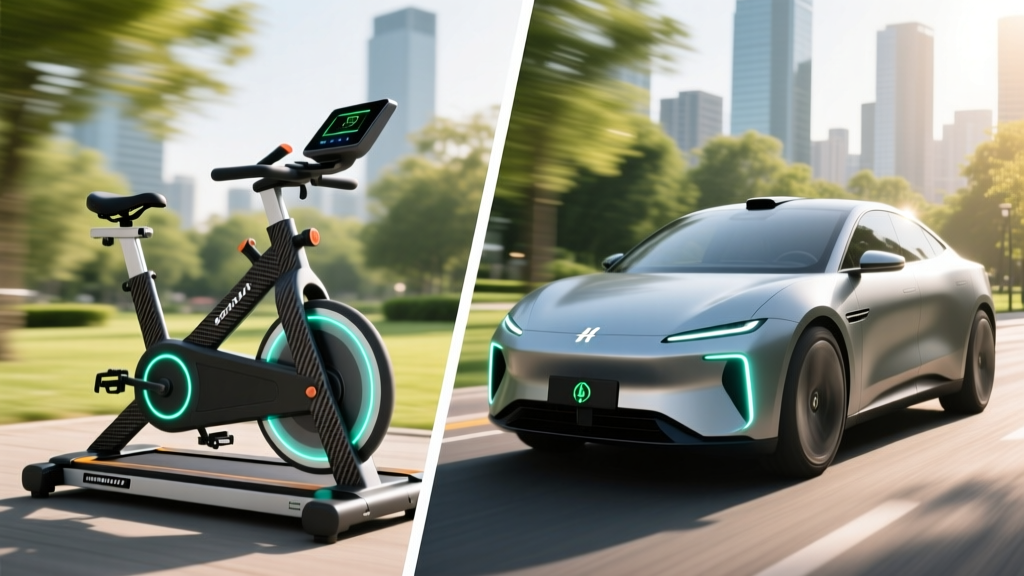
An electric treadmill bike (also called a treadmill bicycle or running bike) is a niche micro-mobility device where the rider powers a belt-driven deck by walking or running — sometimes assisted by a small electric motor under 750W. It is not a practical replacement for a car. If your goal is daily commuting beyond 3-5 miles, carrying cargo, or driving in bad weather, a full-size battery-electric vehicle (BEV) or a plug-in hybrid (PHEV) delivers far more utility per dollar. An electric treadmill bike costs $1,500–$5,000 and covers 5–15 miles on a charge; a compact EV like the 2026 Chevrolet Equinox EV starts around $33,000 (before incentives) and delivers 315+ miles of EPA range. They serve fundamentally different needs.
What Exactly Is an Electric Treadmill Bike?
The electric treadmill bike is a human-powered micro-mobility vehicle that replaces pedals with a treadmill-style belt deck. The rider walks or jogs to move forward, and some models include a small hub motor (typically 250W–500W) for assist on hills or when the rider fatigues. Brands like Lopifit popularized the concept, though availability remains limited and mostly direct-to-consumer from overseas manufacturers.
Key specifications you'll encounter:
- Motor: 250W–500W brushless hub motor (rear wheel)
- Battery: 0.3–0.8 kWh lithium-ion (36V or 48V systems)
- Top speed: 15–20 mph (motor-assisted)
- Range: 5–15 miles depending on assist level and rider effort
- Weight: 45–70 lbs
- Price: $1,500–$5,000 depending on brand and motor size
Legally, most electric treadmill bikes fall into a gray area. They don't meet the Consumer Product Safety Commission's definition of a "low-speed electric bicycle" (which requires operable pedals), meaning they may be classified as motorized scooters or unregistered motor vehicles depending on your state. Check local regulations before riding on public roads or bike lanes.
Electric Treadmill Bike vs Compact EV: The Numbers
If you're researching the electric treadmill bike, you're likely weighing it against other electrified transport. Here's how it stacks up against a practical compact EV — the 2026 Chevrolet Equinox EV 2LT — and a mid-range electric bicycle.
| Attribute | Electric Treadmill Bike | Class 2 E-Bike (750W) | 2026 Chevy Equinox EV 2LT |
|---|---|---|---|
| Base Price | $2,500–$4,000 | $1,200–$2,500 | $33,600 MSRP |
| Battery Capacity | 0.4–0.7 kWh | 0.5–0.75 kWh | 85 kWh usable (NMC) |
| EPA / Estimated Range | 5–15 mi (estimated) | 20–50 mi (estimated) | 315 mi (EPA est.) |
| Top Speed | 15–20 mph | 20 mph (Class 2) | 112 mph (governed) |
| Charging Time (full) | 3–5 hours (120V) | 3–6 hours (120V) | ~9.5 hrs (Level 2, 11.5 kW); ~30 min 10–80% DCFC |
| Cargo Capacity | Backpack only | Panniers / rear rack (~50 lbs) | 57.2 cu ft (seats folded) |
| Weather Protection | None | Minimal | Full climate control, heated seats |
| Federal Tax Credit | None | None (e-bike credit expired/not enacted) | Up to $7,500 (§30D, eligibility varies) |
| Annual Insurance | None / optional | $0–$200 | $1,400–$2,200 (varies by state/driver) |
| Annual Maintenance | $50–$100 (belt, bearings) | $100–$250 (chain, brakes, tires) | $300–$500 (tires, cabin filter, fluid top-off) |
Real Costs: 5-Year Ownership Breakdown
The upfront price is only part of the equation. Below is a realistic 5-year cost estimate assuming a 10-mile daily commute (2,500 miles/year for micro-mobility, 12,000 miles/year for the EV).
| Cost Category | Treadmill Bike | E-Bike | Equinox EV | Gas Compact (Baseline) |
|---|---|---|---|---|
| Purchase Price | $3,500 | $1,800 | $33,600 | $28,000 |
| Federal Tax Credit | $0 | $0 | –$7,500 (if eligible) | $0 |
| Effective Purchase | $3,500 | $1,800 | $26,100 | $28,000 |
| Energy/Fuel (5 yrs) | $40 (electricity) | $60 | $2,700 ($0.14/kWh avg) | $7,500 ($3.50/gal, 30 MPG) |
| Maintenance (5 yrs) | $400 | $800 | $2,000 | $4,500 |
| Insurance (5 yrs) | $0 | $500 | $9,000 | $7,500 |
| 5-Year Total | $3,940 | $3,160 | $39,800 | $47,500 |
| Cost Per Mile | $0.32 | $0.25 | $0.66 | $0.79 |
Key takeaway: The treadmill bike and e-bike win on raw cost-per-mile, but they can't replace a car for most Americans. They work as supplements — fair-weather last-mile solutions — not primary vehicles. The EV costs more upfront but delivers year-round, all-weather, highway-capable transportation with cargo space and safety features.
Common Misconceptions — Fact-Checked
| Myth | Fact |
|---|---|
| "An electric treadmill bike qualifies for the federal EV tax credit." | False. The IRS §30D credit applies only to four-wheeled vehicles with a gross vehicle weight under 14,000 lbs, manufactured by a qualified OEM, meeting battery-sourcing and MSRP caps. Micro-mobility devices do not qualify. (Source: IRS) |
| "It's a great workout and a commuter vehicle in one." | Partially true. You will get exercise, but arriving sweaty at a workplace without a shower is impractical. Motor assist defeats the fitness purpose. Most owners report using it recreationally, not as a daily commuter. |
| "The battery lasts as long as an EV battery." | False. Micro-mobility batteries (typically 18650 or 21700 cells in small packs) degrade faster due to less sophisticated thermal management. Expect 500–800 charge cycles before noticeable capacity loss — roughly 3–5 years of regular use. EV batteries with active thermal management (like the Equinox EV's liquid-cooled NMC pack) are warranted for 8 years/100,000 miles at ≥70% capacity retention. |
| "I can ride it on any bike lane or sidewalk." | Legally ambiguous. Because the treadmill bike lacks pedals, it doesn't meet the CPSC's federal e-bike definition. Many jurisdictions classify it as a motorized vehicle, requiring registration, insurance, and road use — not bike lanes or sidewalks. |
| "It charges from any outlet, so I don't need special equipment." | True for the device itself (standard 120V). But this is also true of e-bikes and is not an advantage unique to the treadmill bike format. |
When Does an Electric Treadmill Bike Make Sense?
The electric treadmill bike occupies a narrow use case. It makes sense only if all of the following are true:
- Your commute is under 5 miles, mostly flat, and in fair weather
- You already own or have access to a car for longer trips, bad weather, and cargo
- You want a novelty fitness device that doubles as short-range transport
- Your workplace has a shower or you don't mind arriving sweaty
- Your local laws permit motorized treadmill-style vehicles on your intended route
If any of these don't apply, a Class 2 e-bike (with pedals, throttle, and clear legal status) is a more practical and affordable micro-mobility choice at $1,200–$2,500.
Decision Framework: What Should You Actually Buy?
If-Then Buying Guide
- If you need a primary vehicle for year-round commuting, highway driving, and cargo → Buy a compact EV (Equinox EV, Hyundai Ioniq 5, Tesla Model 3). Budget $30,000–$45,000 before incentives.
- If you have a 5–30 mile commute and want to avoid car costs → Buy a Class 2 or Class 3 e-bike ($1,200–$3,000). Add panniers and fenders for practicality.
- If you want to reduce gas use but can't charge at home → Buy a PHEV like the Toyota Prius Prime (44 mi electric-only, 52 MPG combined on gas). No home charger needed.
- If you want a fitness novelty for weekend rides on paved trails → Consider the electric treadmill bike ($2,500–$4,000). Understand it's a recreational device, not transportation infrastructure.
- If you live in a rural area with no charging options and long distances → Stick with a hybrid (HEV) like the Toyota Camry Hybrid (52 MPG combined). EVs aren't practical without charging access.
What First-Time EV Buyers Should Know (If You're Upgrading From Micro-Mobility)
If your research into the electric treadmill bike has sparked interest in full-size electric vehicles, here's what matters:
Home Charging Is Non-Negotiable for Most Owners
Over 80% of EV charging happens at home. A Level 2 home charger (240V, 32–48 amps, 7.7–11.5 kW) costs $500–$1,500 for the unit and $800–$2,500 for professional installation depending on your electrical panel. If your home has a 200-amp panel with spare capacity, installation is straightforward. Older homes with 100-amp panels may need a $2,000–$4,000 panel upgrade. Without home charging, public DC fast charging costs $0.30–$0.60/kWh — roughly triple the cost of home charging at the national average of $0.14/kWh.
Real-World Range vs. EPA Stickers
EPA range estimates are tested under controlled conditions. In real-world driving, expect:
- Highway driving (70+ mph): 85–90% of EPA range
- Cold weather (below 32°F): 65–80% of EPA range (battery chemistry and cabin heating reduce efficiency)
- Combined city/highway in mild weather: 95–105% of EPA range (regenerative braking helps in stop-and-go traffic)
A 315-mile EPA-rated Equinox EV will realistically deliver ~260 miles on a cold-weather highway trip. Plan accordingly.
Federal Tax Credit: It's Not Guaranteed
The §30D clean vehicle credit offers up to $7,500, but eligibility depends on:
- MSRP caps: $80,000 for vans/SUVs/pickups; $55,000 for sedans
- Buyer income caps: $150,000 single / $300,000 joint MAGI
- Battery sourcing: Critical minerals and battery components must meet escalating domestic-content thresholds — these tighten annually
- Point-of-sale transfer: You can transfer the credit to the dealer for an immediate price reduction (available since 2024)
Always verify current eligibility on the IRS Clean Vehicle Credits page and cross-reference the specific VIN on fueleconomy.gov before purchasing.
Frequently Asked Questions
Is an electric treadmill bike street-legal?
It depends on your state and municipality. Because it lacks pedals, it doesn't meet the federal CPSC definition of an e-bike. Some jurisdictions classify it as a motorized scooter (legal on roads, not sidewalks); others have no clear classification. Check with your local DMV or transportation authority before purchasing.
Can I use an electric treadmill bike for exercise and commuting?
You can, but it's impractical for most people. Walking or running 5 miles produces significant sweat, and most workplaces lack shower facilities. The motor assist defeats the fitness purpose. Most buyers end up using it recreationally on weekends rather than as a daily commuter.
How does the cost compare to just buying an e-bike?
A quality Class 2 e-bike (750W motor, 0.5–0.75 kWh battery, 20–50 mile range) costs $1,200–$2,500 — significantly less than most treadmill bikes. E-bikes have pedals, clear legal status, better cargo options, and a much larger dealer/service network. For pure transportation value, the e-bike wins decisively.
What's the cheapest full-size EV I can buy in 2026?
The 2026 Nissan Leaf S starts around $28,140 MSRP with 149 miles of EPA range. If you qualify for the full $7,500 §30D credit (income and sourcing requirements apply), the effective price drops to ~$20,640. The 2026 Chevrolet Equinox EV 2LT starts at $33,600 with 315 miles of range — a better value for most buyers who need highway capability and fast charging.
Do electric treadmill bikes require insurance or registration?
In most states, yes — if they're classified as motorized vehicles rather than bicycles. Requirements vary widely. Some states require registration, a driver's license, and liability insurance. Others have no clear rules. Contact your state DMV for guidance specific to your location.
What's the battery lifespan on a treadmill bike vs. a real EV?
Treadmill bike batteries (small lithium-ion packs without active thermal management) typically last 500–800 full charge cycles before significant degradation — roughly 3–5 years of daily use. Full-size EV batteries are liquid-cooled, warrantied for 8 years/100,000 miles, and designed for 1,500–3,000+ cycles. The engineering gap is substantial.