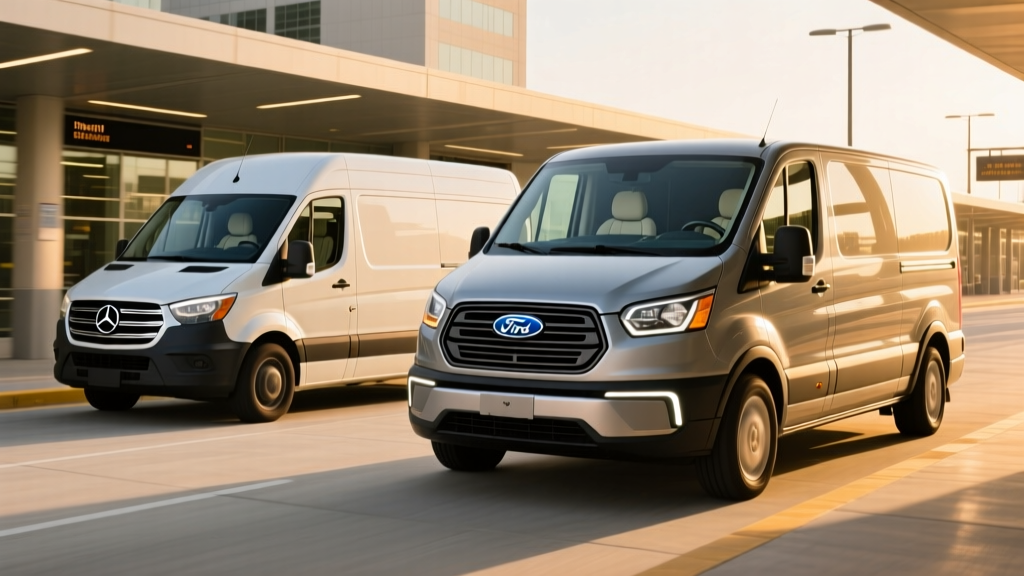
If you run a delivery fleet, trades business, or last-mile logistics operation and are researching electric transit vans, the short answer is this: electric cargo vans save $0.15–$0.25 per mile on fuel and maintenance versus gas equivalents, but their 108–200+ mile real-world ranges mean they work best for predictable urban/suburban routes under 150 miles per day. Upfront costs remain $10,000–$20,000 higher than gas vans before incentives, and DC fast charging from 10–80% takes 30–45 minutes. The Ford E-Transit leads in dealer support and pricing, the Mercedes-Benz eSprinter offers the most range and cargo volume, and the BrightDrop Zevo 600 targets high-volume fleet buyers with competitive efficiency.
Quick Verdict: Is an Electric Transit Van Right for You?
Electric transit vans make financial sense if your daily routes are under 150 miles, you can install depot Level 2 or DC fast charging, and you plan to keep the van 5+ years to recoup the higher purchase price through fuel and maintenance savings. They do not work well for long-haul routes, extreme cold climates without depot charging, or operations without predictable daily mileage.
The 2026 Electric Transit Van Landscape
The commercial electric van market has matured significantly since Ford launched the E-Transit for the 2022 model year. As of the 2026 model year, three main players compete in the US market for light-duty electric cargo vans, each with distinct strengths. These are not consumer vehicles — they're purpose-built work tools where payload capacity, cargo volume, upfit compatibility, and total cost of ownership matter far more than 0-60 times.
Here's how the field stacks up on paper before we dig into real-world numbers:
| Spec | 2026 Ford E-Transit | 2026 Mercedes-Benz eSprinter | 2026 BrightDrop Zevo 600 |
|---|---|---|---|
| EPA Est. Range | 126 mi (low roof) | ~200 mi (150 kWh battery) | ~160 mi (est.) |
| Battery (usable) | 68 kWh, NMC | 113 kWh / 150 kWh, NMC | ~120 kWh, NMC |
| Peak DC Charge Rate | 115 kW | 115 kW | ~120 kW |
| 10–80% DC Charge | ~45 min | ~42 min (150 kWh) | ~40 min (est.) |
| Level 2 Charge Rate | 10.5 kW | 9.6 kW (AC) | 11.5 kW |
| Motor Output | 266 hp / 317 lb-ft | 201 hp / 332 lb-ft | ~260 hp |
| Max Payload | ~3,880 lbs | ~3,285 lbs (150 kWh) | ~2,500 lbs (est.) |
| Cargo Volume (max) | 487.3 cu ft | 532.6 cu ft | ~600 cu ft |
| Base MSRP (approx.) | ~$51,000 | ~$72,000 | Fleet pricing |
| Warranty (battery) | 8 yr / 100,000 mi | 8 yr / 100,000 mi | 8 yr / 100,000 mi |
Sources: Ford Commercial, Mercedes-Benz Sprinter, fueleconomy.gov. BrightDrop specs are preliminary estimates as GM has not finalized 2026 Zevo 600 figures.
Real-World Range: What the EPA Sticker Doesn't Tell You
EPA range estimates for commercial vans are measured under ideal conditions with minimal payload. In the real world, an electric transit van carrying 1,500–2,000 lbs of cargo through stop-and-go urban delivery routes will see different results — and not always worse ones.
Real-World Range Expectations
Ford E-Transit (EPA 126 mi): Expect 95–115 miles with a 2,000-lb payload in moderate weather. Regenerative braking in urban stop-and-go driving can actually help recovery, but highway-speed routes above 65 mph drop range to ~85–100 miles.
Mercedes eSprinter 150 kWh (EPA ~200 mi): Expect 150–180 miles loaded in city delivery. Highway-heavy routes at 70 mph drop this to ~130–150 miles. Cold weather (below 30°F) can cut either van's range by 25–35%.
BrightDrop Zevo 600 (est. ~160 mi): Expect 130–150 miles in typical last-mile use.
The critical takeaway: if your daily route exceeds 100 miles and you cannot charge mid-day, the E-Transit's 126-mile EPA range is uncomfortably tight. The eSprinter's larger 150 kWh battery provides a meaningful buffer, which is why it commands a $20,000+ premium.
Charging Infrastructure: The Hidden Cost of Going Electric
The van is only half the equation. Depot charging infrastructure is where many fleet operators hit unexpected costs and delays.
| Charging Level | Power (kW) | Miles Added/Hour | Typical Use Case |
|---|---|---|---|
| Level 1 (120V) | ~1.4 kW | ~3–4 mi/hr | Not viable for commercial use |
| Level 2 (240V, 40A) | 9.6 kW | ~22–28 mi/hr | Overnight depot charging (8–10 hrs = full charge) |
| Level 2 (240V, 48A) | 11.5 kW | ~28–34 mi/hr | Faster overnight depot; fills E-Transit in ~7 hrs |
| DC Fast (50 kW) | 50 kW | ~120–140 mi/hr | Mid-day top-up; adds ~60 mi in 30 min |
| DC Fast (115 kW peak) | 115 kW | ~250+ mi/hr (peak) | 10–80% in ~42–45 min; tapers above 80% |
Key distinction — kW vs kWh: kW (kilowatts) measures the rate of energy transfer — like water pressure in a hose. kWh (kilowatt-hours) measures the total energy stored in the battery — like the size of the tank. A 68 kWh battery charged at 115 kW doesn't fill in 35 minutes because the charge rate tapers significantly above 80% state of charge (SoC) to protect battery health.
| Item | Single Van (Level 2) | 5-Van Depot (Level 2 + DC) |
|---|---|---|
| Level 2 charger hardware | $600–$1,200 | $3,000–$6,000 (×5 units) |
| Electrical panel upgrade | $0–$3,000 | $5,000–$25,000 |
| Electrician labor & conduit | $1,500–$4,000 | $10,000–$30,000 |
| DC fast charger (50 kW unit) | N/A | $20,000–$50,000 + install |
| Permits & utility coordination | $200–$800 | $2,000–$8,000 |
| Estimated Total | $2,300–$9,000 | $40,000–$120,000+ |
For a single-van operator (plumber, electrician, contractor), a Level 2 home or shop charger is straightforward — budget $3,000–$6,000 installed if your panel has capacity. For a 5–10 van fleet depot, you're looking at commercial electrical work that requires utility coordination, possible transformer upgrades, and load-management software. Many utilities offer commercial EV infrastructure rebates — check with your local provider, as programs vary by jurisdiction.
Always consult a licensed electrician for final installation specs. Panel capacity, conduit runs, and local code requirements vary significantly.
Total Cost of Ownership: Electric Transit Van vs. Gas Van
This is where electric transit vans make their strongest case — but the math depends heavily on your mileage, electricity rates, and how long you keep the vehicle.
| Cost Category | Ford E-Transit | Ford Transit 3.5L V6 (Gas) | Difference |
|---|---|---|---|
| Purchase Price (base MSRP) | $51,000 | $44,000 | +$7,000 (EV) |
| Federal Tax Credit (§30D)* | Up to -$7,500 | $0 | -$7,500 (EV) |
| Net Purchase (after credit) | ~$43,500 | $44,000 | -$500 (EV) |
| Fuel/Energy (15,000 mi/yr × 5 yr) | $5,625 (at $0.15/kWh, 2.5 kWh/mi) | $16,875 (at $3.75/gal, 15 MPG) | -$11,250 (EV) |
| Maintenance (5 yr) | ~$1,500 | ~$4,500 | -$3,000 (EV) |
| Insurance (est. 5 yr) | ~$12,000 | ~$10,000 | +$2,000 (EV) |
| Charger Install (Level 2) | $4,000 | $0 | +$4,000 (EV) |
| 5-Year Total | ~$66,625 | ~$75,375 | -$8,750 (EV saves) |
*The §30D federal tax credit of up to $7,500 requires meeting battery sourcing, critical mineral, buyer income, and MSRP cap rules. Commercial vehicle credits under §45W may apply instead for fleet purchases. Consult IRS guidelines and a tax professional for your specific eligibility.
The E-Transit breaks even against a gas Transit within 2–3 years for most operators driving 15,000+ miles annually, primarily through fuel savings. The maintenance gap is real: no oil changes, no transmission fluid, no spark plugs, and regenerative braking significantly extends brake pad life. However, EV commercial insurance premiums tend to run 10–20% higher due to repair cost structures and battery replacement considerations.
Common Misconceptions About Electric Transit Vans
| Myth | Fact |
|---|---|
| "The battery will need replacing in 5 years." | Modern NMC batteries in commercial vans are warrantied for 8 years/100,000 miles at 70%+ capacity retention. Real-world fleet data from early E-Transit adopters shows ~5–8% degradation over 100,000 miles of urban delivery use. |
| "Electric vans can't handle cold weather." | Range drops 25–35% below 30°F due to battery chemistry and cabin heating demands. A van with 126 mi EPA range may deliver 85–95 mi in a Minnesota winter. Route planning must account for this — or specify the larger-battery eSprinter for cold-climate fleets. |
| "Charging takes too long for commercial use." | For overnight depot charging, Level 2 fully replenishes an E-Transit in ~7 hours — more than enough for vans parked 8–12 hours between shifts. DC fast charging at 115 kW adds 80% in ~45 minutes for mid-day top-ups. |
| "Payload capacity is too low." | The E-Transit offers ~3,880 lbs payload — competitive with a gas Transit 250 low-roof. The battery's weight is offset by removing the engine and transmission. However, the heavier-battery eSprinter 150 kWh does lose ~600 lbs of payload vs. its gas equivalent. |
| "You need a special commercial charging network." | All three vans use the CCS1 connector (with Ford adopting NACS for future models). Public networks like Electrify America and EVgo support commercial van charging, though depot charging is strongly recommended for fleet reliability. |
Who Should Buy an Electric Transit Van — and Who Shouldn't
Decision Framework: Is Electric Transit Right for Your Operation?
Choose an electric transit van if:
- Your daily routes are predictable and under 120 miles (E-Transit) or under 170 miles (eSprinter 150 kWh)
- You can install Level 2 charging at your depot, home, or shop
- You operate primarily in urban/suburban stop-and-go conditions (regenerative braking maximizes efficiency)
- You plan to keep the van 5+ years to capture the TCO advantage
- You qualify for the §30D or §45W federal tax credit, or your state offers commercial EV incentives
- Local emissions regulations or customer sustainability requirements favor zero-tailpipe-emission vehicles
Stick with a gas or diesel van if:
- Your daily routes regularly exceed 150 miles with no mid-day charging opportunity
- You operate in extreme cold climates (sustained below 20°F) and cannot accept 30%+ range loss
- You need maximum towing capacity — electric vans currently offer limited tow ratings vs. gas V8 options
- You lack access to any form of depot or home charging and must rely entirely on public infrastructure
- You turn over vehicles every 2–3 years, before the fuel savings offset the price premium
What First-Time Electric Van Buyers Need to Know
If you've only ever bought gas or diesel work vans, the purchasing process for an electric transit van has some differences worth understanding:
1. Order the charger before the van. Commercial Level 2 installations can take 4–12 weeks from permit to energization, especially if your electrical panel needs upgrading. DC fast charger installations can take 3–6 months with utility coordination.
2. Understand the tax credit landscape. The §30D credit (up to $7,500 for personal/business use) has MSRP caps ($80,000 for vans), buyer income limits, and strict battery sourcing requirements that change annually. For fleet purchases, the §45W commercial clean vehicle credit may apply instead — these are separate programs with different rules. Verify current-year eligibility on IRS.gov and consult a tax professional before committing.
3. Spec for your worst day, not your average day. If your average route is 80 miles but you occasionally need 140, buy the van with enough range for 140 — or plan a mid-day DC fast charge. Range shortfall in a commercial van means missed deliveries, not just inconvenience.
4. Factor in the charging curve. DC fast charging doesn't sustain peak rates. The E-Transit peaks at 115 kW but tapers to ~40 kW above 80% SoC. A "45-minute charge" gets you to 80% — the final 20% takes significantly longer. Plan your charging windows accordingly.
5. Telematics is your friend. Ford Pro, Mercedes PRO Connect, and BrightDrop's platform all offer fleet telematics that monitor state of charge, route efficiency, and charging status remotely. Use these tools to optimize routes around battery levels and prevent range emergencies.
Frequently Asked Questions
Can I tow with an electric transit van?
The Ford E-Transit is rated for up to 7,500 lbs of towing when properly equipped — competitive with a gas Transit 250. However, towing heavy loads significantly reduces range, potentially cutting it by 30–50%. If towing is a daily requirement, calculate your range needs with the trailer attached, not just cargo-only.
How long does the battery last before replacement?
Both Ford and Mercedes warranty their van batteries for 8 years or 100,000 miles, guaranteeing at least 70% of original capacity retention. Real-world fleet data suggests NMC batteries in commercial delivery use lose roughly 1–2% capacity per year under normal cycling. A full battery replacement outside warranty for an E-Transit is estimated at $15,000–$20,000, though this cost is expected to decline as battery prices continue to fall.
Do electric transit vans qualify for the $7,500 federal tax credit?
They can, but eligibility depends on multiple factors: the van's MSRP must be under $80,000, the buyer must meet income caps (varies by filing status), and the vehicle must meet battery component and critical mineral sourcing thresholds that tighten each year. Additionally, fleet buyers may qualify under the separate §45W commercial credit instead. Rules are subject to annual updates — always verify on IRS.gov for the current tax year.
What happens if I run out of charge on a route?
Unlike a gas van where a $20 fuel can solves the problem, a depleted EV requires a flatbed tow to a charger. This means real downtime and cost. The mitigation is operational: route planning software with SoC monitoring, depot charging discipline, and mid-day DC fast charging access for longer routes. Most commercial EV fleet operators report that range-depletion incidents drop to near zero after the first 90 days of telematics-optimized routing.
Is a plug-in hybrid van a better compromise?
As of 2026, there are no mainstream PHEV cargo vans available in the US market. The choice is effectively gas/diesel vs. full battery electric. If your route variability makes a BEV impractical, a gas Transit or Sprinter remains the default — but you'll miss out on the $0.15–$0.25/mile operating cost advantage that electric transit vans deliver on suitable routes.