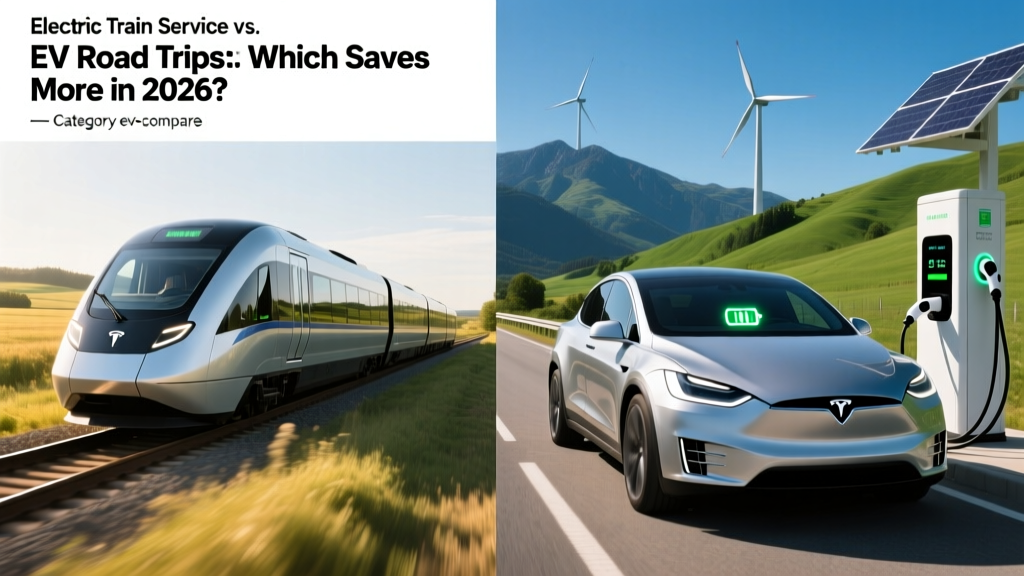
Quick Answer: For corridor trips under 400 miles (e.g., NYC–DC, LA–San Diego), a modern EV like the 2026 Hyundai Ioniq 6 SE (EPA 361 miles, 4.0 mi/kWh) costs roughly $0.04–$0.07 per mile to charge at home, compared to Amtrak's $0.15–$0.35 per mile on the Northeast Corridor. But electric train service wins on total time-value when you factor in traffic, parking, and the ability to work en route. For solo drivers on flexible schedules, the EV is cheaper. For families or business travelers, rail often delivers better total value.
Why "Electric Train Service" Searches Are Surging Among EV Shoppers
Monthly searches for "electric train service" have climbed steadily as travelers weigh intercity transit against EV ownership. Most Amtrak routes and nearly all commuter rail systems (Metro-North, SEPTA, Caltrain, Metra Electric) run on overhead catenary or third-rail electric power — making them, in effect, mass-scale electric vehicles on steel wheels.
The question EV buyers actually want answered isn't whether trains are electric. It's this: Given that I already own or plan to buy an EV, when does it make financial and practical sense to drive versus taking electric rail?
This guide breaks down the real numbers — per-mile energy cost, total trip cost with parking and tolls, time efficiency, and carbon intensity — using 2026 EV models and current Amtrak pricing.
The Per-Mile Energy Cost: EV vs. Electric Rail
To compare apples to apples, we need to separate energy cost to the traveler from energy efficiency of the system. Trains are vastly more efficient per passenger-mile, but you don't pay for efficiency — you pay for a ticket.
| Metric | EV (Home L2, $0.16/kWh) | EV (DC Fast, $0.48/kWh avg) | Amtrak NEC (Northeast Regional) | Amtrak Acela Business |
|---|---|---|---|---|
| Energy/Ticket cost per mile | $0.04 | $0.12 | $0.19 | $0.35 |
| NYC → Washington DC (225 mi) | $9.00 | $27.00 | $43–$62 | $79–$110 |
| LA → San Diego (120 mi) | $4.80 | $14.40 | $35–$42 (Pacific Surfliner) | N/A |
| Boston → NYC (215 mi) | $8.60 | $25.80 | $40–$58 | $75–$105 |
The EV's advantage is stark when you charge at home on a residential electricity rate. The national average residential price sits around $0.16/kWh in early 2026 (EIA data). A Hyundai Ioniq 6 SE with its 77.4 kWh battery and 4.0 mi/kWh efficiency needs about 56 kWh for the NYC–DC run — roughly $9.
But switch to DC fast charging at Electrify America or Tesla Supercharger rates ($0.40–$0.56/kWh depending on location and time), and the gap narrows considerably. A road trip requiring two DC fast charges can push per-mile cost to $0.12, which approaches Northeast Regional coach fares booked in advance.
Total Trip Cost: Parking, Tolls, and the Hidden Math
Energy cost alone tells an incomplete story. The real comparison requires total trip cost.
| Cost Category | EV (2026 Ioniq 6) | Gas Car (2026 Camry LE, 32 MPG) | Amtrak Northeast Regional |
|---|---|---|---|
| Energy/Fuel | $18 (home charge) | $56 ($3.50/gal) | $86–$124 |
| Tolls (NJ Turnpike, etc.) | $30 | $30 | $0 |
| Parking (DC, 1 night garage) | $35–$50 | $35–$50 | $0 |
| Wear/maintenance allocation | $8 | $14 | $0 |
| Total round trip | $91–$106 | $135–$150 | $86–$124 |
| Door-to-door time (one way) | 4.5–5.5 hrs | 4.5–5.5 hrs | 3.5–4 hrs (station to station + transit) |
For a solo traveler, the EV and Amtrak costs converge once parking and tolls enter the equation. The gas car is the clear loser. But add a second passenger to the EV and the per-person cost drops to roughly $45–$53 — well below any Amtrak fare.
This is the core decision insight: EV road trips scale economically with passengers; rail tickets do not.
When Electric Train Service Wins — and When It Doesn't
The practical framework isn't about which mode is universally better. It's about matching the trip to the mode.
Decision Framework: Drive Your EV or Take Electric Rail?
- Choose the EV if: You're traveling with 2+ people, need a car at the destination, have home charging, or are departing outside peak rail pricing windows.
- Choose electric rail if: You're traveling solo, the origin and destination are both near transit hubs, you need to work during travel, or weather/traffic conditions are poor.
- Choose neither (fly) if: The trip exceeds 500 miles and time matters more than cost.
Real-World Scenarios
Scenario 1: Solo business traveler, NYC to DC, same-day return. Amtrak wins. You work on the train, avoid parking, and total cost ($86–$124) is competitive. Driving solo in an EV costs $91–$106 but demands 9–11 hours of attention behind the wheel.
Scenario 2: Family of four, Philadelphia to NYC weekend trip. The EV wins decisively. Four Amtrak tickets run $160–$240+ round trip. The EV costs $28 in energy (home charging), $20 in tolls, and $40 in parking — about $88 total, or $22 per person.
Scenario 3: Solo traveler, no home charging, winter trip. This is where EV ownership gets complicated. Without home L2 access, you're relying on DC fast charging at $0.48/kWh average, pushing the NYC–DC energy cost to $27 one way. Add cold-weather range loss of 20–30% (verified in Recurrent's battery research), and you may need an extra charging stop. Rail becomes the simpler, sometimes cheaper choice.
Common Misconceptions About EVs vs. Electric Trains
| Myth | Fact |
|---|---|
| "Electric trains produce zero emissions, so rail is always greener." | Amtrak's Northeast Corridor draws from regional grids that include fossil generation. The carbon advantage depends on grid mix. An EV charged on a clean grid (e.g., upstate NY hydro) can match or beat rail per-passenger carbon intensity when carrying 2+ people. |
| "EVs can't handle long corridor trips without lengthy charging stops." | The 2026 Ioniq 6 SE does 361 EPA miles. A NYC–DC trip (225 mi) requires zero intermediate charging in normal conditions. Even cold-weather highway driving (~270 mi real-world range) completes the trip on one charge. |
| "Amtrak is always cheaper than driving." | Only for solo travelers booking advance fares. Walk-up Acela business class can exceed $150 one way — more than 10x the EV energy cost for the same corridor. |
| "Charging at your destination is always available." | Hotel and garage charging remains inconsistent. Verify Level 2 availability on PlugShare or ChargePoint before committing to an EV trip. Destination DC fast charging adds $15–$30 to trip cost. |
First-Time EV Buyer? Here's What You Need Before Comparing to Rail
If you're researching electric train service as an alternative to buying an EV, you likely have range or cost concerns. Let's address the fundamentals with 2026 data.
What a Typical 2026 EV Actually Delivers
- EPA range: 250–370 miles for mainstream sedans/SUVs (Chevy Equinox EV 319 mi, Ioniq 6 SE 361 mi, Tesla Model Y Long Range 320 mi)
- Real-world highway range: Expect 80–90% of EPA at 70+ mph; 70–80% in freezing temperatures
- Home charging (Level 2, 240V/48A): Adds ~30–35 miles per hour of charging; full overnight replenishment
- DC fast charging: Peak 150–250 kW on mainstream models; 10–80% in 18–25 minutes (with taper above 80%)
- Federal tax credit (§30D): Up to $7,500 if MSRP, income, and battery-sourcing requirements are met — check current IRS rules before purchasing, as critical-mineral sourcing requirements tighten annually
Home Charging Access Is the Real Dividing Line
EV ownership economics change dramatically without home charging. If you have a garage or driveway where a Level 2 charger (typically a 48-amp, 11.5 kW unit on a 60-amp circuit) can be installed — expect $800–$2,000 for equipment and electrician labor — your per-mile cost stays near $0.04. Without home charging, you're paying DC fast-charger rates 2–4x higher, and the cost advantage over Amtrak erodes on shorter solo trips.
Renters and condo dwellers without charging access should consider whether a PHEV (plug-in hybrid like the 2026 Toyota RAV4 Prime, 42 miles EV range) or continued reliance on electric rail and occasional car-sharing better fits their situation.
The 5-Year Ownership Picture: EV vs. Rail-Dependent Living
For households weighing whether to buy an EV or rely on electric train service plus car-sharing, the 5-year math matters.
| Category | EV Ownership (Ioniq 6 SEL, home L2) | Rail + Zipcar/Enterprise |
|---|---|---|
| Vehicle/transport cost (5 yr) | $42,000 purchase – $7,500 credit = $34,500 | $0 (no vehicle) |
| Energy/fuel (5 yr, 5,400 total corridor miles/yr) | $1,080 (home charging) | $5,400–$7,200 (Amtrak tickets) |
| Insurance (5 yr) | $7,500–$9,000 | $0 |
| Maintenance (5 yr) | $1,200 | $0 |
| Parking/tolls (5 yr) | $4,200 | $0 |
| Car-share for local needs (5 yr) | $0 | $3,600–$6,000 |
| 5-Year total (travel only) | $48,480–$50,480 | $9,000–$13,200 |
The raw numbers show that if intercity travel is your only driving need, rail plus car-sharing costs far less than purchasing an EV. But most EV buyers also need daily local transportation — commuting, groceries, school runs — where the EV replaces a gas car and generates its own savings. The DOE's EV comparison tool at fueleconomy.gov can help you calculate your specific local savings.
Frequently Asked Questions
Are Amtrak trains actually electric?
The Northeast Corridor (Boston–NYC–DC) runs on 25 kV AC overhead catenary electric power. The Pacific Surfliner and some other routes use diesel-electric locomotives. Most commuter rail systems in major metros (Metro-North, LIRR, SEPTA, Metra Electric, Caltrain) are fully electric.
Is it cheaper to drive an EV or take the train for a 200-mile trip?
For a solo traveler with home charging, the EV costs roughly $8–$10 in energy one way versus $40–$60 for a Northeast Regional ticket. But add tolls ($15), parking ($35+), and the value of your driving time, and the gap shrinks to roughly break-even. With 2+ passengers, the EV is almost always cheaper per person.
Do I lose significant EV range on highway corridor trips?
Yes. At sustained 70–75 mph, expect 85–90% of EPA-rated range in mild weather (60–80°F) and 70–80% in freezing conditions. A 361-mile EPA vehicle delivers roughly 310 miles real-world highway in summer and 260–280 in winter. Plan charging accordingly for trips near the vehicle's range limit.
Can I charge my EV at Amtrak stations?
Most Amtrak stations do not have dedicated EV charging. Some stations in shopping centers or transit hubs may have nearby ChargePoint or EVgo units. Check PlugShare before your trip. Amtrak has announced pilot charging programs at select stations, but widespread deployment is not yet available as of 2026.
What's the best EV for corridor road trips in 2026?
Prioritize efficiency (mi/kWh) and DC fast-charge speed over raw range. The Hyundai Ioniq 6 SE (361 mi, 4.0 mi/kWh, ~250 kW peak DC, 10–80% in ~18 min) and Tesla Model 3 Long Range (341 mi, Supercharger network access) are top picks. Both complete a 225-mile corridor trip on a single charge in most conditions.