The Short Answer on Electric Toyota SUVs
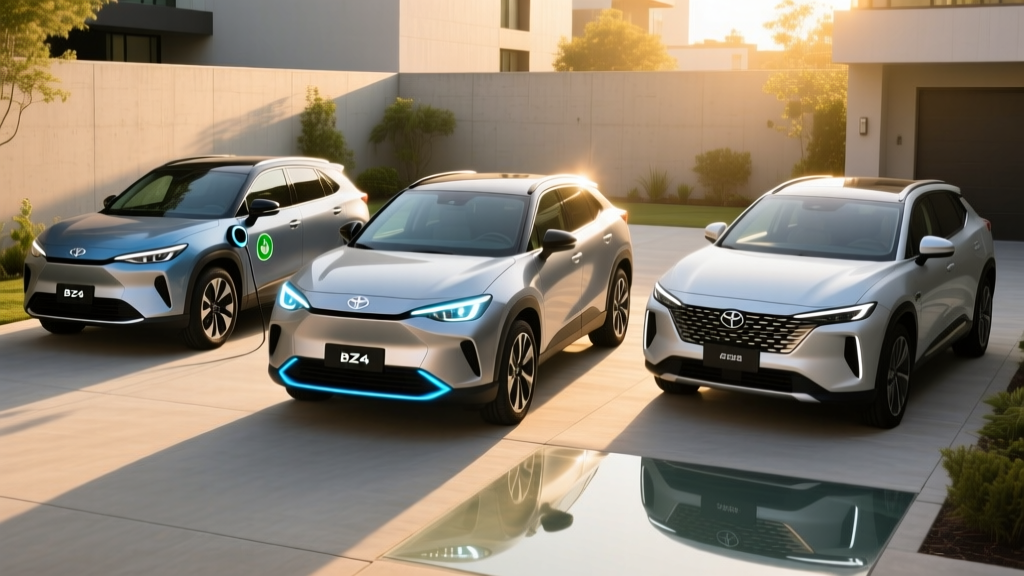
As of the 2026 model year, Toyota sells exactly one fully electric SUV in the U.S.: the bZ4X, a compact crossover with an EPA-estimated range of up to 252 miles (FWD trim), a 71.4 kWh (usable) lithium-ion battery, and DC fast charging that peaks around 150 kW. Pricing starts near $37,070 MSRP before destination. If you need a three-row electric SUV or 300+ miles of range from Toyota today, you'll have to look at competitors — or wait for Toyota's announced expanded EV lineup. For most buyers cross-shopping Toyota, the real decision is between the bZ4X and the far more established RAV4 Hybrid or RAV4 Prime PHEV.
2026 Toyota bZ4X: The Only All-Electric Toyota SUV You Can Buy Today
The bZ4X is Toyota's first mass-market battery-electric vehicle, co-developed with Subaru (which sells the mechanically similar Solterra). It rides on Toyota's e-TNGA platform and comes in two trims for 2026: XLE and Limited, with either front-wheel drive (single motor, 201 hp) or all-wheel drive (dual motor, 214 hp).
| Spec | XLE FWD | XLE AWD | Limited AWD |
|---|---|---|---|
| EPA Range | 252 mi | 228 mi | 222 mi |
| Battery (usable) | 71.4 kWh, lithium-ion (NMC chemistry) | ||
| MPGe (combined) | 131 MPGe | 114 MPGe | 112 MPGe |
| Peak DC Fast Charge | ~150 kW (CCS1 connector) | ||
| 10–80% DC Charge Time | ~30 minutes (under ideal conditions) | ||
| Level 2 (AC) Charge Rate | 6.6 kW (~23 mi/hr) | ||
| Horsepower | 201 hp | 214 hp | |
| 0–60 mph | ~7.1 sec | ~6.5 sec | |
| Cargo Volume | 27.7 cu ft (rear seats up) | ||
| Starting MSRP | $37,070 | $39,120 | $43,920 |
| Battery Warranty | 8 years / 100,000 miles | ||
Source: EPA fueleconomy.gov and Toyota Motor Corporation.
Real-World Range vs. the EPA Sticker
The 252-mile EPA figure applies to the FWD XLE in mixed driving. Expect 210–230 miles on the highway at 70–80 mph, and 160–190 miles in cold weather (below 32°F) due to battery heating demands and cabin climate load. The AWD Limited, with larger 20-inch wheels, delivers the lowest real-world range — plan conservatively around 185–200 miles in mixed conditions.
bZ4X vs. RAV4 Hybrid vs. RAV4 Prime: The Numbers That Matter
Most buyers searching for electric Toyota SUVs are actually deciding whether to go fully electric, hybrid, or plug-in hybrid. Here's how the three main Toyota compact SUV options stack up on cost, range, and daily usability.
| Attribute | bZ4X (BEV) | RAV4 Prime (PHEV) | RAV4 Hybrid (HEV) |
|---|---|---|---|
| Starting MSRP | $37,070 | $43,690 | $33,425 |
| Total Range | 252 mi (electric only) | 44 mi electric + 520 mi gas | 580 mi (gas only) |
| EPA Efficiency | 131 MPGe | 94 MPGe (EV mode) / 38 MPG | 39 MPG combined |
| Home Charging Needed? | Essential | Recommended | No |
| Federal Tax Credit (§30D) | Up to $7,500* | Up to $7,500* | None |
| Fuel/Energy Cost (annual, 15k mi) | ~$540–$810 | ~$700–$1,100 | ~$1,350–$1,600 |
| Maintenance (annual avg.) | ~$300 | ~$550 | ~$550 |
*Federal tax credit eligibility depends on MSRP caps, buyer income limits, battery sourcing requirements, and current-year IRS rules. See IRS §30D guidelines. Always consult a tax professional.
Real Ownership Costs: 5-Year Breakdown
Sticker price is only the beginning. Here's a five-year cost estimate assuming 15,000 miles/year, national average electricity rates (~$0.16/kWh), and $3.50/gallon gasoline. Individual results vary by state, utility rate, and driving pattern.
| Category | bZ4X XLE FWD | RAV4 Hybrid LE |
|---|---|---|
| Purchase Price (MSRP) | $37,070 | $33,425 |
| Est. Federal Tax Credit | −$7,500* | $0 |
| Net Purchase | $29,570 | $33,425 |
| Energy/Fuel (5 years) | $3,375 | $8,075 |
| Maintenance (5 years) | $1,500 | $2,750 |
| Insurance (5 years, avg.) | $7,500 | $6,250 |
| Home Charger Install (Level 2) | $500–$1,500 | $0 |
| Total (approx.) | $42,445–$43,445 | $50,500 |
Key takeaway: The bZ4X can break even or come out ahead over five years if you qualify for the full federal tax credit and have affordable home charging. Without the credit, or if you rely entirely on paid public DC fast charging (~$0.35–$0.48/kWh), the cost advantage narrows significantly. Insurance tends to run 15–20% higher on EVs due to battery replacement cost exposure.
Charging the bZ4X: What You Actually Need to Know
The bZ4X uses a CCS1 connector for DC fast charging and a J1772 connector for Level 1 and Level 2 AC charging. It does not have a NACS (Tesla) port natively, though Toyota has indicated future models will adopt NACS. For now, you'll rely on Electrify America, EVgo, ChargePoint, and other CCS-equipped networks for road trips.
| Level | Power | Miles Added per Hour | Typical Use |
|---|---|---|---|
| Level 1 (120V outlet) | ~1.2 kW | ~4–5 mi/hr | Emergency / overnight trickle |
| Level 2 (240V home) | 6.6 kW | ~23 mi/hr | Daily home charging |
| DC Fast Charge | Peak ~150 kW | ~150 mi in 30 min (10–80%) | Road trips |
The Charging Curve Reality
The bZ4X peaks at roughly 150 kW only when the battery is between 10–30% state of charge and properly preconditioned. Above 60% SoC, charge speed drops significantly — typically to 50–70 kW. This means the advertised "10–80% in 30 minutes" assumes ideal conditions. In cold weather without preconditioning, expect 10–80% to take 40–50 minutes.
Home Charging Is Non-Negotiable for Most Buyers
If you cannot install a Level 2 charger at home or lack access to reliable workplace charging, the bZ4X becomes a difficult daily proposition. A full Level 2 home charge (0–100%) takes roughly 11 hours. Budget $500–$1,500 for a quality Level 2 station and basic electrician installation; if your home needs a panel upgrade (100A → 200A), add $1,500–$3,000.
Federal Tax Credit: Do You Actually Qualify?
The IRS §30D clean vehicle credit offers up to $7,500 for qualifying new EVs, but eligibility hinges on multiple requirements that change periodically:
- MSRP Cap: SUVs must have an MSRP at or below $80,000 (the bZ4X qualifies).
- Buyer Income Cap: Modified AGI must not exceed $150,000 (single), $225,000 (head of household), or $300,000 (joint).
- Battery Sourcing: Critical minerals and battery components must meet phased-in domestic/free-trade-partner sourcing thresholds that tighten each year.
- Point-of-Sale Transfer: As of 2024+, you can transfer the credit to the dealer for an upfront price reduction rather than waiting to claim it at tax time.
- Assembly: The bZ4X is assembled in Japan, which may affect eligibility depending on current-year sourcing rules. Verify on fueleconomy.gov before purchasing.
Rules evolve. Always confirm eligibility on fueleconomy.gov and consult a tax professional before committing to a purchase based on credit assumptions.
Common Misconceptions About the bZ4X
| Myth | Fact |
|---|---|
| "It charges at 250+ kW like a Tesla." | The bZ4X peaks at ~150 kW and sustains lower rates above 60% SoC. It's competitive but not class-leading. |
| "The battery will need replacing in 5 years." | Toyota warranties the battery for 8 years/100,000 miles against failure and excessive degradation. NMC batteries in modern EVs typically retain 85–90% capacity at 100k miles. |
| "I can use Tesla Superchargers directly." | The bZ4X has a CCS1 port. Tesla Supercharger access requires a NACS adapter (check Toyota for compatibility updates) or use of CCS networks like Electrify America. |
| "252 miles means I can drive 252 miles no matter what." | Highway driving at 75 mph, cold weather, and mountain grades can reduce real range by 20–35%. Plan for 180–210 miles on road trips. |
| "EVs have no maintenance costs." | No oil changes, but you still rotate tires (EVs wear tires faster due to torque and weight), replace cabin filters, brake fluid, and wiper fluid. Budget ~$300/year. |
Decision Framework: Should You Buy the bZ4X, a RAV4 Hybrid, or Look Elsewhere?
Choose the bZ4X if:
- You have reliable home Level 2 charging and a daily commute under 80 miles round-trip.
- You qualify for the full $7,500 federal tax credit, bringing effective price near ~$30,000.
- You want zero tailpipe emissions for daily driving and rarely take road trips over 200 miles.
- You value a quiet, smooth electric drivetrain and low running costs.
Choose the RAV4 Hybrid if:
- You cannot charge at home (apartment, street parking, no garage).
- You regularly drive 300+ miles between stops or live in a charging-desert region.
- You want the lowest upfront cost (~$33,425) with no tax-credit dependency.
- You tow occasionally (the bZ4X is not rated for meaningful towing; the RAV4 Hybrid manages up to 1,750 lbs).
Choose the RAV4 Prime (PHEV) if:
- You want 44 miles of electric-only range for daily commuting but need gas flexibility for longer trips.
- You can charge at home but take frequent 300+ mile road trips.
- You want the best of both worlds and can absorb the higher MSRP ($43,690+).
Look at competitors if:
- You need 300+ miles of EPA range (consider Hyundai Ioniq 5 at 310 mi, Tesla Model Y at 320+ mi, or Chevy Equinox EV at 315 mi).
- You need a three-row electric SUV (consider Kia EV9 or Hyundai Ioniq 9).
- You want NACS native access to Tesla Superchargers without an adapter.
Frequently Asked Questions
Is the Toyota bZ4X a good first EV?
It can be, particularly if you qualify for the federal tax credit and charge at home. The range (222–252 mi EPA) is adequate for daily commuting and moderate road trips, and Toyota's reliability reputation provides peace of mind. However, its DC charging speed (~150 kW peak) and CCS connector put it slightly behind rivals like the Hyundai Ioniq 5 (which charges faster and offers more range). Test-drive both before deciding.
Does Toyota make any other electric SUVs?
Not in the U.S. as of the 2026 model year. The bZ4X is Toyota's only fully electric SUV available stateside. Toyota has announced plans for additional EV models globally, but no confirmed U.S. three-row electric SUV has a firm on-sale date. The Subaru Solterra is the bZ4X's twin and shares nearly identical specifications.
How does cold weather affect the bZ4X?
Expect 20–35% range reduction in sustained below-freezing temperatures. The bZ4X uses a resistive heater on some trims (a heat pump is available on the Limited), which draws significant battery energy for cabin heating. Preconditioning the battery while plugged in helps preserve range and improves DC charging speeds in cold conditions.
Can the bZ4X use Tesla Superchargers?
Not natively. The bZ4X uses a CCS1 connector. Some automakers have begun offering NACS adapters for Supercharger access, but compatibility varies. Check with Toyota directly for the latest adapter availability. Meanwhile, the CCS network (Electrify America, EVgo, ChargePoint) covers most major U.S. highway corridors.
What happens if the bZ4X battery degrades?
Toyota's battery warranty covers 8 years or 100,000 miles against defects and excessive capacity loss (typically defined as dropping below 70% state of health). Real-world data from similar NMC batteries suggests most retain 85–92% capacity at 100,000 miles with normal use. Out-of-warranty replacement, if ever needed, currently runs $10,000–$15,000+ for a pack of this size, though prices are trending downward.
Is the bZ4X eligible for the $7,500 federal tax credit?
It may be, but eligibility depends on current-year battery sourcing rules, your income, and the vehicle's MSRP. Because the bZ4X is assembled in Japan and uses battery components from various global suppliers, its credit status can shift as IRS sourcing thresholds tighten. Always verify on fueleconomy.gov before purchasing and ask the dealer for the latest §30D eligibility confirmation.
Sources: EPA fueleconomy.gov, IRS §30D Clean Vehicle Credits, Toyota bZ4X Official Page.