The Quick Answer
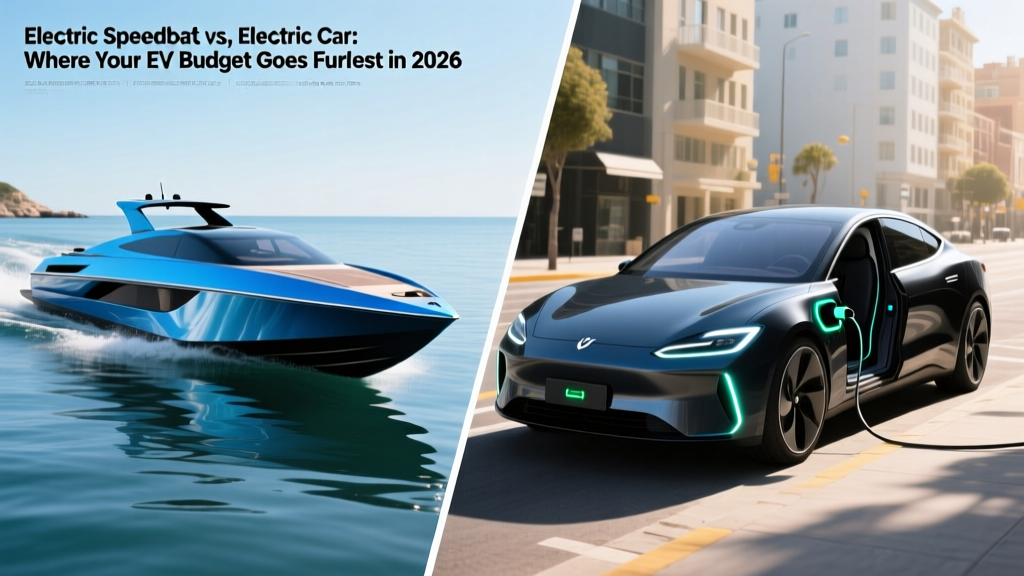
An electric speedboat like the 2026 Arc Sport (starting around $93,000) shares battery chemistry and charging architecture with electric cars, but the economics are wildly different. While a Tesla Model Y or Hyundai Ioniq 5 delivers 270–310 miles of EPA range for $40,000–$53,000 and qualifies for up to a $7,500 federal tax credit under IRS §30D rules, electric speedboats currently receive no federal purchase incentive, offer roughly 40–60 miles of range at cruising speed, and require marine-specific Level 2 charging infrastructure that costs $3,000–$8,000 to install dockside. If your goal is daily electric mobility with strong economics, a car or SUV is the clear winner. If you want silent, wake-enhanced electric recreation on the water and have the budget, a boat like the Arc or Candela is an emerging — but expensive — category.
Searches for "electric speedboat" have surged as companies like Arc, Candela, and X Shore push lithium-ion hulls into the consumer market. But most shoppers researching electric boats are also weighing their broader EV purchase decisions. This guide cuts through the hype with hard numbers: what an electric speedboat actually costs to buy, charge, and maintain compared to a mainstream electric car, and what first-time EV buyers need to know before committing battery budget to the water.
The Electric Speedboat Landscape in 2026: What's Actually for Sale
Unlike the mature EV car market — where dozens of models from Tesla, Hyundai, Ford, BMW, and others offer verified EPA range and standardized NACS/CCS charging — the electric speedboat market is still small, premium-priced, and largely direct-to-consumer. Here's what's available or taking orders as of early 2026:
| Model | Base Price | Battery (kWh) | Est. Range (mi) | Top Speed | Charge Port |
|---|---|---|---|---|---|
| Arc Sport | ~$93,000 | 226 kWh (NMC) | 40–60 (cruise) | ~46 mph | CCS1 (marine adapter) |
| Candela C-8 | ~$420,000 | 69 kWh (NMC) | ~57 (at 22 kn) | ~30 kn (~35 mph) | CCS1 |
| X Shore Eelex 8000 | ~$340,000 | 126 kWh (NMC) | ~50 (cruise) | ~40 mph | Type 2 / CCS |
| Vision Marine E-Motion 180E (powertrain) | ~$40,000 (retrofit) | Varies | Varies | Varies | Varies |
For context, a 2026 Tesla Model Y Long Range starts at roughly $44,990, carries a 75 kWh (usable) NMC/LFP pack, delivers an EPA-verified 310 miles of range, and charges at up to 250 kW on DC fast chargers. The Arc Sport's 226 kWh battery is three times larger, yet delivers less than one-fifth the range — because pushing a hull through water requires vastly more energy than rolling tires on asphalt.
Electric Speedboat vs. EV: The Real Cost Breakdown
Let's put numbers to the ownership comparison. Below, we compare the Arc Sport electric speedboat against a 2026 Hyundai Ioniq 5 (a popular mid-range EV) across five years of typical use.
| Cost Factor | Arc Sport (Electric Speedboat) | 2026 Hyundai Ioniq 5 SE (EV) | 2026 Gas Boat Equivalent (~200 HP I/O) |
|---|---|---|---|
| Base Purchase Price | ~$93,000 | ~$42,600 | ~$55,000–$70,000 |
| Federal Tax Credit (§30D) | $0 (not eligible) | Up to $7,500 (if eligible) | $0 |
| Effective Net Price | ~$93,000 | ~$35,100 (best case) | ~$55,000–$70,000 |
| Annual "Fuel" / Electricity | ~$600–$900 (150 hrs/yr) | ~$540 (12,000 mi/yr at $0.14/kWh) | ~$3,000–$4,500 (gas at ~$3.50/gal, 2–3 MPG) |
| Annual Maintenance | ~$300–$500 | ~$200–$400 | ~$800–$1,500 (winterization, impeller, oil) |
| Insurance (Annual) | ~$1,500–$3,000 | ~$1,800–$2,400 | ~$1,200–$2,500 |
| Dock/Slip or Parking | ~$2,000–$6,000/yr | ~$0 (home garage) | ~$2,000–$6,000/yr |
| 5-Year Total (est.) | ~$115,000–$145,000 | ~$47,000–$58,000 | ~$80,000–$110,000 |
Key takeaway: The electric speedboat saves significantly on fuel and maintenance compared to a gas boat — electricity for 150 hours of cruising might cost $750 versus $3,500+ in gasoline. But the upfront premium is steep, and unlike EVs, there's no federal tax credit to soften it. The Arc Sport's total 5-year cost rivals that of a luxury gas boat, while the Ioniq 5 remains one of the most cost-effective vehicles — gas or electric — on the road.
Charging an Electric Speedboat: It's Not Plug-and-Play
One of the biggest misconceptions in the electric speedboat space is that you can simply plug in at any marina. The reality is far more complicated:
What Charging Looks Like in Practice
- Home dock Level 2 (240V): Most electric speedboats charge via a CCS1 connector adapted for marine use. A 240V/50A circuit delivers roughly 11.5 kW — enough to recharge the Arc Sport's 226 kWh battery in roughly 20 hours from empty. This is adequate for weekend use if you charge overnight between outings.
- Marina shore power: Many marinas offer 30A or 50A 120/240V marine outlets (NEMA L6-30 or similar). These can deliver 3.6–11.5 kW, but you'll need the right adapter, and not all marinas permit EV-style high-draw charging on shared circuits.
- DC fast charging: Arc has demonstrated CCS1 DC fast charging capability, but public marine DC fast chargers are virtually nonexistent as of 2026. You won't find an Electrify America station at your local lake.
Compare this to the Ioniq 5, which charges from 10–80% in approximately 18 minutes on a 350 kW DC fast charger, or overnight in ~6 hours on a home Level 2 wallbox. The public charging network for EVs — while imperfect — includes over 70,000 DC fast-charging ports nationwide, per the U.S. Department of Energy's AFDC database. Nothing comparable exists for electric boats.
Dockside Charging Installation Costs
| Component | Estimated Cost |
|---|---|
| Marine-rated Level 2 EVSE (11.5 kW) | $800–$1,500 |
| Electrical panel upgrade (if needed) | $1,500–$4,000 |
| Wiring & conduit run to dock (50–150 ft) | $1,000–$3,000 |
| Marine electrician labor | $1,500–$3,000 |
| Permits & inspections | $200–$600 |
| Total dockside install | $5,000–$12,100 |
By comparison, a home Level 2 charger install for an EV averages $1,200–$3,500 total, according to industry data — significantly less because you're running wire to a garage, not across a waterfront to a dock with marine-grade, corrosion-resistant components.
Range Reality Check: Water Miles Are Not Road Miles
This is where electric speedboat marketing meets physics. Moving a hull through water at speed is exponentially more energy-intensive than moving a car on a road. Here's why the numbers look so different:
| Metric | Arc Sport (Electric Speedboat) | 2026 Tesla Model Y LR (EV) |
|---|---|---|
| Usable Battery | 226 kWh (NMC) | ~75 kWh (NMC) |
| Official Range | ~50 mi (est. at cruise) | 310 mi (EPA) |
| Energy Efficiency | ~4.5 kWh/mi | ~0.24 kWh/mi (28 kWh/100 mi) |
| Real-World Range (heavy load/cold) | ~30–35 mi (full throttle, towing) | ~240–260 mi (highway 75+ mph, winter) |
| 0-to-Top Speed | ~4 sec (0–30 mph) | 5.0 sec (0–60 mph) |
An electric speedboat consumes roughly 15–20 times more energy per mile than an electric car. That's not a flaw — it's hydrodynamics. Water resistance increases with the cube of speed, which is why range collapses when you push the throttle hard. Expect to get roughly 30–40 minutes of high-speed fun or 2–3 hours of leisurely cruising before needing a recharge. For lake days with a home dock, that's fine. For long-distance water travel, it's a hard limit.
Common Electric Speedboat Myths — Fact-Checked
| Myth | Fact |
|---|---|
| "Electric boats qualify for the $7,500 federal tax credit." | They do not. IRS §30D applies to on-road motor vehicles with four or more wheels. Electric boats, PWCs, and off-road vehicles are excluded. Check current rules at irs.gov. |
| "You can charge at any marina." | Most marinas have 30A/120V outlets designed for boat battery tenders and cabin power — not 11.5 kW sustained EV-style charging. You need a dedicated 240V/50A circuit and proper adapters. |
| "Electric boats are maintenance-free." | They eliminate oil changes, impeller replacements, and winterization of engine coolant — but you still need hull cleaning, anti-fouling paint, battery management, corrosion checks, and propeller/drive maintenance. |
| "The battery will need replacing in 5 years." | Modern NMC marine packs are engineered for 2,000–3,000+ charge cycles with 70–80% capacity retention. Arc offers a multi-year battery warranty. Realistic lifespan is 10–15+ years with proper care — similar to EV car batteries. |
| "Electric speedboats are slower than gas." | The Arc Sport hits ~46 mph with instant electric torque — comparable to many gas V8 ski boats in acceleration. Top speed is competitive; sustained high-speed range is where gas still wins. |
Who Should Buy an Electric Speedboat — and Who Shouldn't
Choose an electric speedboat if:
- You have a private dock or slip with access to 240V/50A shore power
- Your typical outing is 2–4 hours on a lake or calm coastal water within 20–30 miles of your dock
- You value silent operation (no engine noise, no exhaust fumes, better conversation and music onboard)
- You want instant torque for watersports — electric motors deliver peak torque from zero RPM
- You have $100,000+ in discretionary recreation budget and understand this is a premium lifestyle purchase
- You're already an EV owner or plan to be — the charging mindset transfers directly
Stick with gas (or wait) if:
- You boat on large lakes or offshore where range and fast refueling matter
- Your marina lacks adequate electrical infrastructure and upgrading isn't feasible
- You need to tow heavy loads (large groups, water toys) over long distances
- You're budget-conscious and want the best transportation ROI — an EV car or PHEV delivers far more daily utility per dollar
- You boat fewer than 20 hours per year — the electric premium won't pay back in fuel savings
What First-Time EV Buyers Should Know (Whether Car or Boat)
If you're exploring electric speedboats, you're likely also considering an electric car. Here are the non-negotiable basics for any first-time EV purchase in 2026:
- kW vs. kWh — know the difference. kW (kilowatts) measures power — how fast you charge or accelerate. kWh (kilowatt-hours) measures energy capacity — how far you can go. A 226 kWh battery (Arc Sport) holds three times the energy of a 75 kWh car battery, but uses it 15–20× faster.
- Home charging is essential. Whether it's a garage wallbox for your car or a dockside 240V outlet for your boat, reliable home charging is the foundation of EV ownership. Without it, you'll depend on sparse public infrastructure.
- NACS is the standard for cars. As of 2026, nearly all new EVs sold in the U.S. use the Tesla-originated NACS connector and have access to the Supercharger network. Electric boats use marine-adapted CCS1 or proprietary connectors — there's no universal standard yet.
- Tax credits apply to cars, not boats. The federal §30D clean vehicle credit offers up to $7,500 for qualifying new EVs (subject to MSRP caps, buyer income limits, and battery-sourcing rules). It can be transferred to the dealer at point of sale. Electric boats do not qualify.
- Cold weather affects everything with a lithium battery. Expect 15–30% range loss in cold water or air temperatures below 40°F. Preconditioning (warming the battery before use) helps — both cars and boats like the Arc offer this feature.
The Bottom Line: Budget Allocation for the Electrified Lifestyle
The electric speedboat is real, it's thrilling, and it's getting better every year. But it remains a luxury niche — not a practical alternative to an electric car. Here's the decision framework most buyers actually need:
If you have $130,000–$150,000 to spend on electrified transportation and recreation: Buy a Tesla Model Y or Hyundai Ioniq 5 (~$35,000–$50,000 after credits) for daily driving, and put the remaining $80,000–$100,000 toward an Arc Sport or similar electric speedboat. You'll have silent, zero-emission commuting AND lake days — with total fuel costs under $2,000/year for both.
If you have $50,000–$70,000 total: Prioritize the EV car. The daily savings on fuel, maintenance, and emissions are transformative. Revisit electric boating in 3–5 years as prices drop, battery energy density improves, and marina charging infrastructure catches up.
The electric speedboat market will mature. Solid-state batteries (promising 2× energy density) could double range by the late 2020s, and standardization of marine charging connectors is under discussion. But for now, treat an electric speedboat as what it is: an outstanding piece of electric recreation technology that happens to share DNA with your EV — not a replacement for one.
Frequently Asked Questions
Do electric speedboats qualify for any federal tax credits?
No. The IRS §30D clean vehicle credit applies only to qualifying on-road motor vehicles with at least four wheels. Electric boats, personal watercraft, and off-road vehicles are explicitly excluded. Always verify current eligibility at irs.gov or consult a tax professional.
How long does it take to charge an electric speedboat?
On a 240V/50A Level 2 dockside connection (~11.5 kW), the Arc Sport's 226 kWh battery takes roughly 20 hours from empty to full. Overnight charging between weekend outings is the standard pattern. DC fast charging is technically supported but public marine DC chargers don't yet exist.
What's the real-world range of an electric speedboat?
Expect 40–60 miles at moderate cruising speeds (15–25 mph) in calm conditions. At full throttle, range drops to 25–35 miles. Cold water, heavy loads, headwinds, and choppy conditions further reduce range. Unlike EVs, there's no standardized EPA test for boats — treat manufacturer range claims as estimates.
Can I install a charger at my marina slip?
It depends on your marina's electrical capacity and policies. Many older marinas lack the panel capacity for sustained 11.5 kW draws. You'll need a marine electrician to assess your slip's wiring, install a dedicated 240V/50A circuit with a GFCI breaker, and get marina management approval. Budget $5,000–$12,000 for a complete dockside install.
Is an electric speedboat cheaper to own than a gas boat?
On a per-hour operating basis, yes — electricity costs roughly $4–$6/hour versus $20–$40/hour for gasoline, and maintenance is lower. But the upfront purchase premium ($93,000+ vs. $55,000–$70,000 for a comparable gas boat) means you won't break even on fuel savings alone for 10+ years unless you boat heavily. The real value proposition is the experience: silent, instant-torque, zero-fumes operation.
Should I buy an electric car before an electric speedboat?
Almost certainly, yes. An EV car delivers daily utility, qualifies for federal tax credits, benefits from a nationwide charging network, and has a proven resale market. An electric speedboat is a premium recreation purchase best made after your daily EV needs are covered.