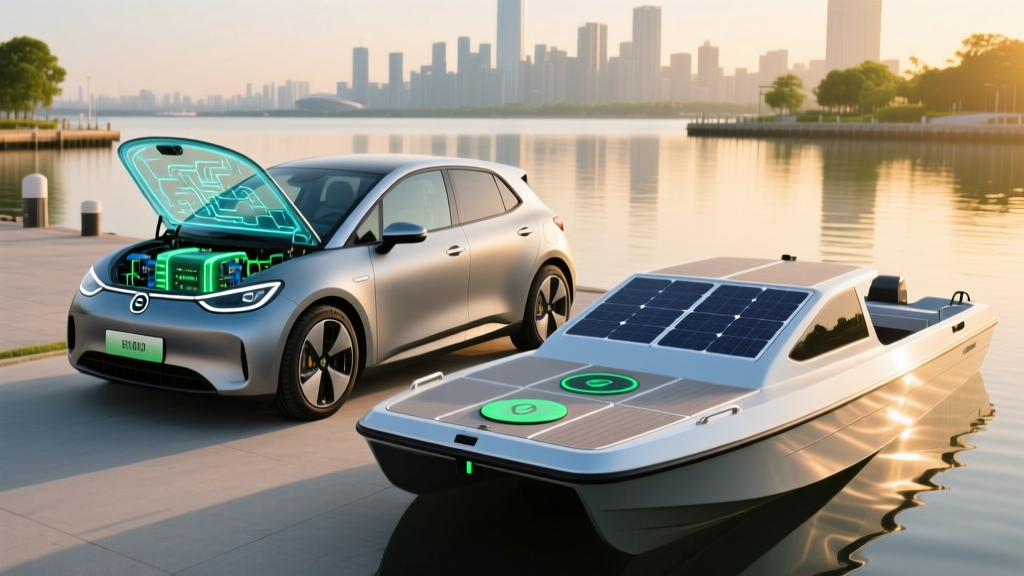
Quick Answer: Can You Buy an Electric Small Boat Like an EV Car?
Short answer: Electric small boats exist and are growing in popularity, but they operate in a fundamentally different market than electric cars. While a 2026 Tesla Model Y offers 320+ miles of EPA range, 250 kW DC fast charging, and a $44,990 starting MSRP with federal tax credit eligibility, electric boats like the X Shore Eelex 8000 or Candela C-8 provide 20-50 nautical miles of range, take 1-3 hours to charge on Level 2, start at $80,000-$390,000, and do not qualify for the IRS §30D federal EV tax credit (which applies only to highway-capable vehicles). If you're shopping for an electric small boat, you're entering a niche marine market — not the EV automotive ecosystem this site covers.
At AutoEdgeView, we specialize in electric vehicles designed for roads: BEVs, PHEVs, and the charging, battery, and ADAS technology that supports them. But we get regular questions from readers who've seen electric small boats trending and want to understand how the technology compares. This guide gives you the honest, data-driven comparison so you can decide where to put your electrification budget.
Electric Small Boats: The Current Market in Numbers
The electric marine market in 2026 includes several notable models, but the scale is nowhere near automotive EV adoption. Here's what the leading electric small boats actually deliver:
| Model | Range (nautical mi) | Battery (kWh) | Charge Time | Top Speed | Price (USD) |
|---|---|---|---|---|---|
| X Shore Eelex 8000 | ~50 nm (eco) | 125 kWh (NMC) | ~3 hr (22 kW AC) | 35 knots | ~$320,000 |
| Candela C-8 (foiling) | ~57 nm @ 22 kn | 69 kWh (NMC) | ~1.2 hr (DC) | 30 knots | ~$390,000 |
| Greenline 33 | ~20 nm (electric only) | 40 kWh | ~4 hr (AC) | ~6 knots (eco) | ~$180,000 |
| Flux Marine (outboard) | Varies by hull | 20-60 kWh | 2-4 hr | Varies | $15,000-$45,000 (motor) |
For comparison, here's what those same dollars buy in the 2026 EV car market:
| Model | EPA Range (mi) | Battery (kWh) | 10-80% DC Charge | 0-60 mph | MSRP |
|---|---|---|---|---|---|
| Tesla Model Y LR | 320 mi | 75 kWh (NMC) | ~25 min (250 kW) | 5.0 sec | $44,990 |
| Hyundai Ioniq 5 LR | 305 mi | 77.4 kWh (NMC) | ~18 min (240 kW) | 5.1 sec | $45,500 |
| Chevrolet Equinox EV | 319 mi | 85 kWh (NMC) | ~24 min (150 kW) | 7.6 sec | $33,600 |
The disparity is stark. An electric small boat costs 5-10x more than a capable EV car, delivers a fraction of the range, and charges far more slowly relative to its energy consumption.
Why Electric Boats Lag Behind Electric Cars
The physics work against marine electrification in ways that road vehicles don't face:
Hydrodynamic Drag vs. Rolling Resistance
A car on a highway at 65 mph fights rolling resistance and aerodynamic drag. A boat hull moving through water fights hydrodynamic drag, which increases with the cube of speed. Pushing a hull from 10 knots to 20 knots doesn't double the energy required — it roughly octuples it. This is why electric boats either cruise slowly (5-7 knots for displacement hulls) or consume enormous battery packs at planing speeds.
Foiling boats like the Candela C-8 address this by lifting the hull above the water on hydrofoils, reducing drag by roughly 80%. That's how Candela achieves 57 nautical miles at 22 knots on a 69 kWh pack — impressive for marine, but still roughly equivalent to a 2012 Nissan Leaf on land.
No Fast-Charging Infrastructure on the Water
EV drivers in 2026 benefit from over 60,000 DC fast-charging ports across the U.S., with networks like Tesla Supercharger, Electrify America, and EVgo offering 150-350 kW speeds. Marinas? Most offer 30-amp or 50-amp shore power — that's 3.6 kW to 12 kW of AC charging. There is no marine equivalent of a 250 kW DC fast charger at your local dock. A 125 kWh X Shore battery that takes 3 hours on 22 kW AC would take over 10 hours on a standard 50-amp marina connection.
Weight and Energy Density
Lithium-ion batteries at the pack level deliver roughly 150-200 Wh/kg (NMC chemistry). Gasoline delivers approximately 12,000 Wh/kg — roughly 60-80x the energy density even accounting for the ~25% thermal efficiency of an internal combustion marine engine. This is why electric boats need massive, heavy battery packs to achieve modest range, and why the marine industry is watching solid-state battery development closely.
Cost of Ownership: Electric Small Boat vs. Gas Boat vs. EV Car
Let's break down the real costs for a typical recreational user — someone who goes out on weekends, roughly 50 days per year.
| Category | Electric Small Boat (~$200K) | Gas Boat (~$80K) | EV Car (~$45K) |
|---|---|---|---|
| Purchase Price | $200,000 | $80,000 | $45,000 |
| Federal Tax Credit (§30D) | $0 (not eligible) | $0 | Up to $7,500* |
| Annual Energy/Fuel | ~$300-$600 (electric) | ~$3,000-$5,000 (gasoline) | ~$500-$800 (electric) |
| Annual Maintenance | ~$500-$1,500 | ~$2,000-$4,000 | ~$200-$500 |
| Insurance (annual) | ~$3,000-$8,000 | ~$1,500-$3,000 | ~$1,200-$2,500 |
| 5-Year Energy Cost | ~$1,500-$3,000 | ~$15,000-$25,000 | ~$2,500-$4,000 |
| Depreciation (5-yr est.) | ~40-60% (niche market) | ~30-40% | ~35-50% |
*§30D credit eligibility requires meeting MSRP caps ($55K SUVs, $25K sedans), buyer income limits ($150K single / $300K joint), and battery sourcing requirements per IRS rules. Always verify with a tax professional.
The electric boat saves significantly on fuel and maintenance — electric motors have far fewer moving parts than marine gasoline or diesel engines, and electricity per kWh is cheaper than marine gasoline. But the purchase premium is so large that total cost of ownership rarely breaks even within a decade for recreational users. The savings case works best for commercial operators (water taxis, ferries) who log heavy daily hours.
Common Misconceptions About Electric Small Boats
| Myth | Fact |
|---|---|
| "Electric boats qualify for the $7,500 EV tax credit" | The IRS §30D credit applies to vehicles "made by a manufacturer for operation primarily on public streets, roads, and highways." Boats do not qualify. |
| "Electric boats are silent and emission-free" | At the point of use, yes — no exhaust, minimal noise. But the electricity generation upstream still carries a carbon footprint depending on your marina's grid mix. This mirrors the same upstream nuance for EV cars. |
| "You can fast-charge an electric boat at any marina" | Most marinas offer 30A or 50A shore power (3.6-12 kW AC). DC fast charging infrastructure for boats is extremely rare as of 2026, limited to a handful of premium marinas in Europe and select U.S. coastal locations. |
| "Electric boats have zero maintenance" | Electric motors and controllers need minimal maintenance, but hulls, foils, cooling systems, battery management systems, and marine electronics all require regular service. Budget $500-$1,500/year minimum. |
| "An electric outboard is just like swapping to an EV" | Electric outboards (like Flux Marine or ePropulsion) are a great entry point at $5,000-$45,000, but range depends entirely on your hull type, weight, and speed. A 20 kWh battery on a heavy displacement hull might deliver 4 hours at 4 knots — or 30 minutes at planing speed. |
Real-World Ownership Considerations
Home Charging Access (or Dock Charging)
If you keep your boat on a trailer in your garage or driveway, you can charge from a Level 2 home station (240V, 7.7-11.5 kW) just like an EV car. Home Level 2 installation typically costs $500-$2,500 including equipment and electrician labor, per U.S. Department of Energy guidance. But most boat owners keep their vessels in a slip — and marina electrical infrastructure varies enormously. Older marinas may only offer 15A or 30A circuits, which charge painfully slowly for large battery packs.
Climate and Seasonality
Just as EV car batteries lose 15-30% range in sub-freezing temperatures, marine batteries face similar cold-weather degradation. If you boat in the Pacific Northwest or Northeast, expect meaningful range reduction in shoulder seasons. Battery thermal management systems in boats are generally less sophisticated than in modern EV cars, which actively precondition battery packs for optimal performance.
Driving (Boating) Patterns Matter
If your typical outing is a 5-mile cruise to a sandbar and back at low speed, almost any electric small boat will work fine — just as a 200-mile EV range handles most daily commutes. But if you regularly run 30+ nautical miles to offshore fishing grounds or between islands, range limitations become a genuine constraint with no fast-charging safety net. This mirrors the "charging desert" problem EV owners face on rural road trips, but with fewer alternatives.
Decision Framework: Should You Go Electric on the Water?
Choose an electric small boat if:
- You have a defined, short-range use case (day cruising, lake use, harbor commuting) within 15-25 nautical miles
- You have reliable dock or trailer charging with at least 240V / 30A access
- You value silent operation and zero on-water emissions (e.g., environmentally sensitive waterways)
- You're a commercial operator with high daily utilization where fuel savings offset the purchase premium
- You understand this is a lifestyle/luxury purchase, not a cost-saving one versus gas
Stick with a gas/diesel boat if:
- You regularly need 40+ nautical miles of range or offshore capability
- Your marina lacks adequate shore power for overnight charging
- You need fast refueling between trips (5 minutes at a fuel dock vs. hours of charging)
- Budget is a primary concern — the purchase premium is substantial
- You boat in cold climates where battery performance drops
Put your electrification budget into an EV car instead if:
- You want maximum environmental impact per dollar — an EV car driven 12,000 miles/year displaces far more fossil fuel than a recreational boat used 50 days/year
- You want federal tax credits, established charging infrastructure, and proven long-term reliability data
- You haven't yet transitioned your daily driver to electric
What First-Time EV Buyers Should Know (Cars vs. Boats)
If you're new to electrification and researching "electric small boat" as your entry point, here's the practical advice:
Start with your car. The EV car market in 2026 offers mature technology, extensive charging networks, competitive pricing starting under $30,000, federal incentives, and comprehensive battery warranties (typically 8 years/100,000 miles with a 70% capacity retention guarantee). The electric boat market is where EV cars were around 2012 — promising, expensive, infrastructure-limited, and best suited for early adopters who can accept the trade-offs.
Consider an electric outboard as a bridge. If you already own a small boat (tender, dinghy, fishing skiff), an electric outboard motor from brands like ePropulsion, Torqeedo, or Flux Marine lets you experience marine electrification for $3,000-$45,000 rather than $200,000+. These work well for short-range, low-speed applications and charge from standard shore power or even portable solar setups.
Watch for solid-state batteries. The marine industry's real inflection point will come when solid-state batteries achieve commercial scale, potentially doubling energy density and halving charge times. As of 2026, solid-state remains in limited production for automotive applications and is not yet available in marine platforms at scale.
Frequently Asked Questions
Do electric small boats qualify for the federal EV tax credit?
No. The IRS §30D Clean Vehicle Credit applies only to highway-capable vehicles meeting specific MSRP, buyer income, and battery component sourcing requirements. Boats are not eligible. Some states may offer separate marine electrification incentives — check your state energy office for current programs.
How long does it take to charge an electric boat?
On a 50-amp marina shore power connection (12 kW), expect roughly 10 hours to charge a 125 kWh battery from empty. On a Level 2 home charger (7.7-11.5 kW), plan for 10-16 hours. Some newer models like the Candela C-8 support DC fast charging at higher rates, reducing time to roughly 1-2 hours, but DC marine charging infrastructure is extremely limited.
What's the real-world range of an electric small boat?
Like EV cars, published range figures assume optimal conditions. For electric boats, range varies dramatically with speed, hull type, payload, wind, and current. A boat rated for 50 nautical miles at eco speed (5-7 knots) may deliver only 15-20 nautical miles at planing speed (20+ knots). Always calculate your range based on your typical cruising speed, not the maximum published figure.
Is an electric boat cheaper to own than a gas boat?
Operating costs are lower — electricity is cheaper than marine gasoline, and electric motors require less maintenance. But the purchase premium ($100,000-$300,000+ over comparable gas boats) means total cost of ownership rarely favors electric for recreational users. Commercial operators with high daily utilization (water taxis, ferries) see better economics.
Can I install a fast charger at my dock?
Technically yes, but it requires significant electrical infrastructure — potentially a dedicated transformer, upgraded marina service, and marine-rated charging equipment. Costs can range from $10,000 to $50,000+ depending on your marina's existing electrical capacity. Consult a licensed marine electrician and your marina management before committing. This mirrors the home EV charger installation process but at higher power levels and costs.
AutoEdgeView focuses on electric and hybrid vehicles for road use. While we cover the broader electrification landscape, our reviews, buying guides, and ownership analysis center on EVs, PHEVs, and the charging/battery/ADAS technology that supports them. For marine-specific purchasing advice, consult a marine dealer or boating publication.