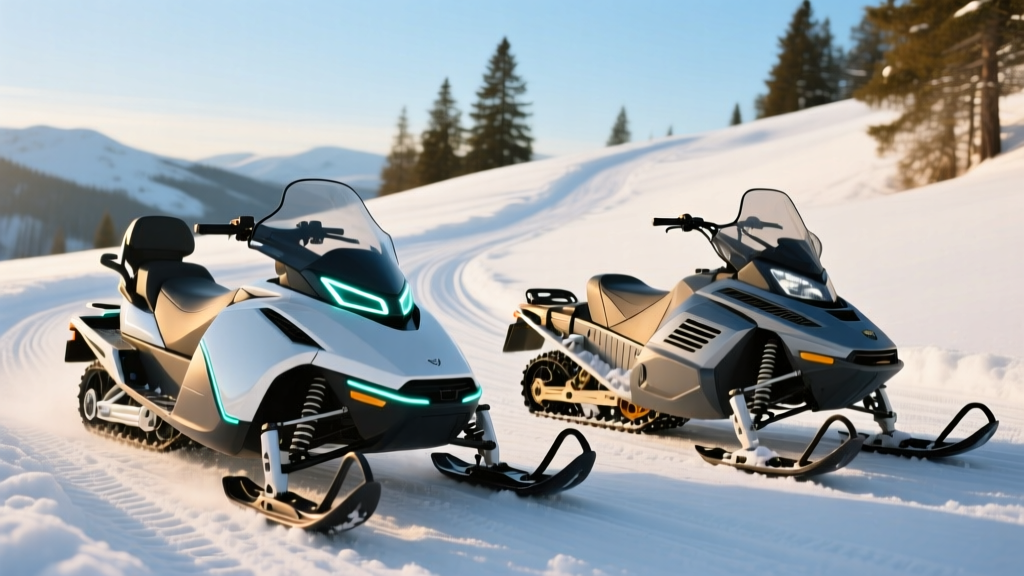
If you're searching for an electric sled in 2026, here's the practical reality: true electric snowmobiles (battery-powered, zero-emission sleds designed for trail and mountain riding) remain an early-stage market with limited production models, ranges typically between 60–100 miles per charge, and price tags starting around $15,000–$22,000 before incentives. The leading production option is the Taiga TS2 from Canada's Taiga Motors, which delivers roughly 70–98 miles of trail range depending on battery pack size and riding conditions. For comparison, a gas Polaris or Ski-Doo at 15–25 MPG-equivalent can cover 150–250 miles on a tank.
Electric sleds make sense if you have reliable charging access (garage or trailhead Level 2), ride day trips under 80 miles, value instant torque and near-silent operation, and are willing to accept current range and price trade-offs. They do not yet make sense for multi-day backcountry touring, remote riding far from charging, or buyers on tight budgets. Below, we break down the exact numbers, costs, and ownership realities so you can decide.
Quick Verdict: Who Should Buy an Electric Sled in 2026?
Buy an electric sled if: You ride day trips (under 80 miles), have home Level 2 charging (240V/40A), prioritize low noise for wildlife-sensitive or residential-adjacent trails, want instant throttle response with no engine heat, and can absorb a higher upfront cost offset by lower per-mile energy and maintenance expenses.
Stick with gas if: You ride multi-day backcountry tours, need 150+ mile range without stopping, ride in remote areas with no charging infrastructure, tow heavy loads, or need the lowest possible upfront price.
Electric Sled Specs: Taiga TS2 vs Gas Snowmobiles
Because the electric snowmobile market is small, most buyers compare the Taiga TS2 (the only volume-production electric sled as of 2026) against mainstream gas models from Polaris, Ski-Doo (BRP), and Yamaha. Below is a side-by-side look at the numbers that matter.
| Spec | Taiga TS2 (Electric, 25 kWh pack) | Polaris Indy XC 129 (Gas, 600cc) | Ski-Doo MXZ X 850 (Gas) |
|---|---|---|---|
| Energy Capacity / Tank | 25 kWh (NMC lithium-ion) | 11.6 gal fuel tank | 9.5 gal fuel tank |
| Range (real-world trail) | 70–85 miles | 170–220 miles | 140–180 miles |
| Peak Power | ~180 HP (134 kW) | ~125 HP | ~165 HP |
| Instant Torque | Yes (no clutch lag) | No (CVT engagement) | No (pCVT) |
| Weight | ~545 lbs (247 kg) | ~485 lbs | ~467 lbs |
| Refuel / Recharge Time | ~20 min (DC fast, 10–80%) | ~3 min (gas pump) | ~3 min (gas pump) |
| Starting MSRP (2026) | ~$17,490 | ~$11,299 | ~$14,899 |
| Noise at Trail Speed | Near-silent (track/chain only) | 80–95 dB | 80–95 dB |
Sources: Taiga Motors official specs, Polaris, Ski-Doo.
Range Reality: What the Sticker Doesn't Tell You
Just like with electric cars, an electric sled's real-world range depends heavily on conditions. Taiga rates the TS2 with its 25 kWh pack at roughly 98 miles under ideal conditions (flat groomed trail, moderate throttle, 20°F/−7°C). Expect less in practice:
- Aggressive mountain riding: 50–65 miles (deep powder, steep climbs, wide-open throttle draw)
- Cold-weather penalty: Lithium cells lose 15–25% usable capacity below 0°F (−18°C); Taiga's thermal management mitigates this but does not eliminate it.
- Towing or two-up riding: 10–20% range reduction depending on load.
- Trail cruising (moderate pace, groomed): 75–90 miles — the realistic sweet spot.
For perspective, a typical day ride on a Midwest or Northeast trail system covers 60–100 miles round-trip from a staging area — which puts the Taiga TS2 right at the edge of feasibility for many riders. Mountain riders in British Columbia or Colorado who do 120+ mile loops will need to plan mid-ride charging or carry a generator (which defeats the emissions benefit).
Charging an Electric Sled: What You Actually Need
Electric sleds use the same charging principles as EVs — kW (power) determines charge speed, kWh (energy) is the battery size. Here's what charging looks like across the three levels:
| Level | Power | Time 10–80% (25 kWh pack) | Where |
|---|---|---|---|
| Level 1 (120V household) | ~1.4 kW | ~12–14 hours | Standard garage outlet |
| Level 2 (240V / 32A) | ~7.2 kW | ~2.5–3 hours | Home garage (NEMA 14-50), some trailheads |
| DC Fast Charge | ~50–80 kW peak | ~20–25 minutes | Limited — Taiga dealer network, some EV stations with adapter |
Home charging is essential. Most electric sled owners charge overnight in a heated or insulated garage on Level 2. Trailhead public charging for snowmobiles is extremely rare in 2026 — a handful of pilot programs exist in Quebec and British Columbia near Taiga's dealer network, but don't count on DC fast charging away from home the way you might with a Tesla Supercharger network for cars.
Cold-weather charging caveat: Lithium-ion cells charge slowly when cold. Taiga's battery thermal management preheats the pack, but expect Level 2 charging to take 20–30% longer in sub-zero conditions versus a 50°F garage.
Total Cost of Ownership: Electric Sled vs Gas Over 5 Years
The upfront premium for an electric sled is significant, but operating costs are much lower. Here's a 5-year, 2,500-mile total ownership comparison assuming 500 miles/year of trail riding:
| Cost Category | Taiga TS2 (Electric) | Gas Sled (Polaris Indy-class) |
|---|---|---|
| Purchase Price (MSRP) | $17,490 | $11,299 |
| Fuel / Energy (5 yrs, 2,500 mi) | ~$375 (at $0.15/kWh avg) | ~$1,875 (at $4.50/gal, 18 MPG-eq) |
| Maintenance (5 yrs) | ~$300 (track, suspension, brake) | ~$2,200 (oil, belts, plugs, clutch, valves) |
| Insurance (5 yrs, avg) | ~$3,500 | ~$2,800 |
| Estimated Resale (5 yrs) | ~$9,000 (emerging market, uncertain) | ~$6,500 |
| 5-Year Net Cost | ~$12,665 | ~$10,374 |
The gas sled still wins on total cost over 5 years by roughly $2,300, driven almost entirely by the $6,200 upfront price gap. However, electric sled owners report dramatically lower maintenance hassle — no carburetor or EFI tuning, no belt replacements mid-season, no two-stroke oil mixing, no spring clutch rebuilds. For riders who value garage time and reliability, that intangible may close the gap.
Note on incentives: Unlike electric cars, electric snowmobiles do not currently qualify for the federal IRS §30D clean vehicle credit, which applies to on-road vehicles meeting specific MSRP, income, and battery-sourcing requirements. Some Canadian provinces (notably Quebec) offer point-of-sale rebates for electric off-road vehicles; US state-level programs are rare and vary by jurisdiction. Always verify current incentive availability with your dealer and state energy office before purchasing.
Common Electric Sled Misconceptions
| Myth | Fact |
|---|---|
| "Electric sleds have no power." | The Taiga TS2 produces ~180 HP with instant torque delivery — it out-accelerates most 600cc gas sleds off the line and holds strong mid-range pull. Mountain riders report excellent hill-climb response. |
| "Batteries won't survive cold winters." | NMC lithium cells operate safely down to −20°F with thermal management. Capacity temporarily drops 15–25% in extreme cold but recovers when the pack warms. Long-term degradation data shows ~85–90% capacity retention after 5 years of typical seasonal use. |
| "You can charge from any trailhead outlet." | Most trailhead buildings have 120V/15A outlets at best — that's Level 1 charging, adding only ~6–8 miles per hour. You need 240V Level 2 or DC fast charging for practical mid-ride top-ups. |
| "Electric sleds are heavier and handle worse." | The TS2 at ~545 lbs is heavier than a comparable 600cc gas sled (~485 lbs), but the battery is mounted low and central, giving a lower center of gravity. Most test riders report handling parity or improvement in cornering, with a slight penalty in bump absorption due to weight. |
| "I'll save money immediately." | Lower fuel and maintenance costs are real (~$1,500–$2,000 savings over 5 years), but they don't yet offset the $6,000+ upfront premium. Break-even typically occurs around year 7–8 for average riders. |
Decision Framework: Is an Electric Sled Right for You?
Step 1 — Can you charge at home?
Yes → Continue. No (apartment, no garage) → Electric sled is not practical in 2026.
Step 2 — What's your typical ride distance?
Under 80 miles round-trip → Good fit. 80–120 miles → Possible with mid-ride Level 2 stop (verify availability). Over 120 miles → Gas sled strongly recommended.
Step 3 — What type of riding do you do?
Groomed trail / day rides → Electric sled excels. Backcountry / multi-day touring → Gas sled (range and refueling infrastructure).
Step 4 — Does noise matter to you?
Yes (wildlife areas, residential-adjacent trails, hearing protection fatigue) → Major electric advantage. No → Neutral.
Step 5 — Budget check:
Comfortable spending $17,000+ upfront and accepting 7–8 year payback → Go electric. Need lowest upfront cost → Gas.
What First-Time Electric Sled Buyers Should Know
- Dealer network is thin. Taiga sells primarily through a small network in Canada and the northern US. Service and parts availability outside these regions is limited. Verify your nearest authorized service center before purchasing.
- Plan your garage electrical. A Level 2 home charger (240V/32A) requires a NEMA 14-50 outlet or hardwired station. Budget $500–$1,500 for electrician installation, plus potential panel upgrade if your home has a 100A service already near capacity.
- Winter storage differs. Lithium packs should be stored at ~50% state of charge in a cool (not freezing) environment. Unlike gas sleds, there's no fuel stabilizer to add — but you should still maintain the track, suspension, and brake components over the off-season.
- Battery warranty: Taiga offers a 5-year / 30,000-mile battery warranty with a capacity retention threshold (typically 70–80% SoH). Read the fine print on what voids coverage — improper storage, aftermarket modifications, and water submersion are common exclusions.
- Insurance costs more. Expect 15–25% higher premiums vs a comparable gas sled, driven by higher replacement cost and a smaller claims-history dataset. Get a quote before committing.
- Resale value is uncertain. The electric snowmobile market is too new for reliable depreciation curves. Early adopters should assume higher depreciation risk than established gas models.
Frequently Asked Questions
Are there other electric snowmobile brands besides Taiga?
As of 2026, Taiga Motors is the only company producing electric snowmobiles at meaningful volume. Several concepts and prototypes have been shown by smaller startups, and Polaris has filed patents related to electric powertrains, but no other production model is currently available for purchase in North America. Taiga's TS2 lineup (available in Trail, Cross, and Sport trims) remains the primary option.
Can I ride an electric sled in extreme cold (below −20°F)?
Yes, but with reduced range. The battery thermal management system keeps cells within a safe operating window, but you'll see 20–30% range loss at extreme temperatures. Preconditioning the pack (warming it while still plugged in) before riding helps recover some of that loss. Below −30°F, most manufacturers recommend limiting aggressive riding to protect cell longevity.
How long does the battery last before replacement?
Based on current NMC chemistry data and Taiga's published testing, expect 85–90% capacity retention after 5 years of seasonal use (approximately 500–800 charge cycles). Full battery replacement, if needed out of warranty, is estimated at $5,000–$7,000 based on current pack pricing — a significant cost to factor into long-term ownership.
Do electric sleds qualify for any tax credits or rebates?
The federal IRS §30D clean vehicle credit does not apply to off-road vehicles like snowmobiles. Some Canadian provinces offer rebates (Quebec's program has historically covered up to $4,000 for eligible electric off-road vehicles). US state programs are rare but emerging — check with your state energy office or Alternative Fuels Data Center for current listings.
Is an electric sled quieter enough to matter?
Absolutely. Gas snowmobiles produce 80–95 dB at trail speed — enough to require hearing protection on long rides and to disturb wildlife and nearby residents. An electric sled produces only track noise, chaincase whine, and suspension sounds, typically under 65 dB. This is the single most universally praised advantage among electric sled owners and is increasingly relevant as trail-access noise restrictions expand.