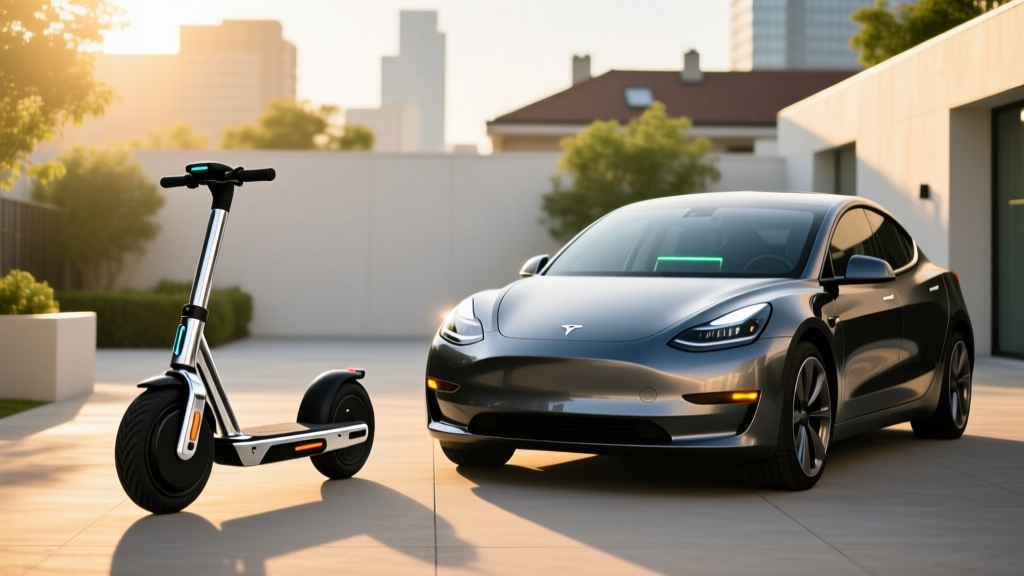
An electric single wheel (often called an electric unicycle or EUC) is a self-balancing, single-wheeled personal electric vehicle that typically costs $1,000–$3,500, delivers 20–60 miles of real-world range on a 1,000–2,400 Wh battery, and charges in 2–5 hours on a standard 120V outlet. It is not a car replacement — it is a last-mile or short-commute tool. Compared to a compact EV like the 2026 Chevrolet Equinox EV (starting around $33,000, EPA 319 miles), an electric single wheel eliminates parking costs, insurance, and registration, but sacrifices weather protection, cargo space, and highway capability. The right choice depends entirely on your commute distance, climate, and whether you need a primary vehicle or a supplement to one.
What Is an Electric Single Wheel, Exactly?
An electric single wheel — technically an electric unicycle (EUC) — is a motorized, gyroscopically stabilized vehicle with a single wheel, two foot platforms, and a handle or grab rail. The rider leans forward to accelerate, leans back to brake (with regenerative braking returning energy to the battery), and shifts weight laterally to steer. Modern EUCs from brands like Begode, Kingsong, InMotion, and Leaperkim use brushless hub motors ranging from 800W to over 3,000W peak, paired with lithium battery packs typically between 1,000 Wh and 3,600 Wh.
These devices fall into a regulatory gray zone in many U.S. jurisdictions. They are generally not classified as motor vehicles by the NHTSA and do not require a driver's license, registration, or insurance at the federal level — but state and local rules vary significantly. Some cities treat them like bicycles; others classify them as motorized scooters with sidewalk restrictions.
Electric Single Wheel vs Compact EV: The Numbers
The core question for buyers considering an electric single wheel is whether it can replace a car commute or supplement one. Here is a direct spec-level comparison between a popular mid-tier EUC (the Kingsong S22, a representative 2024–2026 model) and a mainstream compact EV (the 2026 Chevrolet Equinox EV 2LT) for commuting purposes:
| Attribute | Kingsong S22 (EUC) | 2026 Chevy Equinox EV 2LT |
|---|---|---|
| Purchase Price | ~$2,400 | $33,600 MSRP |
| Usable Battery | 2,220 Wh (Li-ion) | 85 kWh (NMC, usable) |
| EPA / Manufacturer Range | ~40–55 mi (real-world, 180-lb rider, 25 mph) | EPA 319 mi |
| Top Speed | ~43 mph (with tilt-back warning) | 112 mph (governed) |
| Charge Time (Standard Outlet) | ~4–5 hrs (120V, ~500W charger) | N/A (Level 1 adds ~3 mi/hr) |
| Charge Time (Fastest Available) | ~2 hrs (with optional fast charger) | ~10–80% in 34 min at 150 kW DC |
| Energy Cost per Mile | ~$0.003–$0.005 | ~$0.03–$0.05 (at $0.16/kWh) |
| Annual Insurance | $0 (no requirement) | ~$1,400–$1,900 (national EV avg) |
| Registration / Taxes | $0 | ~$150–$500/yr depending on state |
| Maintenance (Annual) | ~$50–$150 (tire, pads, bearings) | ~$300–$500 (tires, wipers, cabin filter) |
| Weather Protection | None (rider exposed) | Full enclosure, climate control |
| Cargo Capacity | Backpack only (~15–30 L) | 26.4 cu ft (rear seats up) |
| Passenger Capacity | 1 (rider only) | 5 |
| Federal Tax Credit (§30D) | Not eligible | Up to $7,500 (subject to IRS eligibility rules) |
Real-World Costs: 5-Year Ownership Breakdown
Purchase price tells only part of the story. For a commuter covering 15 miles round-trip, 5 days a week (~3,750 miles/year), here is what five years of ownership actually costs:
| Cost Category (5 Years) | Electric Single Wheel | 2026 Equinox EV | 2026 Toyota Corolla (Gas Baseline) |
|---|---|---|---|
| Purchase / Net After Credit | $2,400 | $26,100 (est. after $7,500 credit) | $22,550 |
| Energy / Fuel | $55–$95 | $560–$940 | $2,500–$3,100 |
| Insurance | $0 | $7,000–$9,500 | $5,500–$7,500 |
| Registration & Taxes | $0 | $750–$2,500 | $750–$2,000 |
| Maintenance | $250–$750 | $1,500–$2,500 | $2,500–$3,500 |
| Battery Replacement Risk | $400–$800 (if needed, year 4–5) | Covered under 8-yr/100k-mi warranty | N/A |
| Total 5-Year Cost | $2,705–$4,045 | $35,910–$41,540 | $33,800–$38,650 |
| Cost Per Mile | $0.14–$0.22 | $1.92–$2.22 | $1.80–$2.06 |
The electric single wheel's total cost is an order of magnitude lower — but it replaces only the commute, not the vehicle. Most EUC riders still own or lease a car for groceries, trips, passengers, and bad-weather days. The EUC is a cost reducer, not a cost replacement, for the vast majority of users.
Range, Charging, and the Cold-Weather Reality
Electric single wheels use the same lithium-ion cell chemistry principles as EVs, but at a drastically smaller scale. A 2,220 Wh pack is roughly equivalent to 2.6% of the Equinox EV's 85 kWh battery. That means charging is fast and cheap, but range is thin and highly variable.
Real-world range factors for an EUC:
- Rider weight: A 220-lb rider will see 15–25% less range than a 160-lb rider at the same speed.
- Speed: Range drops sharply above 25 mph due to aerodynamic drag (which scales with velocity squared). Cruising at 35 mph can cut range by 30–40% versus 20 mph.
- Terrain: Hills are brutal on small battery packs. A hilly 10-mile commute can consume as much energy as 18 flat miles.
- Temperature: Below 40°F, expect 20–35% range loss from increased cell internal resistance and the energy cost of keeping the rider warm (which the EUC does not help with). Below 20°F, most manufacturers recommend against riding due to reduced regenerative braking effectiveness — a safety hazard on a single-wheel vehicle.
- Battery age: After 500–800 full charge cycles (roughly 2–4 years of daily commuting), expect 15–25% capacity degradation. Replacement packs cost $400–$800 depending on the model.
Charging an EUC is straightforward: plug the included charger into any standard 120V outlet. There is no need for a Level 2 home charger installation, no electrician visit, no panel upgrade. This is a major advantage for apartment dwellers and renters who cannot install EV charging infrastructure. However, you cannot use public DC fast chargers — EUCs charge exclusively from AC wall power at 300–600W.
Common Misconceptions About Electric Single Wheels
| Myth | Fact |
|---|---|
| "It's self-balancing, so you can't fall off." | EUCs balance fore/aft but not laterally. Side-falls are common for beginners, and high-speed cutouts (where the motor exceeds its power limit and shuts off) are a documented risk. Full-face helmets, wrist guards, and knee pads are strongly recommended. |
| "You can ride it on the highway." | Most EUCs top out at 30–50 mph and are illegal on roads with speed limits above 35 mph in many jurisdictions. They lack lighting, turn signals, and crash protection required for road-legal vehicles. |
| "It qualifies for the $7,500 EV tax credit." | The IRS §30D credit applies only to new clean vehicles with four wheels, a GVWR under 14,000 lbs, and specific battery-sourcing requirements. EUCs do not qualify. Some local utility rebates for e-mobility devices may apply — check your local provider. |
| "The battery lasts forever." | Lithium-ion cells degrade with every charge cycle. Expect 500–800 cycles before notable capacity loss. Storing the EUC at 50% charge and avoiding full discharges extends pack life. |
| "It replaces my car." | An EUC replaces a specific subset of car trips — solo commutes under ~25 miles in fair weather. It does not handle passengers, cargo, long trips, or severe weather. |
Who Should Buy an Electric Single Wheel? A Decision Framework
Buy an electric single wheel if:
- Your one-way commute is under 20 miles and mostly on bike paths, campus roads, or low-speed urban streets.
- You live in a mild climate (rarely below 35°F in winter) or have a backup transportation option for cold/rainy days.
- You have secure indoor storage at both ends of your commute (theft is a major concern — EUCs are high-value, portable targets).
- You already own or have access to a car for non-commute trips.
- You want to eliminate fuel, parking, and insurance costs for your daily commute specifically.
- You are willing to invest 10–20 hours in learning to ride safely (the learning curve is real and involves falls).
Choose a compact EV instead if:
- You need a primary vehicle for all driving needs — commuting, errands, road trips, passengers.
- Your commute includes highways, interstates, or roads with speed limits above 40 mph.
- You live in a region with harsh winters, heavy rain, or extreme heat.
- You need cargo space for groceries, gear, or children.
- You qualify for the §30D federal tax credit (income under $150K single / $300K joint, vehicle MSRP under $55K for sedans or $80K for SUVs/trucks, and battery sourcing requirements met), which can bring a compact EV's effective price close to a used gas car.
- You cannot safely store an EUC at your workplace or home.
Consider a hybrid approach if:
- You own an EV or gas car but want to reduce short-trip driving. An EUC handles the commute; the car handles everything else.
- You are a student or urban apartment dweller who doesn't need a car daily but needs one occasionally (pair an EUC with car-sharing services like Zipcar).
Safety, Regulation, and What First-Time Buyers Must Know
The single most important thing a first-time electric single wheel buyer should know is that an EUC is not a toy and not a regulated vehicle. It occupies a gap between consumer electronics and transportation. There are no federal safety standards (no NHTSA crash tests, no IIHS ratings), no mandatory helmet laws specific to EUCs in most states, and no manufacturer-mandated training.
Practical first-time buyer advice:
- Budget $200–$400 for safety gear: Full-face motorcycle-style helmet (not a bike helmet), wrist guards, knee pads, and gloves. This is non-negotiable.
- Start with a mid-range model (1,500–2,500 Wh): Beginner models under $800 often lack the power and battery to sustain safe speeds on inclines, leading to dangerous cutouts. Overpowered models above $3,500 are overkill for learning.
- Check your local laws before buying: Some cities (notably New York City and parts of California) have specific restrictions on motorized unicycles on sidewalks and bike lanes. Contact your local DOT or check municipal code.
- Insure it under renters/homeowners if possible: While no auto insurance is required, theft coverage matters. Some insurers will cover EUCs under personal property riders.
- Learn in a parking lot, not on a trail: Expect 5–15 hours of practice before you can mount, ride, and dismount reliably. Video tutorials from experienced riders are more useful than manufacturer manuals.
Frequently Asked Questions
How fast can an electric single wheel actually go?
Mid-range EUCs (1,500–2,500 Wh, $1,500–$2,800) typically reach 30–43 mph. High-performance models (3,000+ Wh, $3,000–$5,000+) can exceed 55 mph. However, most EUCs have a "tilt-back" safety feature that raises the pedals and pushes the rider backward at a preset speed to warn against going faster. Riding at or near top speed drastically reduces range and increases the risk of a motor cutout.
Can I ride an electric single wheel in the rain?
Most modern EUCs carry an IP55 or IP65 water-resistance rating, meaning they can handle light rain and wet pavement. However, riding in heavy rain or through standing water risks damage to the motor, controller, and battery seals. More critically, wet pavement dramatically reduces traction on a single contact patch — a fall risk that is substantially higher than on a four-wheeled vehicle.
What happens if the battery dies while I'm riding?
This is called a "cutout" and it is the most dangerous failure mode of an EUC. When the motor loses power, the wheel stops balancing and the rider is thrown forward. Cutouts typically happen when the rider exceeds the motor's power limit (going too fast, climbing a steep hill, or riding with a low battery). This is why experienced riders never ride above 70–80% of the EUC's rated top speed and always maintain a 20%+ battery buffer.
Is an electric single wheel cheaper to own than an e-bike?
Purchase prices overlap ($1,500–$3,500 for quality models in both categories). EUCs have slightly lower energy costs (smaller batteries, less rolling resistance) but higher safety-gear costs and a steeper learning curve. E-bikes offer cargo racks, passenger options (some models), and are generally legal in more locations. For pure commuting efficiency and portability (EUCs fold smaller and weigh 45–75 lbs vs. 50–70 lbs for an e-bike), the EUC has a slight edge — if you can ride one safely.
Do electric single wheels qualify for any tax incentives?
Not at the federal level. The IRS §30D clean vehicle credit requires four wheels and specific manufacturer/battery-sourcing criteria. Some states and utilities offer rebates for "micromobility" or "e-mobility" devices — check with your local utility or state energy office. Employers may also offer commuter benefits that cover EUC purchases under qualified transportation fringe benefit rules, though this is uncommon and requires HR verification.