The Short Answer
If you're searching for fast cheap electric scooters as a way to go electric on a tight budget, here's the reality: most scooters in the $800–$2,500 price range deliver 20–40 miles of real-world range, top speeds of 25–45 mph, and charge from a standard 120V outlet in 4–8 hours. They cost pennies per mile to "fuel" and require almost no maintenance. However, they offer zero weather protection, limited cargo capacity, minimal crash protection, and are generally ineligible for the federal §30D EV tax credit. A budget electric car like the 2026 Nissan Leaf ($28,140 MSRP) or used EV qualifying for the $4,000 used clean vehicle credit provides vastly more utility, safety, and range — but at 10–15x the upfront cost. The right choice depends entirely on your commute distance, climate, and whether you need a primary vehicle or a last-mile supplement.
What "Fast Cheap Electric Scooter" Actually Gets You in 2026
The electric scooter market has matured significantly. When buyers search for fast cheap electric scooters, they're typically looking at two categories that get conflated:
- Kick-style electric scooters (stand-up): Think Segway Ninebot, Apollo, Kaabo. Priced $600–$2,200. Top speeds 20–40 mph. Range 15–40 miles. Weight 35–75 lbs.
- Seated electric mopeds/scooters: Think NIU, Super73, CSC. Priced $1,500–$4,500. Top speeds 28–55 mph. Range 25–65 miles. Weight 100–200 lbs.
Neither category qualifies as a "motor vehicle" under NHTSA regulations for the purposes of the federal EV tax credit, and neither carries EPA range ratings the way a car does. Manufacturers self-report range figures under ideal conditions — expect 20–35% less in real-world riding with hills, wind, cold, or a heavier rider.
| Spec | Kick Scooter ($800–$1,500) | Premium Kick ($1,500–$2,500) | Seated Moped ($2,000–$4,500) |
|---|---|---|---|
| Battery Capacity | 0.35–0.55 kWh | 0.6–1.2 kWh | 1.5–3.5 kWh |
| Claimed Range | 25–35 mi | 35–50 mi | 40–70 mi |
| Real-World Range | 15–25 mi | 25–38 mi | 30–50 mi |
| Top Speed | 20–28 mph | 30–45 mph | 28–55 mph |
| Charge Time (120V) | 4–6 hours | 5–8 hours | 5–9 hours |
| Motor Power | 350–500W | 500–1,500W | 1,000–3,000W |
| Weight | 35–50 lbs | 50–75 lbs | 100–200 lbs |
Scooter vs Budget EV: The Numbers That Matter
To make a fair comparison, let's stack a popular "fast cheap" scooter against the most affordable new electric cars available in the US market. This is where the trade-offs become stark.
| Attribute | Premium Kick Scooter (~$1,800) | 2026 Nissan Leaf S ($28,140) | 2026 Chevy Equinox EV LT ($33,400) |
|---|---|---|---|
| Base Price | $1,800 | $28,140 | $33,400 |
| Federal Tax Credit | $0 (not eligible) | Up to $7,500* | Up to $7,500* |
| Effective Price | $1,800 | ~$20,640 | ~$25,900 |
| Battery (usable) | ~0.8 kWh (LFP/NMC) | ~40 kWh (NMC) | ~85 kWh (NMC) |
| EPA Range | N/A (self-reported ~38 mi) | 149 mi (EPA) | 319 mi (EPA) |
| Real-World Highway Range | ~25 mi | ~120 mi | ~265 mi |
| Top Speed | 40 mph | 90 mph (governed) | 110+ mph |
| 0–30 mph | ~4 sec | ~3.5 sec | ~3.2 sec |
| Charging (Level 2) | N/A (120V only) | 7.2 kW (~6 hrs) | 11.5 kW (~8 hrs) |
| DC Fast Charge | None | 50 kW (CCS) | 150 kW (CCS) |
| Cargo Capacity | Backpack only | 23.6 cu ft | 26.4 cu ft |
| Passengers | 1 (rider) | 5 | 5 |
| Weather Protection | None | Full climate control | Full climate control |
| Safety (crash) | Helmet + pads | NHTSA 5-star rated | NHTSA 5-star rated |
*§30D credit eligibility depends on MSRP caps ($55K cars), buyer income limits, and battery mineral sourcing. See IRS guidelines. Point-of-sale transfer available at participating dealers.
Real Cost of Ownership: 5-Year Breakdown
The purchase price is only the beginning. Here's what five years of ownership actually costs when you factor in energy, maintenance, insurance, and depreciation. This assumes a 15-mile daily round-trip commute, 250 riding/driving days per year.
| Cost Category | Premium Scooter ($1,800) | Nissan Leaf ($28,140) | Gas Car Baseline (30 MPG, $25K) |
|---|---|---|---|
| Purchase Price | $1,800 | $20,640 (after credit) | $25,000 |
| Energy/Fuel (5 yrs) | $180 ($0.005/mi @ $0.16/kWh) | $2,250 ($0.04/mi) | $6,250 ($0.12/mi @ $3.50/gal) |
| Maintenance (5 yrs) | $400 (tires, brakes, battery) | $1,500 (tires, cabin filter, fluid) | $3,500 (oil, brakes, tires, filters) |
| Insurance (5 yrs) | $0–$600 (optional, often uninsured) | $6,500 ($1,300/yr avg) | $5,500 ($1,100/yr avg) |
| Depreciation (5 yrs) | $1,200 (~67% loss) | $10,320 (~50%) | $10,000 (~40%) |
| 5-Year Total | $3,580–$4,180 | $41,210 | $50,250 |
| Cost Per Mile | $0.10–$0.11 | $0.22 | $0.27 |
The scooter wins on pure cost by a landslide — but only if it can actually replace the trips you need to make. If you need to carry passengers, drive in rain or snow, travel more than 25 miles one way, or use highways, the scooter simply can't serve as a primary vehicle.
Cold Weather, Rain, and the Comfort Gap
This is where most scooter buyers get blindsided. Lithium-ion batteries (both NMC and LFP chemistries used in scooters) lose 15–30% of their capacity below 40°F. A scooter rated at 35 miles of range in mild weather may deliver only 22–28 miles in a 30°F January commute. Unlike an electric car with a heat pump and battery preconditioning, most scooters have no thermal management system — the battery simply performs worse in the cold and charges slower.
Beyond the battery, there's the rider:
- Rain:
- Wind: At 35+ mph on a scooter, wind chill makes a 45°F morning feel like 25°F. Full winter riding gear adds $150–$300.
- Road hazards: Potholes, wet leaves, gravel, and painted road markings are minor annoyances in a car and genuine crash risks on a scooter.
If you live in a temperate, dry climate with short commutes and good bike infrastructure, a scooter can be a legitimate primary vehicle for 8–10 months of the year. In the Midwest, Northeast, or Pacific Northwest, it's a fair-weather supplement at best.
Charging Reality: What Scooter Owners Don't Expect
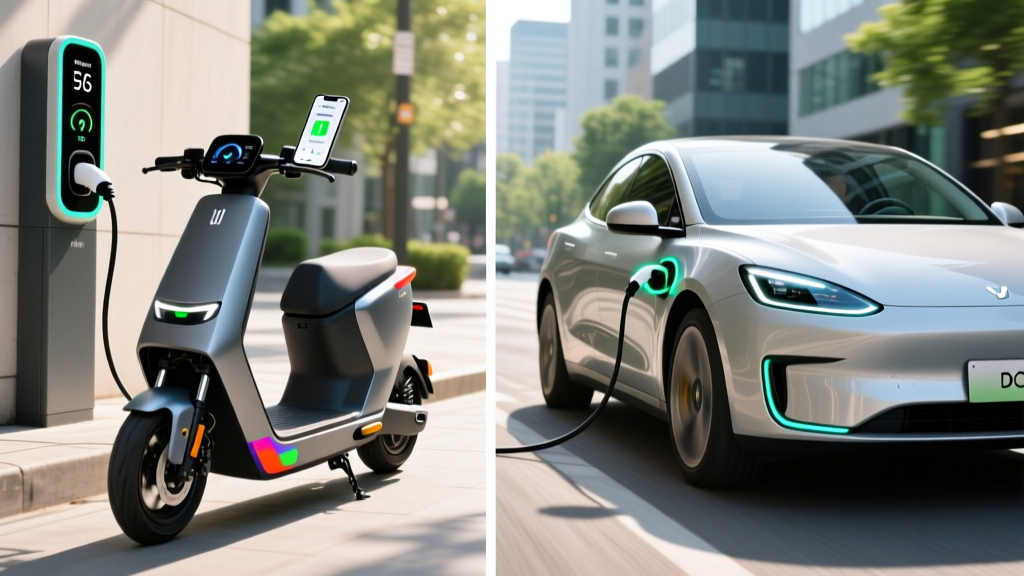
The good news: every electric scooter charges from a standard 120V household outlet. No Level 2 installation, no electrician, no $500–$2,000 home charging setup. You plug it in like a laptop.
The trade-offs:
- Speed: A 0.8 kWh scooter battery at 120V/2A charges at roughly 0.24 kW — that's 4–6 hours for a full charge. You cannot "top up" quickly mid-day the way an EV at a DC fast charger adds 100+ miles in 15 minutes.
- No public infrastructure: There is no scooter equivalent of Tesla Superchargers or Electrify America. You're entirely dependent on your home outlet or carrying the charger with you.
- Battery lifespan: Most scooter batteries are rated for 500–800 full charge cycles before degrading to 80% capacity. At 250 cycles per year, expect to replace the battery ($200–$500) within 2–4 years. By contrast, EV traction batteries are warrantied for 8 years/100,000 miles and typically retain 85–90% capacity at that point.
Common Misconceptions — Myth vs. Fact
| Myth | Fact |
|---|---|
| "Electric scooters qualify for the $7,500 EV tax credit" | They do not. The §30D credit applies to highway-capable four-wheel vehicles meeting specific battery sourcing and MSRP requirements. Scooters are classified as low-speed vehicles or consumer products. |
| "A $1,500 scooter can replace my car" | Only if your commute is under 20 miles, you live in a mild climate, you carry no passengers or cargo, and you accept zero crash protection. For most US commuters, it's a supplement, not a replacement. |
| "Scooter range is the same as advertised" | Manufacturer range claims assume a 165-lb rider on flat ground at moderate speed in 70°F weather. Real-world range is typically 20–35% lower, and 30–50% lower in cold weather or at sustained top speed. |
| "Scooter batteries last forever" | Most scooter batteries degrade to 80% capacity within 500–800 cycles (2–4 years of daily use). Replacement costs $200–$500. EV batteries last 8–15 years and are warrantied accordingly. |
| "Fast scooters are legal everywhere" | Many jurisdictions cap electric scooter speeds at 20–25 mph on public roads. Scooters exceeding 28 mph may be classified as mopeds or motorcycles, requiring registration, insurance, and a license endorsement. Check your state and local laws. |
Decision Framework: Should You Buy a Scooter or an EV?
Buy a Fast Cheap Electric Scooter If:
- Your one-way commute is under 15 miles and doesn't require highway speeds
- You live in a mild, dry climate (fewer than 60 rain days/year)
- You already own or have access to a car for longer trips, bad weather, and cargo runs
- Your budget is under $2,500 and you can't access home Level 2 charging for a car
- You have secure indoor storage (apartment hallway, garage) to charge and protect the scooter
- You're comfortable wearing a helmet and riding in traffic with minimal protection
Buy a Budget Electric Car If:
- You need a primary vehicle for all weather, all distances, and passengers
- Your daily driving exceeds 40 miles round-trip or includes highway segments
- You can install a Level 2 home charger (or already have 240V access in your garage)
- You qualify for the §30D federal credit or the $4,000 used-EV credit, bringing effective cost below $20K
- You value NHTSA crash safety, airbags, and climate control
- You need cargo space for groceries, kids, or gear
Consider a Plug-In Hybrid (PHEV) If:
- You want electric-only commuting (25–40 miles) but gas flexibility for road trips
- You don't have reliable access to DC fast charging for road trips
- You live in a region with extreme cold that hammers EV range
First-Time EV Buyer Essentials
If you're researching fast cheap electric scooters but are actually curious about going fully electric with a car, here's what matters most:
- Home charging is non-negotiable for convenience. A Level 2 home charger (240V, 32–48A) adds 25–40 miles of range per hour of charging and costs $500–$2,000 installed depending on your electrical panel. Without it, you'll rely on public DC fast chargers, which cost 2–3x more per kWh and aren't available everywhere.
- EPA range overstates real-world highway driving by 10–20%. A 300-mile EPA-rated EV delivers roughly 250–270 miles at sustained 75 mph, and 200–230 miles in 25°F weather. Plan your trips around the lower number.
- The used-EV market is a goldmine. A 2022–2024 Chevy Bolt EV with 150–250 miles of range routinely sells for $15,000–$20,000 and may qualify for the $4,000 used clean vehicle credit (income limits apply: $75K single / $150K joint).
- Insurance costs 10–25% more for EVs than equivalent gas cars on average, due to higher repair costs and battery replacement risk. Get quotes before you buy.
- Battery degradation is slower than you think. Modern NMC and LFP EV batteries typically lose only 8–15% capacity over the first 100,000 miles. The 8-year/100,000-mile federal warranty mandates replacement if capacity drops below 70%.
Frequently Asked Questions
Do I need a license to ride a fast electric scooter?
It depends on your state and the scooter's top speed. In most states, kick-style e-scooters under 20 mph require no license. Scooters capable of 25–30+ mph may be classified as mopeds (requiring a standard driver's license or moped endorsement) or motorcycles (requiring an M endorsement, registration, and insurance). Check your state DMV before purchasing a high-speed model.
How much does it cost to charge an electric scooter vs. an EV?
Charging a 0.8 kWh scooter battery costs roughly $0.13 at the national average electricity rate of $0.16/kWh — enough for about 25 miles of riding. Charging a 60 kWh EV battery costs about $9.60 for 200+ miles of driving. Per mile, the scooter costs about $0.005/mi and the EV about $0.04/mi. Both are dramatically cheaper than gas at $0.10–$0.14/mi.
Can I ride an electric scooter in the rain?
Most premium scooters carry an IP54 or IP65 water resistance rating, meaning they can handle splashes and light rain. However, sustained heavy rain, puddles deeper than 2 inches, and wet road surfaces significantly increase crash risk. Traction on wet pavement — especially on painted markings and metal surfaces — is dangerously low on small scooter tires.
What's the cheapest electric car I can buy in 2026?
The 2026 Nissan Leaf S starts at $28,140 and qualifies for up to $7,500 in federal tax credits (subject to income and sourcing requirements), bringing effective cost to roughly $20,640. On the used market, 2022–2023 Chevy Bolt EVs sell for $14,000–$18,000 and may qualify for the $4,000 used-EV credit. These are the lowest-cost paths to a full-featured electric vehicle.
Will a cheap electric scooter battery need replacing?
Yes. Expect to replace a scooter battery every 2–4 years with daily use, at a cost of $200–$500 depending on the model. This is the single largest ongoing cost of scooter ownership. Store and charge the battery between 20–80% state of charge when possible, and avoid leaving it at 100% or 0% for extended periods to maximize lifespan.