Quick Answer: How Much Do Electric Scooters Actually Cost?
Electric kick-scooters (the stand-up kind from Segway, NIU, Apollo, or Unagi) typically cost $400–$2,800 in 2026, with premium commuter models averaging around $1,200–$1,600. Seated electric mopeds/scooters (Vespa Elettrica, NIU MQi+, Zero SR/F-class) run $2,500–$9,000. For comparison, a new entry-level EV like the 2026 Chevrolet Equinox EV starts near $33,000 before the federal §30D credit. Scooters win on upfront price and per-mile energy cost, but they don't solve the same transportation problems as a car — and that distinction drives the real cost equation.
What "Electric Scooter" Actually Means (And Why It Matters for Cost)
Before comparing price tags, clarify the category. The term "electric scooter" covers three very different vehicles, each with its own cost profile and regulatory treatment:
- Kick-scooters (stand-up): Segway Ninebot Max G3, Apollo Phantom, Unagi Model One Voyager. Typical motor: 350–1,000W. Battery: 0.3–1.0 kWh. Range: 15–45 miles. Top speed: 15–30 mph.
- Seated e-scooters / mopeds: NIU MQi+, Super73, Vespa Elettrica. Motor: 1–5 kW. Battery: 1.5–5.4 kWh. Range: 30–70 miles. Top speed: 28–45 mph.
- Electric motorcycles (full-size): Zero SR/F, LiveWire One. Motor: 60–80 kW. Battery: 14–17 kWh. Range: 130–180 miles (EPA). Top speed: 120+ mph.
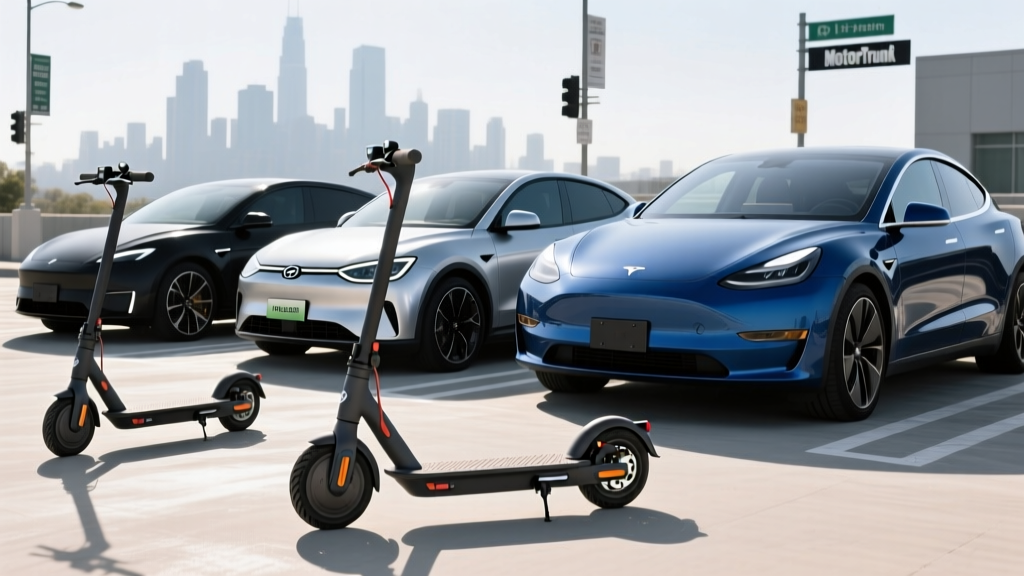
This site's core coverage is electric cars, but readers frequently ask how scooter costs stack up when deciding whether to electrify a commute. The honest answer: a $1,500 kick-scooter and a $35,000 EV answer different questions. The scooter replaces a bus pass or a second car's short trips; the EV replaces the primary vehicle. Treat them as complements, not substitutes.
Purchase Price Breakdown: Scooters vs. EVs in 2026
| Category | Typical 2026 Price Range | Representative Models | Federal Tax Credit Eligibility |
|---|---|---|---|
| Kick-scooter (stand-up) | $400 – $2,800 | Segway Ninebot Max G3, Apollo City 2026 | No — not a qualified highway vehicle under §30D |
| Seated moped-style e-scooter | $2,500 – $9,000 | NIU MQi+, Vespa Elettrica | Generally no — most lack highway certification |
| Electric motorcycle (full-size) | $12,000 – $25,000 | Zero SR/F, LiveWire One | Expired 12/31/2024 under current IRS rules (check for renewal) |
| Entry-level EV (4-wheel, highway-legal) | $29,990 – $40,000 | 2026 Chevy Equinox EV, Nissan LEAF (if carried over), Hyundai Kona Electric | Up to $7,500 via §30D, subject to MSRP, income, and battery-sourcing rules |
| Mid-tier EV | $45,000 – $65,000 | Tesla Model Y, Hyundai Ioniq 5, Ford Mustang Mach-E | Varies by trim, sourcing, and buyer AGI |
The §30D federal credit — administered under IRS clean vehicle rules — applies only to new qualified plug-in vehicles meeting battery critical-mineral and component sourcing thresholds, buyer income caps ($150k single / $300k joint), and MSRP caps ($55k cars, $80k SUVs/trucks/vans). Kick-scooters and most seated mopeds never enter this conversation because they are not highway-capable vehicles. Always verify current-year eligibility with a tax professional before banking on the credit.
Charging Cost Per Mile: Where Scooters Win Easily
Energy economics are where electric scooters genuinely outperform both EVs and gas cars. A kick-scooter's tiny battery (typically 0.35–0.65 kWh) means a full recharge costs pennies at the U.S. average residential rate of ~$0.17/kWh (EIA 2025 data).
| Vehicle | Battery / Tank | Efficiency | Cost per Full Recharge/Refuel | Cost per Mile |
|---|---|---|---|---|
| Kick-scooter (Apollo City 2026) | 0.65 kWh | ~30 Wh/mi | ~$0.11 | $0.005 |
| Seated moped (NIU MQi+) | 2.0 kWh | ~50 Wh/mi | ~$0.34 | $0.009 |
| 2026 Hyundai Kona Electric | 65 kWh usable | ~3.0 mi/kWh (112 MPGe) | ~$11.05 (home) | $0.057 |
| 2025 Toyota Corolla (gas baseline) | 13.2 gal tank | 34 MPG combined | ~$42.90 @ $3.25/gal | $0.096 |
A scooter commuter covering 10 miles round-trip, 250 days a year, spends roughly $12.50/year on electricity. The same commute in a Kona Electric costs about $142/year, and in a Corolla, about $240/year. On energy alone, the scooter is unbeatable — but energy is only one column of the ownership spreadsheet.
Total Cost of Ownership: The Full Picture
First-time EV buyers often fixate on sticker price and miss the ongoing costs. Here's a 3-year ownership projection for a 5-mile-each-way daily commute (2,500 miles/year):
| Cost Category | Kick-Scooter ($1,400) | 2026 Kona Electric SE | 2025 Corolla LE (gas) |
|---|---|---|---|
| Purchase price (after credits) | $1,400 | ~$26,500 (est. after §30D) | $23,500 |
| Insurance (3 years) | $0–$150 (renters add-on) | $5,400 | $4,500 |
| Energy (3 years, 7,500 mi) | $38 | $426 | $720 |
| Maintenance (3 years) | $150 (tires, brake pads) | $450 | $1,350 (oil, filters, brakes) |
| Registration / taxes | $0 | $600 | $450 |
| 3-Year Total | ~$1,738 | ~$33,376 | ~$30,520 |
The scooter's TCO is a fraction of any car's — but the car provides weather protection, crash safety, cargo capacity, highway legality, and year-round usability in most climates. This is where the decision framework matters more than the spreadsheet.
Real-World Ownership Considerations First-Time Buyers Miss
Weather and Seasonality
Kick-scooters are fair-weather vehicles. Below 40°F, lithium-ion batteries lose 20–30% of their rated range (per fueleconomy.gov testing methodology applied to EVs; scooter cells behave similarly). Rain, snow, and ice make stand-up riding unsafe. Most scooter owners in the Northeast or Midwest use them 5–7 months per year; Sun Belt owners use them 10–12.
Home Charging Access
Scooters charge from any standard 120V outlet (Level 1 equivalent, ~100–200W), so apartment dwellers with access to any outlet can top up overnight. A 0.65 kWh battery reaches full in 3–5 hours. EVs, by contrast, need either a dedicated 240V Level 2 circuit (typically $600–$2,200 installed by a licensed electrician) or reliable public charging access. If your building lacks EV-ready parking, a scooter sidesteps the infrastructure problem entirely — but only for trips the scooter can handle.
Insurance and Liability
Most auto insurers don't write standalone policies for kick-scooters; coverage typically rides on renters or homeowners policies (often limited to $1,000–$2,500). If you're in an at-fault collision with a pedestrian or car, personal liability exposure is real. Seated mopeds and electric motorcycles require registration and liability insurance in most states — typically $200–$600/year.
Theft and Storage
Scooters are high-theft items. A $1,500 Apollo or Segway is an easy target if locked to a street rack with a cheap cable. Budget $80–$150 for a U-lock plus folding lock, and bring the scooter indoors when possible. EVs have immobilizers and are far harder to steal.
Common Misconceptions About Electric Scooters and EVs
| Myth | Fact |
|---|---|
| "A $1,500 scooter replaces a $35,000 EV." | They solve different problems. A scooter handles a 5-mile urban commute in fair weather; an EV handles the full spectrum of American driving — highway, family, cargo, winter, long trips. |
| "Scooters are basically free to own." | Energy is nearly free. The purchase, lock, helmet, rain gear, and eventual battery replacement ($150–$400 after 500–800 cycles) add up. |
| "EV batteries die in 5 years, so a scooter is smarter." | Modern EV batteries (NMC and LFP chemistries) retain 85–92% capacity at 100,000 miles per manufacturer and third-party data. Federal law mandates warranty coverage of at least 8 years/100,000 miles. Scooter batteries, by contrast, are smaller but often lack robust thermal management and degrade faster under daily deep cycling. |
| "I don't need a car if I have a scooter." | True for some urban dwellers with transit + rideshare backup. Not true for suburban/rural commuters, families, or anyone who drives in winter. |
| "The federal EV tax credit makes EVs cheaper than scooters." | A $7,500 credit on a $33,000 EV still leaves you at ~$25,500 — an order of magnitude above any scooter. The credit narrows the gap with gas cars, not with micromobility. |
Decision Framework: Scooter, EV, Hybrid, or Gas?
Choose an electric kick-scooter if:
- Your one-way commute is under 8 miles on bike lanes or low-speed streets
- You live in a mild climate or accept seasonal use
- You already own (or share) a car for longer/ugly-weather trips
- Your budget is under $2,000 and you want near-zero fuel cost
Choose a seated e-scooter/moped if:
- You want 30–60 mile urban range with more stability than a kick-scooter
- You have secure storage and a 120V outlet for overnight charging
- Top speeds of 30–45 mph cover your routes (no highways)
Choose an EV (4-wheel) if:
- You need a primary vehicle for year-round, all-weather, multi-purpose driving
- You have (or can install) Level 2 home charging
- You drive 8,000+ miles/year and want lower per-mile energy cost vs. gas
- You qualify for §30D credit or point-of-sale transfer under current IRS rules
Choose a hybrid/PHEV if:
- You lack reliable charging access but want some electric-only miles (PHEVs offer 25–45 mi electric range)
- You regularly take 300+ mile road trips and don't want to plan around DC fast-charger availability
First-Time EV Buyer FAQ
Are electric scooters street-legal?
Kick-scooters are regulated at the state and city level. Most states allow them on bike lanes and streets with speed limits up to 25–35 mph, but not on sidewalks or highways. Seated mopeds often require registration, a license plate, and a motorcycle endorsement depending on top speed and motor wattage. Check your state DMV before purchasing.
How long do scooter batteries last compared to EV batteries?
Kick-scooter lithium-ion packs typically endure 500–1,000 full charge cycles before degrading to ~80% capacity — roughly 2–4 years of daily use. Replacement runs $150–$400. EV batteries, with active thermal management and larger buffers, are warranted for 8 years/100,000 miles and routinely last 150,000–200,000+ miles before significant degradation.
Can I charge an electric scooter from a regular outlet?
Yes. Every consumer kick-scooter and most seated mopeds charge from a standard 120V household outlet. A full charge takes 3–8 hours depending on battery size (kWh) and charger power (W). This is a major advantage for apartment dwellers who can't install a 240V EV circuit.
What's the real range of an electric scooter vs. the advertised range?
Expect 60–80% of the advertised range in real-world conditions. A scooter rated for 40 miles typically delivers 25–32 miles at full speed with a 180-lb rider on mixed terrain. Cold weather, hills, and headwinds reduce this further. The same honesty applies to EVs: EPA range is a reasonable baseline, but highway driving at 75 mph and winter temperatures can cut 15–30% off the sticker number.
Should I buy a scooter now or wait for an EV price drop?
These purchases aren't mutually exclusive. A $1,200–$1,500 scooter today can handle fair-weather commuting while you save for an EV or wait for broader §30D eligibility, model refreshes, or improved DC charging infrastructure in your area. Many EV owners use a scooter for the last mile from transit or for quick neighborhood errands.
Do electric scooters qualify for any tax incentives?
As of 2026, the federal §30D clean vehicle credit does not apply to kick-scooters or most seated e-scooters because they are not qualified highway vehicles. A handful of cities and employers offer micromobility subsidies (typically $100–$500), and some states include e-bikes and e-scooters in broader clean-transportation rebate programs. Check your local transit authority or employer benefits portal.
The Bottom Line
Electric scooters cost $400–$9,000 depending on class, and their per-mile energy cost ($0.005–$0.009) crushes both EVs and gas cars. But the question "how much do electric scooters cost" only matters once you've defined the job: last-mile commute, fair-weather errand runner, or primary vehicle. For the first two, a scooter is arguably the most cost-efficient electrified transport you can buy. For the third — year-round, all-purpose, family-capable driving — a 4-wheel EV, with its ~$25,000–$55,000 real-world cost after incentives, remains the right tool. Buy the scooter for what it does well; buy the EV for everything else.