Is There an Electric RAV4 in 2026?
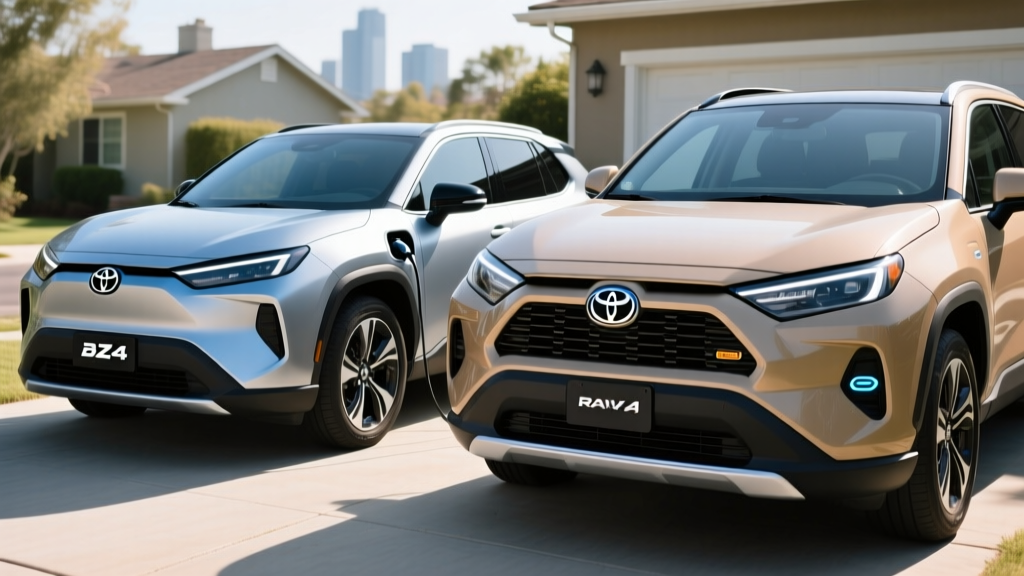
Toyota does not sell a vehicle literally badged "Electric RAV4." The closest equivalent is the 2026 Toyota bZ4X, a compact electric SUV built on the same e-TNGA platform architecture and sized similarly to the RAV4. For the 2026 model year, the front-wheel-drive bZ4X XLE starts at $38,465 (including destination) and carries an EPA-estimated 252 miles of range from a 71.4 kWh (usable) lithium-ion battery. All-wheel-drive variants drop to approximately 228 miles EPA.
If you want RAV4 practicality with electric commuting capability but no range anxiety, the RAV4 Plug-In Hybrid (Prime) offers 42 miles of electric-only range plus 580+ total miles. If you want a pure battery-electric compact SUV from Toyota, the bZ4X is your answer — but it competes against rivals like the Hyundai Ioniq 5 (303 mi EPA) and Tesla Model Y (320 mi EPA) that offer more range.
The bZ4X Spec Sheet: What You're Actually Getting
Before comparing the bZ4X to the gas and hybrid RAV4 lineup, here are the exact numbers that matter for ownership.
| Spec | 2026 bZ4X XLE FWD | 2026 bZ4X Limited AWD |
|---|---|---|
| Base MSRP (incl. destination) | $38,465 | $47,115 |
| EPA Range | 252 miles | 228 miles |
| Battery (usable capacity) | 71.4 kWh | 71.4 kWh |
| Battery Chemistry | NMC (Nickel Manganese Cobalt) | NMC |
| Motor Output | 201 hp / 196 lb-ft | 214 hp / 248 lb-ft (dual motor) |
| 0–60 mph | ~7.1 sec | ~5.8 sec |
| Peak DC Fast Charge Rate | 150 kW | 150 kW |
| 10–80% DC Fast Charge Time | ~30 min | ~30 min |
| Level 2 (240V) Charge Rate | 7.2 kW (~25 mi/hr) | 7.2 kW (~25 mi/hr) |
| MPGe (combined) | 119 MPGe | 104 MPGe |
| Cargo Volume (rear seats up) | 27.7 cu ft | 27.7 cu ft |
| Battery Warranty | 8 yr / 100,000 mi | 8 yr / 100,000 mi |
Real-World Range Expectations
EPA Sticker: 252 miles (FWD) / 228 miles (AWD)
Highway (70–75 mph): Expect ~210–225 miles FWD, ~190–205 miles AWD
Cold Weather (below 32°F): Expect 15–25% range reduction, dropping FWD to roughly 190–215 miles
Mixed Real-World: Most owners report 220–240 miles on the FWD in moderate climates
The bZ4X's efficiency is adequate but trails rivals. The Hyundai Ioniq 5 achieves 303 miles EPA from a similar-size battery, and the Tesla Model Y Long Range posts 320 miles. Toyota has prioritized cabin heating and battery durability over maximum range optimization.
Electric vs. Hybrid vs. Gas: The RAV4 Family Compared
Toyota offers the RAV4 in three powertrains: conventional gas, hybrid (HEV), and plug-in hybrid (Prime). Here's how the bZ4X stacks up on the metrics buyers actually care about.
| Metric | bZ4X FWD (EV) | RAV4 Hybrid AWD | RAV4 Prime PHEV | RAV4 Gas AWD |
|---|---|---|---|---|
| Starting MSRP | $38,465 | $33,575 | $44,565 | $31,075 |
| EPA Range / Total Range | 252 mi | 580 mi | 42 mi EV + 580 mi total | 448 mi |
| Combined Efficiency | 119 MPGe | 39 MPG | 94 MPGe / 38 MPG | 28 MPG |
| Fuel/Energy Cost per Mile | ~$0.04–0.05 | ~$0.09 | ~$0.05–0.08 | ~$0.12 |
| Federal Tax Credit (§30D) | Up to $7,500* | None | Up to $7,500* | None |
| Annual Maintenance Est. | ~$300 | ~$500 | ~$500 | ~$600 |
| 0–60 mph | 7.1 sec | 7.4 sec | 5.7 sec | 8.1 sec |
*§30D tax credit eligibility depends on MSRP caps, buyer income limits, and battery component/critical mineral sourcing requirements. See IRS.gov for current rules. The bZ4X has historically qualified for the full $7,500, but verify at point of sale.
The Real Cost of Ownership: 5-Year Breakdown
Sticker price is only part of the equation. Let's model a realistic 5-year / 75,000-mile ownership scenario for a buyer in a state with average electricity rates ($0.16/kWh) and gas at $3.50/gallon.
| Cost Category (5 yr / 75k mi) | bZ4X FWD | RAV4 Hybrid | RAV4 Gas AWD |
|---|---|---|---|
| Purchase Price (after $7,500 credit) | $30,965 | $33,575 | $31,075 |
| Fuel/Energy | $2,250 | $6,730 | $9,375 |
| Maintenance | $1,500 | $2,500 | $3,000 |
| Insurance (avg) | $7,800 | $6,500 | $6,200 |
| Estimated Depreciation | $14,500 | $12,000 | $13,500 |
| Total 5-Year Cost | $57,015 | $61,305 | $63,150 |
Key takeaways:
- The bZ4X wins on total 5-year cost primarily due to the federal tax credit and dramatically lower energy costs — roughly $0.03/mile for electricity vs. $0.12/mile for gas.
- Insurance premiums on EVs tend to run 15–25% higher than comparable gas models due to higher repair costs and parts pricing. Budget accordingly.
- EV depreciation has been steeper than hybrids in recent years as price wars compress used-EV values. Toyota's brand strength partially insulates the bZ4X, but don't expect RAV4 Hybrid-level resale.
- Maintenance savings are real: no oil changes, no spark plugs, no transmission fluid, and regenerative braking extends pad life significantly.
Charging the bZ4X: What First-Time EV Buyers Need to Know
Charging is where EV ownership either clicks or frustrates. The bZ4X supports three charging levels, and understanding the difference between kW (power/charge speed) and kWh (energy/battery capacity) is critical — confusing them is the most common new-EV-owner mistake.
| Level | Power (kW) | Speed (miles/hr) | Use Case | Full Charge Time |
|---|---|---|---|---|
| Level 1 (120V outlet) | ~1.2 kW | ~4 mi/hr | Emergency/overnight trickle | ~60 hours |
| Level 2 (240V home) | 7.2 kW | ~25 mi/hr | Daily home charging | ~10 hours |
| DC Fast Charge | Up to 150 kW | ~180 mi/hr (peak) | Road trips | 10–80% in ~30 min |
Home Charging Setup & Cost
Most bZ4X owners will want a Level 2 home charger. Here's what to budget:
| Item | Cost Range |
|---|---|
| Level 2 EVSE (charger hardware, 32–48A) | $350–$700 |
| Electrician labor (240V/50A circuit install) | $600–$1,500 |
| Permit & inspection | $100–$300 |
| Panel upgrade (if needed, 100A → 200A) | $1,500–$3,000 |
| Total (typical install) | $1,050–$2,500 |
Important: If your home has a 100-amp electrical panel that's already near capacity, you may need a panel upgrade before installing a Level 2 charger. A licensed electrician can assess this — don't skip this step. Some utilities offer rebates of $250–$500 for home charger installation.
Public Charging & the Charging Curve Reality
The bZ4X's peak 150 kW DC fast-charge rate is competitive but not class-leading. More importantly, understand the charge curve: the battery charges fastest between 10–40% State of Charge, then progressively tapers to protect battery health. Above 80%, charging slows dramatically — from 150 kW down to under 40 kW. This is why manufacturers quote 10–80% times rather than 0–100%.
On a road trip, plan stops around the 10–80% window. A typical DC fast-charge stop in the bZ4X adds roughly 120–150 miles in 25–30 minutes at a 150 kW station. The bZ4X uses the CCS1 connector, which is compatible with Electrify America, EVgo, and most non-Tesla networks. Toyota has announced future models will adopt NACS (Tesla's connector), but the 2026 bZ4X retains CCS1.
Common Misconceptions: Myth vs. Fact
| Myth | Fact |
|---|---|
| "The electric RAV4 (bZ4X) has the same range as competitors." | The bZ4X's 252-mile EPA range trails the Hyundai Ioniq 5 (303 mi), Tesla Model Y (320 mi), and Ford Mustang Mach-E (250–320 mi depending on trim). Toyota prioritized battery longevity and thermal management over maximum range. |
| "EV batteries need replacing every few years." | Toyota warranties the bZ4X battery for 8 years/100,000 miles against degradation below 70% capacity. Real-world data from similar NMC packs shows most retain 88–92% capacity at 100,000 miles. Full replacement (if ever needed out of warranty) runs $8,000–$12,000. |
| "I can't take a road trip in an EV." | You can, but plan more carefully than with a gas car. The bZ4X's 252-mile range means stops every ~180–200 real-world miles on the highway. With 30-minute DC fast-charge stops, a 600-mile trip takes roughly 9–10 hours vs. 9 hours in a gas RAV4. |
| "EVs are worse in cold weather." | EVs lose 15–25% range in freezing temperatures due to battery chemistry and cabin heating demands. The bZ4X includes a heat pump on most trims, which reduces (but doesn't eliminate) cold-weather loss. Preconditioning the battery while plugged in mitigates this significantly. |
| "I'll get the $7,500 tax credit automatically." | Federal §30D credit eligibility requires meeting buyer income caps ($150K single / $300K joint), MSRP caps ($80K for SUVs), and battery sourcing rules. The credit can now be transferred at point of sale as a discount. Verify eligibility on IRS.gov and with your dealer. |
Decision Framework: Which RAV4 Powertrain Is Right for You?
Choose the bZ4X (Electric) If:
- You have reliable home charging (garage or driveway with 240V access)
- Your daily driving is under 150 miles round-trip
- You want the lowest per-mile energy cost (~$0.04/mi with home charging)
- You qualify for the $7,500 federal tax credit, bringing the effective price near $31,000
- You rarely take road trips exceeding 400 miles in a day, or don't mind 30-minute charge stops
- You value near-silent operation and instant torque (201 hp, 7.1 sec 0–60)
Choose the RAV4 Prime (Plug-In Hybrid) If:
- You want 42 miles of electric-only commuting but also need 580+ total miles for road trips
- You don't have reliable home charging but want some EV benefit
- You want the quickest RAV4 (5.7 sec 0–60, 302 hp combined)
- You live in an area with limited public DC fast-charging infrastructure
- You want Toyota's strongest resale value in the RAV4 lineup
Choose the RAV4 Hybrid If:
- Your budget is tightest (starting at $33,575, no tax credit but lowest MSRP of electrified options)
- You want zero lifestyle changes — no plug, no charging apps, no range planning
- You drive high annual miles (20,000+) and want proven 39 MPG combined reliability
- You live in a cold climate where EV range loss is a concern and want consistent year-round efficiency
Choose the Gas RAV4 If:
- Upfront cost is your top priority ($31,075 base)
- You drive fewer than 10,000 miles/year (fuel savings from electrification won't offset higher purchase price)
- You plan to own the vehicle for fewer than 4 years
What a First-Time EV Buyer Should Know Before Signing
- Verify the tax credit before you negotiate. The §30D credit can be applied at point of sale in 2026, effectively reducing your purchase price by $7,500. But eligibility hinges on your income, the vehicle's battery sourcing, and MSRP caps. Ask the dealer for a written credit eligibility confirmation.
- Get a home electrical assessment first. Before committing, have a licensed electrician evaluate your panel capacity and quote a Level 2 install. A $1,500 panel upgrade surprise is better discovered before purchase than after.
- Test the public charging near you. Download the Electrify America, EVgo, and ChargePoint apps. Look at the DC fast-charging stations within 10 miles of your home and workplace. Are they functional? Well-maintained? This is your backup when home charging isn't enough.
- Insurance quotes before you buy. EV insurance premiums average 15–25% higher than equivalent gas vehicles. Get a quote from your insurer on the specific bZ4X trim before finalizing your purchase.
- Understand the charge curve. You will rarely charge from 0–100% on a DC fast charger. The practical road-trip pattern is: drive to ~15% State of Charge, charge to 80% (~25–30 minutes), and continue. Charging from 80–100% can take as long as 10–80% due to tapering.
Frequently Asked Questions
Will Toyota make an actual "Electric RAV4" with the RAV4 name?
As of 2026, Toyota has not announced a vehicle badged "RAV4 Electric." The bZ4X is Toyota's dedicated electric compact SUV and serves as the RAV4's EV equivalent. Toyota has confirmed an expanded EV lineup through 2028, and a next-generation electric SUV wearing the RAV4 nameplate is plausible but not confirmed. Any future model would likely adopt the NACS connector and target 300+ miles of range.
How does the bZ4X's 252-mile range handle real road trips?
Adequately but not ideally. On a highway road trip at 70–75 mph, expect roughly 210–225 real miles before needing to charge. That means stopping every 2.5–3 hours for a 25–30 minute DC fast charge. It's manageable, but rivals like the Ioniq 5 (303 mi EPA) and Model Y (320 mi EPA) allow longer stretches between stops and more buffer in cold weather.
Does the bZ4X qualify for the full $7,500 federal tax credit?
The bZ4X has historically qualified for the full $7,500 under §30D, but eligibility can shift as battery sourcing requirements tighten. The vehicle must meet critical mineral and battery component thresholds, and the buyer must fall under income caps ($150K single, $300K joint). Always verify current status at IRS.gov and confirm with your dealer at point of sale. The credit can be applied as an upfront discount.
What happens if the bZ4X battery degrades?
Toyota warrants the battery for 8 years/100,000 miles, guaranteeing it will retain at least 70% of original capacity. Industry data on similar NMC packs suggests most retain 88–92% at 100,000 miles under normal use. If a full replacement were ever needed out of warranty, expect $8,000–$12,000 — though battery costs continue to decline year over year.
Can I charge the bZ4X at a Tesla Supercharger?
Not directly in 2026. The bZ4X uses the CCS1 connector. Tesla's NACS connector is different, though Tesla has begun opening some Superchargers to CCS vehicles via built-in adapters at select stations. Toyota has indicated future models will adopt NACS, but the current bZ4X relies on the CCS network (Electrify America, EVgo, ChargePoint). A third-party CCS-to-NACS adapter exists but check compatibility and warranty implications before using one.
bZ4X vs. RAV4 Prime: which saves more money over 5 years?
It depends on your driving profile and tax credit eligibility. The bZ4X (after a $7,500 credit) has a lower effective purchase price and lower energy costs. But the RAV4 Prime holds value better and avoids the insurance premium increase. For a driver covering 15,000 miles/year with home charging access, the bZ4X typically saves $3,000–$5,000 over 5 years. For a driver without home charging or who frequently road-trips, the Prime's flexibility wins.