The Short Answer: Electric Railroad vs Your EV
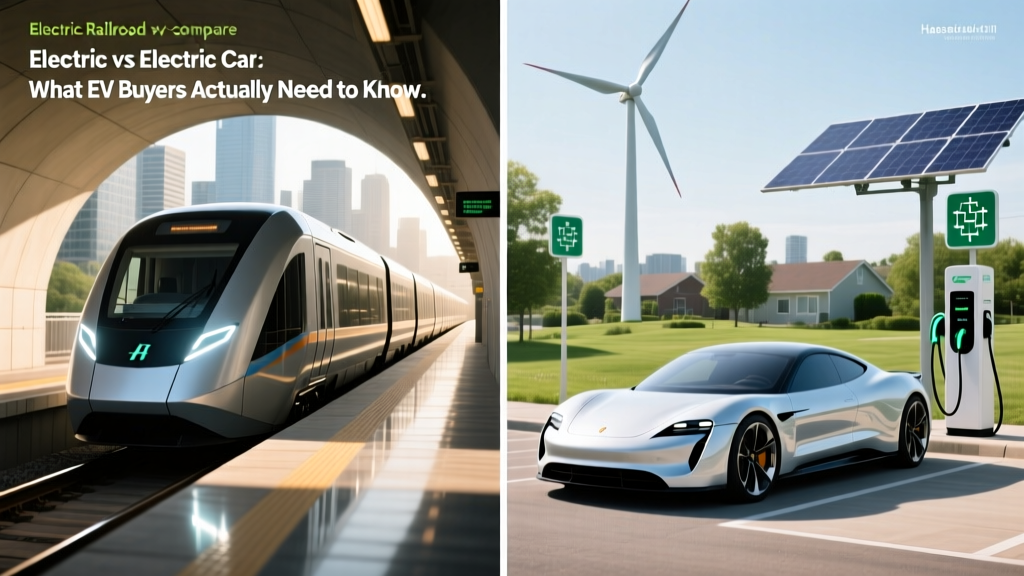
If you've searched "electric railroad" while researching electric vehicles, you're likely encountering two very different electrification worlds. Electric railroads are grid-powered transit systems — locomotives and trains drawing electricity from overhead catenary wires or third rails to move hundreds of passengers or tons of freight. Personal EVs carry onboard battery packs (typically 60–100 kWh) that you recharge at home or at public stations. Both use electric motors, but the infrastructure, costs, and ownership experience are entirely separate. This guide clarifies what rail electrification means for you as an EV buyer, and gives you the concrete numbers you need to decide if a battery-electric car, a plug-in hybrid, or sticking with gas makes the most financial sense in 2026.
Why "Electric Railroad" Keeps Showing Up in EV Searches
The term "electric railroad" historically refers to mainline rail systems powered by external electricity — think Amtrak's Northeast Corridor, SEPTA regional rail, or freight catenary systems in Europe and parts of Asia. In the US, the Association of American Railroads notes that most US freight rail relies on diesel-electric locomotives rather than overhead electrification, unlike Europe where catenary systems are widespread.
Search engines surface "electric railroad" alongside EV queries because the underlying physics overlap: both use electric traction motors, regenerative braking, and lithium-based or grid-tied power. But the ownership question is entirely different. You can't buy a locomotive; you can buy a 2026 Tesla Model Y, Hyundai Ioniq 5, or Toyota RAV4 PHEV. Let's focus on what matters for your driveway.
EV vs Gas vs Hybrid: The Real Numbers for 2026
Before we get into charging logistics, let's ground the decision in hard data. Below is a comparison of three representative 2026 vehicles: a battery-electric crossover (Hyundai Ioniq 5 Long Range RWD), a plug-in hybrid (Toyota RAV4 Prime), and a comparable gas crossover (Toyota RAV4 LE AWD). All figures sourced from fueleconomy.gov and manufacturer MSRP listings.
| Metric | Hyundai Ioniq 5 LR RWD (BEV) | Toyota RAV4 Prime (PHEV) | Toyota RAV4 LE AWD (Gas) |
|---|---|---|---|
| Base MSRP | $44,200 | $46,500 | $32,350 |
| EPA Range / MPG | 303 mi (114 MPGe) | 42 mi EV + 38 MPG gas | 30 MPG combined |
| Battery (usable kWh) | 77.4 kWh (NMC) | 18.1 kWh (NMC) | N/A |
| 0–60 mph | 7.2 sec | 5.7 sec | 8.1 sec |
| Peak DC Charge Rate | 238 kW | N/A (Level 2 only) | N/A |
| 10–80% DC Charge | ~18 min | N/A | N/A |
| Federal §30D Credit Eligibility | Up to $7,500 (income/MSRP/sourcing rules apply) | Up to $7,500 (PHEV eligible) | None |
| Powertrain Warranty | 10 yr / 100,000 mi | 10 yr / 100,000 mi (hybrid battery) | 5 yr / 60,000 mi |
The BEV wins on running cost and performance-per-dollar once the tax credit applies. The PHEV is the pragmatic bridge for apartment dwellers or one-car households who can't always rely on charging. The gas model remains cheapest at purchase but costs significantly more per mile over time.
Real Cost of Ownership: 5-Year Breakdown
Sticker price tells only part of the story. Here's a 5-year / 75,000-mile ownership projection assuming $3.50/gal gas, $0.16/kWh national average electricity, and 80% home / 20% public DC charging for the BEV.
| Cost Category | Ioniq 5 BEV | RAV4 Prime PHEV | RAV4 Gas |
|---|---|---|---|
| Purchase (after est. credit) | $36,700 | $39,000 | $32,350 |
| Fuel / Electricity | $3,450 | $4,800 | $8,750 |
| Maintenance | $1,800 | $3,200 | $4,500 |
| Insurance (avg) | $9,200 | $8,400 | $7,600 |
| Estimated Depreciation | $14,500 | $15,800 | $13,200 |
| 5-Year Total | $65,650 | $71,200 | $66,400 |
The BEV and gas RAV4 converge closely over five years, but the BEV delivers far more performance and tech for similar money. The PHEV carries a premium due to dual powertrain complexity. Insurance remains the BEV's weak spot — typically 15–25% higher than gas equivalents, per III industry data.
Real-World Range: What the EPA Sticker Doesn't Tell You
The Ioniq 5's 303-mile EPA figure assumes a mixed driving cycle at moderate temperatures. In practice:
- Highway-only at 75 mph: Expect 250–270 miles. Aerodynamic drag dominates above 65 mph.
- Cold weather (below 30°F): Range drops 20–30%, so 210–240 miles is realistic without preconditioning.
- Mountain driving: Regenerative braking on descents partially offsets uphill consumption, but net range still falls 10–15%.
- DC fast charging taper: The 238 kW peak only holds to roughly 40% SoC; charging slows substantially above 80% to protect the NMC cells. Plan 10–80% stops (~18 min), not 0–100%.
Models with LFP chemistry (like the base Tesla Model 3 RWD) tolerate 100% daily charging better but trade some energy density and cold-weather performance.
Charging Access: The Make-or-Break Factor
Home charging is the single biggest predictor of EV satisfaction. If you can install a Level 2 (240V) home charger, daily ownership is effortless — you wake up "full" every morning. If you can't, a PHEV or gas car may serve you better.
| Level | Power (kW) | Miles Added per Hour | Typical Use |
|---|---|---|---|
| Level 1 (120V) | 1.4 kW | 3–5 mi/hr | Overnight trickle; PHEVs only |
| Level 2 (240V) | 7.2–11.5 kW | 25–40 mi/hr | Home daily, workplace |
| DC Fast | 50–350 kW | 150–800+ mi/hr | Road trips; 10–80% in 15–40 min |
Home Level 2 installation typically runs $800–$2,500 including a quality EVSE (Emporia, ChargePoint, or Wallbox) and electrician labor, assuming your panel has capacity. A panel upgrade from 100A to 200A can add $1,500–$3,500. Renters and condo dwellers should explore workplace charging, NACS-equipped Tesla Superchargers (now open to non-Teslas via adapter), or Electrify America / EVgo networks.
Common EV Misconceptions, Corrected
| Myth | Fact (with data) |
|---|---|
| "EV batteries need replacement every few years." | Modern NMC and LFP packs routinely exceed 150,000 miles with less than 10% degradation. Federal law mandates 8 yr / 100,000 mi battery warranty minimum; Hyundai and Kia offer 10 yr / 100,000 mi. |
| "The §30D tax credit is $7,500 for everyone." | The IRS §30D credit has MSRP caps ($80K SUVs / $55K sedans), buyer income limits ($150K single / $300K joint), and critical-mineral + battery-component sourcing requirements. Many trims qualify for $3,750 or $0. Point-of-sale transfer is available at participating dealers. |
| "Autopilot and FSD mean the car drives itself." | Tesla Autopilot, FSD (Supervised), GM Super Cruise, and Ford BlueCruise are all SAE Level 2 — the driver must remain engaged and hands on or eyes on the road at all times. Only Waymo and Zoox robotaxis operate at Level 4 (no driver) in limited geofenced zones. |
| "EVs are worse for the environment because of electricity generation." | Even on coal-heavy US grids, lifecycle emissions for BEVs are 50–70% lower than gas cars per EPA and ICCT analyses. On cleaner grids (California, Pacific Northwest), the advantage exceeds 80%. |
| "Public charging is unreliable everywhere." | Tesla Superchargers maintain ~99% uptime. CCS networks (Electrify America, EVgo) average 85–90%. Reliability is improving as NACS becomes the 2026 industry standard. |
Decision Framework: Which Powertrain Is Right for You?
If / Then Powertrain Selector
- If you have a garage or driveway with 240V access AND drive under 250 miles/day → BEV (lowest running cost, best performance).
- If you rent an apartment with no charging OR regularly drive 300+ mile rural routes → PHEV (electric errands, gas for road trips).
- If you live in extreme cold (below 0°F winters) AND lack home charging → HEV or gas for now; revisit when solid-state or LFP cold-weather tech matures.
- If you want the lowest 5-year cost AND qualify for §30D → BEV with credit at point of sale.
- If towing over 5,000 lbs is routine → Gas or diesel still wins; BEV towing drops range 40–50%.
First-Time EV Buyer Checklist
- Audit your charging: Can you install Level 2 at home? Check your panel's amperage and available breaker slots.
- Measure your real commute: 95% of US drivers travel under 40 miles/day — easily covered by any modern BEV.
- Verify §30D eligibility: Use the IRS VIN-check tool before signing; don't trust dealer verbal claims.
- Test-drive in cold: If you live in winter climates, preconditioning and heat-pump efficiency matter more than peak range.
- Quote insurance early: Get BEV quotes before committing — premiums can surprise.
- Plan your road-trip routes: A Better Routeplanner or PlugShare check reveals real corridor coverage.
Frequently Asked Questions
Does "electric railroad" technology apply to personal EVs?
Only in broad principle. Both use electric traction motors and regen braking, but rail systems draw continuous grid power from catenary wires or third rails, while personal EVs store energy in onboard battery packs measured in kWh. You won't encounter railroad-grade electrical systems as a consumer EV owner.
Are BEVs cheaper than gas cars over 5 years?
Often yes, once fuel savings, lower maintenance (no oil, fewer moving parts), and the §30D credit are factored. The Ioniq 5 example above shows near-parity with a gas RAV4 over five years despite a higher MSRP. Breakeven typically occurs between years 3 and 5 depending on mileage and electricity cost.
What happens if my EV battery degrades?
Gradual capacity loss of 1–2% per year is normal. Federal warranty mandates replacement if capacity falls below roughly 70% within 8 years / 100,000 miles. Full pack replacement outside warranty currently costs $8,000–$18,000 depending on chemistry and model, but most packs outlast the vehicle's economic life.
Should I wait for solid-state batteries?
Solid-state cells are entering limited production (Toyota has announced 2027–2028 deployment), but wide availability and affordable pricing remain 4–6 years out. Buying a current BEV or PHEV now and running it 8–10 years is the pragmatic path for most buyers.
Is Level 2 home charging worth the install cost?
Almost always. A $1,200–$2,000 install pays for itself in convenience and electricity-cost savings versus public DC charging within 18–30 months for a typical commuter. It's the single highest-ROI upgrade an EV owner can make.