The Short Answer: Electric Railcar or Personal EV?
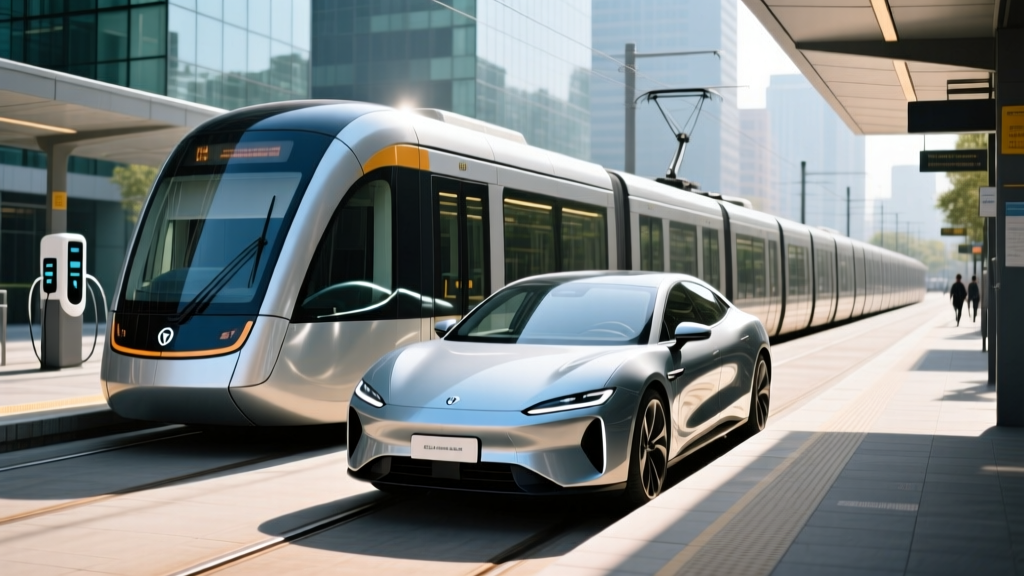
If you're searching for "electric railcar" options for your daily commute, you're likely weighing two forms of electric transportation: public electrified rail transit (light rail, commuter rail, streetcars powered by overhead catenary or third-rail systems) and a personal battery-electric vehicle (BEV). Here's the practical truth: electrified rail remains the most energy-efficient way to move people in dense corridors — a single electric railcar can move 150–300 passengers using roughly 0.2–0.4 kWh per passenger-mile. But for most American commuters outside transit-rich metros, a personal EV like the 2026 Hyundai Ioniq 6 (EPA 361 miles, ~$38,000 base) or Chevrolet Equinox EV (EPA 319 miles, ~$33,600 base) delivers door-to-door convenience that rail simply cannot match. The right choice depends on your corridor, schedule flexibility, and whether you can charge at home.
What an Electric Railcar Actually Is (And Isn't)
The term "electric railcar" covers several distinct technologies. In North American transit, it most commonly refers to an Electric Multiple Unit (EMU) — a self-propelled passenger rail vehicle that draws power from overhead wires (catenary at 12.5 kV or 25 kV AC) or a third rail (750 V DC). Unlike locomotive-hauled trains, EMUs distribute traction motors across multiple cars, enabling faster acceleration and shorter headways.
Modern electric railcars include:
- Light rail vehicles (LRVs): Typically 600–750 V DC from overhead wire; 150–250 passenger capacity per car. Examples: Siemens S700, Alstom Citadis.
- Commuter EMUs: Higher-capacity, bilevel or single-level, operating on mainline rail at up to 110 mph. Examples: Hyundai Rotem Silverliner V (SEPTA), Kawasaki R211 (NYC Subway/LIRR).
- Intercity EMUs: Higher-speed electric trains like Amtrak's Acela (Siemens Avelia Liberty), capable of 160 mph on the Northeast Corridor.
- Battery-electric multiple units (BEMUs): Emerging technology using onboard lithium-ion packs to run on non-electrified track segments. Examples include the Alstom Breeze concept and Stadler's FLIRT Akku, currently in European service with ~80–120 km battery range.
The key distinction for individual buyers: you cannot purchase an electric railcar for personal use. These are fleet vehicles procured by transit agencies at $3–8 million per car. The personal-transport question is whether to ride electrified rail or drive a personal EV.
Efficiency Showdown: Electric Railcar vs Personal EV
Electric rail's efficiency advantage is rooted in physics: steel wheels on steel rails produce roughly 80% less rolling resistance than rubber tires on asphalt, and a single train moving 200 passengers eliminates the energy overhead of 200 individual 4,000-lb vehicles.
| Mode | Energy / Pass-Mile | CO₂ / Pass-Mile (US Grid Avg) | Typical Occupancy |
|---|---|---|---|
| Electric commuter rail (peak) | ~0.22 kWh | ~0.09 lb | 150–300 |
| Light rail (avg load) | ~0.35 kWh | ~0.14 lb | 60–120 |
| Efficient BEV (Ioniq 6, solo) | ~0.26 kWh | ~0.10 lb | 1 |
| Average BEV (solo, 3.5 mi/kWh) | ~0.29 kWh | ~0.11 lb | |
| Gas sedan (30 MPG, solo) | ~1.11 kWh equiv | ~0.66 lb | 1 |
| Gas sedan (30 MPG, 2 passengers) | ~0.56 kWh equiv | ~0.33 lb |
Source: Efficiency figures derived from fueleconomy.gov EPA data for vehicles and U.S. Department of Energy transportation energy databook estimates for rail. CO₂ based on 2025 US grid average of ~0.39 kg CO₂/kWh (EIA).
The takeaway: a solo driver in an efficient EV like the Ioniq 6 (26 kWh/100 mi EPA, or 0.26 kWh/mile) nearly matches a well-loaded commuter train on per-passenger energy. But a gas car is 3–4× less efficient than either option. If your rail line runs half-empty (common in off-peak suburban service), the per-passenger efficiency degrades significantly.
Real Costs: Commuting by Rail vs EV in 2026
Efficiency is only one variable. The financial picture includes vehicle purchase, fueling, maintenance, insurance, and the often-overlooked cost of time.
| Cost Category | Electric Rail (Monthly Pass) | Personal EV (Ioniq 6 SE) | Gas Sedan (30 MPG) |
|---|---|---|---|
| Vehicle / Pass Purchase | $12,000 ($200/mo avg pass × 60 mo) | $38,250 (base MSRP) – $7,500 credit = ~$30,750 | $28,000 |
| Fuel / Energy (5 yr) | $0 (included in pass) | $2,875 (home L2, $0.13/kWh avg) | $10,417 ($3.50/gal avg) |
| Maintenance (5 yr) | $0 | ~$1,500 (tires, cabin filter, wipers) | ~$4,500 (oil, brakes, filters) |
| Insurance (5 yr) | $0 | ~$9,000 ($150/mo avg) | ~$7,200 ($120/mo avg) |
| Parking (5 yr) | $0 | $0–$6,000 (varies by city) | $0–$6,000 |
| 5-Year Total (no parking) | $12,000 | ~$44,125 | ~$50,117 |
| Cost per Commute Trip | $2.40 | $3.53 | $4.01 |
Key caveats: The EV figure assumes you qualify for the full §30D federal tax credit ($7,500), which requires meeting income caps ($150K single / $300K joint), MSRP limits ($55K sedans / $80K SUVs/trucks), and battery critical-mineral/sourcing requirements that change annually. Check current-year rules on IRS.gov before relying on this figure. The point-of-sale transfer option lets dealers apply the credit at purchase, reducing out-of-pocket cost immediately.
The EV also retains resale value — a 5-year-old Ioniq 6 might sell for $18,000–$22,000, reducing effective cost to ~$22,000–$26,000. Rail passes have zero residual value. When you factor in that the EV serves all your trips (not just commuting), the per-mile economics shift further.
First-Time EV Buyer Essentials: What Rail Riders Switching to EVs Must Know
If you've been riding electric rail and are considering a personal EV for the first time, several ownership realities deserve honest treatment:
Home Charging Access Is the Dealbreaker
Approximately 30% of US households lack access to dedicated off-street parking, making Level 2 home charging difficult or impossible. If you can install a 240V Level 2 charger (typically $500–$1,500 for equipment plus $800–$2,500 for electrician labor and permits, depending on panel capacity), daily EV ownership is seamless — you wake up with a "full tank" every morning. Without home charging, you're dependent on public DC fast chargers or workplace charging, which adds time and cost.
Real-World Range vs EPA Stickers
EPA range estimates assume mixed driving at moderate temperatures. In real-world highway driving at 70+ mph, expect 85–90% of EPA range. In freezing temperatures (below 32°F), battery chemistry and cabin heating demands can reduce range by 20–35%. A vehicle rated at 300 miles EPA might deliver only 200–220 miles on a cold January highway trip. Vehicles equipped with a heat pump (standard on Hyundai/Kia E-GMP models, Tesla Model Y, and others) recover some of this loss — typically limiting cold-weather penalty to 15–25%.
Charging Speed: Peak kW vs Sustained Reality
Charging speed is measured in kW (power — the rate of energy delivery), while battery capacity is measured in kWh (energy — the total stored). A 77.4 kWh battery charged at a sustained 150 kW would theoretically fill in ~31 minutes, but real-world DC fast charging follows a charge curve: the battery accepts peak power only at low states of charge (10–30%), then tapers progressively to protect cell health. The Ioniq 6, for example, peaks at ~233 kW on a 350 kW charger and achieves 10–80% in roughly 18 minutes under ideal conditions — but that final 20% (80–100%) can take another 25–30 minutes. Plan road-trip stops around the 10–80% window.
Federal Tax Credit Eligibility Is Narrowing
As of 2026, the §30D credit's battery-sourcing requirements have tightened significantly. Many popular models that previously qualified may no longer meet the critical-minerals and battery-component thresholds. Always verify current eligibility on fueleconomy.gov before purchasing, and consult a tax professional for your specific situation.
| Myth | Fact |
|---|---|
| "EVs are worse for the environment than gas cars because of battery manufacturing." | Studies from ICCT and Argonne National Lab show EVs break even on lifecycle emissions within 1–2 years of US-average-grid driving, then run cleaner for the remaining 10–15 year vehicle life. On cleaner grids (hydro, nuclear, wind-heavy states), break-even occurs within months. |
| "EV batteries need replacing every 5 years like a phone." | Modern LFP and NMC packs are warrantied for 8 years/100,000 miles (federal minimum) with many manufacturers guaranteeing 70%+ capacity retention. Real-world degradation data shows most packs retain 85–92% capacity at 100K miles. Replacement costs, when needed, run $8,000–$18,000 depending on pack size. |
| "Public charging is unreliable and always broken." | Reliability varies sharply by network. Tesla Superchargers consistently report 95%+ uptime. Electrify America and EVgo have improved but still average ~80–88% uptime per J.D. Power studies. The 2025–2026 rollout of NACS connectors across non-Tesla networks is improving interoperability. |
| "Electric rail is always greener than driving an EV." | True at high occupancy. But a half-empty diesel commuter train or a light-rail car carrying 15 passengers at off-peak hours can have higher per-passenger emissions than a solo EV driver on a clean grid. |
Decision Framework: Should You Ride Rail or Drive an EV?
Choose Electrified Rail If:
- Your workplace is within a 10-minute walk of a rail station with frequent service (≤15 min headways at your commute time).
- Your round-trip commute exceeds 60 miles — rail eliminates wear, fuel cost, and fatigue on long corridors.
- You live in a city with congestion pricing or scarce/expensive parking ($200+/month).
- You don't need a car for other trips (groceries, weekend travel, family logistics) — or can supplement with carshare/rental.
- You value reading, working, or relaxing during your commute rather than driving.
Choose a Personal EV If:
- Your nearest rail station requires a car/bus "last mile" connection adding 20+ minutes.
- Your schedule is irregular — shift work, frequent off-peak travel, or multiple stops per day.
- You have access to Level 2 home charging (garage, driveway, or workplace charger).
- You need a vehicle for non-commute trips and would own a car regardless.
- You live in a region with transit gaps — most of the US outside the Northeast Corridor, Chicago, and a handful of West Coast metros.
Choose a PHEV (Plug-In Hybrid) If:
- You can charge at home but regularly take long road trips where DC charging infrastructure is sparse.
- You want EV-mode commuting (25–45 electric-only miles in models like the Toyota RAV4 Prime or Jeep Wrangler 4xe) with gas-engine range security.
- Your household has one vehicle that must serve all purposes.
Real-World Ownership Considerations Most Guides Skip
Climate Matters More Than You Think
In Phoenix, battery thermal management systems work overtime in 115°F summers, modestly accelerating degradation. In Minneapolis, winter range loss of 25–35% is routine, and DC fast charging speeds drop significantly when the battery is cold unless your vehicle supports preconditioning (warming the pack while navigating to a charger — standard on Tesla, Hyundai E-GMP, and most newer platforms). If you live in extreme climates, prioritize vehicles with active liquid thermal management and heat pumps.
Insurance Costs Are Higher for EVs
EV insurance premiums average 15–25% higher than equivalent gas vehicles, driven by higher repair costs (specialized body-shop training, expensive battery-adjacent components, and total-loss thresholds triggered by minor battery enclosure damage). Shop quotes before purchasing — Geico, State Farm, and Progressive vary significantly by model.
The Charging-Desert Reality
Despite rapid network expansion, large swaths of rural America — particularly in the Mountain West, Great Plains, and parts of the South — remain underserved by DC fast charging. If your regular routes include I-70 through Kansas, US-93 in Nevada, or similar corridors, plan carefully. Apps like PlugShare and A Better Routeplanner are essential tools, and a vehicle with 300+ miles of real-world range provides a critical buffer.
Frequently Asked Questions
Are battery-electric trains (BEMUs) replacing diesel rail in the US?
Slowly. Battery-electric multiple units are operational in Europe (Stadler FLIRT Akku in Germany, Alstom Coradia Continental BEMU in the UK) but US adoption lags. Caltrain in California electrified its Peninsula corridor with overhead catenary (not battery) in 2024. BEMUs make sense for partially-electrified routes where extending catenary is cost-prohibitive, but no major US transit agency has deployed them at scale as of early 2026. The technology is proven but procurement cycles are long.
How much does it cost to charge an EV at home vs fueling a gas car?
At the 2025 US average residential electricity rate of ~$0.16/kWh (varies from $0.10 in Louisiana to $0.30+ in California), charging a 77 kWh battery from empty to full costs roughly $12.32 — delivering about 280 real-world miles. That's approximately $0.044 per mile. A 30 MPG gas car at $3.50/gallon costs $0.117 per mile — nearly 3× more. Annual savings for a 12,000-mile driver: roughly $875 in fuel alone, per fueleconomy.gov data.
Can I use an EV if I live in an apartment without a charger?
It's possible but significantly less convenient. You'll rely on workplace charging (if available), public Level 2 chargers at grocery stores or libraries, and DC fast chargers for weekly top-ups. This adds 30–60 minutes per week of dedicated charging time and higher per-kWh costs (DC fast charging averages $0.35–$0.50/kWh vs $0.16 at home). Some apartment complexes are adding Level 2 stations under state "right-to-charge" laws. If you can't charge at home or work, a PHEV may be a more practical electrified option.
Do EVs really have lower maintenance costs?
Yes, measurably. EVs eliminate oil changes, spark plugs, timing belts, exhaust systems, and traditional friction brakes last 2–3× longer thanks to regenerative braking. Consumer Reports estimates lifetime maintenance savings of $4,600–$9,200 vs a gas vehicle. The main wear items are tires (EVs are heavier and produce instant torque, wearing tires 20–30% faster), cabin air filters, wiper blades, and brake fluid flushes.
What happens to EV batteries at end of life?
Most EV batteries outlast the vehicles they're installed in. At 70–80% capacity retention (typically 150,000–200,000 miles), packs are retired from automotive use but retain significant value for stationary energy storage (grid buffering, home solar integration). Recycling infrastructure is scaling — companies like Redwood Materials and Li-Cycle recover 95%+ of critical minerals (lithium, cobalt, nickel) for reuse in new cells. The "battery landfill" concern is largely overstated given the economics of battery material recovery.
Whether you end up swiping a transit pass for an electric railcar commute or plugging in a personal EV in your garage, the data is clear: both are dramatically more efficient and cheaper to operate than a gas car. The right choice is the one that fits your corridor, your schedule, and your charging access — not the one that sounds best in an internet argument.