The Short Answer
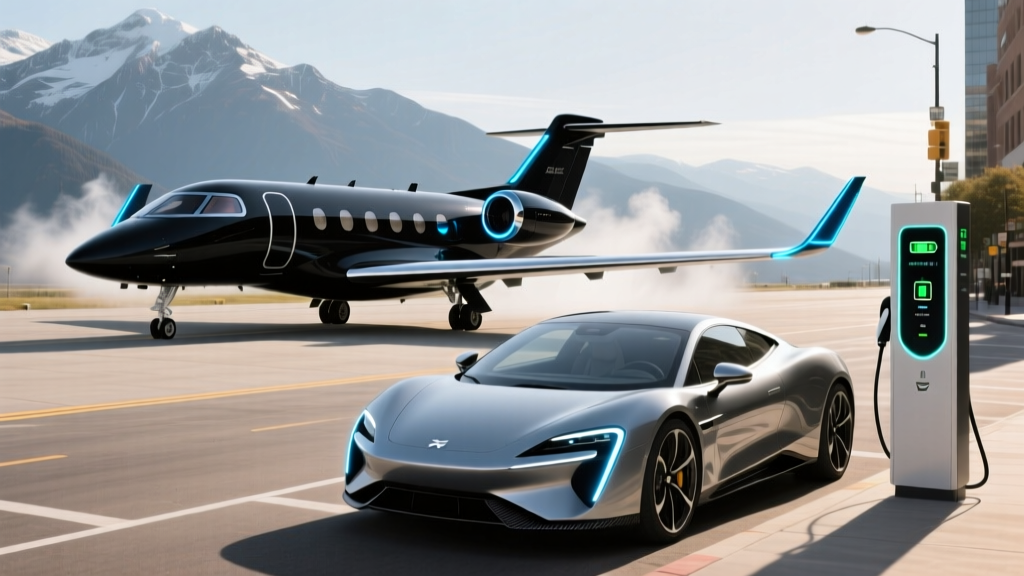
As of 2026, no fully electric private jet is commercially available for purchase or charter. Companies like Heart Aerospace (ES-30), Eviation (Alice), and Beta Technologies (Alia) are in certification testing, targeting regional flights of 200–475 miles with 9–30 passengers, but FAA type certification remains pending. If you're researching "electric private jet" because you're exploring electrified transport options, the practical electrified vehicle you can buy today is a battery-electric car, SUV, or truck — with EPA ranges up to 402 miles, home charging from $500–$2,500 to install, and federal tax credits up to $7,500 under IRS §30D rules.
Why "Electric Private Jet" Searches Are Surging
Searches for electric private jets spiked after high-profile announcements from eVTOL (electric vertical takeoff and landing) companies and electric aircraft startups. Joby Aviation, Archer Aviation, and Beta Technologies have flown prototype aircraft, while Eviation's Alice completed test flights. Headlines promise silent, zero-direct-emission regional air travel. But the gap between prototype flight and certified, purchasable aircraft is enormous — typically 5–10 years in aviation, governed by FAA type certification processes far more rigorous than automotive NHTSA standards.
For ground-level buyers, this matters because the search intent often overlaps: people exploring electric aviation are the same research-heavy, spec-driven shoppers evaluating whether to buy a Tesla Model Y, Ford F-150 Lightning, or Hyundai Ioniq 5. The comparison is worth making concrete.
Electric Aircraft vs. Electric Cars: The Numbers That Matter
| Specification | Electric Aircraft (Announced/Prototype) | Electric Car (Available 2026) | Gas Car (Baseline) |
|---|---|---|---|
| Availability | Not certified for sale | ~80 models on sale | ~300+ models |
| Range | 200–475 mi (projected) | 114–402 mi (EPA) | 350–600 mi |
| Energy capacity | ~600–820 kWh (estimated) | 50–131 kWh (usable) | 12–26 gal tank |
| "Refuel" time | 30–60 min (projected DC) | 15–35 min (10–80% DC fast) | 3–5 min |
| Passenger capacity | 2–30 (varies by concept) | 2–8 | 2–8 |
| Purchase price | $4M–$12M+ (projected) | $29,000–$135,000 MSRP | $22,000–$90,000 |
| Certification body | FAA (pending) | NHTSA / EPA | NHTSA / EPA |
The energy-density gap is the core engineering challenge. Jet-A fuel contains roughly 12,000 Wh/kg of usable energy; the best current lithium-ion EV battery packs achieve around 250–280 Wh/kg at the cell level, and closer to 160–180 Wh/kg at the pack level when you include cooling, structure, and BMS. That ~70:1 ratio is why electric aircraft remain limited to short regional hops, while electric cars can credibly replace gas vehicles for most daily driving.
Real Costs: What Electrified Transport Actually Costs in 2026
If you're budgeting for an EV purchase — the electrified vehicle you can actually drive — here's what the numbers look like for a mainstream midsize electric SUV compared to its gas counterpart.
| Cost Category (5-Year) | 2026 EV SUV (e.g., Tesla Model Y LR AWD) | 2026 Gas SUV (e.g., Toyota RAV4 AWD) |
|---|---|---|
| MSRP / Purchase price | $46,630 | $32,500 |
| Federal tax credit (§30D) | Up to $7,500 (if eligible) | $0 |
| Effective purchase | ~$39,130 | $32,500 |
| Energy/fuel (75,000 mi) | $3,375 (home L2 @ $0.15/kWh) | $9,375 ($3.50/gal @ 28 MPG) |
| Maintenance | ~$1,800 | ~$3,500 |
| Insurance (avg) | ~$11,500 | ~$8,750 |
| Home charger install | $1,200–$2,500 | $0 |
| 5-Year Total Cost | ~$57,005–$58,305 | ~$54,125 |
EVs generally win on energy and maintenance costs but lose on insurance premiums (averaging 15–25% higher due to repair costs and battery replacement risk) and higher upfront price. The break-even point depends heavily on your local electricity rate, annual mileage, and whether you qualify for the federal credit. Per IRS §30D guidelines, eligibility requires meeting adjusted gross income caps ($150K single / $300K joint), vehicle MSRP caps ($55K cars / $80K SUVs and trucks), and critical-mineral and battery-component sourcing thresholds that tighten annually.
First-Time EV Buyer: What Actually Matters
If your interest in electric private jets led you here, and you're now considering a ground-level EV for the first time, these are the decisions that determine whether ownership works.
Home Charging Access
Roughly 80% of EV charging happens at home. A Level 2 (240V) home charger adds 25–44 miles of range per hour of charging (typically 7.2–11.5 kW), meaning an overnight session fully replenishes most EVs. Installation costs range from $500 (simple outlet near panel) to $2,500+ (long wire run, panel upgrade to 200A). If you live in an apartment or lack off-street parking, public DC fast charging becomes your primary strategy — viable but more expensive ($0.35–$0.55/kWh at networks like Electrify America or EVgo) and time-consuming.
Real-World Range vs. EPA Sticker
EPA range estimates assume a mix of city and highway driving at moderate temperatures. In practice:
- Highway-only at 75 mph: Expect 85–90% of EPA range
- Cold weather (below 32°F): Expect 65–80% of EPA range, depending on whether the vehicle has a heat pump
- City/regenerative driving: Often exceeds EPA by 5–10%
A vehicle rated at 310 miles EPA may deliver 250–270 miles on a cold-weather highway trip. Plan charging stops around 200-mile intervals for comfort.
DC Fast Charging Realities
Manufacturers advertise peak charge rates (e.g., "up to 250 kW"), but that peak is sustained for only a portion of the session. The charge curve tapers significantly above 80% state of charge (SoC) to protect battery chemistry. A realistic 10–80% session at a 350 kW-capable vehicle on a 350 kW charger takes 18–25 minutes. Charging from 80–100% can take as long as the 10–80% session. This is why road-trip strategy targets 80% tops.
Common EV Misconceptions — Corrected With Data
| Myth | Fact |
|---|---|
| "EV batteries need replacing every 5 years" | Federal law mandates 8-year/100,000-mile battery warranties. Data from fueleconomy.gov and fleet studies show most EVs retain 85–92% capacity at 150,000 miles. Replacement, if needed, costs $8,000–$20,000 depending on pack size. |
| "EVs are worse in cold weather" | Range drops 20–35% in freezing temps, but EVs start instantly (no cold cranking), and preconditioning while plugged in mitigates range loss. Heat pumps (standard on Hyundai, Tesla, and others) recover 10–15% efficiency vs. resistive heaters. |
| "The grid can't support EVs" | Most EVs charge overnight during off-peak hours. DOE estimates that even at 50% EV adoption, grid upgrades would be gradual and manageable. Home charging at 7–11 kW draws less than an electric dryer. |
| "EVs are always cheaper to own" | Not always. Higher insurance, faster tire wear (due to weight and instant torque), and higher upfront cost mean savings depend on mileage, electricity rates, and credit eligibility. Low-mileage drivers may not break even. |
| "Electric private jets are available now" | No electric aircraft has received FAA type certification for commercial sale as of 2026. All current offerings are prototypes or in testing. |
Decision Framework: Should You Buy an EV in 2026?
Buy a battery-electric vehicle (BEV) if:
- You have reliable home charging (garage, driveway, or workplace Level 2)
- Your daily driving is under 100 miles round-trip (covers 90%+ of US commutes)
- You qualify for the §30D federal tax credit or your state offers EV rebates
- You want the lowest per-mile energy cost ($0.04–$0.06/mile on home electricity vs. $0.12–$0.16/mile on gas)
- You take road trips 1–3 times per year and can plan DC fast-charging stops
Choose a plug-in hybrid (PHEV) if:
- You lack home charging but want some electric-only driving (20–45 miles EPA electric range)
- You frequently drive 300+ miles in areas with sparse charging infrastructure
- You want EV-like city driving without range anxiety on rural or long trips
Stick with a gas or conventional hybrid (HEV) if:
- You live in an apartment with no charging access and no workplace charging
- You regularly tow heavy loads over long distances (EV towing cuts range 40–50%)
- Your annual mileage is under 8,000 miles, making fuel savings negligible against the EV price premium
What About Electric Aviation — Should You Wait?
If you're a private pilot or charter customer genuinely interested in electric aircraft, the timeline is realistic but long. The most promising near-term candidates:
- Heart Aerospace ES-30: 30-seat hybrid-electric regional airliner targeting 2028 entry into service, ~200 km (124 mi) electric range
- Eviation Alice: 9-passenger, projected 250 nautical mile range, ~475 kWh battery, targeting mid-2020s certification
- Beta Technologies Alia: eVTOL cargo and passenger aircraft, in advanced FAA testing, targeting 2026–2027 limited operations
None of these replace the role of a ground-level EV for daily transportation. They're aimed at regional air taxi and cargo routes — not personal ownership. For the foreseeable future, if you want to drive electric, you're buying a car, truck, or SUV.
Frequently Asked Questions
Can I buy an electric private jet in 2026?
No. No fully electric private jet or eVTOL has received FAA type certification for commercial sale or charter as of 2026. Several are in flight testing, but certification timelines typically run 3–7 years from first flight.
How much would an electric private jet cost?
Projected prices for electric aircraft range from $4 million (small eVTOL air taxis) to $12 million+ (regional turboprop replacements like the Eviation Alice). These are manufacturer estimates, not confirmed retail prices.
What electric vehicle should I buy instead?
For most buyers, the best 2026 EVs balance range, charging speed, and price: the Tesla Model Y Long Range (320 mi EPA, ~$46,630), Hyundai Ioniq 5 (310 mi, ~$43,000), and Chevrolet Equinox EV (319 mi, ~$33,000) lead their segments. Check fueleconomy.gov for full EPA ratings.
Do EVs qualify for a $7,500 tax credit?
Some do, but eligibility under IRS §30D depends on your income (under $150K single / $300K joint), the vehicle's MSRP (under $55K for cars, $80K for SUVs/trucks), and whether the battery meets critical-mineral and component-sourcing thresholds. Rules tighten annually. Consult a tax professional and verify on irs.gov before purchasing.
Is it cheaper to charge an EV at home or fuel a gas car?
Home charging is almost always cheaper. At the US average of $0.16/kWh and an EV efficiency of 3.5 mi/kWh, your cost is roughly $0.046/mile. A gas car averaging 28 MPG at $3.50/gallon costs about $0.125/mile — nearly 3× more per mile.