Quick Answer: What Is an Electric Motor for Car Use?
An electric motor for car propulsion converts electrical energy stored in a lithium-ion battery pack into rotational mechanical energy that turns the wheels. Unlike a gasoline engine, which burns fuel to create controlled explosions that drive pistons, an EV motor uses electromagnetic fields generated by passing current through copper windings and permanent magnets. The result is instant torque from 0 RPM, fewer than 20 moving parts (versus hundreds in an internal combustion engine), and energy conversion efficiency of roughly 85–95%, compared to about 20–35% for a gas engine.
As of the 2026 model year, most mainstream EVs use either a permanent magnet synchronous motor (PMSM) for efficiency or an AC induction motor for durability and high-power output. Many all-wheel-drive models pair one of each — a PMSM on the rear axle and an induction motor up front — to balance range with performance.
How an Electric Motor for Car Propulsion Actually Works
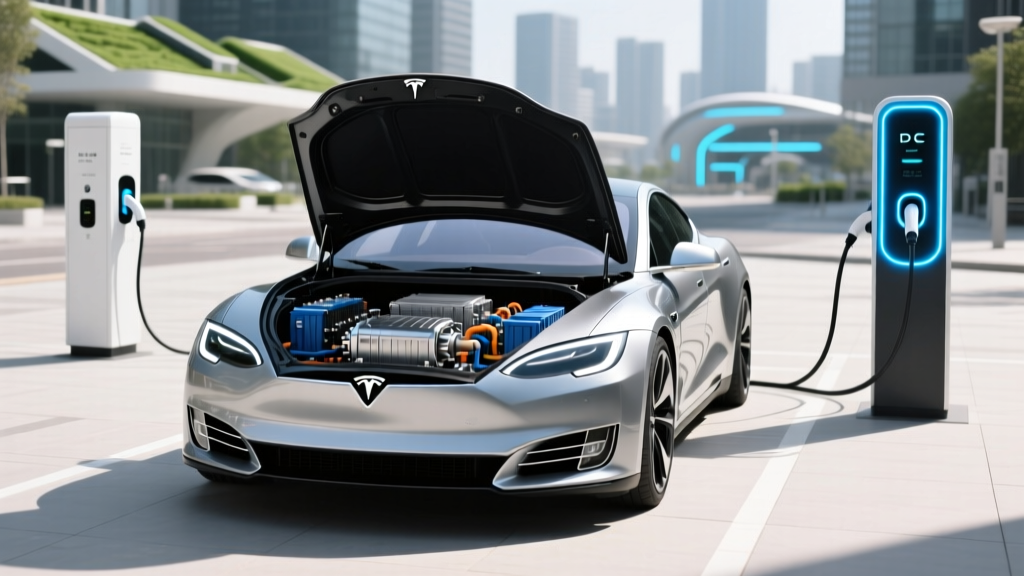
The physics is straightforward: when the inverter draws DC power from the battery and converts it to AC, the stator (the stationary outer ring of the motor) creates a rotating magnetic field. That field pulls the rotor — either embedded permanent magnets or a copper-caged core — into rotation. The rotor connects to a single-speed reduction gear (typically around 10:1 ratio), which multiplies torque and feeds it through a differential to the drive wheels.
There is no multi-speed transmission. No clutch, no torque converter, no gear hunting. The motor's wide power band — often spanning 0 to 15,000+ RPM — means a single fixed gear handles everything from launch to highway speed. This mechanical simplicity is why EVs require no transmission fluid changes, no spark plugs, and no timing belts.
Regenerative braking reverses the process: the motor becomes a generator, converting kinetic energy back into electrical energy and feeding it into the battery. In practice, this recovers roughly 15–30% of energy in stop-and-go driving, according to fueleconomy.gov, and dramatically reduces wear on the friction brake pads.
Motor Types: PMSM vs. AC Induction vs. Emerging Tech
| Motor Type | Efficiency | Torque Characteristic | Rare-Earth Dependency | Common Examples (2026) |
|---|---|---|---|---|
| Permanent Magnet Synchronous (PMSM) | ~93–96% | High torque at low RPM, excellent part-load efficiency | Yes (neodymium magnets) | Hyundai Ioniq 5, Tesla Model 3 RWD, BMW i4 |
| AC Induction Motor | ~88–92% | Strong peak power, can freewheel with zero drag | No rare earths needed | Tesla Model S (front), older Model Y AWD (front) |
| Externally Excited Synchronous (EESM) | ~91–94% | Good efficiency, magnet-free | None (uses copper rotor winding) | BMW iX, some Renault/Nissan models |
| Axial-Flux (emerging) | ~95%+ | Extremely high torque density, compact | Yes (magnets) | Mercedes-AMG EQS (Yasa), limited production |
For most buyers, the motor type matters less than the system-level output: total horsepower, torque, and how the thermal management system sustains power under repeated acceleration or long highway climbs.
EV vs. Gas Car: Cost and Performance Comparison
Here is how a representative 2026 EV stacks up against a comparable gasoline sedan over five years and 75,000 miles of ownership. We are comparing a Tesla Model 3 Long Range AWD ($42,490 MSRP, 341 mi EPA range, 130 MPGe combined) with a Toyota Camry LE ($28,490 MSRP, 32 MPG combined).
| Cost Category | 2026 Tesla Model 3 LR AWD | 2026 Toyota Camry LE (Gas) |
|---|---|---|
| Base MSRP | $42,490 | $28,490 |
| Federal Tax Credit (§30D, if eligible) | −$7,500 (point-of-sale transfer) | $0 |
| Effective Purchase Price | $34,990 | $28,490 |
| Fuel/Energy (75,000 mi) | $3,750 (home L2 at $0.13/kWh avg) | $8,438 (32 MPG at $3.60/gal) |
| Maintenance (5 yr) | ~$1,200 (cabin filter, wipers, tire rotation, brake fluid) | ~$3,500 (oil changes, filters, spark plugs, transmission fluid) |
| Insurance (5 yr avg) | ~$10,500 | ~$7,800 |
| Estimated Depreciation (5 yr) | ~$16,000 | ~$12,500 |
| Total 5-Year Cost of Ownership | ~$66,440 | ~$60,728 |
Sources: fueleconomy.gov, IRS §30D. Tax credit eligibility depends on buyer income caps ($150K single / $300K joint AGI), vehicle MSRP caps ($55K sedans), and battery critical-mineral sourcing requirements. Consult a tax professional.
The EV costs more upfront and carries higher insurance premiums, but the $4,688 fuel savings and $2,300 maintenance savings narrow the gap significantly. If electricity rates are lower (e.g., $0.08/kWh in some utility territories) or if you drive more than 15,000 miles per year, the EV often breaks even or wins outright before year five.
Real-World Range, Efficiency, and What the Motor Delivers
The electric motor's efficiency is only part of the equation. Real-world range depends on battery capacity (kWh), vehicle weight, aerodynamics, tire rolling resistance, ambient temperature, and driving style. Here is what to expect from popular 2026 models:
| Model | Battery (kWh usable) | Motor Power | EPA Range | Real-World Highway (est.) | Cold-Weather Loss |
|---|---|---|---|---|---|
| Tesla Model 3 LR AWD | 75 kWh (NMC) | 346 hp / 389 lb-ft | 341 mi | ~280–300 mi | −20 to −30% |
| Hyundai Ioniq 5 SEL AWD | 77.4 kWh (NMC) | 320 hp / 446 lb-ft | 290 mi | ~240–260 mi | −20 to −30% |
| Chevrolet Equinox EV RS | 85 kWh (NMC) | 288 hp / 355 lb-ft | 319 mi | ~265–285 mi | −20 to −30% |
| Ford Mustang Mach-E Premium AWD | 91 kWh (NMC) | 346 hp / 428 lb-ft | 312 mi | ~255–275 mi | −20 to −30% |
Key takeaways for a first-time EV buyer:
- EPA range is a blended cycle. Sustained 75 mph highway driving typically yields 15–20% fewer miles than the sticker.
- Cold weather is real. Below 30°F, battery chemistry slows and cabin heating draws power. Expect a 20–30% range hit in deep winter, partially mitigated by heat pumps (standard on most 2026 models listed above).
- Preconditioning matters. Warming the battery to its optimal 30–40°C window before DC fast charging can cut 10–80% charge times by 15–25%. Most EVs do this automatically when you navigate to a charger.
Charging Costs and Speeds: What the Motor's Energy Appetite Means for You
The motor does not consume energy at a constant rate. Highway driving at 75 mph might draw 25–30 kW continuously, while city driving with regenerative braking averages 15–18 kW. This directly affects your charging needs:
| Charging Level | Power (kW) | Miles Added per Hour | Best For | Typical Cost |
|---|---|---|---|---|
| Level 1 (120V household) | 1.0–1.4 kW | 3–5 mi/hr | Overnight top-up, low daily mileage | $0.10–0.18/kWh (residential rate) |
| Level 2 (240V home/public) | 7.2–11.5 kW | 25–44 mi/hr | Daily home charging, overnight full charge | $0.10–0.25/kWh |
| DC Fast Charging | 50–350 kW peak | 150–800+ mi/hr (peak) | Road trips, quick stops | $0.30–0.55/kWh (public network) |
A critical nuance: kW is the rate of energy flow (power); kWh is the total energy stored (capacity). A 350 kW DC fast charger can theoretically fill a 75 kWh battery in roughly 13 minutes — but only if the battery can accept that rate. In reality, charge curves taper sharply above 80% state of charge to protect cell health. A Tesla Model 3 LR at a V3 Supercharger (250 kW peak) typically goes 10–80% in about 25–28 minutes, then slows dramatically for the final 20%.
For most owners, Level 2 home charging is the economic sweet spot. A full overnight charge of a 75 kWh battery at $0.13/kWh costs roughly $9.75 and adds ~300 miles of range — versus $33–$40 to fill a gas car's 14-gallon tank for ~400 miles.
Common Misconceptions About Electric Motors and EVs
| Myth | Fact |
|---|---|
| "EV motors wear out quickly." | Electric motors have fewer than 20 moving parts and no combustion stress. Most manufacturers warranty the motor and battery for 8 years / 100,000 miles. Real-world data from fleets shows motors lasting 300,000+ miles with minimal degradation. |
| "Battery replacement will cost $20,000 and you will need it in 5 years." | Modern NMC and LFP batteries are engineered for 1,000–2,000+ full charge cycles with 70–80% capacity retention. Most EVs lose only 8–12% capacity over 100,000 miles. Full pack replacement is rare and typically covered under warranty if capacity drops below 70% within the warranty period. |
| "EVs are worse for the environment because of battery mining." | Lifecycle analyses by the ICCT and Argonne National Laboratory show EVs produce 50–70% fewer greenhouse gas emissions over their lifetime compared to equivalent gas cars, even when accounting for battery manufacturing and grid electricity mix. The gap widens as grids decarbonize. |
| "You cannot drive an EV in cold weather." | You can — but range drops 20–30% in sub-freezing temperatures. Preconditioning, heat pumps, and seat/steering-wheel heaters (which use far less energy than cabin air heating) mitigate the loss. Planning for shorter winter range is essential. |
| "All EVs qualify for the $7,500 federal tax credit." | As of 2026, IRS §30D rules require the vehicle to meet MSRP caps ($55K for sedans, $80K for SUVs/trucks), buyer income limits, and strict battery critical-mineral and component sourcing thresholds. Many models qualify for a partial credit ($3,750) or none at all. Always verify on the IRS clean vehicle credit list before purchasing. |
Decision Framework: Is an EV With an Electric Motor Right for You?
Choose an EV if:
- You have access to Level 2 home charging (garage or driveway with a 240V outlet) or reliable workplace charging.
- Your daily commute is under 80 miles round-trip, and you take road trips fewer than 6 times per year.
- You want to minimize ongoing fuel and maintenance costs and plan to keep the vehicle 5+ years.
- You live in a region with moderate winters, or you are willing to plan around 20–30% cold-weather range loss.
- You qualify for the full or partial §30D federal tax credit based on income and vehicle eligibility.
Choose a PHEV (plug-in hybrid) if:
- You want 30–45 miles of electric-only range for daily commuting but need the gas engine for frequent long road trips.
- Home charging is available but you regularly drive 300+ miles in a single day.
- Example: Toyota RAV4 Prime (42 mi EV range, 38 MPG combined on gas, ~$43,695 MSRP).
Stick with a gas or conventional hybrid if:
- You have no reliable access to home or workplace charging and public DC fast-charger infrastructure in your area is sparse.
- Your budget is under $28,000 and you need a new vehicle (the most affordable new EVs start around $28,000–$30,000 before credits).
- You frequently tow heavy loads (>5,000 lbs) in hot climates, where EV range under load can drop 40–50%.
First-Time EV Buyer Checklist
If you are seriously considering a vehicle with an electric motor, work through this list before visiting a dealer:
- Audit your charging access. Do you have a garage or driveway where a Level 2 (240V / 40–48A) charger can be installed? Expect $500–$2,500 for installation depending on panel capacity and run length. A licensed electrician should assess your panel — a 200-amp service is ideal; older 100-amp panels may need a $1,500–$3,000 upgrade.
- Calculate your real daily mileage. Per the FHWA, the average American drives ~37 miles per day. If that sounds like you, even a modest-range EV (250 mi EPA) will require charging only 2–3 times per week at home.
- Check tax credit eligibility. Use the IRS clean vehicle credit lookup tool to confirm whether the specific model and trim you want qualifies for the full $7,500, partial $3,750, or no credit. Remember the income caps: $150,000 single, $225,000 head of household, $300,000 joint.
- Get insurance quotes before buying. EV insurance premiums run 15–25% higher than equivalent gas cars, according to industry data, due to higher repair costs and parts pricing. Shop at least three insurers.
- Test-drive in conditions you will actually experience. If you live in a cold climate, test in winter if possible. Pay attention to one-pedal driving feel (regen strength), cabin heating speed, and infotariat usability with gloved hands.
- Understand the warranty. Federal law mandates a minimum 8-year / 100,000-mile warranty on EV battery packs and electric motors for emissions-related compliance. Some manufacturers extend this to 10 years. The warranty typically guarantees 70% capacity retention — not a replacement for normal degradation.
Frequently Asked Questions
How long does an electric motor in a car last?
Electric motors routinely outlast the vehicles they power. With no combustion, no oil contamination, and minimal friction, the primary wear items are the bearings and the cooling system. Fleet data from high-mileage Teslas and commercial EVs shows motors operating beyond 300,000 miles without major service. The battery pack — not the motor — is the component that degrades over time.
Can you replace a gas car's engine with an electric motor?
Technically, yes — EV conversion kits exist and shops perform them. However, a professional conversion typically costs $20,000–$50,000+, requires custom fabrication, and the result will not meet modern crash-safety or emissions certification standards. For most buyers, purchasing a purpose-built EV is far more practical, safer, and eligible for warranties and tax credits that conversions are not.
Do electric motors lose power over time?
The motor itself does not meaningfully lose output. What changes is the battery's ability to deliver peak current as it ages and its internal resistance increases. After 100,000 miles, you might notice slightly slower DC fast-charge speeds and a modest reduction in peak acceleration — but the motor's horsepower rating remains the same. It is the battery, not the motor, that defines an EV's aging curve.
Is an electric motor more efficient than a gas engine?
Yes, by a large margin. Electric motors convert 85–95% of electrical energy into mechanical motion. Gasoline engines convert only 20–35% of fuel energy into motion — the rest is lost as heat, friction, and exhaust. This is why an EV rated at 130 MPGe can travel further on $10 of energy than a 32 MPG gas car can on $10 of gasoline.
What maintenance does an electric motor require?
Essentially none beyond the vehicle's regular service schedule. There are no oil changes, no spark plugs, no timing belts, no exhaust system, and no transmission fluid. Typical EV maintenance over 5 years includes cabin air filter replacement ($30–$60 every 2 years), brake fluid flush ($80–$120 every 2–3 years), tire rotation ($20–$40 every 7,500 miles), and windshield washer fluid. Friction brake pads often last 100,000+ miles thanks to regenerative braking handling most deceleration.