The Quick Answer: What Do Electric Miles Really Cost?
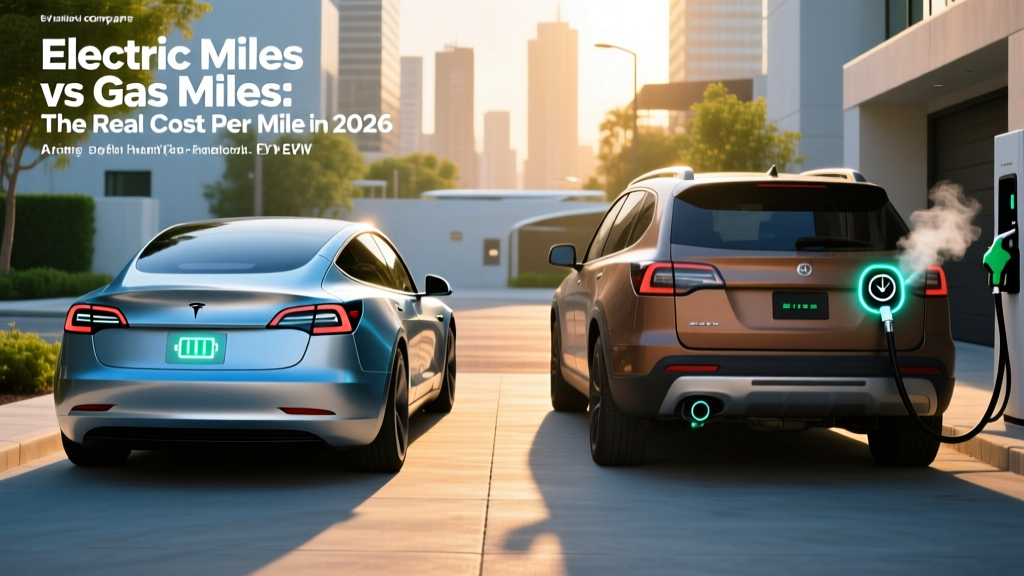
Electric miles cost an average of $0.04 to $0.06 per mile when charging at home on a national average electricity rate of $0.17/kWh, compared to $0.12 to $0.16 per mile for a comparable gas car averaging 28 MPG at $3.40/gallon. That's a per-mile savings of roughly 50–65% on energy alone. However, the full picture depends on your local electricity rate, whether you have access to home charging, your driving patterns, and the specific EV's efficiency (measured in kWh/100 miles). Over five years and 75,000 miles, the energy savings alone can total $4,500 to $7,500 — but upfront purchase price, insurance premiums, and depreciation can offset some or all of that gain depending on the model.
Breaking Down the Cost of an Electric Mile
The phrase "electric miles" gets thrown around in EV marketing, but what it really means to your wallet comes down to a simple calculation: how many kilowatt-hours (kWh) of energy does the vehicle consume per mile, and what does each kWh cost you?
Here's the formula:
Cost per electric mile = (kWh/100 miles ÷ 100) × your electricity rate per kWh
Let's apply this to three popular 2026 EVs with very different efficiency profiles:
| Vehicle | Efficiency (kWh/100mi) | EPA Range | Cost/Mile (Home) | Cost/Mile (Public DC Avg $0.48/kWh) |
|---|---|---|---|---|
| 2026 Tesla Model 3 RWD | 25 | 272 mi | $0.043 | $0.120 |
| 2026 Hyundai Ioniq 5 SEL AWD | 30 | 290 mi | $0.051 | $0.144 |
| 2026 Ford F-150 Lightning XLT | 47 | 240 mi | $0.080 | $0.226 |
The efficiency gap matters enormously. The Model 3 sips electrons while the F-150 Lightning gulps them — the truck costs nearly twice as much per electric mile as the sedan, even on the same electricity plan. And if you're relying exclusively on public DC fast charging (averaging around $0.48/kWh nationally in 2026, per NREL data), your cost per mile roughly triples.
This is the single biggest misconception about electric miles: they are not universally cheap. The savings depend entirely on where and how you charge.
Electric Miles vs Gas Miles: Head-to-Head Comparison
Let's put electric miles up against gas miles using a concrete scenario: 15,000 miles of annual driving split 55% city / 45% highway, which mirrors the EPA's combined driving cycle.
| Vehicle | Powertrain | Efficiency | Annual Energy Cost | Cost/Mile |
|---|---|---|---|---|
| 2026 Tesla Model 3 RWD | BEV | 25 kWh/100mi | $638 (home) / $1,800 (public DC) | $0.043 / $0.120 |
| 2026 Toyota Camry LE | Gas | 28 MPG combined | $1,821 | $0.121 |
| 2026 Toyota Camry Hybrid LE | HEV | 52 MPG combined | $981 | $0.065 |
| 2026 Toyota RAV4 Prime | PHEV | 42 mi electric + 38 MPG gas | ~$780* | ~$0.052* |
*RAV4 Prime assumes 70% of miles driven on electricity (home charging) and 30% on gas. Your ratio will vary based on commute length and charging habits.
The data reveals something important: a hybrid like the Camry HEV at $0.065/mile is competitive with an EV charged on public DC fast chargers at $0.120/mile. The EV's per-mile advantage is massive when you charge at home, but it shrinks considerably — or even reverses — if you're dependent on paid public charging infrastructure.
For a direct comparison of the EV and gas baselines: the Model 3 on home charging saves $1,183 per year over the gas Camry. Over five years, that's $5,915 in energy savings alone. But let's not stop at energy costs.
The Full Cost Picture: Purchase, Insurance, Maintenance, and Depreciation
Electric miles are only one line item. Here's a five-year total cost of ownership (TCO) estimate for the same vehicles, assuming 75,000 total miles, home charging for the EV, and current market conditions:
| Cost Category | Tesla Model 3 RWD | Toyota Camry LE (Gas) | Toyota Camry Hybrid LE |
|---|---|---|---|
| Base MSRP | $38,990 | $28,495 | $30,495 |
| Federal Tax Credit (§30D) | –$3,750 to –$7,500* | $0 | $0 |
| Effective Purchase Price | ~$31,490–$35,240 | $28,495 | $30,495 |
| 5-Year Energy/Fuel | $3,188 (home) | $9,107 | $4,904 |
| 5-Year Maintenance | ~$1,800 | ~$3,600 | ~$3,400 |
| 5-Year Insurance (avg) | ~$10,500 | ~$7,500 | ~$7,800 |
| Estimated 5-Year Depreciation | ~$14,000 | ~$10,500 | ~$10,800 |
| Estimated 5-Year TCO | ~$50,978–$54,728 | ~$59,202 | ~$57,399 |
*§30D credit eligibility depends on buyer income caps ($150K single / $300K joint), vehicle MSRP caps ($55K sedans), battery critical-mineral and component sourcing requirements, and manufacturer compliance. The credit can be transferred to the dealer as a point-of-sale discount under current IRS rules. Verify your eligibility with a tax professional.
Key takeaways from this breakdown:
- Maintenance savings are real but modest. EVs skip oil changes, transmission fluid, spark plugs, and exhaust repairs. Expect to save roughly $1,500–$2,000 over five years. But tires wear faster on EVs due to instant torque and heavier curb weight — budget for one extra tire rotation or replacement set.
- Insurance is the hidden cost. EVs cost 15–30% more to insure on average due to higher repair costs and specialized parts. The Model 3 is one of the better-rated EVs for insurance, but it still runs roughly $500–$600/year more than the Camry.
- Depreciation is the wild card. EV depreciation has been volatile. Tesla's price cuts in 2023–2024 hammered resale values across the EV market. By 2026, depreciation has stabilized somewhat, but EVs still lose a higher percentage of value than Toyota sedans in most segments. This single factor can erase your energy savings if you plan to sell after 3–4 years.
Real-World Factors That Change Your Electric Mile Cost
Sticker numbers assume ideal conditions. Here's what actually moves the needle on your cost per electric mile:
Home Charging Access
If you can install a Level 2 home charger (240V, 32–48 amps, delivering 7.7–11.5 kW), you'll do 85–95% of your charging at home at residential electricity rates. A Level 2 installation typically costs $800–$2,500 including equipment and electrician labor, assuming your electrical panel has sufficient capacity. If you need a panel upgrade from 100A to 200A service, add $1,500–$3,500. This upfront investment pays for itself within 1–3 years through energy savings versus public charging.
If you live in an apartment or lack dedicated parking, you'll rely on public Level 2 and DC fast chargers. At $0.35–$0.55/kWh for public DC charging, your cost per electric mile jumps to $0.09–$0.16 — erasing much of the advantage over gas. This is the single biggest ownership variable.
Climate and Seasonal Range Loss
Cold weather reduces battery efficiency and available range. In sustained temperatures below 25°F, expect 15–30% range reduction depending on whether the vehicle has a heat pump (which helps significantly). A Model 3 rated at 272 miles EPA may deliver 190–230 miles in a Minnesota January. This means more frequent charging sessions and slightly higher cost per mile in winter months.
Hot climates have a smaller but still measurable impact — aggressive air conditioning use in 100°F+ heat can reduce range by 5–15%. Battery degradation also accelerates in consistently hot climates, potentially affecting long-term capacity.
Driving Patterns
EVs are most efficient in stop-and-go city driving, where regenerative braking recovers energy that a gas car wastes as heat. Highway driving at 75+ mph is where EVs lose their efficiency advantage — aerodynamic drag hits all vehicles, but EVs don't get the regenerative benefit on open roads. If your commute is 90% highway miles at 80 mph, expect real-world efficiency to be 10–20% worse than the EPA combined figure.
Common Misconceptions About Electric Miles
| Myth | Fact |
|---|---|
| "Electric miles are always cheaper than gas." | Only if you charge at home or at low-cost workplace/solar charging. Exclusive public DC fast charging at $0.48+/kWh can match or exceed gas per-mile costs for efficient vehicles. |
| "EVs cost nothing to maintain." | Maintenance is lower — no oil changes, fewer fluid swaps — but tires wear 20–30% faster due to weight and torque, cabin air filters still need replacement, and brake calipers can seize from lack of use (regen does most braking). |
| "The battery will need expensive replacement." | Modern LFP and NMC batteries are warrantied for 8 years/100,000 miles with a minimum 70% capacity retention threshold. Data from Recurrent Auto shows most 2020+ EVs lose only 5–10% capacity over 100K miles. Full replacements are rare and typically covered under warranty during the coverage period. |
| "You'll save $10,000+ over gas in five years." | Possible if you drive high miles, charge cheaply at home, and the EV holds value. But higher insurance ($2,500–$3,000 more over 5 years), steeper depreciation on some models, and upfront price premiums can cut savings to $2,000–$4,000 — or result in a net loss if you sell early. |
| "Any EV will work for any driver." | If you regularly drive 300+ miles in cold weather, tow heavy loads, or lack home charging, a PHEV or efficient hybrid may deliver lower total cost and less hassle than a BEV. |
EV vs Hybrid vs Gas: Which Powertrain Fits Your Miles?
Not every driver benefits equally from electric miles. Here's a practical decision framework based on your situation:
Choose a Battery EV (BEV) If:
- You have reliable home or workplace Level 2 charging
- Your daily driving is under 200 miles round-trip
- You live in a moderate climate or choose a model with a heat pump
- You plan to keep the vehicle 5+ years (to recoup the upfront premium through energy and maintenance savings)
- You qualify for the §30D federal tax credit or state incentives, reducing the effective purchase price
Choose a Plug-In Hybrid (PHEV) If:
- You have home charging but also take frequent 300+ mile road trips
- You want 30–42 miles of electric-only commuting with a gas backup for longer drives
- You live in a cold climate where BEV range loss would be disruptive
- You're not ready to rely on public charging infrastructure for road trips
Choose a Standard Hybrid (HEV) If:
- You have no access to home or workplace charging
- You want maximum fuel efficiency without any behavior change (no plugging in)
- Your budget prioritizes low purchase price and strong resale value
- You drive high annual miles in mixed conditions where a 50+ MPG hybrid shines
Stick With Gas (for now) If:
- You tow frequently (towing crushes EV range — expect 40–60% reduction)
- You live in a charging desert with minimal public infrastructure
- Your annual mileage is under 8,000 miles (energy savings are too small to offset the EV premium)
What First-Time EV Buyers Should Know Before Counting Electric Miles
If you're seriously considering an EV, here's a practical checklist grounded in real ownership experience:
- Audit your charging access first. Before picking a model, confirm you can charge at home or work. If you're installing a Level 2 charger, get a quote from a licensed electrician that includes a panel capacity assessment. A 200-amp panel with open breaker slots is the ideal scenario. A 100-amp panel may require a costly upgrade.
- Calculate your actual electricity rate. Check your utility bill for the per-kWh cost — national average is ~$0.17, but rates range from $0.10/kWh in parts of the South to $0.30+/kWh in California and the Northeast. Some utilities offer time-of-use (TOU) plans with off-peak rates as low as $0.06–$0.08/kWh overnight, which dramatically lowers your cost per electric mile.
- Test-drive in conditions you'll actually face. If you commute in winter, test the EV in cold weather with the heater running. If you take highway road trips, do a 70+ mph loop and watch the efficiency readout. EPA range numbers are based on moderate conditions — your reality may differ by 15–25%.
- Understand the charging curve. DC fast charging speed is not constant. A vehicle that advertises "250 kW peak charging" may only sustain that rate between 10–40% state of charge, then taper to 100 kW, then 50 kW above 80%. A 10–80% charge time is the most useful real-world metric. For example, the 2026 Ioniq 5 peaks at 240 kW and charges 10–80% in approximately 18 minutes under ideal conditions — but cold battery temperatures or a high state of charge can double that time.
- Get insurance quotes before you buy. Call your insurer with the specific VIN or trim. EV insurance varies wildly — some carriers surcharge heavily, while others (like Tesla Insurance in eligible states) offer competitive rates tied to real-time driving data.
- Verify tax credit eligibility before relying on it. The §30D credit has MSRP caps ($55,000 for sedans, $80,000 for SUVs/trucks/vans), buyer income caps ($150K single / $300K joint AGI), and evolving battery sourcing requirements. A vehicle that qualified in 2025 may not qualify in 2026 if its battery supply chain changed. Check the fueleconomy.gov tax credit lookup and consult a tax professional.
Frequently Asked Questions
How many electric miles can I get from a full charge in real-world driving?
The EPA range sticker is a useful baseline, but plan for 80–90% of that number in mixed real-world driving. Highway-heavy routes at 75+ mph typically yield 75–85% of EPA range. Cold weather (below 25°F) can reduce range to 65–80% of the sticker. For a 2026 Tesla Model 3 RWD rated at 272 miles EPA, expect roughly 230–250 miles in moderate conditions, 200–220 on the highway, and 180–210 in freezing weather.
Is it cheaper to charge an EV at home or fill up a gas car?
Home charging is almost always cheaper per mile. At $0.17/kWh and 30 kWh/100mi efficiency, your cost is $0.051/mile. Gas at $3.40/gallon and 28 MPG is $0.121/mile — more than double. However, public DC fast charging at $0.48/kWh brings the EV cost to $0.144/mile, which is more expensive than the gas car. Your charging location determines whether electric miles save you money.
Do electric miles cost more in winter?
Yes. Cold batteries are less efficient, and cabin heating draws significant energy (unlike gas cars, which use waste engine heat). Expect 15–30% higher energy consumption in sustained cold weather, which raises your cost per mile proportionally. Preconditioning the battery while plugged in and using a heat pump-equipped EV can mitigate some of this loss.
How do electric miles compare to hybrid miles in cost?
A highly efficient hybrid like the Toyota Prius (57 MPG combined) costs about $0.060/mile at $3.40/gallon. An efficient EV like the Model 3 on home charging costs $0.043/mile — about 28% less. But a PHEV like the RAV4 Prime can split the difference: its first 42 miles are electric (roughly $0.04–$0.05/mile on home power), and remaining miles run on gas at about $0.089/mile (38 MPG). For short commutes with home charging, a PHEV's electric miles are just as cheap as a BEV's.
Will my EV battery last long enough to make electric miles worthwhile?
Current data is encouraging. Federal law mandates that EV batteries carry a warranty of at least 8 years/100,000 miles with a minimum capacity retention of 70% (though manufacturers set their own thresholds). Real-world data from Recurrent Auto and owner surveys show that most 2020+ EVs with modern thermal management systems retain 88–95% of original capacity after 100,000 miles. LFP (lithium iron phosphate) batteries, used in standard-range Tesla Model 3/Y and some other models, show even slower degradation. The battery is very likely to outlast your ownership period.
What's the cheapest way to maximize my electric miles?
Three strategies: (1) Enroll in your utility's time-of-use plan and schedule charging for off-peak overnight hours, when rates can drop to $0.06–$0.10/kWh. (2) Use free or subsidized workplace charging if available — this can reduce your effective energy cost to near zero for commuting miles. (3) Choose a more efficient EV — the difference between a 25 kWh/100mi sedan and a 47 kWh/100mi truck nearly doubles your per-mile cost, regardless of electricity rate.