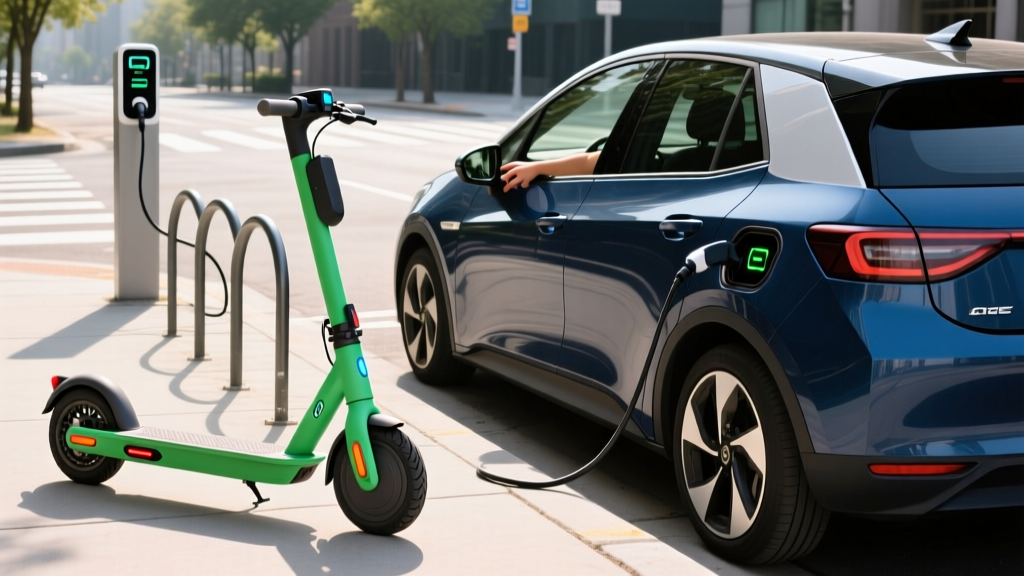
If you're searching for an electric kickscooter as a commute solution, here's the practical reality: a quality scooter (Segway Ninebot Max G3, NIU KQi3 Pro) costs $600–$1,200, delivers 18–28 miles of real-world range, and charges from a standard 120V outlet in 4–6 hours. It's unbeatable for last-mile trips under 5 miles. But if your daily commute exceeds 10 miles round-trip, involves highway speeds, or faces rain and winter weather, a budget EV like the 2026 Chevrolet Equinox EV ($33,400 MSRP, 319 miles EPA) is the safer, more versatile investment — even after factoring in insurance, registration, and home charging setup.
The Quick Verdict
Choose an electric kickscooter if: Your commute is under 5 miles each way, you have secure storage, you live in a mild climate, and you want sub-$1,000 entry cost.
Choose a budget EV if: You need all-weather capability, highway speeds, cargo space, passenger safety, or your round-trip exceeds 10 miles.
What an Electric Kickscooter Actually Delivers (Specs That Matter)
Let's ground this in real numbers. The premium electric kickscooter market in 2026 is dominated by a few proven models. Here's what you're actually buying:
| Model | Battery (Wh) | Claimed Range | Real-World Range | Top Speed | Charge Time (0–100%) | MSRP |
|---|---|---|---|---|---|---|
| Segway Ninebot Max G3 | 551 Wh (NMC) | 43 mi | 25–30 mi | 22 mph | 6 hours (120V) | $1,099 |
| NIU KQi3 Pro | 486 Wh (NMC) | 31 mi | 18–22 mi | 20 mph | 5 hours (120V) | $849 |
| Apollo Air 2026 | 600 Wh (NMC) | 37 mi | 22–27 mi | 22 mph | 5.5 hours | $1,199 |
Key takeaways for buyers:
- Real-world range is 50–70% of claimed range. Manufacturer tests use a 165-lb rider on flat ground at 12 mph. Add hills, headwinds, a heavier rider, or cold weather (below 50°F), and expect the lower end of the real-world figures above.
- Battery chemistry is NMC (nickel manganese cobalt) across the category — the same chemistry in most EVs. Expect 500–800 full charge cycles before capacity drops to 80%. That's roughly 3–5 years of daily commuting before noticeable range loss.
- No fast charging exists in this segment. You're limited to the integrated charger (typically 100–150W), drawing from a standard household outlet.
Electric Kickscooter vs. Budget EV: The Cost Breakdown
The most common question I get: "Should I spend $1,000 on a scooter or $33,000 on an EV?" The answer depends entirely on your commute profile. Here's a side-by-side 3-year ownership cost comparison, assuming a 6-mile daily round-trip commute (1,500 miles/year), 250 workdays annually:
| Cost Category | Premium E-Scooter (3 Years) | 2026 Chevy Equinox EV LT (3 Years) |
|---|---|---|
| Purchase Price | $1,099 | $33,400 |
| Federal Tax Credit (§30D) | $0 (not eligible) | Up to $7,500 (income/MSRP/sourcing rules apply) |
| Net Purchase Cost | $1,099 | ~$25,900 (if credit qualifies) |
| Energy Cost (4,500 mi total) | ~$45 (at $0.16/kWh) | ~$480 (at $0.16/kWh, 3.2 mi/kWh efficiency) |
| Insurance (3 years) | $0–$150 (renters add-on) | ~$4,800 ($1,600/yr avg EV insurance) |
| Maintenance (3 years) | ~$120 (tires, brake pads) | ~$450 (cabin filter, tire rotation, wipers) |
| Registration/DMV | $0 | ~$600 (varies by state) |
| 3-Year Total Cost | ~$1,264–$1,414 | ~$32,230 (or ~$24,730 w/ credit) |
The math is clear: For pure last-mile commuting under 5 miles each way, the scooter wins on cost by an enormous margin. But this comparison only works if the scooter can actually replace the car — and for most people, it can't.
Where the Kickscooter Falls Short: Weather, Safety, and Practical Limits
Here's what no scooter marketing will tell you:
Weather Reality
Most premium scooters carry an IP55 or IPX5 water resistance rating — meaning they survive light rain splashes but not sustained downpours or standing water. Riding in freezing temperatures (below 32°F) reduces NMC battery capacity by 20–30% and creates traction hazards on wet metal deck lids and painted road markings. If you live in a climate with real winters (Minneapolis, Chicago, Boston), your scooter is a 7-month vehicle at best.
Safety Data
According to the CDC's 2023 e-scooter injury surveillance report, emergency departments treated an estimated 47,380 e-scooter injuries between 2017–2022, with head injuries comprising 28% of cases. Unlike an EV's steel cage, crumple zones, airbags, and IIHS Top Safety Pick ratings, your protection on a scooter is a helmet and your reflexes.
Cargo and Passenger Limits
You cannot carry a week's groceries, a child seat, or a passenger on an electric kickscooter. If your commute involves daycare drop-off, hardware store runs, or carpooling, the scooter becomes supplementary transportation, not a car replacement.
The Decision Framework: Scooter, EV, or Both?
If Your Commute Is...
Under 3 miles each way, flat terrain, mild climate, secure storage at both ends:
→ Electric kickscooter. A $900 NIU KQi3 Pro or Segway Max G3 will handle this easily. You'll spend ~$15/year in electricity and save thousands versus any car.
3–10 miles each way, mixed terrain, four-season climate, or you need cargo/passenger capacity:
→ Budget EV. The 2026 Equinox EV (319 mi EPA, $33,400), Hyundai Kona Electric (261 mi EPA, $32,975), or Nissan LEAF (212 mi EPA, $28,140) offer all-weather safety, highway capability, and 10+ years of usable range.
Under 5 miles but you also need a car for weekend trips, family, or bad weather:
→ Both. A scooter for weekday commuting plus a used EV or PHEV for everything else is a highly practical combination. Many EV owners I know use a scooter for the office run and keep the EV for weekends and winter.
Over 15 miles each way or involves highway driving:
→ EV only. Scooters are illegal on most highways, limited to 20–25 mph top speed, and physically unsafe at car speeds. This isn't a scooter use case.
Common Misconceptions About Electric Kickscooters
| Myth | Fact |
|---|---|
| "I'll save $30,000 by choosing a scooter over an EV." | Only if the scooter fully replaces your car — meaning no passengers, no cargo, no bad weather, no highway trips. For most households, a scooter supplements a car rather than replacing it. |
| "E-scooters are zero-emission." | The electricity comes from your grid mix. If your utility is coal-heavy, the upstream emissions are real. That said, per-mile emissions are still far below any ICE vehicle due to the tiny energy draw (~15 Wh/mile). |
| "The battery will die in 2 years." | Quality NMC cells from Segway, NIU, or Apollo retain ~80% capacity after 500–800 full cycles. With daily partial charges (20–80% SoC), you can expect 4–6 years before replacement is needed. Replacement batteries cost $200–$400. |
| "I can ride it anywhere — bike lanes, sidewalks, roads." | Regulations vary wildly by state and city. Many jurisdictions ban sidewalk riding, require helmets for riders under 18, and cap speed at 15–20 mph. Check your local DOT rules before assuming legality. |
| "It charges as fast as an EV." | A scooter charges at ~100–150W (0.1–0.15 kW). An EV on Level 2 charges at 7.2–11.5 kW — roughly 50–100× faster in terms of power delivery. A scooter needs 4–6 hours from a wall outlet; an EV adds 200+ miles in that same window on Level 2. |
What First-Time Buyers Should Know Before Spending
1. Test the weight. Premium scooters weigh 40–55 lbs. If you need to carry it up three flights of stairs to your apartment every evening, that weight becomes a daily burden. Lighter models (under 30 lbs) sacrifice battery capacity and range.
2. Budget for a quality lock. E-scooter theft is rampant. A $60–$100 U-lock (Kryptonite New York or Abus Granit) is non-negotiable for street parking. If your workplace doesn't offer secure indoor storage, rethink the scooter plan.
3. Check your renters or homeowners insurance. Most policies don't cover e-scooters under standard terms. You may need a personal articles floater (~$100–$150/year) to cover theft or damage.
4. Tire type matters more than you think. Pneumatic (air-filled) tires offer far better ride quality and wet-weather grip than solid rubber, but require occasional inflation and are susceptible to flats. Tubeless pneumatic tires (found on the Segway Max G3 and Apollo Air) are the best compromise — puncture-resistant with good ride quality.
5. No federal incentives apply. Unlike EVs (which can qualify for the IRS §30D credit of up to $7,500, subject to MSRP caps, income limits, and battery sourcing rules), electric kickscooters are classified as consumer products and receive no federal tax credit. Some municipal transit agencies offer commuter e-scooter rebates — check your local transit authority.
Frequently Asked Questions
Can an electric kickscooter replace my car for commuting?
Only if your commute is under 5 miles each way, your climate is mild, you don't need to carry passengers or significant cargo, and you have secure storage at both ends. For most households, a scooter is a complement to a car (or EV), not a replacement. A practical test: try using rideshare or transit for one week on your scooter's "off days" (rain, extreme cold, heavy errands). If that's workable and affordable, a scooter-only setup may suit you.
How long do electric kickscooter batteries last before needing replacement?
Quality NMC batteries retain approximately 80% of original capacity after 500–800 full charge cycles. With typical daily use (partial discharge, 20–80% SoC range), expect 4–6 years of practical service life. Replacement batteries cost $200–$400 depending on the model. Budget scooters (under $500) often use lower-grade cells that degrade faster — avoid them for daily commuting.
Is an electric kickscooter cheaper to own than a budget EV?
Over 3 years, a premium scooter costs ~$1,300–$1,400 total (purchase + energy + minimal maintenance) versus ~$25,000–$32,000 for a budget EV (net of tax credits). But this comparison only holds if the scooter fully replaces the car. If you still need a vehicle for weekends, family, or bad weather, you're paying for both — making the combined cost higher than an EV alone.
What's the real-world range of a $1,000 electric kickscooter?
Expect 22–30 miles from models like the Segway Ninebot Max G3 (551 Wh battery) under realistic conditions: 180-lb rider, moderate hills, 15 mph average speed, 60°F weather. In cold weather (below 40°F) or on hilly routes, subtract 20–30%. Manufacturer claimed ranges (35–43 miles) assume optimal lab conditions that don't reflect real commuting.
Are electric kickscooters street-legal?
Regulations vary by jurisdiction. Most US states classify e-scooters similarly to bicycles, allowing them in bike lanes and on roads with speed limits under 25–30 mph. Sidewalk riding is prohibited in many cities. Speed limiters (typically 15–20 mph) are often legally mandated. Check your state's DOT or DMV website for specific e-scooter classification and helmet requirements.