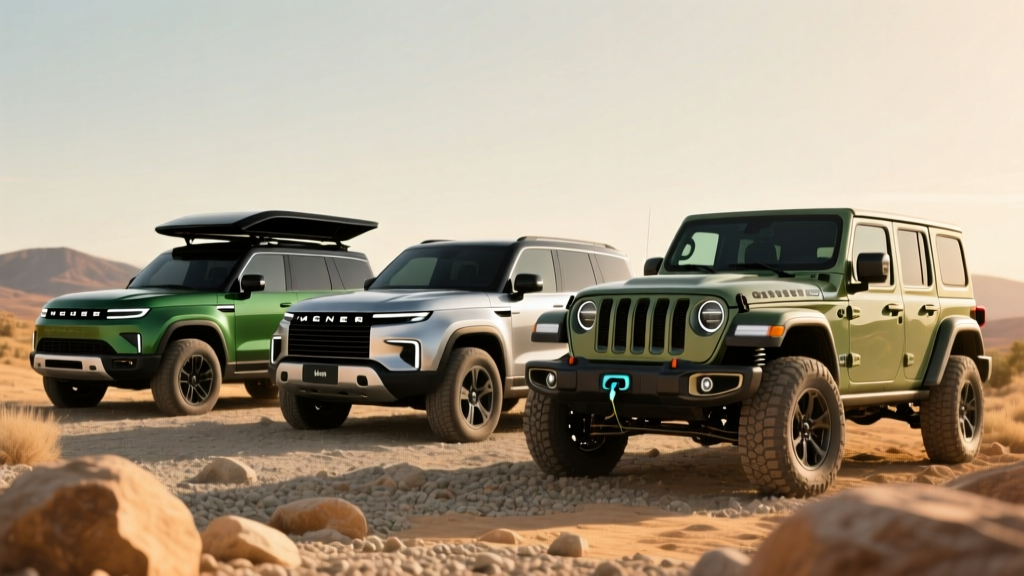
Quick Answer: If you're searching for an "electric Jeep," you have three electrified paths in 2026. The Wagoneer S is Jeep's first fully electric SUV (BEV) with an EPA-estimated 300 miles of range and a starting MSRP around $65,995. The Jeep Recon (announced, expected late 2025/2026) targets the off-road EV crowd with Trail Rated capability. The Wrangler 4xe is a plug-in hybrid (PHEV) offering ~22 miles of electric-only range and 49 MPGe, starting near $52,995. Your best pick depends on whether you need true zero-emission daily driving, off-road chops, or a bridge between gas and electric.
The Electric Jeep Lineup: What's Actually Available?
Jeep's electrification strategy spans three distinct vehicle types, and confusing them is the most common mistake shoppers make. Let's separate what you can drive home today from what's still in the pipeline.
| Model | Type | EPA Range / Electric Miles | Battery (kWh) | 0-60 mph | Horsepower | Base MSRP |
|---|---|---|---|---|---|---|
| Wagoneer S | BEV (all-electric) | 300 mi (EPA est.) | 100 kWh (usable) | 3.4 sec | 600 hp | $65,995 |
| Jeep Recon | BEV (announced) | ~320 mi (preliminary) | ~100 kWh (est.) | TBA | TBA | TBA |
| Wrangler 4xe | PHEV | 22 mi electric / 49 MPGe | 17.3 kWh | 6.0 sec | 375 hp | $52,995 |
The Wagoneer S rides on Stellantis' STLA Large platform and is the first ground-up electric Jeep sold in North America. It's a premium, performance-oriented SUV — think Grand Cherokee luxury with instant electric torque. The Recon, when it arrives, will slot below it in price and lean harder into the Trail Rated off-road identity. The Wrangler 4xe, meanwhile, has been on sale since 2021 and remains one of the best-selling PHEVs in the U.S. — it's a gas Jeep you can plug in for short commutes.
Electric Jeep vs. Gas: The Real Cost Comparison
Sticker price alone tells the wrong story. Here's a five-year cost breakdown comparing the Wagoneer S (BEV), the Wrangler 4xe (PHEV), and a comparable gas-powered Grand Cherokee against typical ownership patterns.
| Cost Factor (5 Yr / 75,000 mi) | Wagoneer S (BEV) | Wrangler 4xe (PHEV) | Grand Cherokee (Gas) |
|---|---|---|---|
| Purchase Price (base) | $65,995 | $52,995 | $44,995 |
| Federal Tax Credit (§30D) | Up to $7,500* | Up to $3,750* | $0 |
| Fuel / Electricity | ~$3,200 | ~$5,800 | ~$9,400 |
| Maintenance | ~$1,800 | ~$3,500 | ~$4,200 |
| Insurance (est.) | ~$11,500 | ~$9,200 | ~$8,000 |
| Estimated 5-Yr Total | ~$82,495 | ~$71,495 | ~$66,595 |
*Federal EV tax credit eligibility under IRS §30D depends on your modified adjusted gross income, the vehicle's MSRP cap ($80,000 for SUVs), battery critical-mineral sourcing, and final assembly requirements. Rules are subject to change — consult a tax professional. Point-of-sale transfer is available at participating dealers.
The BEV's electricity cost assumes a blended home/public charging mix at $0.14/kWh national average. The Wrangler 4xe savings assume ~40% of miles driven on electricity. The gas Grand Cherokee figure uses $3.40/gallon at 21 MPG combined. Your actual numbers will shift based on local electricity rates, gas prices, and how often you plug in the 4xe.
Range, Charging, and Real-World Expectations
Wagoneer S Range Reality Check: The EPA-estimated 300 miles assumes moderate temperatures and mixed driving. Expect ~250-270 miles on the highway at 70+ mph, and ~200-220 miles in sub-freezing winter conditions. Cold weather increases battery resistance and cabin heating draws significant energy — this is physics, not a defect.
Charging speed is where the Wagoneer S shows its modern architecture. On a DC fast charger, it peaks at approximately 150 kW, delivering a 10-80% charge in roughly 23 minutes under ideal conditions. However, charge curves taper significantly above 80% — a full 10-100% session takes closer to 55 minutes. For road trips, plan to charge to 80% and move on; the last 20% is painfully slow on any lithium-ion pack.
| Charging Level | Power (kW) | Wagoneer S Speed | Wrangler 4xe Speed |
|---|---|---|---|
| Level 1 (120V household) | 1.4 kW | ~3 mi/hr | ~2 mi/hr (electric only) |
| Level 2 (240V home/public) | 7.2-11.5 kW | ~25 mi/hr (full in ~10 hrs) | Full in ~2.5 hrs |
| DC Fast Charge | Up to 150 kW | 10-80% in ~23 min | Not supported |
The Wrangler 4xe does not support DC fast charging — its 17.3 kWh battery is designed for Level 2 home charging, which tops it off in about 2.5 hours. This is fine for overnight charging but means you can't quickly replenish the electric range on a road trip.
Home Charging: What First-Time Buyers Must Know
Assuming you have access to a garage or dedicated parking spot, here's what Level 2 home charging installation actually costs and requires:
| Item | Typical Cost Range | Notes |
|---|---|---|
| Level 2 Charger (hardware) | $300-$700 | ChargePoint Home Flex, Emporia, Wallbox |
| Electrician labor | $500-$2,000 | Depends on panel proximity and conduit run |
| Electrical permit | $50-$200 | Required in most jurisdictions |
| Panel upgrade (if needed) | $1,500-$4,000 | If your panel is 100A or maxed out |
| Total (typical install) | $850-$2,900 | Before any utility rebates |
Many utilities offer rebates of $200-$500 for Level 2 charger installation — check with your local provider. The critical question is whether your electrical panel has capacity. A 200-amp panel with spare breaker slots makes installation straightforward. A 100-amp panel in an older home may require a costly upgrade, which is the single biggest hidden expense of EV ownership.
If you live in an apartment or lack dedicated parking, public charging becomes your primary option. Networks like Electrify America, EVgo, and ChargePoint offer DC fast charging, but at $0.30-$0.48/kWh, your "fuel" cost rises significantly — sometimes rivaling gas. Plan accordingly.
Myths vs. Facts: Clearing Up EV Misconceptions
| Myth | Fact |
|---|---|
| "EV batteries need replacing every 5 years" | Stellantis warranties the Wagoneer S battery for 8 years/100,000 miles with a capacity retention threshold. Real-world data from similar NMC packs shows ~10-15% degradation over 100,000 miles — not a cliff. |
| "The Wrangler 4xe is basically electric" | It's a PHEV with only 22 miles of electric-only range. After that, it operates as a conventional hybrid on gasoline. Great for short commutes; not a BEV. |
| "EVs are more expensive to insure" | Sometimes true — EV insurance premiums run 10-25% higher on average due to higher repair costs and parts pricing. Get quotes before buying. |
| "Charging takes too long" | Home Level 2 charging happens while you sleep. DC fast charging to 80% takes 20-25 minutes on the Wagoneer S — about the time for a rest stop and snack. |
| "EVs don't work in cold weather" | They work, but range drops 20-30% in freezing temps. Preconditioning the battery while plugged in mitigates this significantly. |
Off-Road Capability: Can an Electric Jeep Trail Rated?
This is the question Jeep loyalists care about most. The Wagoneer S is a luxury performance SUV — it has all-wheel drive with dual motors, but it's not Trail Rated and isn't designed for serious rock crawling. Think of it as a Jeep-flavored electric luxury cruiser.
The Recon is Jeep's answer to the off-road EV question. Announced with Trail Rated ambition, it's expected to feature removable doors, a powered tonneau, and Jeep's Selec-Terrain traction system adapted for electric motors. However, final specs, pricing, and availability remain preliminary. Jeep has not confirmed a firm on-sale date as of early 2026.
The Wrangler 4xe, meanwhile, is genuinely Trail Rated and a proven off-roader. Its electric-only mode adds near-silent trail crawling capability — an advantage over gas Wranglers in noise-sensitive wilderness areas. The trade-off: the 17.3 kWh battery adds weight low in the chassis, and the PHEV powertrain is more complex than a pure BEV or gas setup.
Decision Framework: Which Electric Jeep Is Right for You?
Choose the Wagoneer S (BEV) if:
- You want zero tailpipe emissions and 300 miles of real-world range
- You have home charging access (Level 2)
- Your daily commute is under 80 miles round-trip
- You value luxury and performance (600 hp, 3.4-sec 0-60)
- Your budget accommodates a ~$66K starting price
Choose the Wrangler 4xe (PHEV) if:
- You want off-road capability that's proven and Trail Rated
- Your commute is under 22 miles (covering it on electricity)
- You take frequent road trips and don't want to plan around chargers
- You want a lower entry price (~$53K) and don't mind gasoline for longer drives
- You live in an area with limited DC fast charging infrastructure
Wait for the Recon if:
- Off-road Trail Rated capability in a BEV is your top priority
- You're willing to wait for announced-but-unreleased vehicles
- You want a potentially lower-priced electric Jeep than the Wagoneer S
Frequently Asked Questions
Does the Wagoneer S qualify for the $7,500 federal tax credit?
The Wagoneer S may qualify for up to $7,500 under IRS §30D, but eligibility depends on battery critical-mineral sourcing, final assembly in North America, your income (capped at $150K single / $300K joint for SUVs), and the vehicle's MSRP staying under the $80,000 SUV cap. The base Wagoneer S at $65,995 clears the MSRP cap, but higher trims may exceed it. Point-of-sale transfer at the dealer can apply the credit as an upfront discount. Always verify current eligibility on fueleconomy.gov before purchasing.
How long will the Wagoneer S battery last?
Stellantis provides an 8-year/100,000-mile warranty on the high-voltage battery, guaranteeing it retains a minimum percentage of original capacity (typically 70%). Based on degradation data from similar 100 kWh NMC packs in the industry, expect roughly 85-90% state of health after 100,000 miles with normal use. Avoid routinely charging to 100% or leaving the vehicle at 0% for extended periods to maximize longevity.
Can I tow with the Wagoneer S or electric Jeep?
The Wagoneer S is rated for up to 4,000 lbs of towing capacity. However, towing significantly reduces range — expect a 30-50% reduction depending on trailer weight and aerodynamics. A 300-mile range could drop to 150-200 miles while towing a loaded car trailer. Plan charging stops accordingly.
Is the Wrangler 4xe a good first EV?
It's a good first electrified vehicle, but not a true EV. You get 22 miles of electric range for daily errands, then the gas engine takes over seamlessly. It eliminates range anxiety entirely because you can fill up at any gas station. If you want to dip your toes into plug-in driving without committing to a BEV, the 4xe is a practical bridge — just know you'll still be buying gasoline for longer trips.
What connector does the Wagoneer S use?
The Wagoneer S uses the CCS1 connector standard for DC fast charging and J1772 for Level 2 AC charging. As the industry transitions to NACS (Tesla's standard), adapters are increasingly available, and Stellantis has indicated future models may adopt NACS natively. For now, CCS1 gives you access to Electrify America, EVgo, and ChargePoint DC fast-charging networks.