The Short Answer on the Electric Hyundai Santa Fe
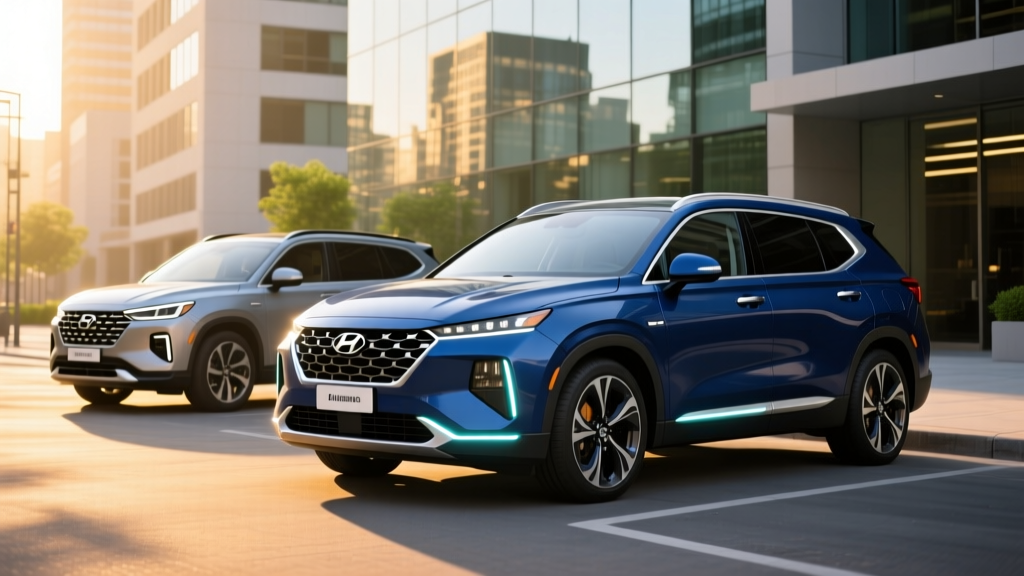
As of the 2026 model year, Hyundai does not sell a fully electric Santa Fe in the United States. The Santa Fe lineup includes a conventional 2.5L turbo gas model and the Santa Fe Hybrid (HEV), which pairs a 1.6L turbo with an electric motor for an EPA-estimated 36 MPG combined. If you want a Hyundai electric SUV in the Santa Fe's size-and-price class, the closest match is the Hyundai Ioniq 5 (EPA range up to 318 miles, starting near $42,600) or the 3-row Hyundai Ioniq 9 (EPA range up to 335 miles, starting near $52,000). Below, we break down exactly what the Santa Fe Hybrid delivers, how it stacks up against going full EV with the Ioniq 5, and which powertrain actually saves you more over five years.
What Hyundai Actually Sells in the Santa Fe Lineup for 2026
The fifth-generation Santa Fe (introduced for 2024, refreshed through 2026) is offered in three powertrain flavors: a 2.5L turbocharged 4-cylinder gas engine (277 hp), a 1.6L turbo hybrid (HEV, 230 hp combined), and in select markets outside the U.S., a plug-in hybrid variant. No battery-electric Santa Fe has been announced for North America as of early 2026.
Hyundai's electrification strategy places the Santa Fe in the hybrid camp while the Ioniq sub-brand handles fully electric SUVs. This is a deliberate segmentation: the Santa Fe targets buyers who want 3-row versatility and hybrid efficiency without range concerns, while the Ioniq 5 and Ioniq 9 target buyers ready for a BEV.
| Spec | Santa Fe Gas (2.5T) | Santa Fe Hybrid (HEV) |
|---|---|---|
| Powertrain | 2.5L Turbo I4 | 1.6L Turbo I4 + Electric Motor |
| Combined HP | 277 hp | 230 hp |
| EPA MPG (City/Hwy/Combined) | 20/28/23 | 35/35/36 |
| Drivetrain | FWD / AWD | FWD / AWD |
| Starting MSRP | ~$35,500 | ~$39,000 |
| Seating | 6 or 7 | 6 or 7 |
| Federal EV Tax Credit (§30D) | Not eligible | Not eligible (HEV, not PHEV/BEV) |
The EV Alternative: Hyundai Ioniq 5 vs. Santa Fe Hybrid
Since there is no electric Hyundai Santa Fe, the real comparison shoppers are making is between the Santa Fe Hybrid and the Ioniq 5. Both are midsize Hyundai SUVs in a similar price bracket, but they serve different needs.
| Attribute | Santa Fe Hybrid | Ioniq 5 (Long Range AWD) |
|---|---|---|
| Powertrain | 1.6L Turbo HEV | BEV, 84 kWh usable (NMC) |
| EPA Range / MPG | 36 MPG combined (~480 mi per tank) | 290 mi EPA (AWD); 318 mi (RWD) |
| 0–60 mph | ~7.6 sec | ~4.5 sec (AWD) |
| Max DC Fast Charge | N/A | 240 kW peak (10–80% in ~18 min) |
| Level 2 Charge Rate | N/A | 10.9 kW (~9 hrs 0–100%) |
| Starting MSRP | ~$39,000 | ~$47,600 (SEL AWD) |
| Federal Tax Credit (§30D) | $0 | Up to $7,500 (if eligible, see IRS rules) |
| Cargo Volume (behind 2nd row) | 40.5 cu ft | 27.2 cu ft |
| Seating Rows | 3 rows (6–7 seats) | 2 rows (5 seats) |
The tradeoff is clear: the Santa Fe Hybrid wins on cargo space, 3-row seating, and upfront price. The Ioniq 5 wins on performance, fueling cost per mile, and available tax credits. If you need 3 rows in a Hyundai BEV, the Ioniq 9 is the electric equivalent, starting around $52,000 with up to 335 miles of EPA range.
Real-World Range and Efficiency: What the Sticker Doesn't Tell You
EPA figures are a starting point, not a guarantee. For the Ioniq 5 AWD (EPA 290 miles), real-world highway driving at 70–75 mph typically yields 250–270 miles before you need to charge. In cold weather (below 30°F), expect a 15–30% range reduction, bringing effective range down to 200–245 miles depending on conditions and whether you use the heat pump (standard on most 2026 Ioniq 5 trims).
Ioniq 5 AWD Real-World Range Expectations:
- City/mixed driving (mild weather): 280–300 miles
- Highway 70 mph (mild weather): 250–270 miles
- Highway 70 mph (20°F): 200–230 miles
- With preconditioning + heat pump: cold-weather loss reduced to ~15%
For the Santa Fe Hybrid, real-world fuel economy hovers close to the EPA 36 MPG combined in mixed driving but can dip to 30–32 MPG on sustained highway trips where the electric motor assists less. Towing (up to 3,500 lbs on AWD trims) will further reduce efficiency.
5-Year Cost of Ownership: Hybrid vs. EV by the Numbers
The purchase price is only the beginning. Here's a 5-year / 75,000-mile cost projection comparing the Santa Fe Hybrid and Ioniq 5 AWD, assuming 15,000 miles per year, $3.50/gallon gas, and $0.14/kWh home electricity (national average).
| Cost Category | Santa Fe Hybrid (HEV) | Ioniq 5 AWD (BEV) |
|---|---|---|
| Purchase Price (base MSRP) | $39,000 | $47,600 |
| Federal Tax Credit (§30D) | $0 | –$7,500 (if eligible) |
| Effective Purchase | $39,000 | $40,100 |
| Fuel/Energy (75k mi) | $7,290 (gas @ 36 MPG) | $2,835 (home charging @ 3.2 mi/kWh) |
| Maintenance (5 yr) | ~$3,200 | ~$1,400 |
| Insurance (est. avg/yr) | ~$1,700/yr ($8,500 total) | ~$2,000/yr ($10,000 total) |
| Home Charger Install | $0 | ~$1,200 (Level 2, 48A) |
| Total 5-Year Cost | $57,990 | $55,535 |
The Ioniq 5 edges ahead on total cost over five years, primarily because of the federal tax credit (which, under current IRS §30D rules, requires meeting battery sourcing, MSRP caps under $80,000 for SUVs, and buyer income limits of $150K single / $300K joint). Without the credit, the Santa Fe Hybrid is cheaper to own.
Key caveats: Insurance for EVs is typically 10–20% higher. Public DC fast charging costs more than home charging ($0.30–$0.50/kWh), which erodes EV savings if you can't charge at home. The Santa Fe Hybrid requires oil changes, transmission fluid service, and eventual brake pad replacement — costs the Ioniq 5 largely avoids thanks to regenerative braking.
Charging at Home vs. Public: What First-Time EV Buyers Must Know
If you're considering the Ioniq 5 as your "electric Santa Fe" alternative, charging logistics are the single biggest ownership variable.
Level 1 (120V household outlet): Adds roughly 3–5 miles of range per hour. A full charge from empty takes 2–3 days. Fine for low-mileage commuters, inadequate for road trips.
Level 2 (240V, 48A home charger): Adds ~30–35 miles per hour. A full charge takes about 9 hours — perfect for overnight charging. Expect $800–$2,000 for a quality Level 2 unit plus professional installation by a licensed electrician. If your home has a 200-amp electrical panel with spare capacity, installation is straightforward. Older homes with 100-amp panels may need a $1,500–$3,000 panel upgrade.
DC Fast Charging (public): The Ioniq 5 peaks at 240 kW on an 800V-capable charger (like Electrify America's 350 kW stalls), going from 10–80% in approximately 18 minutes. However, the charge curve tapers significantly above 80% — expect 80–100% to take an additional 20+ minutes. Sustained average power during a 10–80% session is closer to 150–180 kW, not the 240 kW peak.
| Charging Level | Power (kW) | Miles Added per Hour | Full Charge Time |
|---|---|---|---|
| Level 1 (120V) | ~1.4 kW | ~4 mi/hr | ~60 hours |
| Level 2 (240V, 48A) | ~10.9 kW | ~32 mi/hr | ~9 hours |
| DC Fast (peak) | 240 kW | ~700+ mi/hr (burst) | 10–80% in ~18 min |
Common Misconceptions About Going Electric vs. Hybrid
| Myth | Fact |
|---|---|
| "EV batteries need replacing every 5 years." | Hyundai covers the Ioniq 5 battery for 10 years/100,000 miles. Real-world degradation data shows NMC packs retaining 85–90% capacity after 100K miles. Replacement, if needed, costs $8,000–$15,000. |
| "Hybrids are always cheaper than EVs." | Over 5 years, an EV with the §30D tax credit and home charging can be $2,000–$4,000 cheaper to own than a comparable hybrid, even with higher insurance. |
| "I can't road-trip in an EV." | The Ioniq 5's 240 kW charging and access to the Tesla Supercharger network (via NACS adapter, included with 2025+ models) makes road trips practical — plan a 20-min stop every 200–250 miles. |
| "The Santa Fe has an electric version I'm missing." | There is no BEV Santa Fe for 2026. Hyundai positions the Ioniq 5 (2-row) and Ioniq 9 (3-row) as its electric SUV alternatives. |
| "Cold weather destroys EV range permanently." | Cold-weather range loss is temporary and reversible. Preconditioning the battery while plugged in recovers most of the loss. The Ioniq 5's heat pump minimizes cabin-heating energy drain. |
Decision Framework: Which Hyundai SUV Is Right for You?
Choose the Santa Fe Hybrid if:
- You need 3 rows of seating and maximum cargo space
- You don't have access to home charging (apartment, street parking)
- You regularly tow (up to 3,500 lbs on AWD)
- You drive in extreme cold frequently and want zero range variability
- You want a lower upfront purchase price without tax-credit complexity
Choose the Ioniq 5 (EV) if:
- You can install a Level 2 home charger and want $0.04–$0.05/mile "fuel" cost
- You qualify for the §30D federal tax credit (check IRS eligibility rules)
- You want faster acceleration (4.5 sec 0–60) and a quieter ride
- 2 rows / 5 seats is sufficient for your household
- You want minimal maintenance (no oil changes, fewer brake replacements)
Choose the Ioniq 9 (EV) if:
- You need 3 rows AND want a fully electric Hyundai SUV
- You're willing to pay a ~$52,000 starting price for 335 miles of EPA range
Frequently Asked Questions
Will Hyundai ever make an electric Santa Fe?
Hyundai has not announced a battery-electric Santa Fe for North America as of early 2026. The company's Ioniq sub-brand covers its EV SUV lineup (Ioniq 5, Ioniq 9). A future electric Santa Fe is possible but unconfirmed. Hyundai has stated it aims to sell 2 million EVs annually by 2030, so additional models are likely, but nothing is on the immediate roadmap.
Does the Santa Fe Hybrid qualify for any federal tax credit?
No. The §30D federal clean vehicle credit applies only to plug-in electric vehicles (BEVs and PHEVs) that meet battery sourcing, MSRP, and buyer income requirements. A conventional hybrid (HEV) like the Santa Fe Hybrid does not plug in and is not eligible. Some states offer separate hybrid incentives — check your state's energy office for details.
How much does it cost to charge the Ioniq 5 at home per month?
At the national average electricity rate of ~$0.14/kWh and an efficiency of ~3.2 miles/kWh, driving 1,250 miles per month costs approximately $55/month in electricity. Compare that to the Santa Fe Hybrid at 36 MPG and $3.50/gallon gas: roughly $122/month. That's a monthly savings of ~$67 with the EV, or ~$800/year.
Is the Ioniq 5 bigger or smaller than the Santa Fe?
The Ioniq 5 is slightly shorter overall (182.7 in vs. 190.2 in for the Santa Fe) and offers 2 rows / 5 seats vs. the Santa Fe's 3 rows / 6–7 seats. Cargo space behind the second row is 27.2 cu ft (Ioniq 5) vs. 40.5 cu ft (Santa Fe). For a similarly sized 3-row electric Hyundai, the Ioniq 9 (199.8 in long) is the closer match.
What is the Ioniq 5 battery warranty?
Hyundai covers the Ioniq 5's high-voltage battery for 10 years or 100,000 miles, whichever comes first. The warranty guarantees the battery will retain a minimum capacity threshold (typically 70% of original capacity). The basic vehicle warranty is 5 years/60,000 miles, and the powertrain warranty is 10 years/100,000 miles. Source: Hyundai's official warranty page.
Can I use Tesla Superchargers with the Ioniq 5?
Yes. Starting with the 2025 model year, Hyundai Ioniq 5 models are equipped with the NACS (North American Charging Standard) port, granting native access to Tesla's Supercharger network without an adapter. This adds over 15,000 fast-charging stalls to the Ioniq 5's charging map, significantly improving road-trip coverage in rural and highway corridors.