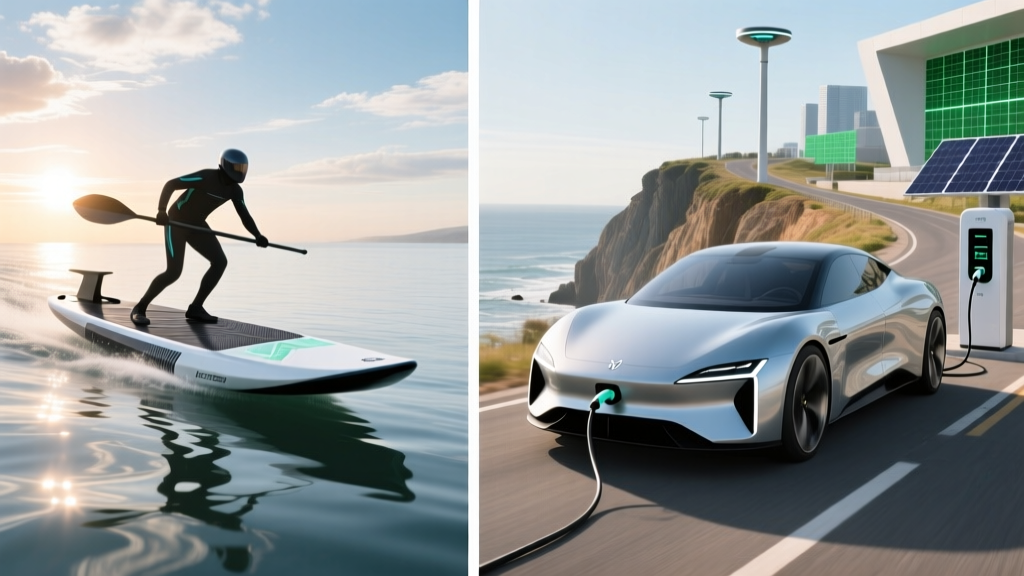
Electric hydrofoil boards (eFoils) are battery-powered surfboards that use a submerged hydrofoil wing to lift the rider above the water, eliminating drag and enabling smooth, silent cruising at 15–30 mph. They are not road vehicles, do not qualify for the federal EV tax credit, and serve a completely different use case than electric cars. If you're researching "electric hydrofoil boards" while also considering an EV purchase, this guide breaks down the costs, charging requirements, battery technology, and real-world ownership realities of both — so you can decide where your electrification dollars go.
Quick Answer
An electric hydrofoil board is a recreational watercraft, not a transportation EV. Expect to pay $6,000–$15,000 for a quality eFoil, with a battery that provides 1–2 hours of ride time per charge. A battery-electric car like the 2026 Hyundai Ioniq 5 ($42,600 base, EPA 318 mi) replaces your daily driver and can save $800–$1,500/year in fuel costs. They are complementary purchases, not alternatives.
What Electric Hydrofoil Boards Actually Are (and Aren't)
Electric hydrofoil boards combine a surfboard-style deck with a mast, fuselage, and hydrofoil wings submerged below the waterline. A compact electric motor (typically 3–6 kW peak) drives a propeller, and a removable lithium-ion battery pack (1.5–3.5 kWh capacity) powers the system. The hydrofoil lifts the board clear of the water at around 5–8 mph, dramatically reducing drag and enabling speeds up to 30 mph depending on rider weight and conditions.
Leading brands in 2026 include Lift Foils (Lift eFoil), Fliteboard, and Awake. These are premium recreational products aimed at lake, ocean, and flatwater riders. They are not commuter vehicles, they are not registered or insured like cars, and they have zero overlap with the IRS §30D federal EV tax credit, which applies only to on-road motor vehicles with four wheels and a gross vehicle weight under 14,000 lbs.
Spec Comparison: eFoil vs Entry-Level EV
To ground this comparison in real numbers, here's how a premium electric hydrofoil board stacks up against a mainstream battery-electric vehicle on the specifications that matter:
| Specification | eFoil (Lift eFoil Sport, 2026) | 2026 Hyundai Ioniq 5 SE Std Range |
|---|---|---|
| Base Price | $8,495 | $42,600 |
| Battery Capacity | 1.9 kWh (LFP option avail.) | 63.0 kWh usable (NMC) |
| Motor Power | ~5 kW peak | 125 kW (168 hp) |
| Range / Runtime | ~1.5 hours at moderate pace | EPA 245 mi; real-world ~210 mi highway |
| Charge Time (0–100%) | ~2.5 hours (standard charger) | Level 2: ~5.5 hrs; DC 10–80%: ~18 min at 150 kW |
| Top Speed | ~25 mph (rider-dependent) | 115 mph (electronically limited) |
| Weight | ~55 lbs (board + battery) | ~4,300 lbs curb weight |
| Federal Tax Credit | Not eligible | Up to $7,500 (subject to MSRP, income, sourcing rules) |
| Warranty | 1 year limited | 10 yr / 100,000 mi battery; 5 yr / 60,000 mi vehicle |
Real Cost Breakdown: eFoil Ownership vs EV Ownership
Despite sharing "electric" and "battery" in their descriptions, the ownership economics of an eFoil and an EV are entirely different. An eFoil is a discretionary recreational purchase; an EV replaces a transportation expense. Here's what five years of ownership actually costs for each:
| Cost Category | eFoil (5 Years) | 2026 Ioniq 5 (5 Years, 15k mi/yr) |
|---|---|---|
| Purchase Price | $8,495 | $42,600 |
| Tax Credit / Incentive | $0 | −$7,500 (if eligible; point-of-sale) |
| Effective Purchase | $8,495 | $35,100 |
| "Fuel" / Electricity (5 yr) | ~$180 (home charging, ~120 rides) | ~$3,200 (home L2, $0.14/kWh avg) |
| Maintenance (5 yr) | ~$400 (prop replacement, seals) | ~$1,800 (tires, cabin filter, wipers, brake fluid) |
| Insurance (5 yr) | ~$0 (typically uninsured; optional ~$200/yr) | ~$9,500 ($1,900/yr avg, varies by state) |
| Registration / Tax | $0 | ~$2,000 (varies by state) |
| Battery Replacement Risk | ~$1,500 (spare battery at year 4–5) | Covered under 10-yr warranty |
| Total 5-Year Cost | ~$10,575 | ~$51,600 |
For comparison, a 2026 gas-powered compact SUV averaging 28 MPG combined at $3.30/gallon would cost roughly $8,840 in fuel alone over 75,000 miles — plus ~$3,500 in maintenance and ~$8,000 in insurance, totaling around $55,000+ in operating costs on top of the vehicle purchase price. Data from fueleconomy.gov confirms that EVs typically cost $0.04–$0.06 per mile to "fuel" at home versus $0.12–$0.15 per mile for a gasoline vehicle.
Charging Realities: What You Need to Know
Both eFoils and EVs require you to think about charging infrastructure, but the scale and complexity are vastly different.
eFoil Charging
Most eFoil batteries charge on a dedicated proprietary charger that plugs into a standard 120V household outlet. A full charge of a 1.9 kWh battery takes approximately 2–2.5 hours. There is no installation cost, no electrician visit, and no panel upgrade. You simply plug in the charger after your session. The trade-off is that these chargers are brand-specific — a Lift charger won't work on a Fliteboard battery, and vice versa.
EV Home Charging
For an EV, home Level 2 charging (240V, 7–11 kW) is the practical standard. Installation costs vary widely:
| Component | Low Estimate | High Estimate |
|---|---|---|
| Level 2 Charger (hardware) | $350 | $750 |
| Electrician labor (240V run) | $500 | $2,500 |
| Electrical panel upgrade (if needed) | $0 | $3,000 |
| Permit / inspection | $50 | $300 |
| Total | $900 | $6,550 |
If your home has a 200-amp panel with spare capacity and a garage or driveway outlet location near the panel, expect the lower end. Older homes with 100-amp service or long conduit runs may hit the higher end. Always get a quote from a licensed electrician before purchasing — the panel upgrade is the variable that surprises most first-time EV buyers.
Once installed, a Level 2 charger adds roughly 25–35 miles of range per hour of charging for a vehicle like the Ioniq 5. Overnight charging (8–10 hours) fully replenishes the battery, which is sufficient for the vast majority of daily driving patterns.
Battery Chemistry: LFP, NMC, and What It Means for You
Both eFoils and EVs use lithium-ion batteries, but the chemistry choices reflect their different use cases.
eFoils increasingly offer LFP (lithium iron phosphate) battery options. LFP is heavier but more stable, tolerates full 100% charges without accelerated degradation, and has a longer cycle life (2,000–3,000+ cycles before 80% capacity retention). For a watercraft where weight is less critical than safety and longevity, LFP is a smart choice.
EVs use both chemistries depending on the model and trim. The standard-range Tesla Model 3 and some Hyundai/Kia models use LFP for cost and durability. Long-range variants typically use NMC (nickel manganese cobalt) or NCA (nickel cobalt aluminum) for higher energy density — meaning more range in the same physical space, but with a recommendation to charge to 80% daily and 100% only for trips.
For either product, understand that kWh is energy capacity (how much the battery holds) and kW is power (how fast it charges or discharges). A 63 kWh battery charged at 7 kW takes about 9 hours from empty; the same battery on a 150 kW DC fast charger can reach 80% in roughly 18 minutes, though the charge curve tapers significantly above 80% SoC to protect the cells.
Common Misconceptions: eFoils and EVs
| Myth | Fact |
|---|---|
| "eFoils qualify for the EV tax credit." | False. The IRS §30D credit applies only to qualified on-road motor vehicles. Watercraft, e-bikes, and golf carts are excluded. |
| "EVs are more expensive to own than gas cars." | Over 5 years, an EV like the Ioniq 5 typically saves $4,000–$8,000 in fuel and maintenance vs a comparable gas SUV, even after accounting for higher insurance. Source: fueleconomy.gov. |
| "eFoil batteries degrade quickly in saltwater." | Modern eFoils are sealed to IP68 ratings. Degradation is driven by charge cycles and storage conditions, not water exposure. Store at 50% SoC when not in use for extended periods. |
| "You need a special outlet for an eFoil." | Standard 120V household outlets are sufficient for eFoil charging. No electrician required. |
| "EV batteries need replacing every 5 years." | EV battery degradation averages 1–2% per year. Most manufacturers warranty 70% capacity retention for 8 years / 100,000 miles. Real-world data shows many packs lasting 150,000+ miles before reaching 80% SoH. |
| "Cold weather kills EV range." | Cold reduces range 15–30% depending on temperature and whether you precondition. Vehicles with heat pumps (like the Ioniq 5) lose less. This is a real limitation, not a myth — plan accordingly in sub-30°F climates. |
Decision Framework: Should You Buy an eFoil, an EV, or Both?
Use This Framework to Decide
- Choose an EV first if: You currently drive a gas car, have access to home charging (garage or driveway), drive more than 10,000 miles per year, and want to reduce fuel costs. The math favors EVs most when you can charge at home at residential electricity rates ($0.10–$0.18/kWh in most US markets). The federal tax credit of up to $7,500 (point-of-sale as of 2026, subject to income caps of $150k single / $300k joint and MSRP caps of $55k sedans / $80k SUVs) further tips the economics.
- Choose an eFoil if: You live near a body of water (lake, calm ocean, reservoir), have $6,000–$15,000 in discretionary spending, and want a unique recreational experience. An eFoil does not replace any transportation expense — it's a lifestyle purchase comparable to a jet ski, kayak, or mountain bike.
- Buy both if: You have the budget and the use case. The EV saves you money on commuting; the eFoil gives you weekend recreation. They charge on the same household electrical system without conflict — an eFoil's 1.9 kWh draw is negligible compared to an EV's daily 20–40 kWh consumption.
- Choose neither yet if: You lack home charging access (apartment, street parking only) and your area has limited public DC fast-charging infrastructure. In that scenario, a plug-in hybrid (PHEV) like the 2026 Toyota RAV4 Prime (42 mi electric-only range, 38 MPG combined after depletion) may be a better bridge solution until your charging situation improves.
What First-Time EV Buyers Must Know
If the eFoil research has sparked your interest in electric vehicles broadly, here are the non-negotiable facts for a first-time EV purchase in 2026:
- Home charging is the foundation. Public charging works for road trips, but 80–90% of EV charging happens at home. Before buying, confirm you can install a 240V Level 2 charger or at least use a 120V Level 1 trickle charger (which adds ~3–5 miles of range per hour — sufficient only for low-mileage drivers).
- EPA range is not real-world range. Expect 10–20% less range in highway driving at 70+ mph, and 15–30% less in sustained sub-freezing temperatures. A vehicle rated at 300 miles EPA may deliver 240 miles on a cold highway day.
- DC fast charging is measured in peak kW, not sustained kW. A vehicle that advertises "250 kW peak charging" typically sustains that rate only between 10–30% SoC. The charge curve tapers progressively, and a 10–80% time of 18–25 minutes is realistic for modern 800V architectures.
- Tax credit eligibility is complex. The §30D credit requires the vehicle to meet battery sourcing and critical mineral thresholds, the buyer to be under income caps, and the vehicle MSRP to be under the limit. Always verify on irs.gov and consult a tax professional before relying on the credit in your budget.
- Insurance costs are typically higher. EV insurance premiums run 10–25% above comparable gas vehicles due to higher repair costs and specialized parts. Get quotes before purchasing.
Frequently Asked Questions
Do electric hydrofoil boards qualify for any federal or state EV incentives?
No. The IRS §30D clean vehicle credit applies exclusively to on-road motor vehicles with at least four wheels. eFoils, e-bikes, electric skateboards, and electric boats do not qualify. Some states offer separate rebates for electric marine equipment, but these are rare and vary by jurisdiction — check your state energy office for current programs.
How long does an eFoil battery last before needing replacement?
With proper care (avoiding storage at 0% or 100% SoC, keeping the battery out of extreme heat), an eFoil battery should provide 500–1,000+ charge cycles before significant degradation. For a weekend rider doing 40–60 sessions per year, that translates to 8–15+ years of usable life. Replacement batteries cost $1,200–$2,500 depending on the brand and capacity.
Can I charge an eFoil and an EV on the same home electrical system?
Yes, without issue. An eFoil charger draws roughly 800W–1,500W from a standard 120V outlet. A Level 2 EV charger draws 7,200W–11,500W from a dedicated 240V circuit. They operate on entirely separate circuits and do not compete for capacity unless your home's total electrical service is already near its limit — which a licensed electrician can assess.
Is an eFoil harder to maintain than an EV?
Different, not harder. eFoils require rinsing with freshwater after saltwater use, periodic propeller and seal inspections, and battery storage management. EVs require tire rotations, cabin air filter replacements, and occasional brake fluid checks. Neither requires oil changes, spark plugs, or transmission service. Overall maintenance costs are low for both compared to gas vehicles.
What's the best eFoil brand in 2026?
Lift Foils and Fliteboard remain the market leaders with the most mature product ecosystems, widest wing and propeller selections, and best dealer support networks. Awake offers a performance-oriented alternative. Prices range from $6,000 for entry-level packages to $15,000+ for carbon-fiber pro setups. Test-ride before buying — dealer demo days are common in waterfront markets.
Should I buy a PHEV instead of a full EV if I'm also buying an eFoil?
Only if your charging situation is limited. A PHEV gives you 30–45 miles of electric-only range for daily errands plus a gas engine for longer trips, eliminating range anxiety. But if you can charge at home, a full EV offers lower operating costs, less maintenance, and a smoother driving experience. The eFoil purchase doesn't change this calculus — it's a separate recreational budget item.