Quick Answer: What Does "Electric Golf" Actually Mean for Buyers?
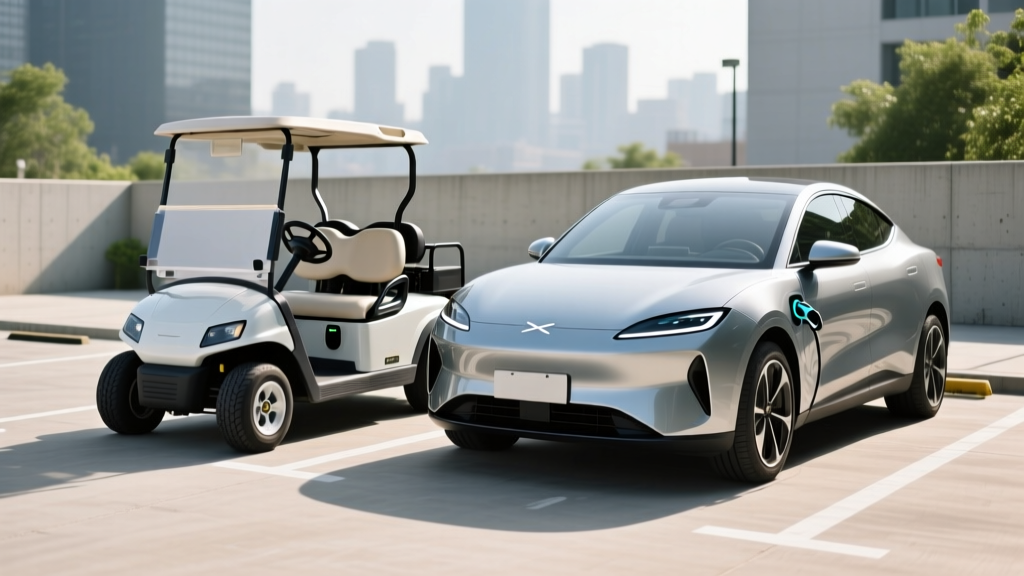
When shoppers search for electric golf vehicles, they're usually looking at one of three categories: (1) traditional electric golf carts (top speed 15–19 mph, range 15–30 miles, $8,000–$18,000), (2) street-legal Neighborhood Electric Vehicles (NEVs/LSVs) like the GEM e2 or Club Car Villager (top speed 25 mph, range 30–50 miles, $12,000–$20,000), or (3) full highway-capable EVs that golfers happen to drive (EPA range 250+ miles, $30,000+, eligible for federal tax credits). Only the third category qualifies for the IRS §30D tax credit and can legally travel on roads posted above 35 mph. This guide covers all three so you can match the vehicle to your actual driving needs.
The Three "Electric Golf" Vehicle Categories Explained
The term "electric golf" spans a wide spectrum. Before spending any money, understand which bucket your use case falls into.
Category 1: Electric Golf Carts (Off-Road / Private Property)
Standard electric golf carts from Club Car, EZGO, and Yamaha are designed for golf courses, gated communities, and private property. They typically run on 48V or 72V battery systems (lead-acid or increasingly lithium iron phosphate — LFP), produce 3–15 horsepower, and top out at 15–19 mph. A new lithium-equipped cart like the Club Car Onward 4 with a 72V LFP pack delivers roughly 25–30 miles of range and costs between $10,000 and $14,000 depending on options.
Category 2: Street-Legal NEVs / Low-Speed Vehicles (LSVs)
NEVs are federally regulated under FMVSS 500 and street-legal on roads posted 35 mph or lower. They must have seatbelts, headlights, turn signals, and VIN numbers. The Polaris GEM e2 (2025–2026 model) offers a 72V system with up to ~50 miles of range at a starting MSRP around $13,000–$15,000. The Club Car Villager 2+2 LSV starts near $14,500 with roughly 40 miles of range. These use LFP or AGM lead-acid batteries and charge on standard 120V outlets in 6–10 hours.
Category 3: Full Highway-Capable EVs for Golfers
If you need to drive beyond neighborhood streets — commuting to work, highway travel, or road trips — you need a full battery electric vehicle (BEV). These start around $30,000 MSRP, offer 230–400+ miles of EPA range, support DC fast charging at 100–350 kW, and may qualify for up to $7,500 in federal tax credits under IRS §30D.
Cost Comparison: Golf Cart vs NEV vs Full EV
The total cost of ownership varies dramatically across these categories. Here's a 5-year breakdown assuming 3,000 miles driven annually (the realistic figure for neighborhood and course use).
| Cost Factor | Electric Golf Cart (LFP) | NEV/LSV (e.g., GEM e2) | Full EV (e.g., Chevy Equinox EV 2LT) |
|---|---|---|---|
| Purchase Price (MSRP) | $10,000–$14,000 | $13,000–$20,000 | $33,000–$43,000 |
| Federal Tax Credit (§30D) | Not eligible | Not eligible | Up to $7,500 (income/MSRP/sourcing rules apply) |
| Annual "Fuel" (Electricity) | ~$30–$50/yr | ~$60–$100/yr | ~$400–$700/yr (at $0.16/kWh) |
| Annual Maintenance | ~$100–$200/yr | ~$150–$300/yr | ~$200–$400/yr |
| Insurance (Annual) | $0–$200/yr (optional) | $300–$600/yr (required in most states) | $1,200–$2,000/yr |
| Battery Replacement (if needed in 5 yrs) | $1,500–$3,000 (lead-acid); rare for LFP | $2,000–$4,000 | Unlikely; covered under 8-yr/100k-mi warranty |
| Estimated 5-Year Total Cost | $11,500–$17,500 | $17,500–$27,000 | $35,000–$50,000 |
Note: The full EV column assumes 12,000 miles/year since these vehicles serve as primary transportation. The golf cart and NEV columns assume 3,000 miles/year for local use.
EV vs Gas Cart: What Are the Real Savings?
If you're specifically choosing between an electric and gas-powered golf cart or NEV, the math favors electric for most buyers.
| Metric | Electric Golf Cart (72V LFP) | Gas Golf Cart (12–14 HP) |
|---|---|---|
| Purchase Price | $10,000–$14,000 | $8,000–$12,000 |
| Fuel/Energy Cost per Mile | ~$0.01–$0.02/mi | ~$0.08–$0.12/mi (gasoline) |
| Annual Fuel/Energy (3,000 mi) | $30–$60 | $240–$360 |
| Annual Maintenance | $100–$200 (no oil, filters, spark plugs) | $250–$500 (oil changes, belts, carburetor) |
| Noise Level | Near-silent | 65–75 dB (lawnmower-level) |
| Emissions | Zero tailpipe; grid-dependent upstream | Direct CO₂, NOₓ, hydrocarbons |
| 5-Year Fuel + Maintenance Total | ~$650–$1,300 | ~$2,450–$4,300 |
The electric cart carries a higher upfront cost of roughly $2,000–$3,000 but recoups that within 3–5 years through dramatically lower operating costs. The LFP battery pack in modern carts (like those from Club Car and RELiON) typically lasts 8–10 years with minimal degradation, compared to lead-acid packs that need replacement every 4–6 years at $1,500–$2,500 per swap.
Real-World Ownership: What First-Time Buyers Must Know
Whether you're buying a golf cart, NEV, or full EV, these practical realities shape daily ownership.
Charging Access
Golf carts and NEVs charge on standard 120V household outlets. A full charge takes 6–10 hours depending on battery size and depth of discharge. You don't need a dedicated Level 2 charger — but you do need a grounded outlet near where you park. If your cart lives in a garage or carport, this is trivial. If it parks on the street or in a lot with no outlet access, charging becomes a daily logistical problem.
Full EVs require Level 2 (240V) home charging for practical daily use. Installation costs range from $500 to $2,500 depending on your electrical panel capacity and the distance from panel to charger. A 200-amp panel is typically required. Budget $500–$800 for the charger hardware (e.g., ChargePoint Home Flex, Emporia Level 2) and $500–$1,700 for licensed electrician labor and permits.
Climate and Range Impact
Golf carts and NEVs suffer the same cold-weather range loss as full EVs — roughly 20–40% reduction at temperatures below 32°F due to increased battery internal resistance and cabin heating load (if equipped). A cart rated for 30 miles of range in 75°F weather may deliver only 18–22 miles in 25°F conditions. LFP chemistry handles cold slightly worse than NMC at the cell level, but the short range of carts means you're rarely operating near the limit anyway.
For full EVs, cold-weather range loss is well-documented. The EPA rates vehicles at moderate temperatures; expect 15–30% less range in sustained sub-freezing driving, especially on highways. Preconditioning the battery (warming it while plugged in before departure) mitigates this and is standard on most 2025–2026 EVs.
Driving Patterns Matter Most
The right vehicle depends entirely on where and how far you drive:
- Course-only or gated community (under 15 miles/day, private roads): Electric golf cart is the correct tool.
- Neighborhood errands, school runs, beach trips (under 30 miles/day, roads ≤35 mph): NEV/LSV covers this legally and affordably.
- Comuting, highway travel, road trips (any road, any speed): Full BEV required. No golf cart or NEV is legal or safe for highway use.
Common Misconceptions About Electric Golf Vehicles
| Myth | Fact |
|---|---|
| "Electric golf carts are street-legal everywhere." | Standard golf carts are NOT street-legal in most jurisdictions. Only NEVs/LSVs meeting FMVSS 500 (with VIN, seatbelts, lights, mirrors) can legally drive on roads posted ≤35 mph, and even then, local ordinances vary. Check your state and city rules. |
| "I can get a $7,500 tax credit on an electric golf cart." | The IRS §30D clean vehicle credit applies only to highway-capable vehicles with a gross vehicle weight rating (GVWR) under 14,000 lbs that meet battery sourcing and MSRP caps. Golf carts and most NEVs do not qualify. |
| "LFP batteries in golf carts degrade quickly." | LFP (lithium iron phosphate) chemistry actually offers longer cycle life than NMC — typically 3,000–5,000 full cycles before reaching 80% capacity retention. In a golf cart driven 3,000 miles/year, that translates to 15+ years of usable life. Lead-acid is the chemistry that degrades quickly (500–800 cycles). |
| "An NEV is just as good as a real EV for short commutes." | NEVs are limited to 25 mph by federal law and cannot be driven on roads posted above 35 mph. They also lack crash-test ratings, airbags, and modern ADAS features. For any route involving higher-speed roads, a full EV is the only safe and legal option. |
| "Electric carts have no power for hills." | Modern 72V LFP-equipped carts produce 15–20 HP equivalent with instant torque — more than enough for steep cart-path hills. Older 48V lead-acid carts could struggle, but current models handle inclines well. |
Decision Framework: Which "Electric Golf" Vehicle Is Right for You?
Choose an Electric Golf Cart If:
- You drive exclusively on golf courses, private property, or in a gated community that permits carts
- Your daily travel is under 15 miles at speeds below 20 mph
- You want the lowest operating cost and simplest ownership
- You have access to a standard 120V outlet for overnight charging
- Budget: $10,000–$14,000 purchase, under $250/year in operating costs
Choose a Street-Legal NEV/LSV If:
- Your daily routes stay on roads posted 35 mph or lower
- You need to carry 2–4 passengers for school runs, errands, or community trips
- You want street legality with minimal cost and zero tailpipe emissions
- You understand the safety limitations (no crash testing, no airbags)
- Budget: $13,000–$20,000 purchase, under $1,000/year in operating and insurance costs
Choose a Full Highway-Capable EV If:
- You need to drive on roads posted above 35 mph or take highways
- Your daily commute exceeds 30 miles or involves mixed-speed roads
- You want federal tax credit eligibility (up to $7,500 under §30D, subject to income caps of $150K single / $300K joint, MSRP caps of $55K cars / $80K SUVs, and battery sourcing requirements)
- You need crash-test safety ratings, ADAS features, and year-round weather capability
- Budget: $30,000–$50,000+ purchase (potentially $22,500–$42,500 after tax credit), plus home Level 2 charging installation ($1,000–$2,500)
2026 Full EV Picks for the Golfer Who Needs a Real Car
If your "electric golf" search is really about finding a capable EV that also hauls your clubs, here are three data-backed options for 2026:
- Chevrolet Equinox EV 2LT — EPA 319 miles range, 85 kWh NMC battery, 150 kW peak DC charging (10–80% in ~30 min), 213 HP, $33,000 MSRP. Qualifies for the full $7,500 §30D credit (verify sourcing and income eligibility on irs.gov). Cargo: 26.4 cu ft rear / 57.2 cu ft folded — easily fits two full-size golf bags.
- Hyundai Ioniq 5 SE — EPA 303 miles range (RWD), 77.4 kWh NMC battery, 236 kW peak DC charging (10–80% in ~18 min), 225 HP, $42,500 MSRP. NACS port standard for 2025+, direct Tesla Supercharger access. Cargo: 27.2 cu ft / 59.3 cu ft folded.
- Tesla Model Y Long Range — EPA 320 miles range, ~75 kWh NMC battery, 250 kW peak DC charging (10–80% in ~22 min), 384 HP, $44,990 MSRP. Cargo: 30.2 cu ft / 72.1 cu ft folded — fits four golf bags diagonally. Tax credit eligibility varies by sourcing; check fueleconomy.gov for current status.
Frequently Asked Questions
How long does an electric golf cart battery last?
LFP lithium batteries in modern carts typically last 8–10+ years or 3,000–5,000 charge cycles before dropping to 80% capacity. Lead-acid batteries last 4–6 years or 500–800 cycles. At $30–$60 per year in electricity, the operating cost is negligible compared to gas carts.
Can I drive my electric golf cart on public roads?
In most US jurisdictions, standard golf carts are not street-legal on public roads. Some states and municipalities allow them on roads posted 25–35 mph with specific equipment (headlights, turn signals, seatbelts, slow-vehicle emblem). NEVs/LSVs are federally certified for roads up to 35 mph. Always check your local DMV and municipal ordinances before driving on any public road.
Do electric golf carts qualify for any tax credits?
No. The federal §30D clean vehicle credit requires the vehicle to be highway-capable, have a GVWR under 14,000 lbs, meet MSRP and buyer income caps, and satisfy battery critical-mineral and component sourcing requirements. Golf carts and most NEVs do not meet the highway-capable requirement. Some states or local utilities may offer rebates for electric off-road vehicles — check your state energy office.
What's the difference between kW and kWh for golf cart batteries?
kW (kilowatts) measures power — how fast energy flows, relevant to motor output and charge speed. kWh (kilowatt-hours) measures energy capacity — how much total energy the battery stores, which determines range. A golf cart with a 10 kWh battery and a 5 kW motor can theoretically run at full power for 2 hours. This distinction applies identically to full EVs: a Tesla Model Y has ~75 kWh of battery capacity and can charge at up to 250 kW of power.
Is an NEV safe compared to a full EV?
NEVs are not crash-tested by NHTSA or IIHS and lack airbags, crumple zones, and electronic stability control. They are safe for low-speed neighborhood driving when operated within their design limits but should never be driven on high-speed roads. A full EV provides 5-star safety ratings, advanced driver-assistance systems (ADAS), and structural crash protection that NEVs simply don't have.
How much does it cost to charge an electric golf cart at home?
Charging a 72V golf cart with a ~10 kWh battery from empty to full uses roughly 10–12 kWh of electricity (accounting for charger inefficiency). At the US average residential rate of $0.16/kWh, a full charge costs about $1.60–$1.92. Most daily top-ups cost under $1.00.