The Short Answer: What Is a "Golf Electric Car" in 2026?
If you're searching for a golf electric car, you're likely considering one of two things: (1) a street-legal low-speed electric vehicle (LSV) for use on and around a golf course, or (2) a mainstream EV like the 2026 Volkswagen ID.4 — VW's electric SUV that carries the "golf" association through brand heritage and is practical for daily driving plus weekend trips to the course. For a real daily-driver EV with highway capability, full safety equipment, and 200+ miles of range, the 2026 VW ID.4 starts at approximately $40,790 with an EPA-estimated 291 miles of range (Pro trim, RWD). A neighborhood golf-cart-style LSV costs $8,000–$15,000 but tops out at 25 mph and cannot legally travel on most roads above 35 mph. This guide breaks down both paths with real numbers so you can choose the right one.
Understanding the Two "Golf Electric Car" Paths
The term "golf electric car" spans two very different vehicle categories, and confusing them leads to costly purchase mistakes. Here's the split:
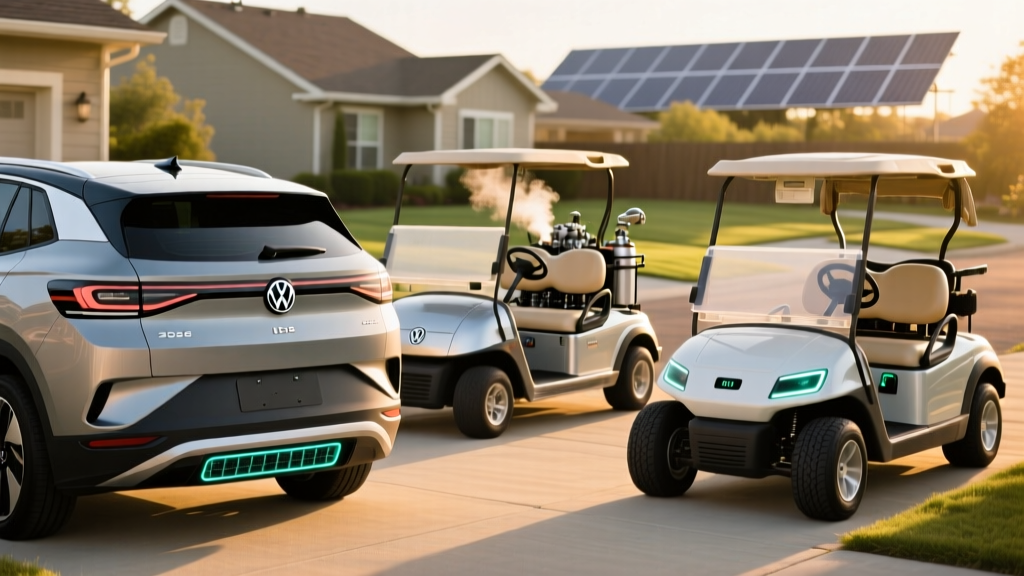
Path A: Low-Speed Vehicles (LSVs) / Golf Carts. These are electric or gas-powered carts designed for golf course use, gated communities, and short neighborhood trips. They're regulated under FMVSS 500, limited to a top speed of 25 mph, and street-legal only on roads with speed limits of 35 mph or below (varies by state). Brands include Club Car, E-Z-GO, Yamaha, and ICON Electric Vehicles.
Path B: Full-Speed Electric Vehicles with Golf Brand Heritage. The 2026 VW ID.4 is Volkswagen's mainstream compact electric SUV. It carries the VW badge — the same brand behind the iconic Golf hatchback — and is a practical daily-driver EV that also serves perfectly for hauling clubs, commuting, and road trips. This is the vehicle we'll focus on for detailed specs, since it's the one that integrates into a real transportation budget.
| Attribute | Electric LSV (Club Car Onward) | 2026 VW ID.4 Pro (RWD) |
|---|---|---|
| Top Speed | 25 mph | 99 mph (electronically limited) |
| EPA Range | N/A (15–30 mi typical) | 291 miles |
| Battery Capacity | ~5–10 kWh (lead-acid or Li-ion) | 82 kWh usable (NMC) |
| Highway Legal | No (roads ≤35 mph only) | Yes — all roads |
| Safety (Airbags, Crash Tested) | No | Yes — IIHS Top Safety Pick eligible |
| Base Price (2026) | $8,000–$15,000 | $40,790 |
| Federal EV Tax Credit | Not eligible | Potentially up to $7,500 (§30D) |
| Climate Control | None or basic heater | Full HVAC with heat pump available |
| Cargo (Golf Bags) | 2–4 bags (external rack) | 30.3 cu ft rear (fits 4+ bags inside) |
2026 VW ID.4: Specs That Matter for Real Buyers
If you're considering the ID.4 as your "golf electric car" — a practical EV with VW DNA — here's the exact data you need. These figures are based on the 2026 model year as published by Volkswagen and the EPA at fueleconomy.gov.
| Spec | Pro (RWD) | AWD Pro S |
|---|---|---|
| Base MSRP | $40,790 | $49,190 |
| EPA Range | 291 mi | 263 mi |
| Battery (usable) | 82 kWh, NMC | 82 kWh, NMC |
| Motor Output | 282 hp / 339 lb-ft | 335 hp / 339 lb-ft combined |
| 0–60 mph | ~7.3 sec | ~5.4 sec |
| Peak DC Fast Charge | 175 kW | 175 kW |
| 10–80% DC Fast Charge | ~28 min | ~28 min |
| Level 2 Charge Rate | 11 kW (AC) | 11 kW (AC) |
| MPGe (combined) | 107 MPGe | 101 MPGe |
| Cargo Volume (rear up) | 30.3 cu ft | 30.3 cu ft |
| Battery Warranty | 8 yr / 100,000 mi | 8 yr / 100,000 mi |
| Towing Capacity | 2,200 lbs | 2,700 lbs |
Real-World Range: What to Actually Expect
The EPA rates the ID.4 Pro RWD at 291 miles. In real-world highway driving at 70–75 mph, expect 240–260 miles in mild weather. In cold conditions (below 30°F), range can drop to 200–220 miles due to battery chemistry limitations and cabin heating load. The heat pump (standard on most 2026 trims) mitigates some of this loss but doesn't eliminate it. For a round-trip to a golf course 50 miles away plus errands, you'll use roughly 40–50% of the battery in normal conditions.
Charging the ID.4: Home, Course, and Road Trip
Owning any electric car — whether it's your daily driver or your "golf electric car" — lives or dies on charging access. Here's the realistic breakdown for the ID.4:
| Level | Power (kW) | Miles Added Per Hour | Best For |
|---|---|---|---|
| Level 1 (120V household) | ~1.4 kW | ~4–5 mi/hr | Emergency top-off only |
| Level 2 (240V home charger) | 11 kW | ~37 mi/hr | Daily overnight charging |
| DC Fast Charge (peak) | 175 kW | ~210 mi/hr (peak) | Road trips, quick stops |
kW vs. kWh refresher: kW (kilowatts) measures power — how fast electricity flows into the car. kWh (kilowatt-hours) measures energy — how much the battery holds total. The ID.4's 82 kWh battery charged at 11 kW takes about 7.5 hours from empty to full on Level 2.
Home charging reality: A Level 2 home charger installation typically costs $500–$2,000 for the equipment and $800–$2,500 for electrician labor, depending on whether your panel needs an upgrade (200-amp service recommended). If you live in a condo or apartment without dedicated parking, this is your biggest ownership hurdle — plan for public charging or workplace charging access before buying.
On the road: The ID.4 uses the CCS1 connector for DC fast charging. VW includes complimentary charging at Electrify America stations (typically 2 years or a set kWh allowance). The 175 kW peak rate is not sustained — the charge curve tapers significantly above 80% State of Charge (SoC) to protect battery health. Plan road-trip stops around 10–80% charges for fastest sessions.
Cost Breakdown: ID.4 vs. Gas Compact SUV vs. Electric LSV
Here's where buying decisions get real. We compared 5-year ownership costs for the ID.4 against a gas compact SUV baseline (e.g., Honda CR-V AWD, ~$36,000) and an electric LSV golf cart. Electricity priced at $0.14/kWh (national average); gas at $3.40/gallon.
| Cost Category | VW ID.4 Pro RWD | Gas Compact SUV | Electric LSV |
|---|---|---|---|
| Purchase Price | $40,790 | $36,000 | $12,000 |
| Federal Tax Credit (§30D) | Up to –$7,500* | $0 | $0 |
| Fuel/Energy (5 yr) | ~$3,900 | ~$7,650 | ~$520 |
| Maintenance (5 yr) | ~$1,800 | ~$4,200 | ~$600 |
| Insurance (5 yr avg) | ~$9,500 | ~$7,800 | ~$2,500 |
| Home Charger Install | ~$1,500 | $0 | ~$300 (120V) |
| Net 5-Year Cost | ~$48,490 | ~$55,650 | ~$15,920 |
*§30D credit eligibility depends on buyer income limits (≤$150K single / ≤$300K joint), vehicle MSRP caps ($55K for SUVs), and battery critical-mineral sourcing requirements. Verify current rules at IRS.gov. The credit may be applied at point of sale as of 2024+.
Key takeaway: The ID.4 costs more upfront than a gas SUV, but the tax credit and fuel/maintenance savings can close the gap to roughly $7,000 cheaper over 5 years. The electric LSV is dramatically cheaper — but only because it's not a real car. You can't drive it on highways, it won't protect you in a crash like a full-size vehicle, and it has no climate control. It's a golf cart, not a car replacement.
Real-World Ownership: What First-Time EV Buyers Miss
If the ID.4 (or any mainstream EV) is your first electric car, these are the practical considerations that spec sheets don't highlight:
1. Charging Deserts Still Exist. Rural areas, national parks, and some highway corridors still have sparse DC fast-charging infrastructure. If you regularly drive routes more than 200 miles from a charger cluster, plan carefully or consider a PHEV instead.
2. Cold Weather Range Loss Is Real. The ID.4's NMC lithium-ion battery loses efficiency below freezing. Expect a 20–35% range reduction in sustained sub-30°F weather. Preconditioning the battery while plugged in (using the VW app) helps — it warms the battery before you drive, improving both range and regenerative braking performance.
3. Insurance Costs More. EV insurance premiums run 15–25% higher than equivalent gas vehicles, driven by higher repair costs and battery replacement expense. Get a quote before committing. Providers like Geico, Progressive, and State Farm now offer EV-specific policies.
4. Tire Wear Accelerates. The ID.4's instant torque and ~4,600 lb curb weight wear tires faster than a gas equivalent. Budget for replacement every 30,000–40,000 miles. EV-specific tires (like Michelin Pilot Sport EV) cost more but last longer and reduce road noise.
5. Battery Degradation Is Slower Than You Think. VW warranties the ID.4 battery for 8 years / 100,000 miles with a capacity retention threshold of 70%. Real-world data from similar VW MEB-platform vehicles shows degradation of roughly 5–8% over 100,000 miles under normal use. Avoid routinely charging to 100% for daily driving — set the charge limit to 80% for longevity.
| Myth | Fact |
|---|---|
| "The battery will need replacing in 5 years" | NMC batteries in modern EVs retain 85–92% capacity at 100K miles. VW warranties 70% at 8yr/100K mi. |
| "You can charge from any household outlet quickly" | Level 1 (120V) adds only ~4–5 miles per hour. A full charge takes over 3 days. Level 2 is essential for daily use. |
| "Electric golf carts are street-legal everywhere" | LSVs are restricted to roads with speed limits ≤35 mph. State and local rules vary — check your DMV. |
| "EVs cost more to own in every scenario" | After tax credits and fuel savings, the ID.4 can beat a gas SUV over 5 years — but only if you can charge at home. |
| "The ID.4 is self-driving" | VW's IQ.DRIVE is an SAE Level 2 driver-assist system. You must keep hands on the wheel and eyes on the road at all times. |
Tax Credit Eligibility: Can You Claim $7,500?
The federal §30D Clean Vehicle Credit can reduce the ID.4's effective price significantly — but eligibility is not guaranteed. Here's the checklist as of current IRS rules:
- Income Cap: Modified AGI ≤ $150,000 (single) or ≤ $300,000 (married filing jointly)
- MSRP Cap: Vehicle MSRP ≤ $80,000 for SUVs (ID.4 qualifies — all trims are under $55K)
- Battery Sourcing: Critical minerals and battery components must meet phased percentages from US/FTA countries — this changes yearly and may affect eligibility
- Assembly: The ID.4 for the US market is assembled in Chattanooga, Tennessee (domestic production)
- Point-of-Sale Transfer: As of 2024, you can transfer the credit to the dealer for an immediate price reduction at purchase
- Consult a Tax Professional: Rules shift and individual situations vary — verify with your CPA or check IRS.gov Clean Vehicle Credits
Important caveat: Battery sourcing requirements have tightened since 2024, and some previously eligible vehicles have seen their credit amount reduced from $7,500 to $3,750 or eliminated entirely depending on the model year and supply chain changes. Always verify current eligibility before purchase — do not assume the full credit applies.
Decision Framework: Which "Golf Electric Car" Is Right for You?
Choose Based on Your Actual Driving Life
Choose the VW ID.4 if:
- You need a real daily-driver that handles highways, rain, cold, and long trips
- You have (or can install) Level 2 home charging
- You want crash-tested safety, airbags, and modern ADAS features
- You drive more than 30 miles per day on roads above 35 mph
- You qualify for the §30D tax credit, making the effective price ~$33,290
Choose an Electric LSV / Golf Cart if:
- You live in a gated golf community with cart-path access
- Your daily driving is under 15 miles on low-speed neighborhood roads
- You already own a primary vehicle for highway/real-road driving
- You want a low-cost, low-maintenance runabout for the course and clubhouse
- Budget is under $15,000 and you don't need climate control or crash protection
Choose a PHEV (like the Toyota RAV4 Prime) if:
- You can't install home charging reliably
- You take frequent road trips beyond 300 miles where DC chargers are sparse
- You want electric-only commuting (42 mi EPA) with a gas backup for long hauls
Frequently Asked Questions
Is the VW ID.4 actually related to the VW Golf?
Not directly. The ID.4 is built on VW's dedicated MEB electric platform, while the Golf was built on the MQB platform for internal-combustion vehicles. VW discontinued the Golf in the US after 2021. The ID.4 is VW's spiritual electric successor in the compact segment, sharing brand DNA but no mechanical components with the old Golf.
Can I drive an electric golf cart on public roads?
Only on roads with speed limits of 35 mph or below, and only if the cart meets LSV (Low-Speed Vehicle) federal standards — which include headlamps, turn signals, seat belts, and a VIN. State and local rules add further restrictions. Check your state DMV before assuming legality. Full-size EVs like the ID.4 face no such restrictions.
How long does the ID.4 battery actually last?
VW warranties the 82 kWh NMC battery for 8 years or 100,000 miles with at least 70% capacity retention. Based on real-world data from MEB-platform vehicles in Europe and North America, most owners see 5–8% degradation at 100K miles with normal charging habits (avoiding routine 100% charges and deep discharges). A full battery replacement outside warranty would cost approximately $15,000–$20,000, but this is rarely needed within the vehicle's practical lifespan.
What does it cost to charge the ID.4 at home?
At the US average electricity rate of ~$0.14/kWh, a full 82 kWh charge costs about $11.50 — good for roughly 291 miles. That works out to about $0.04 per mile, compared to ~$0.12/mile for a 28 MPG gas SUV at $3.40/gallon. Over 15,000 miles/year, home charging saves roughly $1,200 annually vs. gasoline.
Does the ID.4 have enough cargo space for golf clubs?
Yes. With 30.3 cubic feet behind the rear seats (and 64.2 cu ft with seats folded), the ID.4 easily fits four golf bags standing upright in the cargo area, plus additional gear. The rear seat also folds 60/40 for longer items. There's no front trunk (frunk) on the ID.4, unlike some competitors.
Is the ID.4 self-driving?
No. The ID.4's IQ.DRIVE suite includes adaptive cruise control, lane-keeping assist, and Travel Assist — all classified as SAE Level 2 driver-assistance. You must remain fully engaged, keep hands on the steering wheel, and monitor the road. No production VW offers autonomous (Level 4+) driving.