Quick Answer: Is Driving Electric Free?
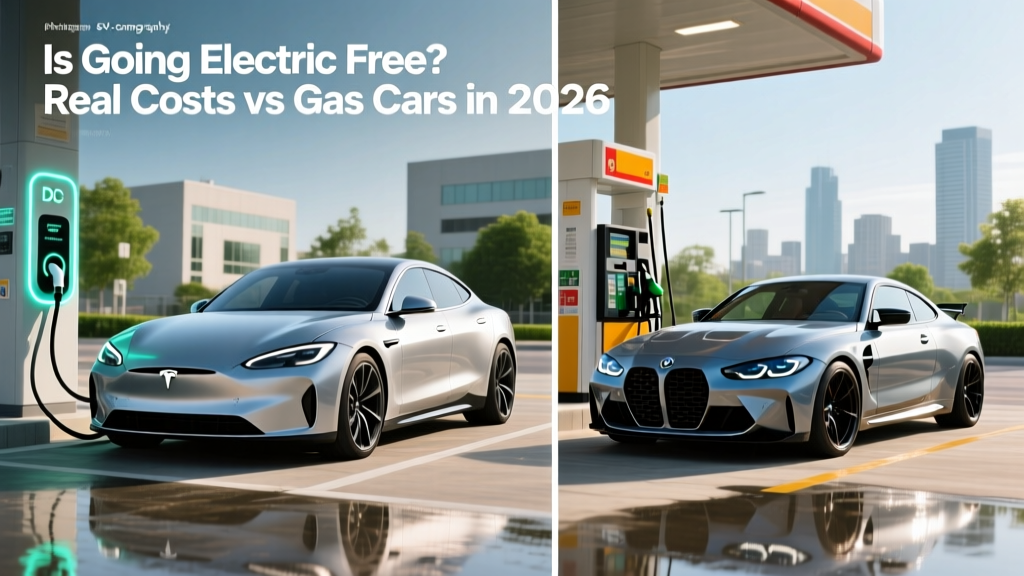
No, owning an EV is not free — but it can be dramatically cheaper than a gas car. A 2026 EV owner paying residential electricity rates (~$0.16/kWh) spends roughly $540/year on "fuel" for 12,000 miles of driving, compared to $1,680/year on gasoline for a 25 MPG gas car at $3.50/gallon. That's a $1,140 annual fuel savings. However, EVs carry higher purchase prices, insurance premiums, and potential home-charging installation costs. The total-cost-of-ownership advantage depends on how long you keep the car, whether you qualify for the federal §30D tax credit (up to $7,500), and your local electricity rates. Home charging is the biggest variable — public DC fast charging at $0.40-$0.60/kWh can erase the fuel savings entirely.
The Real Cost of Going Electric: A 2026 Breakdown
The phrase "electric free" gets tossed around EV forums and marketing copy, usually implying that once you buy an EV, your fuel costs vanish. That's misleading. Electricity isn't free, and the economics of EV ownership depend on a chain of variables: what you paid for the car, how you charge it, where you live, and how long you plan to keep it.
Let's build a realistic 5-year ownership comparison using a popular mainstream EV — the 2026 Hyundai Ioniq 5 SEL (EPA-estimated 303 miles of range, 77.4 kWh battery, starting MSRP around $45,500) — against a comparable gas-powered compact SUV, the 2026 Toyota RAV4 XLE (28 MPG combined, starting MSRP around $33,500).
| Cost Category | Hyundai Ioniq 5 SEL (EV) | Toyota RAV4 XLE (Gas) |
|---|---|---|
| Base MSRP | $45,500 | $33,500 |
| Federal §30D Tax Credit (if eligible) | −$3,750 to $7,500* | $0 |
| Effective Purchase Price | $38,000 – $41,750 | $33,500 |
| Home Charger Install (Level 2, 240V/48A) | $800 – $2,000 | $0 |
| Fuel / Electricity (5 years, 60,000 mi) | $2,700 (home) / $5,400 (public DCFC) | $8,400 |
| Maintenance (5 years) | $1,200 – $1,800 | $3,500 – $4,500 |
| Insurance (5-year avg) | $9,500 – $11,000 | $7,500 – $9,000 |
| Estimated Depreciation (5 yr) | ~45-55% | ~35-45% |
| 5-Year Total (home charging, w/ credit) | ~$52,000 – $61,000 | ~$52,000 – $58,000 |
*The §30D credit amount depends on battery component and critical-mineral sourcing requirements, your taxable income, and the vehicle's MSRP cap compliance. See IRS.gov §30D rules for current eligibility details. As of 2026, the Hyundai Ioniq 5 (U.S.-built) qualifies for partial or full credit depending on the buyer's income — single filers must earn ≤$150,000 AGI, joint filers ≤$300,000.
EV vs Gas: Where the Money Actually Goes
The sticker price gap between EVs and comparable gas cars has narrowed, but it hasn't disappeared. The real financial story lives in the operating costs — and those costs swing wildly based on your charging habits.
| Expense | EV (Home L2 Charging) | EV (Public DCFC Only) | Gas Car (25 MPG) |
|---|---|---|---|
| "Fuel" Cost | $540 ($0.16/kWh, 3.5 mi/kWh) | $1,715 ($0.50/kWh avg) | $1,680 ($3.50/gal) |
| Oil Changes | $0 | $0 | $240 – $400 |
| Brake Pads (annualized) | $40 – $80 | $40 – $80 | $120 – $200 |
| Tire Rotation | $50 – $80 | $50 – $80 | $50 – $80 |
| Coolant / Fluids | $0 – $30 | $0 – $30 | $60 – $120 |
| Annual Operating Total | $630 – $730 | $1,805 – $1,905 | $2,150 – $2,480 |
The home-charging EV owner saves roughly $1,500-$1,750 per year in operating costs versus the gas car. That gap closes to just $250-$675/year if you rely entirely on public DC fast charging. This is the single most important variable in EV economics: home charging access determines whether "electric free" is real or a myth.
Charging Costs: The Math Behind kWh
Understanding EV fueling costs requires one critical distinction: kW (kilowatts) measures charging speed — how fast energy flows into the battery. kWh (kilowatt-hours) measures energy capacity — how much the battery holds. You pay per kWh, not per kW.
Here's what charging actually costs across different scenarios for a 77.4 kWh battery (Ioniq 5):
- Home Level 1 (120V, 1.4 kW): ~$0.16/kWh = $12.38 for a full charge. Adds ~3-5 miles of range per hour. A full 0-100% charge takes 55+ hours — impractical for daily use but works as overnight top-up for short commutes.
- Home Level 2 (240V, 11.5 kW): ~$0.16/kWh = $12.38 for a full charge. Adds ~30 miles of range per hour. Full charge in ~7 hours — the practical standard for daily EV ownership.
- Public DC Fast Charging (150-350 kW): $0.40-$0.65/kWh = $31-$50 for a full charge. 10-80% in 18-25 minutes (the Ioniq 5 peaks at ~240 kW on an 800V-capable charger). Best for road trips, not daily use.
- Workplace / Free Charging: $0. Some employers and municipalities offer complimentary Level 2 charging. This is the closest you'll get to "electric free" — but it's a perk, not a guarantee.
According to fueleconomy.gov, the 2026 Ioniq 5 RWD achieves 117 MPGe combined, translating to roughly 29 kWh per 100 miles. At the U.S. residential average of $0.16/kWh, that's $4.64 per 100 miles — versus $14.00 per 100 miles for a 25 MPG gas car at $3.50/gallon.
Maintenance Savings: The Quiet Advantage
EVs have far fewer moving parts than internal-combustion vehicles. No oil changes, no spark plugs, no timing belts, no exhaust system, no multi-speed transmission fluid. Regenerative braking handles most deceleration, meaning brake pads often last 100,000+ miles before replacement.
Over 5 years and 60,000 miles, expect to spend:
- EV maintenance: $1,200-$1,800 (cabin air filter, tire rotations, brake fluid check, wiper blades, washer fluid)
- Gas car maintenance: $3,500-$4,500 (oil changes every 5,000-10,000 mi, air filters, transmission fluid, spark plugs at 60K, plus all the EV items)
The maintenance savings alone — roughly $2,000-$2,700 over 5 years — offset a meaningful portion of the EV's higher purchase price. This is where long-term EV ownership quietly wins, even if the sticker price stings upfront.
Insurance: The Uncomfortable Reality
EV insurance premiums run 15-25% higher than equivalent gas cars. Reasons include higher repair costs after collisions (specialized parts, battery-pack sensitivity, fewer qualified body shops), higher vehicle values, and insurer risk models still adjusting to EV claim data.
For our comparison: expect $1,900-$2,200/year for the Ioniq 5 versus $1,500-$1,800/year for the RAV4. Over 5 years, that's an extra $1,500-$2,500 in insurance costs — a real offset against fuel and maintenance savings. Always get quotes from your insurer before purchasing.
Home Charging Access: The Make-or-Break Factor
The "electric free" promise only works if you can charge at home at residential electricity rates. Here's the reality check:
Can You Charge at Home?
- Single-family home with garage/driveway + 240V outlet: You're set. A Level 2 charger installation runs $800-$2,000 depending on panel proximity. If your electrical panel needs an upgrade to 200A (common in older homes), add $1,500-$3,000.
- Single-family home, panel far from garage: Still viable, but expect $1,500-$3,500 for longer conduit runs and potential panel upgrades.
- Townhouse/condo with dedicated parking: Check HOA rules. Many states have "right to charge" laws preventing HOAs from blocking installation, but shared electrical infrastructure complicates costs.
- Apartment/street parking only: This is the hard case. Public charging at $0.40-$0.65/kWh erases most fuel savings. Workplace charging can bridge the gap if available. Consider a PHEV instead — you get electric-only commuting without full reliance on public infrastructure.
Installing a 48-amp Level 2 home charger (like a ChargePoint Home Flex or Wallbox Pulsar Plus) on a 60-amp circuit is the sweet spot for most EV owners. A licensed electrician should handle the install — never DIY 240V electrical work. Expect the charger hardware itself to cost $400-$700, with labor and materials making up the rest.
Common Misconceptions About "Free" EV Ownership
| Myth | Fact |
|---|---|
| "Charging an EV is free" | Home electricity costs ~$0.16/kWh. A full Ioniq 5 charge costs ~$12. Only free if your employer, apartment complex, or municipality provides complimentary charging. |
| "EVs save everyone money" | Without home charging, public DCFC rates ($0.40-$0.65/kWh) can match or exceed gasoline costs per mile. Savings depend on charging access. |
| "The $7,500 tax credit applies to everyone" | The §30D credit has income caps ($150K single / $300K joint AGI), MSRP caps ($55K cars / $80K SUVs/trucks), and battery-sourcing requirements that change yearly. Many EVs qualify for partial credit or none at all. Check IRS.gov before buying. |
| "EV batteries need replacing every few years" | Modern NMC and LFP batteries retain 85-92% capacity after 100,000 miles. Hyundai, Tesla, and most manufacturers warranty the battery for 8 years / 100,000 miles (10 yr/100K in CARB states) with a 70% capacity retention threshold. Full replacements run $8,000-$18,000 but are rarely needed within the warranty period. |
| "EVs are worse in cold weather" | Range drops 20-35% in sub-freezing temperatures due to battery chemistry and cabin heating demands. A 303-mile EPA Ioniq 5 may deliver 200-240 miles in 20°F weather. Preconditioning the battery while plugged in mitigates this. Cold weather is a real limitation — not a dealbreaker, but a planning factor. |
Decision Framework: Is an EV Right for You?
Choose an EV (BEV) If:
- You have reliable home or workplace Level 2 charging access
- Your daily driving is under 200 miles (covers 95%+ of American commutes)
- You qualify for the §30D tax credit (check income, MSRP, and sourcing rules)
- You plan to keep the car 5+ years (amortizing the higher purchase price)
- You want to minimize routine maintenance visits
- Local electricity rates are below $0.20/kWh
Choose a PHEV (Plug-in Hybrid) If:
- You lack home charging but want some electric-only driving
- You take frequent road trips exceeding 300+ miles and want gas-station flexibility
- You live in an extreme cold-weather climate where EV range loss is significant
- Your budget is tighter — PHEVs like the Toyota RAV4 Prime (42 mi electric-only, 38 MPG gas) start around $44,000
Stick With a Gas Car (or Wait) If:
- You live in an apartment with no charging access and no workplace charging
- You drive 400+ miles per week for work and can't afford DC fast-charging costs
- Your local electricity rates exceed $0.30/kWh (some Northeast and California areas)
- You need maximum towing capacity (EVs tow well but range drops dramatically under load)
The Bottom Line on "Electric Free"
Going electric isn't free — but for the right buyer, it's the cheapest way to drive a modern car. A homeowner with Level 2 charging, a qualifying income for the §30D credit, and a 5+ year ownership horizon will likely spend less total than a comparable gas-car buyer, even with higher insurance premiums.
The savings aren't automatic. They require homework: confirming tax credit eligibility, getting an electrician quote for home charging, comparing insurance quotes, and honestly assessing your daily mileage and road-trip patterns. The EV owners who come out ahead are the ones who treat the purchase as a financial calculation — not a lifestyle statement.
For the latest efficiency ratings and MPGe data across all current EVs, check the EPA's database at fueleconomy.gov, and verify your tax-credit eligibility at IRS.gov before signing any paperwork.
Can I really charge an EV for free?
Only if you have access to complimentary charging — some employers, shopping centers, and apartment complexes offer free Level 2 charging as a perk. Otherwise, home electricity costs roughly $0.16/kWh nationally, meaning a full charge for a typical 77 kWh battery costs about $12. That's still 60-70% cheaper per mile than gasoline.
How much does a home EV charger cost to install?
A Level 2 (240V, 48-amp) home charger installation typically costs $800-$2,000 for the equipment and electrician labor combined, assuming your electrical panel is nearby and doesn't need upgrading. A 200-amp panel upgrade adds $1,500-$3,000. Always hire a licensed electrician for 240V work.
Do EVs really save money on maintenance?
Yes. With no oil changes, no spark plugs, no timing belts, and regenerative braking extending brake-pad life to 100,000+ miles, EVs typically cost $1,200-$1,800 in maintenance over 5 years versus $3,500-$4,500 for a gas car. That's a $2,000-$2,700 savings.
What happens if the EV battery fails?
Federal law requires EV battery warranties of at least 8 years / 100,000 miles (10 years / 150,000 miles in CARB states). The warranty covers capacity loss below 70% of original. Full battery replacements cost $8,000-$18,000 depending on the vehicle, but are rarely needed within the first 10 years based on current degradation data from manufacturers and fleet operators.
Is a PHEV a better choice than a full EV?
It depends on your charging access and driving patterns. A PHEV like the Toyota RAV4 Prime (42 miles electric-only, then 38 MPG on gas) gives you electric commuting without range anxiety or dependence on public charging. If you can't install a home charger, a PHEV is often the smarter financial choice than a full BEV.