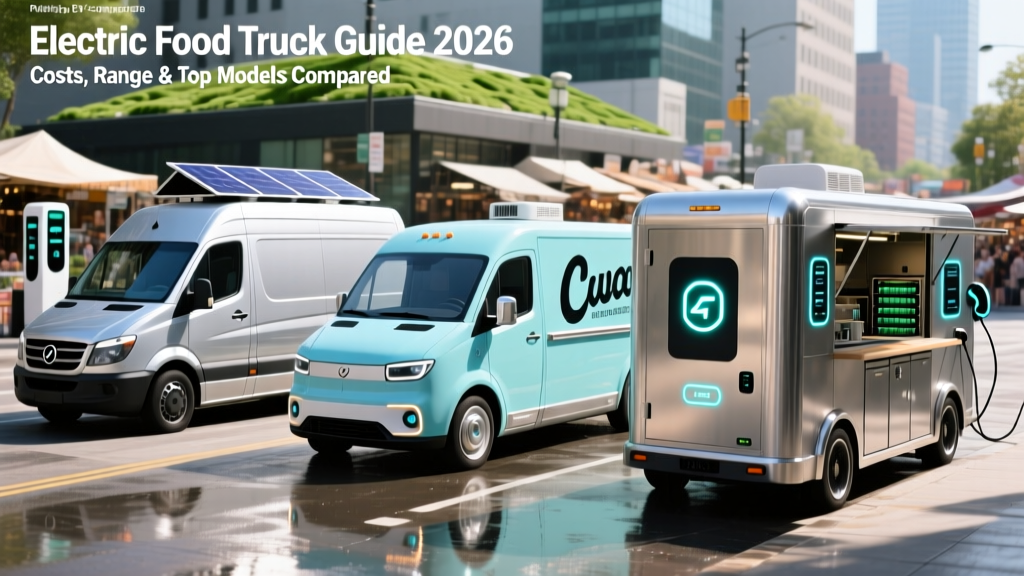
Quick Answer: Should You Buy an Electric Food Truck?
An electric food truck makes financial and operational sense if your daily route stays under 120 miles, you can install Level 2 charging at a depot or commissary, and you operate primarily in urban or suburban areas. Expect a base purchase price between $90,000 and $180,000 (before incentives), real-world range of 80–150 miles depending on battery size and auxiliary kitchen load, and annual fuel savings of $3,000–$7,000 compared to a diesel equivalent. The payback period typically runs 4–7 years, heavily dependent on local electricity rates and commercial EV incentive availability.
The commercial EV space has matured significantly by 2026. Medium-duty electric trucks from manufacturers like BrightDrop, Ford, and Lightning eMotors now offer viable platforms for food-service upfits. But an electric food truck is a fundamentally different purchase than a passenger EV — you're buying a mobile kitchen with a traction battery, and the auxiliary power demands of refrigeration, cooking equipment, and HVAC can cut your driving range by 20–40%. This guide breaks down exactly what to expect.
Top Electric Food Truck Platforms for 2026
Most electric food trucks aren't sold as turnkey units from a single OEM. Instead, buyers select a chassis-cab or step-van platform, then work with an upfitter to install the kitchen. Here are the leading platforms available or taking orders in 2026:
| Platform | Battery (kWh) | EPA Est. Range | Peak DC Charge (kW) | 10–80% Time | Base Chassis MSRP | GVWR |
|---|---|---|---|---|---|---|
| BrightDrop Zevo 600 | 165 kWh (NMC) | ~160 mi | 120 kW | ~75 min | ~$110,000 | 19,500 lbs |
| Ford E-Transit (Cutaway) | 68 kWh (NMC) | ~108 mi (cargo van); ~80–95 mi upfit | 115 kW | ~45 min | ~$55,000 | 9,500 lbs |
| Lightning eMotors Class 4 | 120 kWh (NMC) | ~130 mi | 85 kW | ~90 min | ~$130,000 | 22,000 lbs |
| Workhorse E-Gen (Step Van) | 75–150 kWh (configurable) | ~100–150 mi | 80 kW | ~70–90 min | ~$95,000–$140,000 | 15,000–19,500 lbs |
Real-World Range Reality: EPA range figures assume a cargo load without continuous auxiliary draw. In a food-truck configuration with refrigeration running (2–5 kW continuous), electric prep equipment, and frequent stop-and-go driving, expect 70–80% of the sticker range. A BrightDrop Zevo 600 rated at 160 miles may deliver 110–130 miles in active food-service use. Always spec your battery for 30–40% more range than your planned daily route.
Electric Food Truck vs. Diesel: Total Cost Breakdown
The upfront cost of an electric food truck is substantially higher than a comparable diesel rig, but operating costs tell a different story over a 7–10 year ownership cycle. Here's a side-by-side comparison based on a typical urban food-truck operation driving 60 miles per day, 260 days per year:
| Cost Category | Electric Food Truck (BrightDrop Zevo 600 platform) | Diesel Food Truck (Class 4 Step Van) |
|---|---|---|
| Purchase Price (chassis + kitchen upfit) | $155,000–$185,000 | $85,000–$115,000 |
| Federal Commercial EV Credit (§45W) | Up to $40,000 (vehicles >14,000 lbs GVWR) | $0 |
| Net Purchase After Incentive | $115,000–$145,000 | $85,000–$115,000 |
| Annual Fuel/Energy Cost | $2,800–$4,200 (at $0.12–$0.18/kWh) | $8,500–$11,000 (at $4.00–$4.50/gal, 8 MPG) |
| Annual Maintenance | $800–$1,500 | $3,000–$5,000 |
| 5-Year Total Operating Cost (fuel + maintenance) | $18,000–$28,500 | $57,500–$80,000 |
| Battery Warranty | 8 years / 100,000 miles (typical) | N/A |
| Estimated 7-Year Total Cost of Ownership | $140,000–$180,000 | $145,000–$195,000 |
Key takeaway: The breakeven point typically arrives between years 4 and 7, depending on local diesel prices, electricity rates, and how aggressively you can claim the §45W Commercial Clean Vehicle Credit. Unlike the consumer §30D credit, §45W has no MSRP cap and applies to commercial fleets — but the vehicle must meet battery-component and critical-mineral sourcing requirements similar to passenger EVs.
Charging an Electric Food Truck: Depot, Public, and Auxiliary Power
Charging logistics are the single biggest operational challenge for electric food truck owners. Unlike a passenger EV that charges at home overnight, a food truck needs a commercial charging strategy.
| Charging Level | Power (kW) | Miles Added Per Hour | Best Use Case | Install Cost Estimate |
|---|---|---|---|---|
| Level 1 (120V) | 1.4–1.9 kW | 2–4 mi/hr | Emergency/trickle only | $0 (standard outlet) |
| Level 2 (240V, 40–80A) | 9.6–19.2 kW | 15–35 mi/hr | Overnight depot charging (primary) | $3,000–$12,000 per stall |
| DC Fast Charge (CCS) | 50–150 kW | 80–200+ mi/hr | Mid-shift top-up, route emergencies | Use public networks; $0.25–$0.55/kWh |
Depot charging is non-negotiable. If your food truck returns to a commissary kitchen or dedicated parking lot each night, installing a Level 2 charger (or multiple chargers for a fleet) is the backbone of your operation. A full overnight charge on a 165 kWh battery at 19.2 kW takes roughly 8.5 hours — perfect for an evening-to-morning cycle.
Auxiliary power is the hidden advantage. Many electric food truck operators use the traction battery to power kitchen equipment via a V2L (vehicle-to-load) inverter, eliminating the need for a separate gasoline generator. A 165 kWh battery can run a full electric kitchen (refrigeration, induction cooktop, ventilation) for 8–12 hours of stationary service without meaningfully impacting next-day driving range — as long as you charge overnight.
Common Misconceptions About Electric Food Trucks
| Myth | Fact |
|---|---|
| "The battery can't handle kitchen equipment and driving." | A 165 kWh battery has ample capacity for both. An induction cooktop draws 1.8–3.7 kW; refrigeration draws 1–3 kW. Running all equipment for an 8-hour service window uses roughly 30–50 kWh — leaving 100+ kWh for driving. |
| "Electric food trucks can't operate in cold weather." | Cold reduces range by 20–35% (same as any EV), but kitchen equipment actually benefits — refrigeration runs more efficiently, and battery thermal management systems precondition the pack. Diesel trucks also suffer in cold (gelled fuel, hard starts). |
| "You'll be stranded without charging infrastructure." | With proper route planning and depot charging, daily operations are unaffected. DC fast-charger networks (Electrify America, EVgo, Tesla Supercharger with NACS adapter) provide backup for longer repositioning trips. |
| "Battery replacement will bankrupt the business." | Commercial NMC batteries are warrantied for 8 years/100,000 miles with 70–80% capacity retention guarantees. By 2026, battery replacement costs for medium-duty platforms range from $15,000–$35,000 — significant, but comparable to a diesel engine rebuild. |
| "The tax credits don't apply to commercial vehicles." | The §45W Commercial Clean Vehicle Credit provides up to $40,000 for vehicles over 14,000 lbs GVWR. Check current IRS guidelines for sourcing requirements. |
What First-Time Electric Food Truck Buyers Must Know
If you're transitioning from a diesel food truck or starting a mobile food business from scratch, these operational realities will shape your experience:
- Route planning is everything. Map your daily circuit — driving miles, stationary service hours, and return-to-depot distance. Add a 30% buffer for traffic, detours, and auxiliary load. If your total exceeds 80% of the truck's real-world range, you need a larger battery or a mid-day DC fast-charge stop.
- Kitchen electrification pays dividends. Going all-electric in the kitchen (induction cooktops, electric convection ovens, DC-powered refrigeration) lets you leverage the traction battery and eliminate generator fuel, noise, and maintenance. Propane is still an option for high-BTU applications, but many operators find induction sufficient.
- Permitting and health department compliance vary. Some jurisdictions have specific requirements for electric food-service vehicles (battery isolation, fire suppression near the pack, ventilation standards for induction equipment). Check with your local health department before finalizing your upfit.
- Insurance premiums run 10–20% higher than equivalent diesel trucks, reflecting the higher replacement cost of battery packs and specialized components. Get quotes before committing to a purchase.
- Resale value is uncertain but trending positively. The used commercial EV market is still young. Early data from Kelley Blue Book suggests commercial EVs are holding value comparably to diesel equivalents at the 3-year mark, but long-term depreciation curves are still forming.
Decision Framework: Is an Electric Food Truck Right for You?
Choose an electric food truck if:
- Your daily route is under 120 miles round-trip
- You have depot/commissary access with the ability to install Level 2 charging
- You operate primarily in urban or suburban areas (benefiting from regenerative braking in stop-and-go traffic)
- You want to eliminate generator noise at events, festivals, and residential neighborhoods
- You can absorb higher upfront cost in exchange for 5–7 year operating savings
- Local or state commercial EV incentives are available in your area (check AFDC state incentive database)
Stick with diesel (or consider a PHEV platform) if:
- Your daily route exceeds 150 miles or involves significant highway driving at sustained speeds
- You frequently operate at remote events, rural festivals, or areas without reliable charging infrastructure
- You cannot secure depot charging (street parking only, no commissary access)
- Your kitchen requires very high-BTU gas cooking that electrification can't yet match
- You need a truck immediately and can't wait for platform lead times (some electric chassis have 3–6 month build queues)
Frequently Asked Questions
How long does it take to charge an electric food truck overnight?
A BrightDrop Zevo 600 with a 165 kWh battery charging on a 19.2 kW Level 2 circuit will go from 10% to full in roughly 8–9 hours — ideal for overnight depot charging. A Ford E-Transit cutaway with 68 kWh charges in about 3.5 hours at the same rate.
Can I power my kitchen equipment from the truck's driving battery?
Yes, through a V2L (vehicle-to-load) inverter system. Most commercial EV platforms support auxiliary power takeoff, and upfitters can integrate this directly into your kitchen's electrical panel. A 165 kWh battery can sustain a full electric kitchen for a typical 8–10 hour service day with energy to spare.
What happens if the battery degrades after 5 years?
NMC batteries in commercial platforms typically retain 80–85% of original capacity after 5 years of daily cycling. That means your 160-mile range becomes roughly 130 miles. The 8-year/100,000-mile warranty covers replacement if capacity drops below the manufacturer's threshold (usually 70%).
Do electric food trucks qualify for the $7,500 federal tax credit?
Not the consumer §30D credit — that applies to personal-use vehicles. Commercial food trucks qualify for the §45W Commercial Clean Vehicle Credit, which offers up to $7,500 for vehicles under 14,000 lbs GVWR or up to $40,000 for heavier trucks. Battery sourcing and critical mineral requirements apply. Consult a tax professional for your specific eligibility.
What's the maintenance difference between electric and diesel food trucks?
Electric food trucks eliminate oil changes, fuel filter replacements, DEF fluid, exhaust system repairs, and transmission service. Brake wear drops significantly thanks to regenerative braking. You'll still need tire rotations, cabin air filter changes, and kitchen equipment maintenance. Expect annual maintenance savings of $2,000–$4,000.