The Short Answer on Electric Fleet Management
Electric fleet management means deploying battery-electric vehicles (BEVs) across a commercial or municipal fleet, supported by depot or route charging infrastructure, telematics, and energy-cost planning. For most light-duty fleets (sedans, compact SUVs, cargo vans) covering under 200 miles per day with overnight depot access, EVs in 2026 deliver a total cost of ownership (TCO) of roughly $0.12–$0.18 per mile versus $0.22–$0.32 per mile for comparable gas vehicles — a 30–45% per-mile savings after accounting for higher upfront purchase price, lower fuel cost, and reduced maintenance. The breakeven point typically arrives between 36,000 and 60,000 miles, depending on local electricity rates, vehicle class, and whether the fleet qualifies for the federal commercial EV credit under IRS §45W.
Why Fleets Are Switching to EVs in 2026
Fleet electrification is no longer a pilot-program experiment. The economics have shifted decisively for duty cycles that match EV strengths: predictable daily routes, overnight parking at a single depot, and moderate daily mileage. The core drivers are fuel-cost stability (electricity prices fluctuate far less than gasoline), reduced maintenance (no oil changes, fewer brake replacements thanks to regenerative braking, no transmission fluid), and regulatory pressure from municipal clean-air mandates and corporate ESG commitments.
The vehicles have caught up to the use case. The Ford E-Transit (126 mi EPA range, 68 kWh usable battery, 266 hp) handles last-mile delivery routes, while the Chevrolet Silverado EV Work Truck (up to 492 mi EPA range on the 4WT trim, 200+ kWh battery) covers longer regional hauls. For sedan fleets, the Hyundai Ioniq 6 SE (361 mi EPA, 77.4 kWh battery, 225 hp, ~$38,650 MSRP) and Tesla Model 3 RWD (272 mi EPA, ~$38,990 MSRP) remain strong contenders. On the cargo-van side, the BrightDrop Zevo 600 offers up to 272 mi of EPA range with 519 cu ft of cargo volume.
EV Fleet vs Gas Fleet: Real Cost Comparison
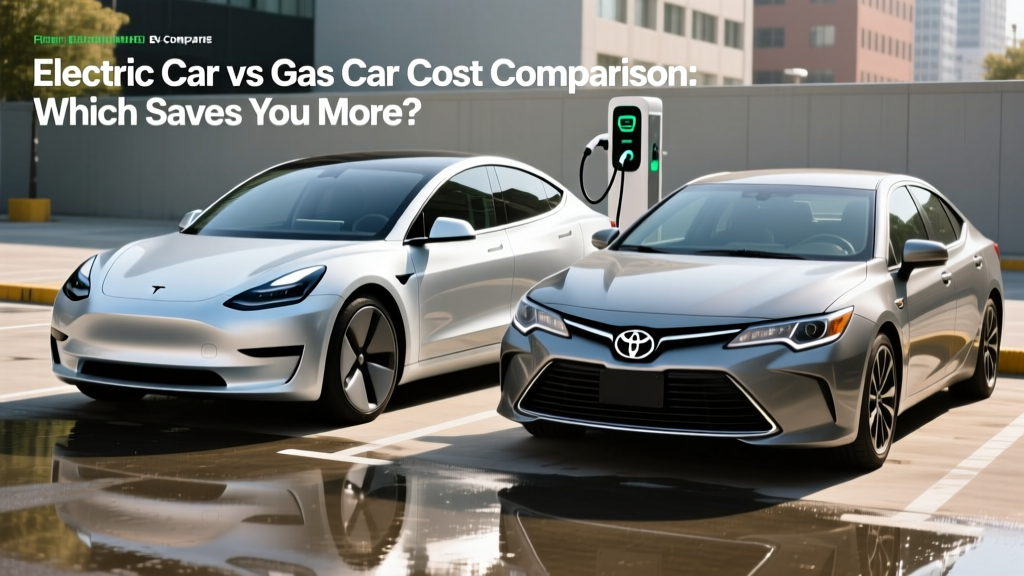
Here's where the math matters. Below is a 5-year / 75,000-mile TCO comparison for a midsize sedan fleet vehicle (comparable to a Toyota Camry LE gas vs Hyundai Ioniq 6 SE EV), based on national averages. Your numbers will shift with local utility rates and fuel prices.
| Cost Category | Gas Fleet Vehicle | EV Fleet Vehicle |
|---|---|---|
| Purchase Price (MSRP) | $28,500 | $38,650 |
| Federal Tax Credit (§45W commercial) | $0 | −$7,500 |
| Net Acquisition Cost | $28,500 | $31,150 |
| Fuel/Energy (75k mi) | $9,375 (30 MPG, $3.75/gal) | $2,813 (3.5 mi/kWh, $0.13/kWh) |
| Maintenance (5 yr) | $3,750 | $1,500 |
| Insurance (5 yr) | $7,500 | $8,625 (+15% EV premium) |
| Depot Charging Install (amortized/vehicle) | $0 | $2,200 |
| Total 5-Year Cost | $49,125 | $46,288 |
| Cost Per Mile | $0.655 | $0.617 |
The EV fleet vehicle saves roughly $2,837 over 5 years per vehicle in this scenario, or about $0.038 per mile. Scale that across 50 vehicles and you're looking at $141,850 in savings. For cargo vans and heavier duty cycles with more stop-and-go driving (where regen braking shines and gas vehicles burn fuel idling), the per-mile gap widens significantly — often $0.08–$0.12 per mile in the EV's favor.
A critical note on the tax credit: the IRS §45W Commercial Clean Vehicle Credit provides up to $7,500 for vehicles under 14,000 lbs GVWR and up to $40,000 for heavier vehicles. Unlike the consumer §30D credit, §45W has no MSRP cap and no buyer income limit — but the vehicle must be acquired for business use and meet battery-sourcing requirements. Consult a tax professional for your specific fleet structure.
Depot Charging Infrastructure: What It Actually Costs
The single biggest planning challenge in electric fleet management isn't the vehicles — it's the charging infrastructure. Every fleet manager I've spoken with underestimates the timeline and cost of depot charging installation. Here's a realistic breakdown for a 20-vehicle fleet depot:
| Component | Low Estimate | High Estimate | Notes |
|---|---|---|---|
| Level 2 Chargers (19.2 kW, dual-port × 10 units) | $20,000 | $40,000 | $1,000–$2,000 per single port |
| Electrical Panel Upgrade | $5,000 | $35,000 | May need 400A+ service for 20 ports |
| Trenching & Conduit | $8,000 | $25,000 | Depends on parking lot layout |
| Permitting & Utility Coordination | $3,000 | $12,000 | Utility transformer upgrade can add $15k–$50k |
| Electrician Labor | $15,000 | $40,000 | Varies by region and complexity |
| Charging Management Software | $2,400/yr | $6,000/yr | Load balancing, scheduling, reporting |
| Total Year 1 | $53,400 | $158,000 | |
| Per-Vehicle Amortized (5 yr) | $534 | $1,580 |
Key lesson: engage your utility company early. Many utilities offer make-ready programs that cover the cost of bringing sufficient power to your site, which can eliminate the single largest variable (transformer and service upgrades). Programs vary by state and utility — check with your local provider. Also factor in lead times: transformer upgrades can take 6–12 months in some regions.
For fleets that need DC fast charging (e.g., vehicles that run multiple shifts or can't rely on overnight charging), costs jump dramatically. A single 150 kW DC fast charger installation runs $80,000–$160,000 including equipment, electrical work, and utility upgrades. Most light-duty fleets are better served by Level 2 depot charging at 19.2 kW, which adds roughly 55–70 miles of range per hour of charging — more than enough for overnight replenishment.
Fleet Vehicle Spec Comparison: Top EV Picks for 2026
| Spec | Hyundai Ioniq 6 SE | Ford E-Transit 150 Cargo | Chevy Silverado EV 4WT | Tesla Model 3 RWD |
|---|---|---|---|---|
| EPA Range | 361 mi | 126 mi | 492 mi | 272 mi |
| Real-World Range (highway/loaded) | ~290–310 mi | ~90–105 mi | ~370–400 mi | ~225–245 mi |
| Battery (usable) | 77.4 kWh, NMC | 68 kWh, NMC | ~200 kWh, NMC | ~57.5 kWh, LFP |
| Peak DC Charge Rate | 240 kW | 115 kW | 350 kW | 170 kW |
| 10–80% DC Charge Time | ~18 min | ~45 min | ~20 min (est.) | ~25 min |
| Level 2 Charge Rate | 10.9 kW | 10.5 kW | 19.2 kW | 11.5 kW |
| Horsepower | 225 hp | 266 hp | 510 hp | 271 hp |
| 0–60 mph | 7.0 sec | ~8.0 sec | ~5.5 sec | 5.8 sec |
| Cargo Volume | 12.3 cu ft (trunk) | 246.7 cu ft | 57.2 cu ft (bed + frunk) | 23 cu ft (trunk + frunk) |
| Base MSRP | $38,650 | $45,995 | $55,000 (est.) | $38,990 |
| §45W Credit Eligible | Up to $7,500 | Up to $7,500 | Up to $7,500 | Up to $7,500 |
| Battery Warranty | 10 yr / 100k mi | 8 yr / 100k mi | 8 yr / 100k mi | 8 yr / 120k mi |
| MPGe (combined) | 140 MPGe | 2.0 kWh/mi (est.) | ~1.8 kWh/mi (est.) | 132 MPGe |
Source: fueleconomy.gov and manufacturer specifications. Real-world range estimates reflect loaded/highway conditions and may be 15–25% below EPA in cold weather (below 30°F).
Cold Weather, Range Loss, and Route Planning Realities
If your fleet operates in northern climates, cold weather is the single largest operational variable you must plan for. EVs lose 15–30% of their EPA range at temperatures below 30°F due to battery chemistry limitations and cabin-heating energy draw. A Ford E-Transit rated at 126 miles EPA may deliver only 88–107 miles on a 15°F January morning in Chicago.
Mitigation strategies that work in practice:
- Preconditioning: Warm the battery and cabin while the vehicle is still plugged in at the depot. This preserves range and ensures the battery can accept a full charge. Most fleet management software platforms (ChargePoint, EV Connect, AmpUp) support scheduled preconditioning.
- Oversize the route buffer: Plan routes at no more than 70% of the vehicle's cold-weather range. A 126-mi EPA vehicle should be routed for 85 mi max in winter.
- Heat pump option: Vehicles equipped with a heat pump (standard on Ioniq 6, optional on some others) reduce cabin-heating energy draw by 30–50% versus resistive heaters, preserving more range.
- Opportunity charging: For routes that push range limits, install a DC fast charger at a midpoint depot or partner with a public network like Electrify America or EVgo for mid-shift top-ups.
Common Fleet EV Misconceptions — Corrected
| Myth | Fact |
|---|---|
| "EVs cost more than gas vehicles over their lifetime." | Higher purchase price is offset by $0.04–$0.12/mi lower operating cost. TCO breakeven typically occurs at 36k–60k mi for light-duty vehicles. |
| "Battery replacement will destroy the economics." | Modern NMC and LFP batteries are warranted for 8–10 years / 100k–120k mi with 70%+ capacity retention. Fleet data from NHTSA and operator reports show most batteries retain 85–92% capacity at 100k mi. Full replacement costs $8,000–$20,000 depending on vehicle — rare before 150k mi. |
| "EVs don't work for towing or heavy payloads." | The Silverado EV 4WT tows up to 10,000 lbs. However, towing at capacity reduces range by 40–50%. Plan accordingly — this is physics, not a defect. |
| "Charging takes too long for fleet operations." | For overnight depot charging at 19.2 kW Level 2, a 77 kWh battery charges from 10–100% in ~4 hours. Vehicles parked 8+ hours overnight have more than enough time. |
| "We can just plug into standard outlets." | Level 1 (120V) charging adds only 3–5 miles per hour — inadequate for fleet use. Dedicated Level 2 circuits (240V, 40–80A) are required for practical fleet operations. |
Decision Framework: Should Your Fleet Go Electric?
Step 1: Audit Your Duty Cycles
Map every vehicle's daily mileage, route predictability, and parking pattern. Vehicles that travel under 200 mi/day and return to a fixed depot overnight are ideal EV candidates.
Step 2: Check Your Depot's Electrical Capacity
Have a licensed electrician assess your site's panel capacity. A 200A residential-style panel supports roughly 4–6 Level 2 ports at 19.2 kW. A 400A+ commercial service supports 15–20 ports. If a utility transformer upgrade is needed, budget $15,000–$50,000 and 6–12 months lead time.
Step 3: Model Your TCO
Use this rule of thumb: if your fleet vehicle drives more than 15,000 miles/year and your electricity rate is below $0.18/kWh, an EV will almost certainly save money over 5 years. If you drive fewer than 8,000 mi/yr, the higher purchase price may not be recouped before the vehicle is retired.
Step 4: Choose the Right Vehicle
- Choose an EV if: Daily route <200 mi, overnight depot parking, local electricity <$0.18/kWh, §45W credit eligibility confirmed, cold-weather range buffer acceptable.
- Choose a hybrid (HEV/PHEV) if: Routes exceed 250 mi/day unpredictably, depot charging is not feasible, or you operate in extreme cold (<0°F) regularly.
- Choose gas if: Heavy towing (>8,000 lbs) is daily, routes are highly variable and exceed 300 mi, or your region has no public DC fast-charging infrastructure as a backup.
Step 5: Pilot Before You Scale
Start with 3–5 vehicles on your most predictable routes. Track actual energy consumption (kWh/mi), real-world range in all seasons, and driver feedback for 6 months before committing to a full fleet conversion. Most fleet telematics platforms (Geotab, Samsara, Motive) now include EV-specific energy tracking.
What First-Time Fleet EV Buyers Must Know
If you're managing your first EV fleet procurement, these are the lessons that don't appear in manufacturer brochures:
- Order vehicles 6–12 months ahead. Fleet allocations for popular models (E-Transit, Silverado EV) remain constrained. Don't assume you can buy 20 units next month.
- Start charging infrastructure planning before you order vehicles. The charger install timeline (especially with utility upgrades) often exceeds vehicle delivery time.
- kW vs kWh — know the difference. kW (kilowatts) is the charge rate (how fast energy flows); kWh (kilowatt-hours) is the battery capacity (how much energy is stored). A 77 kWh battery charging at 19.2 kW takes roughly 4 hours from empty. This is the single most confused concept in fleet EV planning.
- Insurance premiums run 10–20% higher for EVs due to repair costs and parts availability. Budget accordingly and get fleet quotes before committing.
- Driver training matters. Regenerative braking behavior, one-pedal driving, and preconditioning workflows are not intuitive for drivers transitioning from gas vehicles. Budget a half-day training session per driver.
- Monitor battery State of Health (SoH). Most fleet telematics platforms can track battery degradation over time. Flag any vehicle dropping below 85% SoH within the warranty period for a dealer battery assessment.
Frequently Asked Questions
How long do fleet EV batteries last before replacement?
Most 2026 fleet EV batteries are warranted for 8–10 years or 100,000–120,000 miles with a 70% capacity retention guarantee. Real-world fleet data suggests most batteries retain 85–92% of original capacity at 100,000 miles. Full replacements are uncommon before 150,000 miles and cost $8,000–$20,000 depending on the vehicle and chemistry.
Can we use public charging networks for fleet vehicles?
Yes, but it's not ideal as a primary strategy. Public DC fast charging costs $0.30–$0.48/kWh (vs $0.08–$0.15/kWh for depot electricity) and reliability varies. Networks like Electrify America, EVgo, and Tesla Supercharger (now open to NACS-equipped non-Tesla vehicles) can serve as backup for unexpected route extensions. Fleet charging cards from providers like ChargePoint and EVgo offer consolidated billing.
Do we qualify for the federal EV tax credit as a business?
Businesses and tax-exempt organizations can claim the §45W Commercial Clean Vehicle Credit, which provides up to $7,500 for vehicles under 14,000 lbs GVWR and up to $40,000 for heavier vehicles. Unlike the consumer §30D credit, there is no MSRP cap and no buyer income limit. However, battery-sourcing and critical-mineral requirements still apply. Because these rules are subject to change and depend on your entity structure, consult a tax professional before projecting credit amounts into your TCO model.
What happens if a fleet EV needs a long road trip?
For occasional long-distance trips, plan DC fast-charging stops using apps like A Better Routeplanner (ABRP). A Hyundai Ioniq 6 at a 240 kW charger adds ~200 miles in 18 minutes (10–80%). For fleet vehicles with lower charge rates (E-Transit at 115 kW), budget 40–50 minutes for a 10–80% charge. If long trips are frequent, a PHEV or gas vehicle may be a better fit for that specific duty cycle.
How do we handle charging in multi-shift operations?
For vehicles that run two shifts, opportunity charging during shift changes is essential. A 150 kW DC fast charger can add 80–120 miles of range in 20–30 minutes for most fleet vehicles. Alternatively, maintain a larger vehicle pool so each unit can rotate through depot charging between shifts. Fleet charging management software can automate scheduling to ensure no vehicle is dispatched below a minimum State of Charge (typically 60–70%).