The Short Answer
If you're researching an electric fishing boat in 2026, here's what you need to know upfront: production-ready electric fishing boats remain a niche, premium-priced category. Models like the X Shore Eelex 8000 start around $329,000, while smaller electric pontoons and skiffs from brands like Arc and Veer run $40,000–$90,000. Most offer 40–80 miles of range at cruising speed on 60–200 kWh battery packs. By contrast, if your goal is simply getting to the lake quietly and emission-free, a mainstream EV truck like the Ford F-150 Lightning or Rivian R1T towing a conventional aluminum bass boat often delivers more practical value at a lower total cost. Your decision hinges on whether you want electrification on the water or just to the water.
What Is an Electric Fishing Boat — and What's Actually Available?
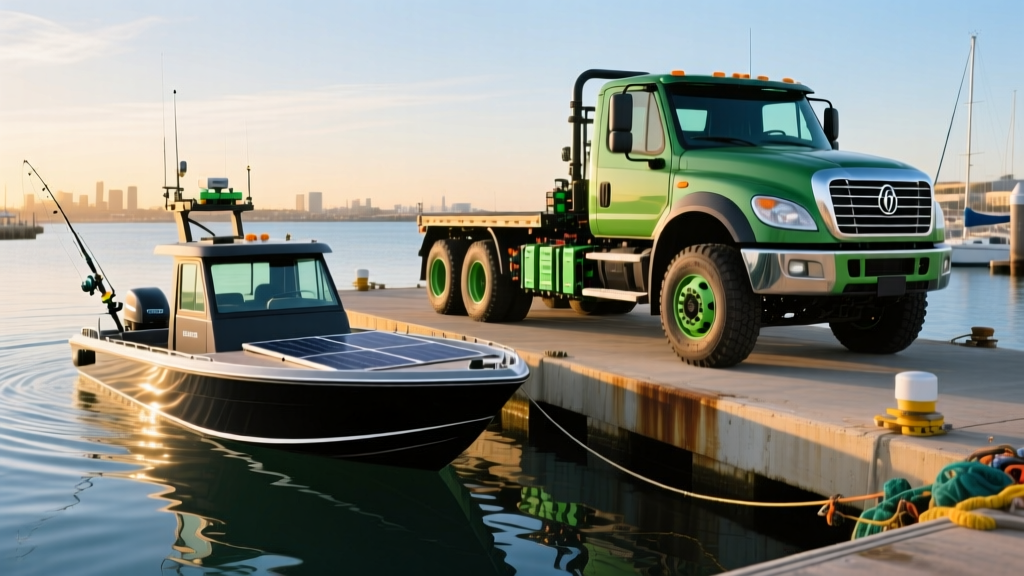
The term "electric fishing boat" covers a wide spectrum in 2026. At the high end, fully electric day cruisers and center consoles from X Shore, Candela, and Arc Boats use large lithium-ion packs (often NMC chemistry) paired with electric outboards or pod drives. At the accessible end, you'll find 16–20 ft electric pontoons, jon boats, and skiffs — essentially aluminum hulls fitted with electric trolling motors or small inboard systems powered by 10–40 kWh batteries.
Here's the reality most marketing glosses over: electric marine propulsion faces physics challenges that EVs on land do not. Water resistance is dramatically higher than rolling resistance, meaning energy consumption per mile is steep. A 200 kWh battery that delivers 300+ miles in an EV sedan might push a 22-ft powerboat roughly 50–70 nautical miles at moderate cruising speed. Hull design, passenger load, wind, and current all compound the problem.
| Model | Type | Battery (kWh) | Est. Range (mi) | Top Speed | Base Price |
|---|---|---|---|---|---|
| X Shore Eelex 8000 | Day cruiser | 125 kWh (NMC) | ~50–70 | 40 knots | ~$329,000 |
| Arc One | Day boat / fishing | 200 kWh (NMC) | ~60–80 | 35 knots | ~$300,000 |
| Veer 13 (Electric) | Pontoon | ~15–20 kWh | ~20–30 | ~15 mph | ~$45,000 |
| Custom jon boat + Torqeedo | Jon boat / skiff | 5–10 kWh (LFP) | ~10–20 | ~8 mph | ~$12,000–$25,000 |
Electric Fishing Boat vs. EV Truck + Conventional Boat: The Real Comparison
For most anglers, the more practical question isn't "should I buy an electric boat?" but "should I buy an EV truck to tow my existing boat?" Let's run the numbers on both approaches.
| Category | Electric Fishing Boat (Arc-class) | EV Truck + Gas Bass Boat | Gas Truck + Gas Bass Boat |
|---|---|---|---|
| Upfront purchase | $300,000 | $60,000 (truck) + $45,000 (boat) = $105,000 | $50,000 (truck) + $45,000 (boat) = $95,000 |
| Fuel / energy (5 yrs) | ~$3,500 (electric marine charging) | ~$5,200 (truck charging + boat gas) | ~$14,000 (truck gas + boat gas) |
| Maintenance (5 yrs) | ~$2,000 (minimal motor service) | ~$6,500 (boat engine + truck minimal) | ~$11,000 (both engines + truck service) |
| Insurance (5 yrs) | ~$18,000 (specialty marine) | ~$12,000 (auto + marine combo) | ~$10,000 (auto + marine combo) |
| 5-year total | ~$323,500 | ~$128,700 | ~$130,000 |
The math is stark. Even the most optimistic ownership scenario for a production electric fishing boat puts it at 2–3× the total cost of an EV-truck-towed conventional setup over five years. The electric boat wins on silent operation, zero on-water emissions, and near-zero powertrain maintenance — but you pay a massive premium for those benefits.
Real-World Range and Charging: What the Brochures Don't Tell You
Electric boats share a frustrating trait with EVs: real-world range falls well short of ideal-condition marketing claims. On the water, the variables are even less predictable than on the road.
Range reality check: An electric boat rated for 80 miles of range at 15 mph may deliver only 35–45 miles if you push to 25+ mph, face headwinds, or carry a full load. Planing hulls at speed consume energy exponentially — similar to how an EV's efficiency collapses above 75 mph on the highway, but worse.
Charging infrastructure for electric boats is the category's biggest practical hurdle in 2026:
- Marina charging: A handful of forward-thinking marinas in coastal metros (Miami, San Diego, Seattle) have installed 50–150 kW DC marine chargers. Most marinas still offer only 30-amp or 50-amp shore power (3.6–12 kW AC), meaning a full charge for a 125 kWh boat battery can take 10–35 hours.
- Trailer charging: If you trailer your electric boat home, you can charge from a Level 2 home setup (typically 7.6–11.5 kW), but a 200 kWh pack at 11.5 kW still requires 17+ hours for a full charge.
- No universal standard: Unlike the automotive world's convergence on NACS, marine DC fast charging connectors remain fragmented. CHAdeMO marine adapters, proprietary systems, and CCS variants all coexist — verify compatibility before buying.
Tax Credits and Incentives: What Applies to Electric Boats?
This is where buyer confusion runs high. The federal §30D Clean Vehicle Credit — which offers up to $7,500 for qualifying new EVs and up to $4,000 for used EVs — applies to road vehicles, not watercraft. An electric fishing boat does not qualify for the §30D credit.
What does qualify:
- An EV truck (F-150 Lightning, Rivian R1T, Chevy Silverado EV) used to tow your boat — subject to MSRP caps ($80,000 for trucks/vans/SUVs), buyer income limits ($300K MFJ / $150K single), and battery critical-mineral sourcing rules per IRS §30D guidelines.
- Point-of-sale transfer of the credit to the dealer is available for qualifying vehicles as of 2024 onward.
What does NOT qualify:
- The electric boat itself — no federal purchase credit exists for marine vessels.
- Some states (California, New York) offer limited rebates for electric marine equipment, but these vary by jurisdiction and funding cycle. Check your state energy office for current programs.
Common Misconceptions About Electric Fishing Boats
| Myth | Fact |
|---|---|
| "Electric boats are silent, so fishing is better" | True at trolling speeds (<5 mph). At planing speed, hull slap and water noise dominate regardless of propulsion type. |
| "I can charge at any marina" | Most marinas offer only slow AC shore power (3.6–12 kW). DC fast marine charging is rare and concentrated in a few coastal markets. |
| "Electric boats have zero maintenance" | Electric motors need minimal service, but battery thermal management systems, hull antifouling, bilge pumps, and electronics still require upkeep. |
| "The battery will last forever" | Marine NMC packs degrade similarly to EV batteries — expect 70–80% capacity retention after 8–10 years of regular use. Replacement costs $15,000–$60,000+ depending on pack size. |
| "I'll get a tax credit for buying electric" | Federal §30D credits apply to road vehicles only. No federal incentive exists for electric watercraft as of 2026. |
Decision Framework: Which Path Should You Take?
Choose an electric fishing boat if:
- You boat primarily on lakes or protected coastal waters where range (30–60 mi) is sufficient
- Silent, emission-free operation is a priority (e.g., no-wake zones, environmentally sensitive areas)
- You have dock access with shore power or can trailer and charge at home
- Budget is not your primary constraint ($100K+ for a capable electric boat)
- You value near-zero powertrain maintenance and cutting-edge marine tech
Choose an EV truck + conventional gas boat if:
- You want maximum range and flexibility — gas boats refuel in 5 minutes anywhere
- Total cost of ownership matters (the EV truck + gas boat combo costs 60–70% less over 5 years)
- You trailer your boat to different lakes and need reliable marina-agnostic fueling
- You want to capture the §30D federal tax credit on your tow vehicle
- You fish tournaments or need sustained high-speed runs to remote spots
Choose a small electric pontoon/jon boat if:
- You fish small lakes, ponds, or slow rivers where 8–15 mph is adequate
- Your budget is $15,000–$50,000
- You can charge at home via a standard 120V or 240V outlet between trips
- Silent trolling is your main use case — essentially replacing a gas-powered trolling motor with an integrated system
Frequently Asked Questions
Can I tow an electric fishing boat with an EV truck?
Yes, but range drops significantly when towing. The Ford F-150 Lightning (EPA range ~320 mi) typically delivers 120–170 miles when towing a 5,000–7,000 lb boat and trailer at highway speed. Plan charging stops accordingly. The Rivian R1T Dual-Motor (EPA ~352 mi with Max Pack) performs similarly. Always check your specific truck's tow rating — most EV trucks are rated for 7,500–11,000 lbs.
How long does it take to charge an electric fishing boat?
It depends on the battery size and charger. A 125 kWh boat battery on a 50 kW DC marine charger reaches 10–80% in roughly 2 hours. On a 50-amp marina shore power connection (12 kW AC), that same battery takes 10+ hours for a full charge. At home on a Level 2 charger (11.5 kW), expect 11–12 hours. For smaller 15–20 kWh electric pontoons, a standard 240V Level 2 charger delivers a full charge in 2–3 hours.
Are electric boat batteries safe in marine environments?
Marine-grade battery packs are sealed to IP67 or higher standards and include thermal management systems. However, saltwater corrosion, vibration, and bilge water exposure remain real concerns over time. Look for batteries certified to marine standards (e.g., ABYC, DNV) and factor in periodic inspection costs. Battery replacement for large packs (100+ kWh) can cost $30,000–$60,000 — a significant long-term ownership consideration.
What's the best EV truck for towing a fishing boat in 2026?
The top contenders are the Ford F-150 Lightning Extended Range (320 mi EPA, 10,000 lb tow rating, ~$70,000–$85,000), the Rivian R1T Max Pack (352 mi EPA, 11,000 lb tow rating, ~$90,000+), and the Chevy Silverado EV 4WT (up to 440 mi EPA, 10,000 lb tow rating, ~$75,000+). All three qualify for the §30D credit if you meet IRS income and sourcing requirements. The Silverado EV leads on range, the R1T on tow capacity, and the Lightning on value and dealer support.
Will electric fishing boats get cheaper?
Battery costs continue to decline — LFP chemistry in particular is pushing pack prices below $100/kWh at the cell level as of 2025–2026. However, low production volumes and specialized marine engineering keep electric boat prices high. Expect meaningful price drops in the pontoon and small skiff segment first. Large electric center consoles and day cruisers will likely remain premium products through at least 2028.
Bottom Line
The electric fishing boat market in 2026 is real but narrow. If you have the budget, dock charging access, and a use case centered on quiet, emission-free day boating, electric boats from X Shore, Arc, or the growing electric pontoon segment deliver a genuinely compelling on-water experience. For the majority of anglers, however, pairing a capable EV truck with a proven gas-powered fishing boat offers dramatically better value, range flexibility, and access to the §30D federal tax credit. Electrify your tow rig first — the electric boat market will mature in the years ahead, and waiting will save you both money and range anxiety on the water.